A polypropylene sheet material data sheet lists dozens of values, but the ones that predict field performance are a handful, and they change with the grade. The overlooked variable is that no single polypropylene exists: the density, strength, and heat deflection of a sheet depend on whether the resin is homopolymer or copolymer, whether it is filled with glass or talc, and which test method produced the number. Comparing datasheets without accounting for those three variables leads to a wrong material selection.
This guide explains the polypropylene sheet material properties that matter for engineering, gives the physical, mechanical, thermal, and chemical values you will find on a data sheet, and shows how filled grades change them. It ends with a method for reading a pp material data sheet so the value on paper matches the performance in service. For the full material family, start with the polypropylene sheet guide.
Key Takeaways
- No single polypropylene exists. Density, strength, and heat deflection change with the base grade, the filler, and the test method, and a datasheet must state all three to be comparable.
- The two base grades answer two jobs. Homopolymer PP is about a third stiffer and stronger, with higher heat deflection, for structural sheet; copolymer PP is tougher and survives cold and impact, for flexing and containers.
- Density is the lowest of the engineering sheets. At roughly 0.905 g/cm³, a 3 mm sheet weighs about 2.7 kg per square meter, and that weight saving is the reason polypropylene is specified for panels and parts.
- Thermal and chemical limits define the service. The sheet holds to about 105 °C at 0.45 MPa, 80 to 100 °C continuous, and resists dilute acids, alkalis, and alcohols, but not strong oxidizing acids or aromatic and chlorinated hydrocarbons.
- Filled grades are engineering choices. Glass-filled PP raises the modulus to 6 to 7 GPa and the HDT to about 150 °C at the cost of weight and impact; talc raises stiffness cheaply, and the filler is chosen for a measured requirement, not as a default.
Polypropylene Sheet Material: What the Datasheet Tells You
A polypropylene sheet material is defined by the resin it is made from, and the datasheet is the contract between the supplier and the engineer. The resin family is large, and the property values that reach the datasheet are the result of three decisions made before the sheet is extruded: the base polymer grade, any filler added to it, and the test standard used to measure the result. Read those three on every datasheet before comparing two materials.
Grade, Fill, and Test Method: The Three Variables
The first variable is the base grade, which is either a homopolymer or a copolymer, and the two differ in toughness and stiffness. The second is the filler: glass fiber, talc, and other reinforcements raise the modulus and the heat deflection at the cost of density and impact. The third is the test method, because the same material measured to ASTM and to ISO can return different numbers, and a value quoted without its standard is not comparable. A datasheet that states all three is a datasheet you can trust; one that quotes only “tensile strength” without the grade, the fill, or the standard leaves the comparison to guesswork.
Homopolymer vs Copolymer: The Two Base Grades
The two base grades answer two different design questions. Homopolymer polypropylene is the stiffer, stronger, and harder of the two, with higher tensile strength and heat deflection, and it is the default for structural sheet, tanks, and ductwork. Copolymer polypropylene trades some of that stiffness for low-temperature toughness and impact resistance, and it is specified where the sheet is flexed, dropped, or used in cold service. The property difference is real but modest: a homopolymer is roughly a third stiffer and a third stronger in tension than a copolymer of the same melt flow, while the copolymer survives cold impact that a homopolymer does not. Choosing the wrong base grade for the application is the most common cause of a sheet that fails in service.
The base grade is the first line to check on any quotation for a polypropylene sheet material, because it is the cheapest way to change the material’s behavior. A supplier who quotes “polypropylene sheet” without the base grade is leaving the decision open, and the sheet delivered may be the homopolymer or the copolymer depending on stock. Writing the base grade, the melt flow, and the filler into the purchase order closes that gap and makes the delivered sheet match the tested one. The melt flow, a number often overlooked, also matters, because it sets the molecular weight and with it the strength and the processing behavior, so a data sheet that states the melt flow and the base grade is the complete identification of the material.
Physical and Mechanical Properties of PP Sheet
The mechanical properties of a polypropylene sheet material are what a structural design hangs on, and they are quoted from standard tests so the values are repeatable between suppliers. The table below gives the published values for the two base grades, sourced from the British Plastics Federation property data, and it shows the trade at the heart of the material: the homopolymer is stiffer and stronger, and the copolymer is tougher. The values are typical, and the delivered grade should carry a datasheet that matches them.
| Property | Homopolymer | Copolymer |
|---|---|---|
| Density (kg/m³) | 905 | 905 |
| Tensile strength (MPa) | 33 | 25 |
| Tensile modulus (GPa) | 1.4 | 1.0 |
| Elongation at break (%) | 150 | 300 |
| Hardness (Rockwell R) | 90 | 80 |
| HDT at 0.45 MPa (°C) | 105 | 100 |
| HDT at 1.8 MPa (°C) | 65 | 60 |
PP Sheet Density
The pp sheet density is the lowest of the common engineering sheet plastics, at roughly 0.90 to 0.91 g/cm³, and it is the property that drives the weight of every panel and component. A 3 mm sheet weighs about 2.7 kg per square meter, a 6 mm sheet about 5.4 kg, and a standard 4 by 8 foot panel at 6 mm comes to about 16 kg, which is why polypropylene parts are specified where weight saves handling, freight, or energy. The density also makes the sheet float in water, which matters for marine and flotation products. The high-density grades of the material, and the properties that density-based selection uses, are covered in the high density polypropylene sheet guide.
Density also sets the cost base of a polypropylene sheet material, because resin is sold by weight and a sheet is priced by area. A 3 mm sheet at 0.905 g/cm³ uses about 2.7 kg per square meter, and because polypropylene is less dense than acrylic at 1.19 g/cm³ or polycarbonate at 1.20 g/cm³, a polypropylene panel of the same thickness uses less resin weight and costs less per square meter. That is the arithmetic behind the material’s price advantage, and it holds at every thickness. When a design comparison is made, the weight per square meter, not the sheet thickness alone, is the number that connects the density to the cost.
Tensile Strength and Modulus
Tensile strength and tensile modulus are the two numbers a load-carrying design reads first. Polypropylene has a tensile strength at yield near 27 to 35 MPa and a tensile modulus near 1.3 to 1.4 GPa for a standard homopolymer, per the Engineering ToolBox polymer property tables, with a long elongation before break that makes the material ductile rather than brittle. That ductility is why a polypropylene sheet absorbs impact and flexes under load instead of cracking, and it is also why a loaded panel creeps with time, so a long-term load must be designed to the creep strength, not the short-term tensile value. The modulus is low compared with acrylic or PVC, which means a polypropylene panel under load needs more thickness or ribbing to reach the same stiffness.
Impact, Hardness, and Fatigue
Impact resistance is where polypropylene earns its place in guards, tanks, and containers. The notched impact strength runs from about 3 to 30 kJ/m² depending on the grade and the test, and the copolymer sits at the tougher end, surviving the cold and the repeated blows that would crack a brittle plastic. Hardness, at about 90 on the Rockwell R scale for the homopolymer, is moderate, which means the surface scratches more easily than acrylic or nylon but resists indentation better than the soft polyolefins. Polypropylene also has excellent fatigue resistance, withstanding repeated flexing without cracking, which is the property behind the integral hinge in caps and the living-hinge behavior in polypropylene parts.
Thermal Properties of Polypropylene Sheet
The thermal properties of polypropylene define where the sheet can work and where it sags, and they are the second check in any specification. Polypropylene is a thermoplastic with a melting point near 160 to 166 °C for commercial isotactic resin, but the usable service range sits far below the melt, because stiffness falls away as temperature rises. A design that works at 20 °C can fail at 80 °C if the load and the temperature are not checked together.
Melting Point and Heat Deflection
The melting point, near 160 to 166 °C, is the temperature at which the polymer crystal structure gives way, and it sets the upper limit for welding and forming rather than for service. The heat deflection temperature (HDT) is the number that matters for a loaded part: it is the temperature at which a standard test bar deflects under a fixed stress, and it runs about 105 °C at 0.45 MPa and 65 °C at 1.8 MPa for a homopolymer, a few degrees lower for the copolymer. The gap between the two HDT values is the lesson: a lightly loaded sheet survives far hotter service than a heavily loaded one, so the deflection temperature must be matched to the actual stress in the part, not to a single headline number.
Continuous Service Temperature and Expansion
Continuous service temperature is the working ceiling, and it sits well below the melting point at roughly 80 to 100 °C depending on the load and the grade. Chemical service lowers the ceiling further, because the combined attack of heat and chemicals is more aggressive than either alone, and a transparent or flame-retardant grade may carry its own reduced temperature rating. Thermal expansion is significant, at about 100 to 150 millionths per degree Celsius, roughly double the expansion of aluminum, so a long polypropylene run needs expansion allowance at the joints or it will buckle and stress-crack. The material is also a poor conductor of heat, which makes it a reasonable insulator for ductwork and tank lagging but means a heated panel holds its temperature rather than shedding it.
For a polypropylene sheet material in hot service, the practical check is a simple rule: the load and the temperature are read together. A tank wall at 60 °C and 5 meters of head carries a real stress, and the HDT at 0.45 MPa is the value that governs, not the melting point that the sales sheet headlines. The same sheet that sags on a hot roof may be perfectly stable in a cool process line, so the service temperature is not a property of the material alone but of the material under the actual load. Specify the continuous temperature, the peak temperature, and the load together, and confirm the grade against the HDT at the relevant stress before the panel is ordered.
Chemical Resistance and Water Absorption
Chemical resistance is the property that puts polypropylene in chemical tanks, ductwork, and scrubbers, and it is broad but not universal. The polymer resists a wide range of chemicals at ambient temperature, and the exceptions are consistent across grades, so the chemical check is a short table rather than a test program. The water absorption, by contrast, is uniformly low, which is why the sheet keeps its dimensions and its strength in wet service.
Resistance Profile
Polypropylene resists dilute acids, dilute alkalis, and alcohols very well, and it is rated good against most salts and many organic solvents, per the Engineering ToolBox polypropylene chemical resistance tables. The weak points are consistent: strong oxidizing acids attack it, and aliphatic, aromatic, and chlorinated hydrocarbons cause swelling and degradation. The rule for specification is to check the specific chemical, its concentration, and its temperature against the resistance data, because the rating of a 10 percent solution and a concentrated solution can differ by two grades on the scale. A sheet selected for its chemical duty this way will outlast one selected on price alone.
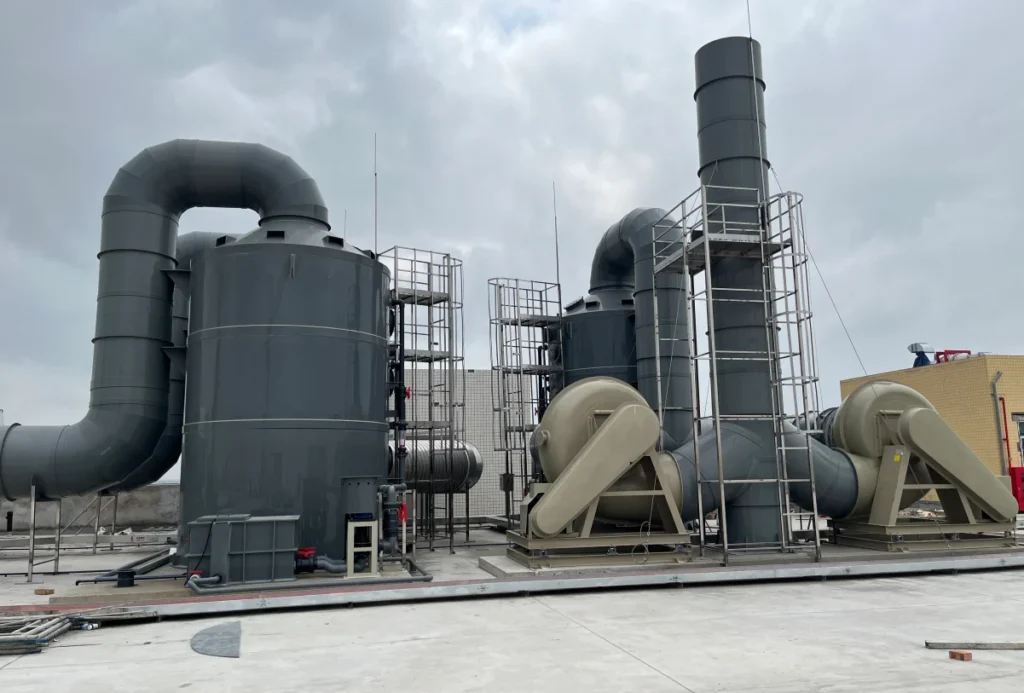
The chemical profile explains where polypropylene sheet material is used and where it is not. It is the standard for plating and anodizing racks, fume scrubbers, acid storage tanks, and ductwork, because the wet, acid-rich service of those processes matches the material’s resistance. It is not the choice for service with hot concentrated sulfuric acid, chlorinated solvents, or strong oxidizing media, where a fluoropolymer or a different construction is required. The resistance tables also show why the chemical check is specific rather than general: a material rated excellent against acetic acid at 10 percent is not automatically safe at 100 percent or at an elevated temperature, so the exact duty is the specification.
Water Absorption
Polypropylene absorbs almost no water, typically under 0.1 percent over 24 hours, and the sheet neither swells nor loses strength when immersed. That property makes the material dimensionally stable in wet and humid service, so a polypropylene tank or panel holds its size where a nylon or a wood-composite part would move. It also means the sheet does not wick moisture into an assembly or provide a path for corrosion, and it is the reason polypropylene is specified for plating racks, marine parts, and food-contact surfaces. The low absorption, combined with the chemical resistance, is what allows the material to serve for years in contact with aggressive liquids.
Filled Grades: Glass-Filled and Talc-Filled PP Sheet
The base polypropylene properties can be changed deliberately by adding a filler, and the filled grades are where a polypropylene sheet material moves from a general-purpose plastic to an engineering material. Glass fiber raises the stiffness, the strength, and the heat deflection at the cost of density and impact; talc raises stiffness and lowers cost and shrinkage. The comparison below uses published values for the common filled grades, and it shows how far the filler can move the material.
| Property | Unfilled | GF20 | GF30 | Talc (TD20) |
|---|---|---|---|---|
| Density (g/cm³) | 0.905 | 1.04 | 1.12 | ≈ 1.05 |
| Tensile strength (MPa) | 33 | ≈ 35–60 | 65–110 | ≈ 28–30 |
| Flexural modulus (GPa) | 1.4 | ≈ 3.8 | 6.0–7.0 | ≈ 2.0–2.5 |
| HDT at 0.45 MPa (°C) | 105 | ≈ 120 | ≈ 150 | ≈ 110 |
| Chemical resistance | Excellent | Good | Good | Good |
Glass-Filled PP Sheet (GF20, GF30)
Glass-filled polypropylene sheet carries short glass fibers in the resin, and the fibers carry the load. A glass filled polypropylene sheet at 30 percent fiber, GF30, reaches a tensile strength of roughly 65 to 110 MPa and a flexural modulus of about 6 to 7 GPa, several times the stiffness of the unfilled material, with a density that rises to about 1.12 g/cm³. The fibers also raise the heat deflection temperature to about 150 °C at 0.45 MPa, so a glass-filled panel keeps its shape where an unfilled sheet would soften. The trade-offs are a heavier panel, a more abrasive material that wears tooling faster, and a lower impact resistance, because the stiff fibers do not flex the way the neat polymer does.
Talc-Filled and Copolymer Grades
Talc-filled polypropylene, often specified by a TD number for the talc loading, is the cost-effective stiffening route. A 20 percent talc grade raises the modulus to roughly 2 to 2.5 GPa and the density to about 1.05 g/cm³, and it reduces the molded or extruded shrinkage, which improves dimensional control in sheet and parts. Talc does not add the strength of glass fiber, and it lowers the impact resistance slightly, so it is chosen where a stiffer, flatter, lower-cost panel is the goal rather than a high-strength structural one. Copolymer grades, separately, bring the low-temperature toughness, and a filled copolymer combines some stiffness with impact survival, which is the specification for parts that run cold and take a load.
The filler also changes how a polypropylene sheet material fabricates, and that matters on the shop floor. A glass-filled sheet is abrasive, so saw blades and router bits wear faster and need carbide tooling, and the fibers leave a rougher cut edge than the neat polymer. A talc-filled sheet machines more easily but can powder at the edge, and both filled grades are less weldable than unfilled polypropylene, because the filler weakens the weld seam. When the part is welded structural fabrications, the unfilled homopolymer remains the standard, and the filled grade is reserved for panels and machined components where the stiffness and the heat performance justify the tooling and the weld compromise.
When a Filled Grade Is the Right Choice
Choose a filled grade when the unfilled material fails a stiffness, heat, or dimensional requirement. A long, flat panel that must not sag uses glass-filled PP for the higher modulus; a part that must hold its shape at temperature uses it for the higher HDT; and a component that must hold tight tolerances uses it for the lower, more predictable shrinkage. Skip the filler when impact or ductility is the priority, because the filled material cracks more readily on impact, and skip it when weight matters, because the glass and talc add density. The filled grade is an engineering choice, and it should be specified against a measured requirement, not chosen as a default upgrade.
How to Read a PP Material Data Sheet
A pp material data sheet is only useful if you read it in the right order, and the order is grade first, test method second, property values third. Most selection errors come from comparing two sheets on a single tensile number without checking that the grade and the test standard match. The method below turns a data sheet into a decision in four checks.
The Test Method Matters (ASTM vs ISO)
Every property value on a pp material data sheet is only meaningful with its test method, because ASTM and ISO run different specimens and procedures. A tensile strength measured to ASTM D638 uses a different test bar and speed than one measured to ISO 527, and the two can report different numbers for the same resin. The same applies to impact, HDT, and modulus, so the first step is to confirm the standard and keep the comparison within one standard. A supplier that states the standard on every line is publishing a real datasheet; a datasheet that lists values with no method is a marketing sheet, and it should not drive a structural decision.
The Values That Matter Per Application
Map the data sheet to the job by asking which property carries the design. A tank or a pressure vessel is governed by tensile strength, chemical resistance, and HDT, because the wall must hold the load, survive the chemical, and stay below the softening temperature. A load floor or a panel is governed by flexural modulus and deflection, because it must not sag across its span. A guard or a container is governed by impact strength, because it must survive a blow without cracking. A part exposed to sun and weather is governed by the UV rating of the grade, which the data sheet should state if the sheet is stabilized. Reading the sheet this way, one property at a time against the service, produces a material decision that survives contact with the real load.
A worked example shows the method. A buyer comparing two sheets for a chemical tank checks the grade line and finds both are homopolymer, then confirms both tensile values are quoted to ISO 527, and only then compares the numbers, finding one sheet rated at 33 MPa and the other at 29 MPa. The lower value is within the scatter of the grade, so the chemical resistance table and the HDT become the deciding lines, and the sheet with the better acid rating and the higher HDT is selected even though it is not the highest tensile number. That is the correct order of a pp material data sheet read: grade, standard, the property that carries the load, and the property that carries the environment, and the decision falls out of the sheet instead of the sales pitch.
FAQ
What is the density of polypropylene sheet?
Polypropylene sheet has a density of roughly 0.90 to 0.91 g/cm³, about 905 kg/m³, which is the lowest of the common engineering sheet plastics. A 3 mm sheet weighs about 2.7 kg per square meter, and the low density is the reason polypropylene parts are specified where weight saves freight, handling, or energy.
What temperature can polypropylene sheet withstand?
A polypropylene sheet melts near 160 to 166 °C, but its usable service range is far lower. The heat deflection temperature runs about 105 °C at 0.45 MPa and 65 °C at 1.8 MPa for a homopolymer, and continuous service sits near 80 to 100 °C depending on load and grade. A glass-filled grade raises the heat deflection temperature to about 150 °C at 0.45 MPa.
Is polypropylene sheet chemical resistant?
Yes, broadly. Polypropylene resists dilute acids, dilute alkalis, and alcohols very well, and it is rated good against most salts and many organic solvents at ambient temperature. The exceptions are strong oxidizing acids and aliphatic, aromatic, and chlorinated hydrocarbons, which attack the polymer, so the specific chemical, concentration, and temperature must be checked.
What is the difference between homopolymer and copolymer PP?
Homopolymer polypropylene is stiffer, stronger, and harder, with higher tensile strength and heat deflection, and it suits structural sheet, tanks, and ductwork. Copolymer polypropylene is tougher and survives low temperatures and repeated impact better, and it suits flexing, containers, and cold service. The homopolymer is about a third stiffer and stronger in tension, and the copolymer is the impact choice.
What is glass filled polypropylene sheet?
Glass-filled polypropylene sheet carries short glass fibers in the resin to raise the stiffness, strength, and heat deflection. A 30 percent glass grade reaches roughly 65 to 110 MPa tensile strength and 6 to 7 GPa flexural modulus, with a density near 1.12 g/cm³, and it suits structural panels and parts that must hold their shape at temperature, at the cost of weight and impact resistance.
Conclusion
A polypropylene sheet material is a known, documented material, and the data sheet is only a mystery if the three variables behind the numbers are ignored. Read the grade, the filler, and the test method first, then compare the property values that carry your design, and the selection follows the load and the environment instead of the sales page. The material rewards that discipline: it is light, tough, chemically resistant, and cheap per kilogram, and it serves structural, thermal, and chemical duty when the grade is chosen for the job.
When you are ready to specify, review the PP sheet product range for rigid and flame-retardant grades, or contact the Xicheng engineering team with your load, temperature, and chemical duty, and they will match the grade and the data sheet to the application.