Key Takeaways
- A centrifugal fan moves air with a spinning impeller that accelerates gas radially outward and turns the discharge 90° into a scroll housing, building the static pressure axial fans cannot.
- It draws air in at the impeller eye, flings it outward at the blade tips, then the expanding volute converts velocity into pressure — that pressure is what pushes air through ductwork, filters, hoods, and scrubbers.
- Three blade families dominate: forward-curved (high volume, low pressure), backward-curved (most efficient, highest pressure), and radial (self-cleaning, for dust-laden air).
- Centrifugal fans beat axial fans whenever the system resistance exceeds roughly 1 inch of water gauge — ducts, dampers, long runs, and pollution-control equipment all qualify.
- For corrosive gas and fume service, FRP and PP centrifugal fans outlast metal fans because no bare steel touches the airstream — a key point when the “blower” carries acid, chlorine, or solvent vapor.
What Is a Centrifugal Fan?
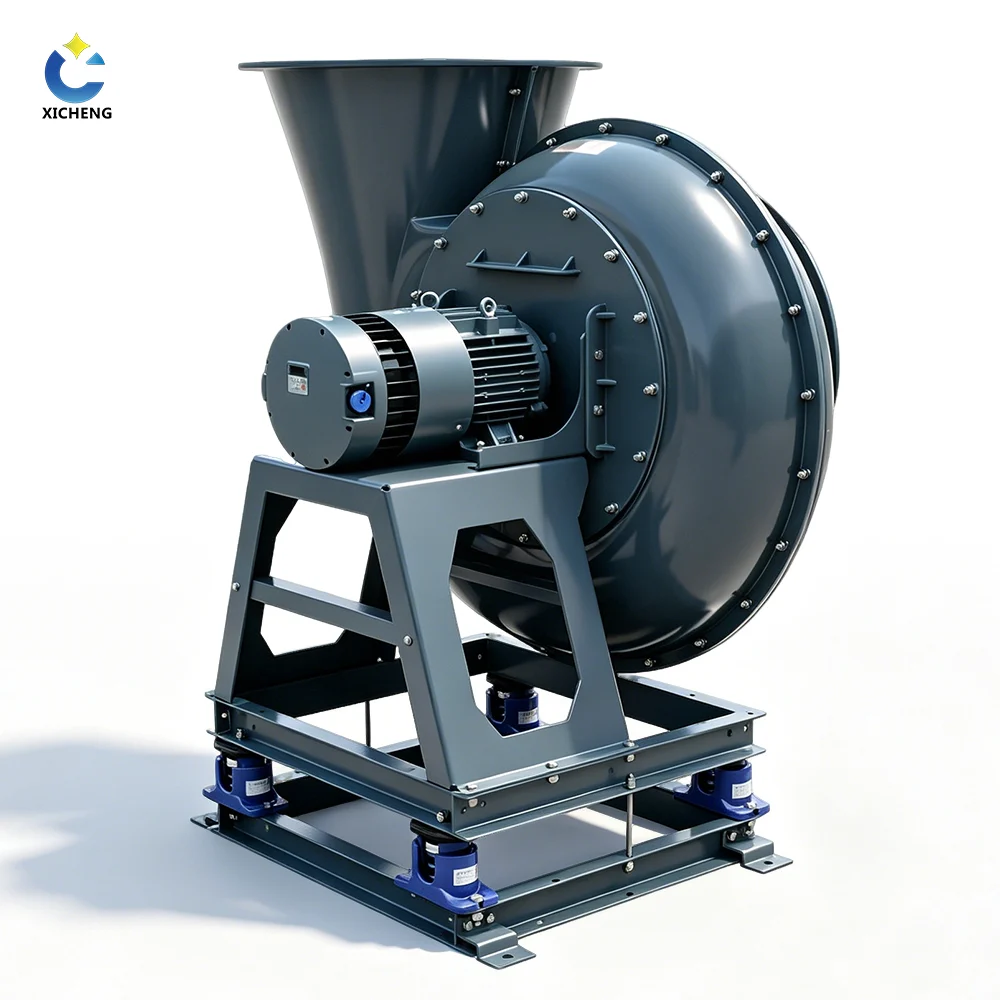
A centrifugal fan is a mechanical air-moving device that creates airflow with a rotating impeller. Air enters the center of the impeller (called the eye), is flung outward by centrifugal force, and leaves the fan radially at 90° to the intake. The spinning wheel raises both the velocity and the pressure of the gas, which is what lets a centrifugal fan do work that a simple propeller cannot: push air through long duct runs, filters, packed-bed scrubbers, and fume hoods that all resist the flow.
In industry the terms overlap, but the family is usually labeled by pressure capability:
| Term | Typical pressure ratio | Where it sits |
|---|---|---|
| Fan | < 1.1 | Low static pressure; general ventilation |
| Blower (centrifugal blower) | 1.1 – 1.2 | Ducted exhaust, fume extraction, scrubbers |
| Turbo blower / compressor | > 1.2 | High-pressure process air, pneumatic conveying |
These bands follow the long-standing machine pressure-ratio classification used across ventilation and process engineering — under roughly a 1.1 ratio the machine is a fan, up to about 1.2 it is a blower, and beyond that a compressor takes over.
When engineers say “centrifugal fan blower” they usually mean the middle band — a unit strong enough to overcome the resistance of a real duct system, yet still a single-stage machine. XICHEng builds this whole family in corrosion-resistant plastic: FRP and PP blowers that handle the same industrial jobs a steel fan would, without rusting out when the airstream is wet or acid.
Every centrifugal fan shares the same four elements: an impeller (the wheel that does the work), a scroll housing (that collects and directs the air), a motor, and an inlet with a discharge. The rest of this guide explains how those parts work together, how to compare blade types, where centrifugal fans are used, and what to specify when you buy one.
How Does a Centrifugal Fan Work?
Understanding how a centrifugal fan works comes down to two stages: acceleration by the impeller, then pressure recovery in the housing.
The Impeller Accelerates Air Radially
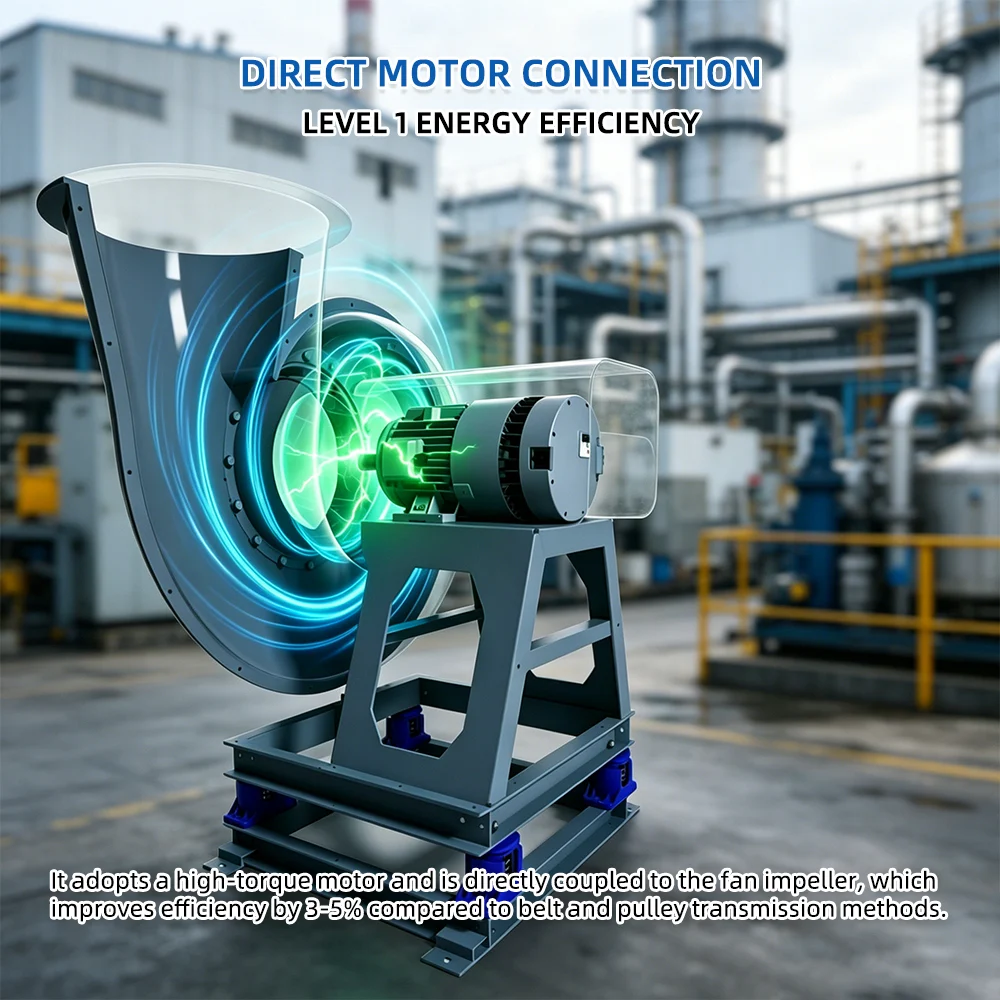
Turn the impeller and a low-pressure zone forms at the eye. Atmospheric pressure pushes gas into that zone continuously, so the fan draws air along the shaft axis into the center. The rotating blades then catch that entering gas and throw it outward to the blade tips. By the time the gas leaves the wheel it is moving at high velocity, perpendicular to the shaft — this is the 90° redirection that gives centrifugal fans their characteristic design and distinguishes them from axial machines that push air straight through.
How much velocity the impeller imparts depends on wheel diameter, blade geometry, and rotational speed. Doubling wheel speed roughly quadruples the pressure the fan can develop, which is why speed control is such a powerful tool for matching a fan to its duty.
The Scroll Housing Converts Velocity into Static Pressure
The high-velocity gas does not help anything until it is slowed down. The scroll housing — the spiral casing wrapped around the wheel — is shaped precisely for this. As the spiral cross-section grows toward the discharge, the airstream decelerates and its velocity pressure converts into static pressure. That static pressure is the quantity that pushes air through ductwork, filters, and process vessels. A well-designed volute captures most of the kinetic energy; a poor one wastes it in turbulence. Engineers track the two together as total pressure — static plus velocity — and every fan performance table lists both, because a scrubbing tower consumes static pressure while the duct section adds velocity pressure back.
This two-step sequence also explains the shape of a centrifugal fan curve. At free delivery (no resistance) the fan moves maximum volume at low pressure. As the system resists the flow, static pressure rises while volume falls along the fan curve, until the fan operates at its design point — where the fan curve meets the system resistance curve. Keep that mental model: any centrifugal fan will find its operating point at the intersection of those two curves, and the manufacturer’s performance table shows what CFM each model delivers at a given static pressure and RPM.
Centrifugal Fan vs. Axial Fan: Which Do You Need?
The single most common selection question in ventilation is whether a centrifugal fan or an axial fan fits the job. The honest answer is that neither is “better” — they are optimized for different system resistance.
An axial fan (propeller style) moves air along its shaft axis, like a household fan. It is cheap, compact, and moves enormous volume in free air, but it develops almost no static pressure. The moment you attach ductwork, a filter, a grease hood, or a packed tower, the fan sees back-pressure — and an axial wheel stalls, loses flow, and gets noisy.
A centrifugal fan is built for exactly that resistance. It trades physical size and initial cost for the ability to hold airflow against several inches of water gauge, which is why scrubbers, fume hoods, dust collectors, and long industrial duct runs are almost always centrifugal.
| Parameter | Centrifugal fan | Axial fan |
|---|---|---|
| Static pressure | 0.5 – 15 in. w.g. (typical industrial range) | 0.1 – 1.5 in. w.g. |
| Airflow per unit size | Moderate, pressure-optimized | High, volume-optimized |
| Airflow direction | 90° change from inlet to outlet | Straight through (along shaft) |
| Noise at design point | Quieter at peak efficiency | Rises sharply against back-pressure |
| Duct/filter/hood compatibility | Designed for ducted systems | Best in free air or short runs |
| Typical first cost (comparable CFM) | Higher ($300 – $5,000+) | Lower ($100 – $2,000) |
A practical rule of thumb: if the system total static pressure stays under about 1 in. w.g. and the duct is short, an axial fan saves money. If you are pushing air through hoods, filters, long runs, or any pollution-control vessel, go centrifugal. Most industrial exhaust and corrosion applications — the ones XICHENG blowers serve — fall firmly on the centrifugal side.
There is an energy and noise angle to the same decision. An axial fan throttled by a partially closed damper wastes power converting pressure into turbulence, and its noise climbs 10–15 dB when it fights back-pressure it was never designed to face. A properly selected centrifugal fan runs near its peak-efficiency zone, which is also its quietest operating range, and a variable frequency drive can follow varying process demand instead of throttling. Over the life of a 5 HP system the difference in electricity and in replacement parts usually settles the choice well before the nameplate price does.
Centrifugal Fan Impeller Designs
Three blade families cover nearly every duty a centrifugal fan will face: forward-curved, backward-curved, and radial. The blade geometry sets the pressure, efficiency, noise, and how well the wheel survives a dirty airstream — the same physics documented in the classic centrifugal fan literature on impeller and volute design.
| Blade type | Peak static efficiency | Pressure capability | Best suited for |
|---|---|---|---|
| Forward-curved (FC) | 60 – 75% | Low – medium (up to ~5 in. w.g.) | High volume, clean air, HVAC, compact units (the familiar “squirrel cage”) |
| Backward-curved (BC) | 80 – 85% | Medium – high (up to ~15 in. w.g.) | Industrial exhaust, high-efficiency systems, continuous duty |
| Radial / paddle | 50 – 70% | Medium – high | Dust-laden air, material handling, self-cleaning duty |
- Forward-curved wheels have many short blades curving in the direction of rotation. They pack a lot of blade area into a small diameter, so they move high volume at low speed — quietly and cheaply. The trade-offs are lower efficiency and sensitivity to dirt: buildup on the blades unbalances the wheel and drains performance, so forward-curved fans belong in clean-air service.
- Backward-curved wheels tilt their blades away from rotation, in an airfoil-profile family. They are the most efficient centrifugal design known, and they handle the highest static pressures. In corrosive service, the same aerodynamic profile is molded in FRP or PP to keep efficiency while shedding the metal. These are the workhorses of industrial exhaust.
- Radial (paddle) wheels have flat blades pointing straight out from the hub, giving strong mechanical strength and a self-cleaning face — particles do not stick to a straight blade the way they load a curved pocket. For dust collection, pneumatic conveying, and abrasive or moisture-laden streams, radial is the reliable choice, usually at a cost in efficiency.
Impeller material matters as much as blade shape. In a clean aluminum or stainless housing a corrosion-resistant wheel is often unnecessary — but the moment the airstream carries moisture, acid fume, or solvent, the wheel should match the housing. That is where FRP centrifugal fans and their PP cousins step in, offering the same backward-curved efficiency with zero metal in contact with the gas.
What Is a Centrifugal Fan Used For?
Wherever air must be pushed against resistance — dust, fumes, heat, or corrosion — a centrifugal fan is the standard tool. The list below covers the main industrial families.
Industrial Exhaust and Fume Control
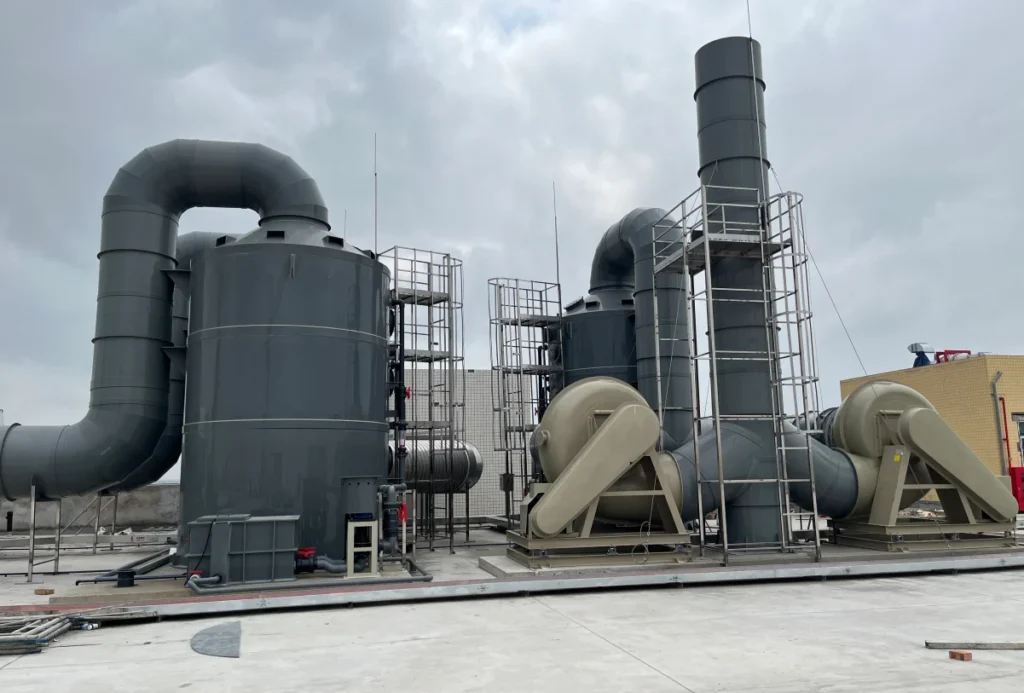
Centrifugal fan exhaust systems pull contaminated gas out of process buildings, ventilate paint spray booths and plating lines, and feed scrubbers and absorbers. This is the biggest single application for the fans XICHENG builds. An exhaust fan must generate enough static pressure to overcome the capture hood, the duct friction, and the scrubber internals — exactly the duty a backward-curved centrifugal wheel is designed for. In these systems the fan is the heart of the treatment train: it is the component that keeps the building under slight negative pressure so fumes never escape into the working space.
Dust Collection and Pneumatic Conveying
Baghouses, cartridge collectors, and cyclone systems all rely on a centrifugal fan to draw dusty air into the filter media. Radial-blade wheels shine here because their straight blades shed dust instead of packing it. The same pressure capability powers pneumatic conveying loops that push pellets, powder, and chips through pipelines — duties that also favor radial-tip wheels with abrasion-resistant construction.
Air Moving and Air Knives
When buyers search for a “centrifugal air mover” they often find consumer carpet-drying machines, but the industrial meaning is different: a centrifugal blower is the pressure source for blowing clean air through drying lines, air knives, cooling stations, and make-up air systems. The engineering is identical to exhaust — a wheel building static pressure to push a controlled stream of air into a process. If your process needs high-velocity clean air rather than suction, a centrifugal fan is still the right prime mover. For wet-chemical processes, the same unit is often paired with a gas scrubber to treat the discharge so it can be released safely.
Beyond these three, centrifugal fans supply combustion air to boilers and incinerators, circulate heated air in ovens and dryers, cool electrical enclosures, and aerate wastewater. Each of those is a resistance problem in disguise: a burner needs a stable, metered stream of air against furnace back-pressure; an oven needs even recirculation through a chamber full of racks and baffles; a blower feeding an air pollution control train has to push against the scrubber packing, the mist eliminator, and the stack damper one after another. The unifying theme repeats: wherever the gas path offers resistance rather than open space, centrifugal wins. That is why our corrosion-resistant blowers end up on scrubber skids and plating lines more often than anywhere else — the fan is the force that keeps the whole train moving.
Centrifugal Fan Motors and Drive Configurations
The centrifugal fan motor and its drive are the second decision after blade type, because they set maintenance cost, controllability, and whether the motor survives the atmosphere around the fan.
| Drive | How it works | Strengths | Watch-outs |
|---|---|---|---|
| Direct drive (motor shaft → impeller) | Wheel mounted straight on the motor shaft | Fewer parts, no belts to slip, lowest maintenance, ideal for continuous duty | Rotation speed fixed by motor (or VFD); no pulley tuning |
| Belt drive (V-belt) | Motor turns impeller through pulleys | Speed tuned by pulley ratio; can re-configure flow/pressure easily | Quarterly tension checks, periodic belt replacement |
| VFD (variable frequency drive) | Electronically varies motor speed | Matches fan to duty, cuts energy 20–50% at part load, soft start | Adds electronic cost and a speed range to respect |
For corrosive exhaust duty, the motor placement matters as much as the drive type. The best practice is to keep the motor outside the airstream, so acid vapor, moisture, and heat never attack the bearings and windings. XICHENG PP and FRP blowers use an A-type direct-drive configuration that mounts the motor cleanly outboard of the fan scroll — the motor turns the wheel through a proper separator while the housing carries only the process gas. Direct drive also removes belt-maintenance routines from plants that run 24 hours a day.
When load varies — a production line that runs some days at full capacity and others at 20% — a belt drive or VFD lets you move the operating point back down the fan curve instead of throttling with a damper, which wastes energy. If the process duty is steady and the atmosphere is aggressive, choose the simplest, most reliable path: a clean, outboard motor and as few wearing parts as possible.
Corrosion-Resistant Centrifugal Fans: FRP and PP
This is where a centrifugal fan stops being a commodity. When the airstream carries moisture, acid, chlorine, solvent vapor, or salt, a steel or galvanized fan becomes a maintenance problem: the housing corrodes, the wheel unbalances, and leaked vapor attacks whatever sits downstream. The durable industrial answer is to remove metal from the gas path entirely and build the fan in fiber-reinforced plastic — FRP and PP centrifugal fans are built for exactly this duty.
Why FRP Centrifugal Fans Beat Metal in Acid Service
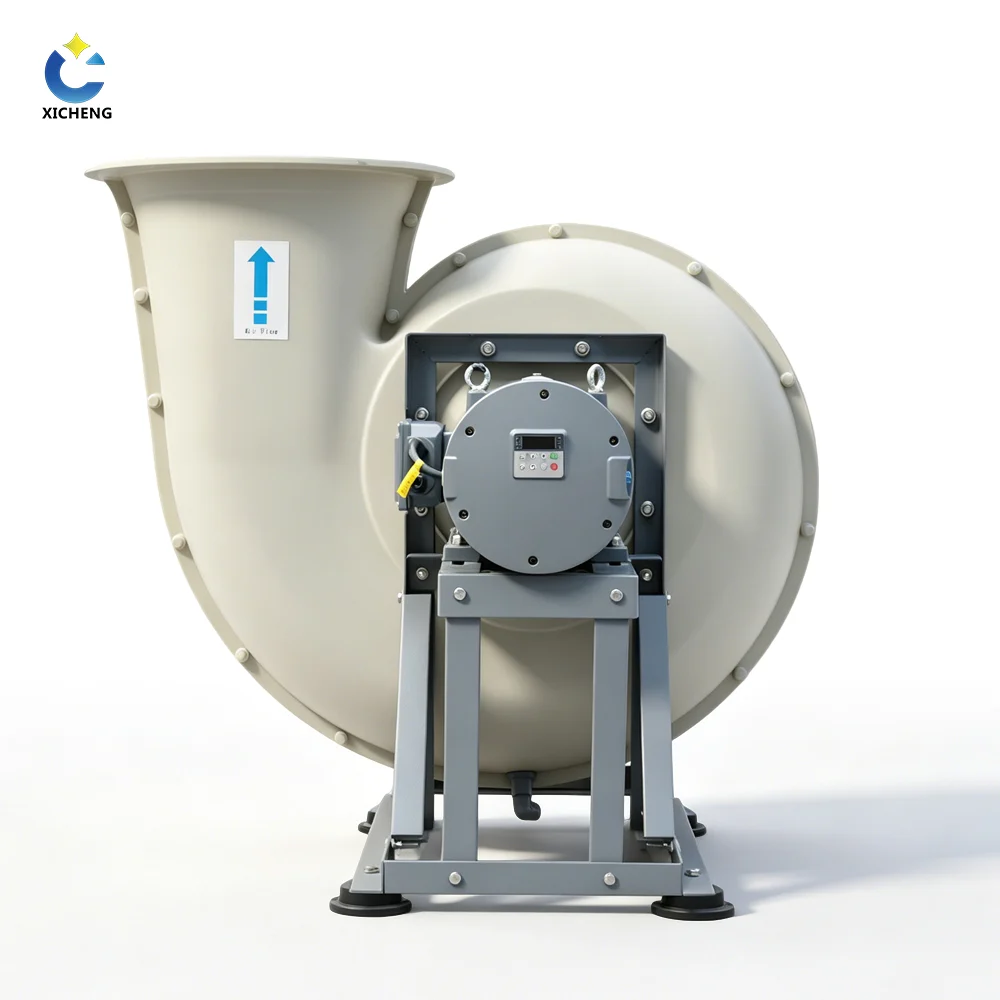
FRP (fiberglass-reinforced plastic) combines the structural stiffness a fan wheel needs with true corrosion resistance. A molded FRP impeller has no weld seams, no bare steel edges, and no coating to chip — the reinforcement is inside the resin, so the whole part resists attack from wet acid fumes like sodium hydroxide, hydrochloric acid vapor, and chromic acid mist that would chew through a coated carbon-steel wheel. The backward-curved FRP profile keeps the same 80%-class efficiency you would expect from an airfoil wheel, simply because the material is plastic rather than steel. For hot process gas (up to roughly 250 °F) and the most aggressive chemicals, an FRP centrifugal fan is the standard choice. XICHENG pairs that wheel with a matching FRP scroll so the entire gas path is one continuous polymer assembly.
PP Fans for Moderate Corrosion
Polypropylene (PP) centrifugal fans cover the lighter end of the corrosion spectrum — plating fumes, lab exhaust, semiconductor process venting, and general chemical ventilation where temperatures stay below about 190 °F. PP is lighter, less expensive, and fully weldable, which makes fabrication quick and the finished unit easy to handle and mount. Its one-piece injection-molded PP impellers keep the wheel dynamically balanced, preventing the blade fatigue that shortens the life of welded metal fans.
The practical rule: for high temperatures and severe chemicals, choose FRP centrifugal fans; for moderate temperatures and cost-sensitive plastic duct systems, choose PP fans. Both are available as direct-drive units with the motor outboard of the airstream — browse the FRP blower product line and the PP blower product line for the same technology in a catalog form. When the vapor is organic or laden with particulates, our activated carbon adsorption media steps in downstream of the fan.
How to Specify a Centrifugal Fan
Specifying a centrifugal fan correctly comes down to five numbers. Nail these and the manufacturer can match the wheel, motor, and material precisely.
- Airflow (CFM) — the volume the process actually needs. For exhaust, compute room volume × air changes per hour ÷ 60; for process capture, size from the hood.
- Static pressure (in. w.g.) — total system resistance: duct friction (roughly 0.08 in. w.g. per 100 ft of straight metal duct), plus elbows, dampers, filters, and vessel internals. This is the number most often under-specified.
- Gas temperature and chemistry — temperature sets the material (FRP vs PP vs metal); chemistry sets corrosion resistance, impeller material, and whether the motor must be isolated from the airstream.
- Duty cycle — 24/7 continuous operation favors direct drive and heavy-duty bearings; an intermittent clean-air job can tolerate a lighter unit.
- Sound and space — noise limits and the mechanical room layout decide blade type and mounting (upblast, inline, sidewall, or free-standing scroll).
| Quick spec sheet for a small PP exhaust fan | Typical value |
|---|---|
| Airflow | 50 – 6,000 CFM |
| Static pressure | up to ~10 in. w.g. (centrifugal range) |
| Temperature limit | PP ~190 °F · FRP ~250 °F |
| Drive | direct (A-type) or belt |
| Material | FRP or PP, all-plastic gas path |
Two caution notes worth carrying into every purchase. First, size to the calculated load, not “just in case” — oversizing a fan by 30% raises annual energy cost by 15–25% with no ventilation benefit, as the unit runs forever off its design point. Second, verify performance data against a recognized test standard; AMCA-certified ratings are measured under a defined laboratory method, so they let you compare different brands apples-to-apples rather than trusting an optimistic nameplate.
When the performance table arrives, check the operating point, not just the free-air CFM. A centrifugal fan delivers its rated volume only at one specific static pressure per speed; pick a model whose table shows your required CFM at (or slightly above) your calculated resistance and whose wheel sits in the efficient part of the curve. That intersection is where the fan will actually run once the duct is connected, and it is the difference between a quiet, low-draw machine and one that hums off-peak for years. When in doubt, give the manufacturer the five numbers above and let them propose the wheel and drive that lands on the design point.
Centrifugal Fan FAQ
Is a centrifugal fan the same as a blower?
“Blower” is used loosely, but the useful line is pressure. A centrifugal fan moving air at a pressure ratio below about 1.1 is usually called a fan; between 1.1 and 1.2 it is a centrifugal blower; above that it becomes a turbo blower or compressor. Most industrial exhaust machines sit in the blower band — built on the same impeller + scroll design, just doing more work against the duct system.
What is the difference between a centrifugal fan and a centrifuge fan?
They are the same machine — “centrifuge fan” is simply a misspelling of “centrifugal fan.” The correct name comes from centrifugal force, the same physical effect a laboratory centrifuge uses to spin heavier material outward. If you see either spelling in a request-for-quote, the equipment needed is identical: a wheel that flings air radially and builds static pressure.
Why is a centrifugal fan sometimes called a squirrel cage fan?
The forward-curved wheel carries many narrow blades wrapped around the hub, and the assembly resembles a hamster exercise wheel — hence the nickname. Squirrel cage fans are a sub-type of the centrifugal family optimized for high volume at low to medium pressure, common in HVAC blowers and small supply fans. Industrial exhaust fans more often use backward-curved or radial wheels for higher pressure and efficiency.
How much static pressure can a centrifugal fan generate?
A single industrial centrifugal fan typically builds between 0.5 and 15 inches of water gauge. Multiple stages in series (or a turbo blower) push far higher, but for scrubber and ducted-exhaust work, 10–15 in. w.g. from one wheel is usually enough. Axial fans, by contrast, manage only about 0.1–1.5 in. w.g. — the margin that decides which fan a ducted system needs.
What causes a centrifugal fan to vibrate or grow noisy?
Most field problems trace to operating off the design point or to imbalance. A forward-curved wheel with dirt buildup on the blades unbalances in service, so clean the wheel on a schedule. Running the fan far from its best-efficiency point adds 10–15 dB against design. For continuous corrosive duty, an FRP/PP wheel keeps balance longer than a welded metal wheel because the one-piece molding has no welds to fatigue. If vibration persists, check belt tension, bearing condition, and foundation bolts.
When should I choose an FRP centrifugal fan instead of a metal one?
Whenever the airstream is wet, acidic, chlorinated, or salt-laden, an FRP or PP centrifugal fan outlasts painted steel because no metal ever contacts the gas. Choose FRP for the hottest and most aggressive chemistry (to about 250 °F), and PP for moderate temperatures at lower cost. In clean, dry, ordinary-temperature air, a metal fan remains the economical default.
Get a Quote for the Right Centrifugal Fan
Every centrifugal fan XICHENG builds starts with the same five numbers: airflow, static pressure, gas temperature, chemistry, and duty cycle. Send us those and our engineers will match the wheel, the FRP or PP material, and the drive to your process — no more guessing between a squirrel-cage supply fan and a backward-curved scrubber duty wheel.
Tell us about your application and we will respond with a performance table you can check against your fan curve, not a nameplate promise. Contact XICHENG for a quote or to confirm the correct centrifugal fan for your duct system.