Key Takeaways
1. Polypropylene blowers are the corrosion-resistant answer for most acid, alkali, and salt fume streams. The whole wetted airstream is polypropylene, so there is no metal touching the gas, no coating to blister, and no steel to pit.
2. Know the temperature ceiling: roughly 190°F for polypropylene, 140°F for PVC, and 250°F for FRP. Stay inside the envelope and a polypropylene fan runs for years; go past it and the housing softens and loses shape.
3. A polypropylene blower costs less than FRP or stainless steel yet outlasts painted carbon steel in humid, acidic air. The plastic itself is the protection, so there is nothing to repaint, reline, or derate over time.
4. Match the fan type to the duty. Centrifugal PP blowers carry static pressure, axial polypropylene fans move high flow at low pressure, and inline units fit confined duct runs and roofs. Typical duties range from about 100 to 6,000 CFM and up to 10 in w.g.
5. Buy on verified performance and material — not on price. Ask for the fan curve, impeller balance report, homopolymer or copolymer grade, weld joint inspection, and a factory test before you pay.
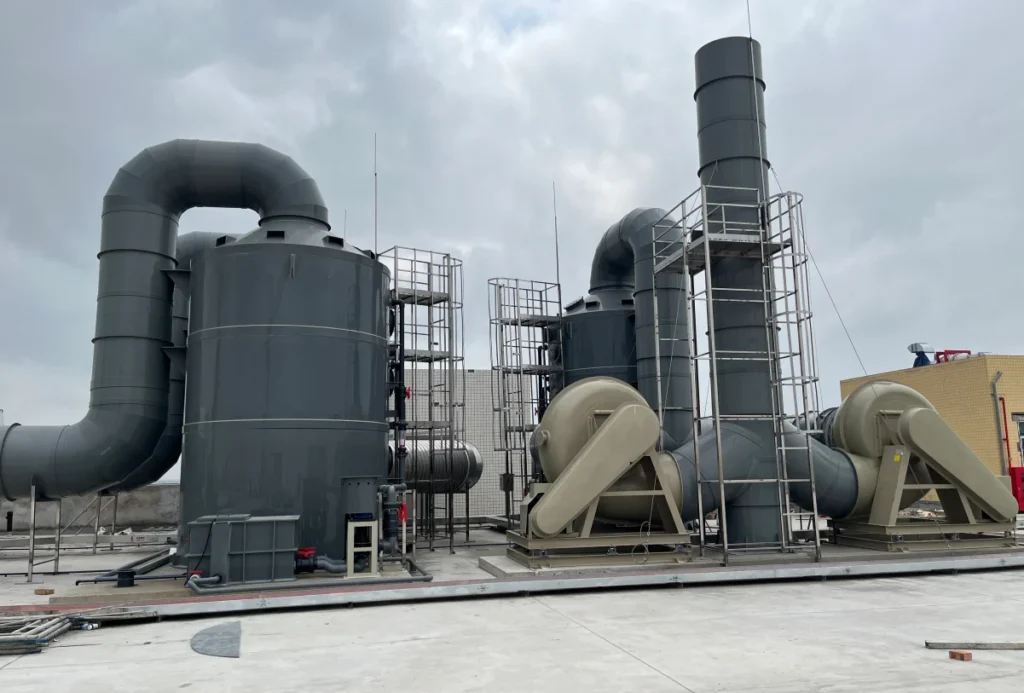
When your exhaust stream carries acid mist, chlorine, hydrogen sulfide, or humid salt air, a standard painted fan is a dying asset from the day it ships. Coatings blister, fasteners corrode, painted carbon steel pits within a season, and the failure is usually not gradual — it is a fan that seizes, cracks, or sheds rust into a clean process. The material-driven answer used across chemical plants, plating lines, and wastewater facilities is a polypropylene blower: a fan whose housing, impeller, and inlet cone are molded entirely from polypropylene, with nothing metallic in contact with the gas.
Polypropylene is a thermoplastic that resists a broad family of acids, alkalis, and inorganic salts without any surface treatment. Because the corrosion protection is the material itself, a polypropylene blower keeps working after coated-metal alternatives have already been swapped out twice. It is also lighter than fiberglass or stainless steel, simpler to install, and noticeably cheaper to buy — which is why many buyers treat “industrial polypropylene fan” as the default first choice and reserve heavier construction for hotter or more abrasive duties.
This guide walks through what a polypropylene blower is made of and how it is built, how it compares with PVC, FRP, and metal fans, which types fit which airflow and pressure ranges, how to size one correctly, and what to verify before importing a polypropylene fan from a China supplier. If you are comparing against fiberglass construction first, start with our complete guide to FRP blowers, then return here for the polypropylene option.
Xicheng manufactures corrosion-resistant PP industrial blowers and FRP fans built on the material rules below; the product page shows real construction details and test certificates.
What Are Polypropylene Blowers?
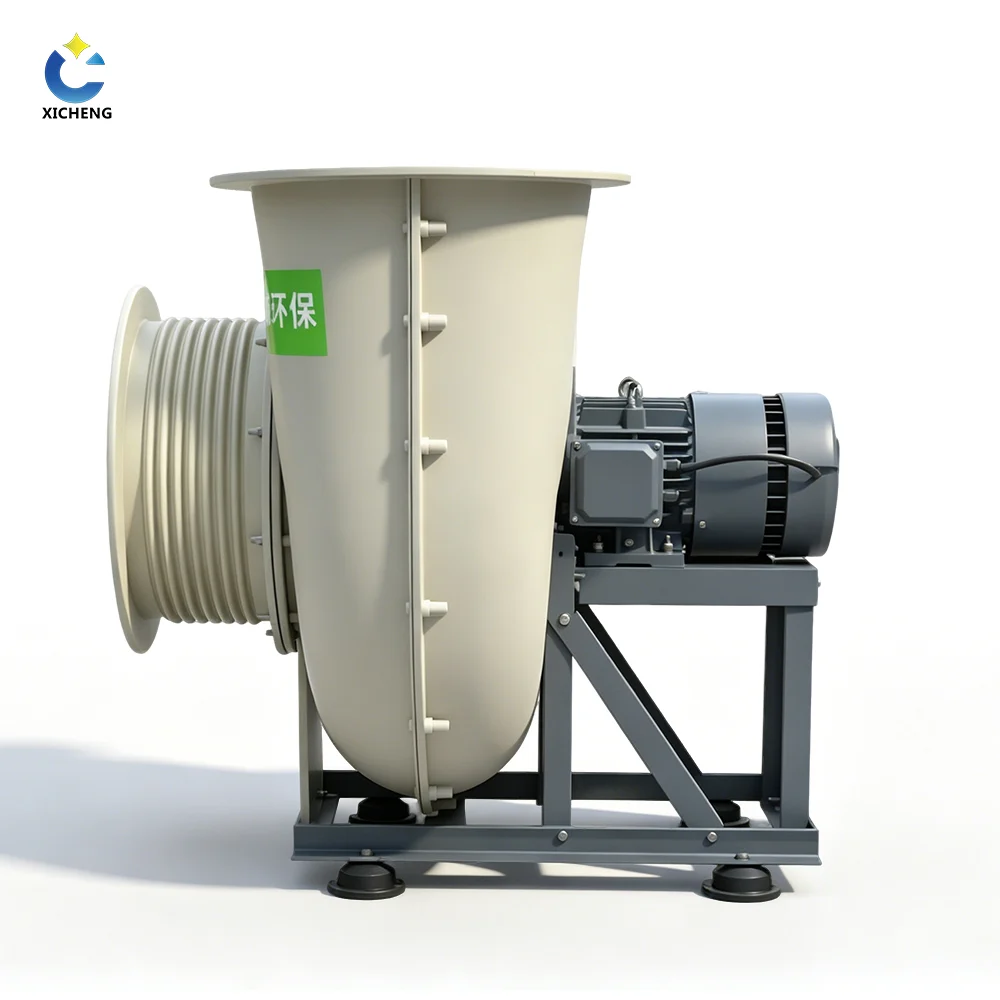
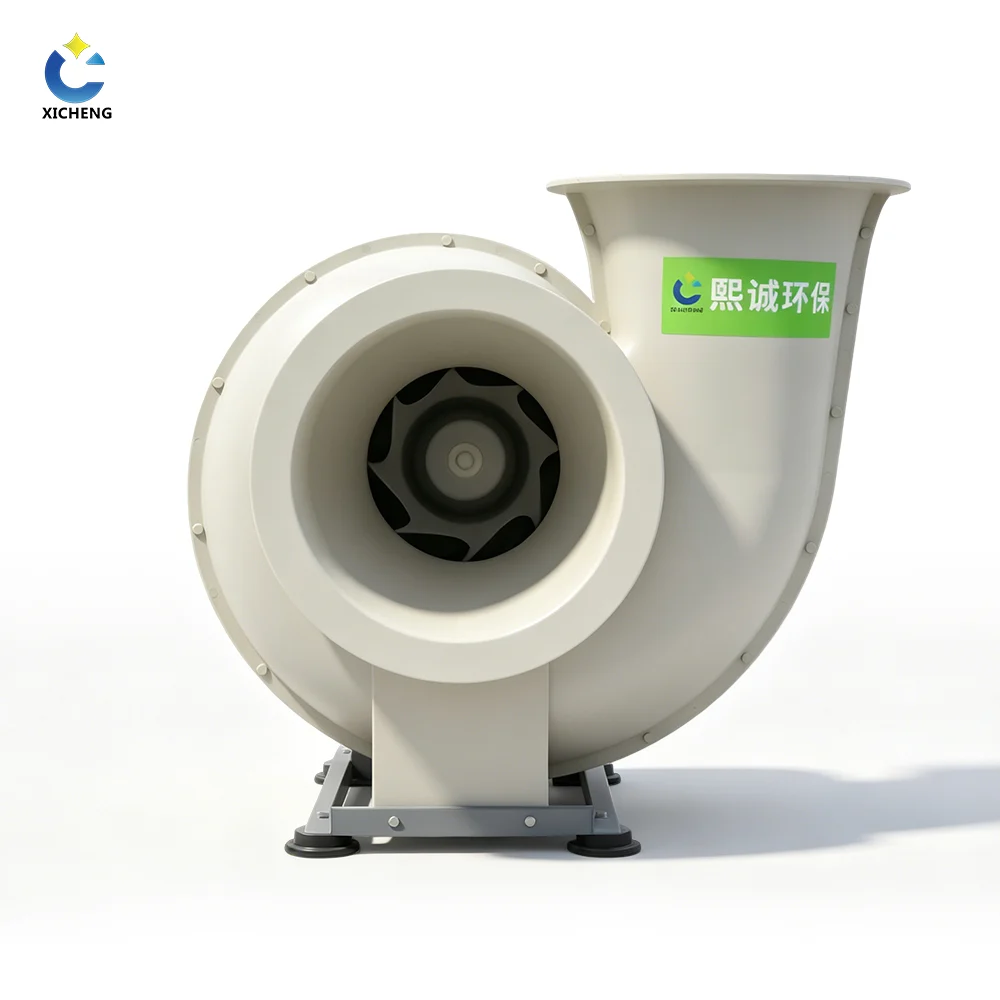
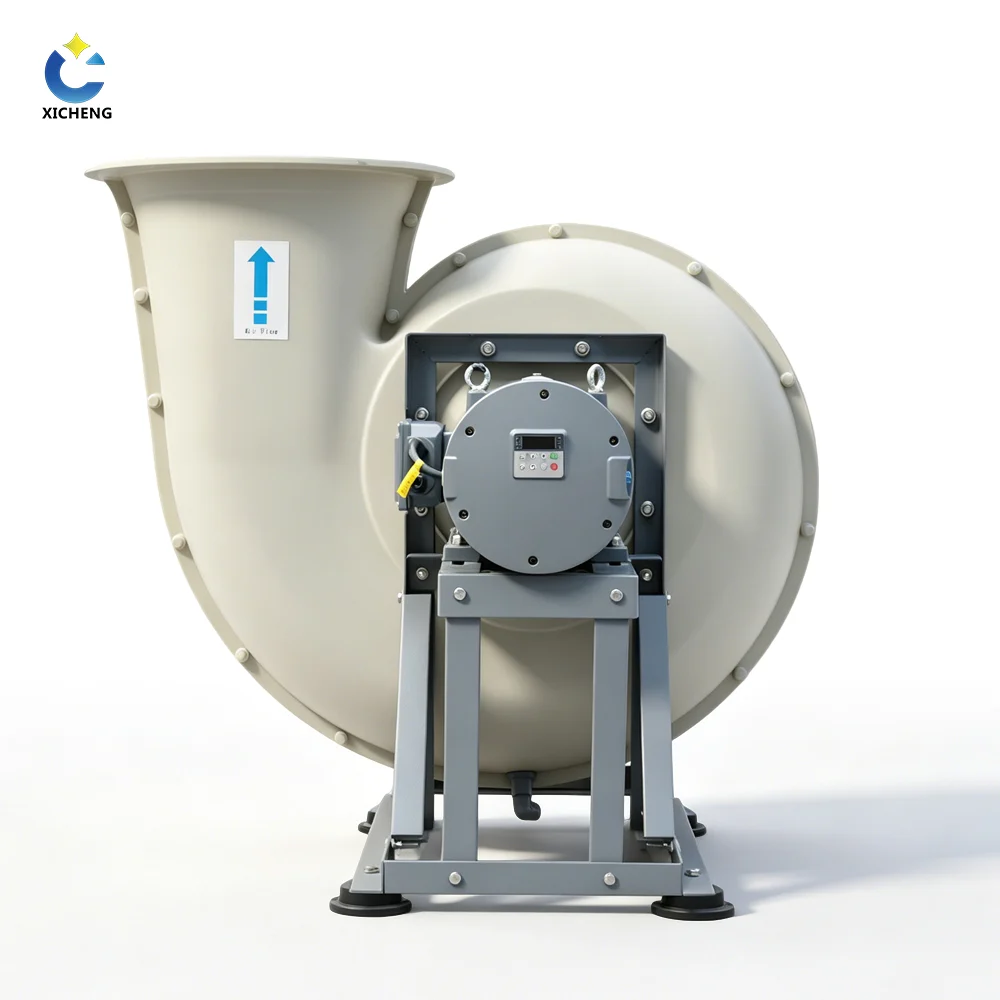
A polypropylene blower is a centrifugal or axial fan whose complete wetted airstream — casing, scroll, impeller, inlet cone, and any flanges — is molded or welded from polypropylene (PP), a semi-crystalline thermoplastic. The motor, shaft seals, and bearings sit outside the gas path and drive the impeller through the housing, so the only surfaces the corrosive stream sees are polymer. This is the property that separates a polypropylene fan from every painted, coated, or dipped metal fan: the protection is not an applied layer that can fail; it is the body of the machine.
Polypropylene is the same material trusted for chemical storage tanks, acid piping, and shipping drums. It holds up against most inorganic acids and bases, salt solutions, and a wide range of organic vapors up to about 190°F in steady service. It is tough rather than brittle, which matters in industrial handling — a polypropylene blower shrugs off impact and vibration that would crack a rigid PVC part or flake a coating.
Manufacturers shape PP fans by vacuum thermoforming or injection molding, then hot-air weld subassemblies. Both routes give an accurate, repeatable shape. Injection molding is the tighter of the two: an injection-molded impeller is identical part to part, which is what lets a factory dynamically balance a PP wheel so it runs calm at its maximum working speed. Calm rotation means less shaft strain, less bearing load, and longer motor life. Whatever the forming route, the result is a one-piece corrosion envelope with no metal exposed to the gas — the sentence you will see repeated across every serious polypropylene fan supplier, and the one that matters most.
Two family notes help when you are comparing products. First, “fan” and “blower” are used loosely in catalogs: a polypropylene fan is the generic name, while a polypropylene blower usually means a centrifugal machine that can push against the static pressure of duct runs, packed towers, and elbows. Second, PP is one member of the plastic-fan family that also includes FRP (glass-reinforced plastic) and PVC. FRP earns its place on hotter or more mechanically abusive duties; polypropylene is the more economical, all-polymer choice for the majority of acid and salt fume work. Our FRP blower guide covers that side of the family in detail, and this guide stays with polypropylene.
Why Polypropylene Wins in Corrosive Air
Corrosion in an exhaust system comes from the chemicals in the gas. The usual suspects are hydrogen sulfide, chlorine, sulfur dioxide, ammonia, ozone, mercaptans, hydrogen fluoride, and sodium hypochlorite — found in wastewater treatment, chemical processes, plating, bleaching, and coastal environments. Against those, a metal fan fails one of three ways: the steel rusts, the coating blisters and lifts, or fasteners and impeller edges corrode where the paint was thin. A polypropylene blower removes all three failure modes at the design stage.
Chemical resistance without coatings or linings. Polypropylene resists most acids, caustics, and inorganic salt solutions directly at the molecular surface. There is no paint film to monitor, no rubber lining to delaminate, no galvanized coating to wear through at an impeller tip. The resin itself is the barrier, and because the wall is thick structural plastic rather than thin applied paint, corrosion cannot “get behind” the protection. The practical effect shows up in maintenance records: where a coated steel fan appears fine for a season and then fails fast, a polypropylene fan degrades slowly and predictably over its life.
Weight and handling. Polypropylene is roughly a fifth the density of steel. A PP centrifugal fan hoists into place with one rigging crew where a stainless unit needs a crane team, and it loads less onto roof structures and duct supports. For retrofit work in existing buildings, the lighter fan often needs no structural reinforcement at all.
UV resistance and outdoor life. Polypropylene parts are molded with an anti-UV additive that absorbs ultraviolet energy. That matters for roof-mounted exhausters and outdoor installations, where unprotected plastic would degrade and chalk within a few years.
Property and impact toughness. Polypropylene flexes instead of shattering. Handling shocks, vibration, and thermal cycling that crack rigid PVC or chip a coated surface are absorbed. The same flexibility is why PP outranks PVC in temperature ceiling as well.
Polypropylene vs PVC vs FRP vs stainless steel vs coated steel
The decision between materials is a decision about temperature, chemistry, duty, and budget. The table below is the practical summary used by engineers when they shortlist a corrosive-air fan.
| Material | Steady temp limit | Chemical resistance | In the airstream | Relative cost | Best duty |
|---|---|---|---|---|---|
| Polypropylene (PP) | ≈ 190°F | Most acids, alkalis, inorganic salts | All polymer, no metal | Low | Humid, acidic, or salty fume at low–medium temperature |
| PVC | ≈ 140°F | Good for acids and salts; brittle | All polymer, no metal | Low | Cool laboratory and plating exhaust |
| FRP | ≈ 250°F | Very broad, plus abrasion options | Resin and glass; no metal | Medium | Hot gases, larger systems, abrasive or severe duty |
| 304/316 stainless steel | High (400°F+) | Good, but chloride pitting risk on 304 | Metal | High | Heat, particulates, or high-pressure blower duty |
| Coated carbon steel | Depends on coating | Only as good as the film | Metal under coating | Lowest first cost | Mild, dry exhaust only |
Read the table as a filter. If your gas is over about 190°F, move up to FRP. If the stream carries abrasive particulates and you need extreme hot gas, stainless steel earns its price. If you have particulates plus heat plus salt, an FRP fan with an abrasion-resistant layer, like the FRP blowers Xicheng builds, is the standard answer. But for the most common corrosive cases — plating line mist, acid storage venting, wastewater odors, laboratory fume — the polypropylene fan delivers the same no-metal-in-the-air-stream protection as FRP at a lower price, and that is the decision this guide is built around.
Polypropylene Fan Types
Polypropylene appears in every aero-dynamic family because the resin works for both high-pressure centrifugal and high-flow axial designs. Which family you need is set by the resistance of your system, not by preference.
Polypropylene centrifugal blowers
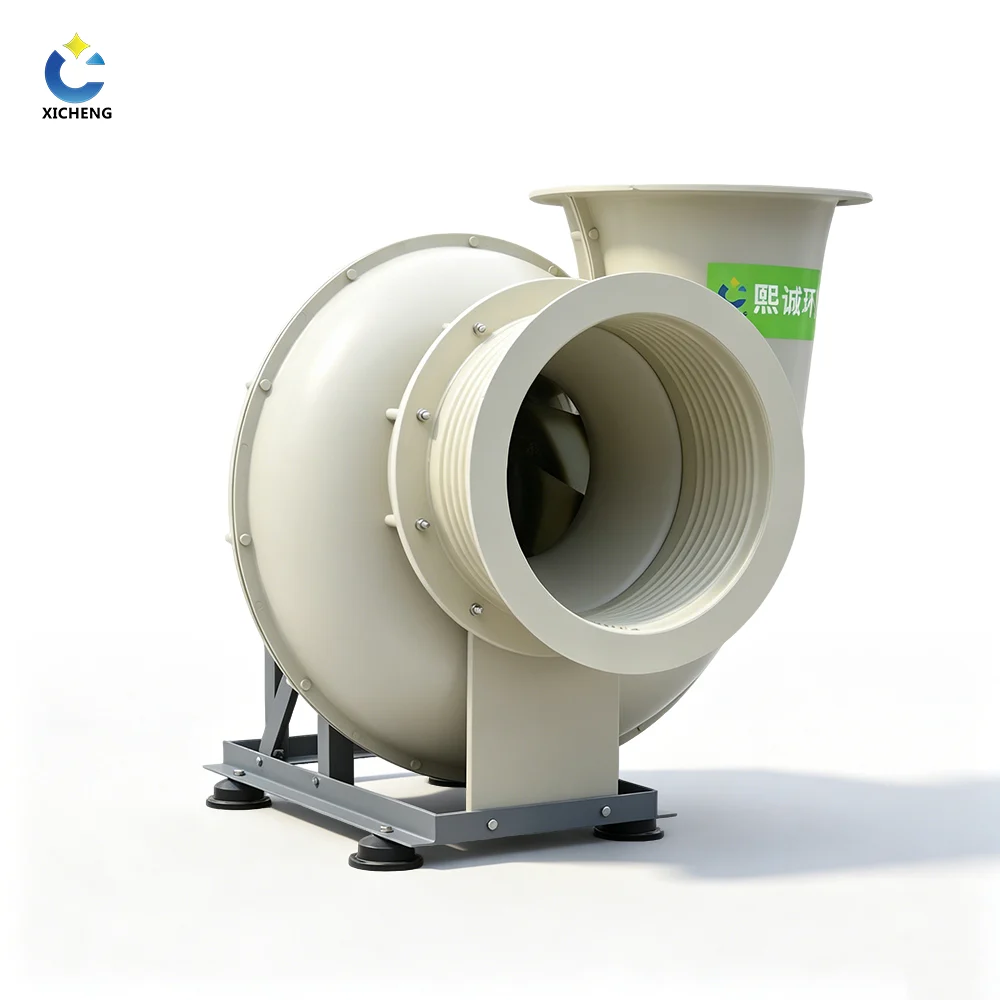
The centrifugal polypropylene blower is the workhorse of corrosive exhaust. Air enters through the inlet cone, a curved impeller throws it outward, and the scroll discharges it at right angles to the intake under elevated pressure. That pressure is what pushes gas through long duct runs, elbows, dampers, and packed scrubber media — all the resistance that defeats an axial fan. Backward-inclined PP impellers run efficiently at moderate speeds and suit general fume duty; radial-blade wheels hold pressure stability and resist build-up, which suits pressure blowers and streams that carry traces of dirt. When a buyer asks for a “polypropylene blower” they almost always mean this centrifugal type.
Polypropylene exhaust fans
“Polypropylene exhaust fan” is the broader category: any PP fan moving gas out of a space — wall exhausters, roof exhausters, and inline units included. Chemical plant roof ventilators, plating shop wall fans, and wastewater lift-station exhausters are typically polypropylene exhaust fans rather than blowers, because their job is moving volume against modest resistance rather than developing pressure.
Polypropylene axial fans
Axial polypropylene fans push air parallel to the shaft, delivering very high flow at very low pressure. Tube-axial and panel fans are the standard choice for bulk ventilation of corrosive rooms and large envelope exhaust where duct resistance is small. They cannot overcome dense packing or long runs; if your system has real pressure, step across to a centrifugal blower.
Inline and roof-mount configurations
The same wheel serves different layouts. Inline centrifugal polypropylene fans mount directly in the duct run, which suits tight interiors where a scroll fan will not fit. Roof-mounted inline units keep the motor clear of the weather on a curb and exhaust vertically away from the roof membrane. Both share the wetted-side polypropylene construction and the corrosion rules that go with it. When the system also needs corrosion-resistant ducts, elbows, and fittings, they should be specified in the same material family so the whole envelope is consistent — Xicheng supplies the matching industrial polypropylene duct and fittings.
| PP fan type | Typical airflow | Typical static pressure | Best for |
|---|---|---|---|
| Centrifugal blower (backward-inclined) | ~100 – 6,000 CFM | Up to ~10 in w.g. | Duct runs, scrubbers, plating and acid fume |
| Centrifugal blower (radial / pressure) | Low – moderate | Higher, up to 15+ in w.g. | Tall stacks, dense packing, corrosive gas at pressure |
| Inline centrifugal | 200 – 3,000 CFM | ~1 – 4.5 in w.g. | Confined runs, roof exhaust, ducts |
| Axial (tube / panel / wall) | High | 0.5 – 4 in w.g. | Large-volume room ventilation, low resistance |
The numbers above are the working bands seen across major polypropylene fan lines — the low end matches laboratory and small plating duties, the upper end covers most chemical and wastewater exhaust. Very large corrosive systems, above roughly 35,000 CFM, are more commonly built in FRP, which is one reason the two materials coexist in every serious catalog.
Polypropylene Fan Performance and Specifications
Correctly reading a polypropylene blower specification means separating the material limits from the aerodynamic performance. The two interact, and buyers who ignore one of them buy the wrong machine.
Airflow and static pressure range
Industrial polypropylene fans are, as discussed, built for low and medium flow with useful pressure. Catalog lines typically span roughly 50 to 6,000 CFM for direct- and belt-drive centrifugal models, up to about 10 in. w.g. of static pressure, with inline units around 200 to 3,000 CFM and lower pressure. Airflow is always the intersection of the fan curve and the system curve — a fan moves whatever its wheel pressure can push through the resistance — so the number that matters is not the free-air rating but the CFM at your design static pressure.
Operating temperature
The polypropylene temperature ceiling sits around 190°F in steady service; short excursions can go a little higher but every hour past the rated limit trades away service life as the housing softens and creeps. This is the line in the sand between polypropylene and its neighbors: PVC tops out near 140°F, FRP near 250°F, and stainless steel far above. Specifying temperature honestly at the start — including heat from the process and any heat gained in duct runs — is the cheapest insurance you can buy, because a blower bought for 160°F will be quietly over-temperature the moment summer heat adds ten degrees.
Impeller balance and drive configuration
A molded impeller is only as good as its balance. Quality polypropylene blowers ship with impellers dynamically balanced at the maximum working speed so the wheel runs vibration-free across the operating range. On installation, a direct-drive (A-type) polypropylene blower couples the impeller straight to the motor shaft — simplest, fewest wearing parts, and the common standard for most duties. Belt-drive (or magnetically coupled) arrangements allow speed adjustment for field balancing of airflow and protect the motor against aggressive gas when the drive stays out of the fume path. High-efficiency permanent-magnet motors are a growing option for continuously running corrosive-exhaust fans because their energy savings compound on 8,000-hour years; Xicheng offers PM-driven corrosion fans in its permanent magnet fan range.
Explosion protection for flammable vapors
Some corrosive duties carry flammable solvent vapor as well. Polypropylene itself can accumulate static charge, so manufacturers offer conductive grades — carbon-impregnated polypropylene, sometimes labeled CIP or PPs-EL — that drain charge and prevent spark build-up. Paired with explosion-proof (XP) motors and proper grounding of the housing, a conductive polypropylene blower is the standard answer for solvent-laden exhaust in hazardous areas, with ATEX Zone 1 and Zone 2 versions available in most product lines.
Sound and tested ratings
Ask whether the fan has been sound-tested and efficiency-tested rather than submitted at free air. Fans tested in accordance with AMCA-style standards give you names you can compare; a manufacturer that publishes curve-plus-sound data is also the manufacturer most likely to have balanced its impellers properly in the first place.
Plastic Fans vs Metal, PVC, and FRP — How to Choose
“Polypropylene is cheaper than FRP, so it must be worse” is the most common misconception in corrosive ventilation. In fact, plastic fans are chosen because the plastic is the corrosion protection. The right question is not “how exotic is the material” but “does this construction survive this gas, at this temperature, into this budget.”
When polypropylene is enough
Most corrosive exhaust work happens below 190°F: plating line mist, acid storage and transfer venting, wastewater odor extraction, chemical dosing rooms, laboratory fume, battery rooms, and marine-coastal salt air. In every one of these, a polypropylene fan — all-polymer wetted parts, no metal in the airstream, UV-stabilized resin — outlasts coated carbon steel, because there is no coating to fail. This is the “industrial plastic fan” case that should always be evaluated first before any metal option is priced.
PP vs PVC: the 140°F / 190°F split
PVC and polypropylene are close cousins and are often confused. The separating line is temperature and toughness. PVC, widely used for ducting and polyvinyl chloride fans, is reliable to about 140°F and is stiffer and more brittle; it cracks under impact and thermal shock. Polypropylene goes to about 190°F and flexes rather than shatters, which is why PP is the material of choice for the impeller even in many “PVC” fans. For warm, humid, or handling-prone duty, the polypropylene fan is the more forgiving buy; if correct, use it for the exhaust fans on cool lab and plating systems where first cost matters.
When to step up to FRP or stainless
Two conditions pull you off polypropylene. First, temperature: sustained process heat above roughly 190°F belongs to frp blowers, which handle about 250°F, or to stainless steel for very hot, particulate-laden gas and high-pressure blower duty. Second, severe abrasion: if the stream carries grit, dust, or droplets of hard particulate, FRP with an abrasion-resistant resin layer — or stainless steel with its surface hardness — resists erosion that would slowly wear a polymer surface. In these cases the extra first cost buys a fan that survives; in every other case polypropylene delivers the same no-metal-in-the-air-stream protection at a lower price, which is why the two material families sit side by side in every specialist catalog.
Ventilation system perspective. Choosing a plastic fan is only half the plant. The corrosion envelope must extend through the duct, elbows, scrubber, and stack or a single mild-steel duct will corrode around a perfect fan. Match the whole gas path to the same material logic, and consider what happens to the contaminants you capture: a gas scrubber turns corrosive gases into a neutralized stream, and our guide to chemical waste gas treatment walks through the sequencing from hood to stack.
Where Polypropylene Blowers Work Best
Polypropylene blowers earn their keep wherever humid, acidic, or salty gas eats metal machines. The recurring applications below are where an industrial polypropylene fan is normally the recommended first choice, not a compromise.
Chemical plants and solvent handling. Loading stations, storage tank vents, and process vents emit acid vapor and fumes at temperatures well inside the polypropylene envelope. A PP blower on the vent pulls the gas away before it condenses and corrodes, and the all-polymer body shrugs off the mixed vapor stream.
Electroplating and metal finishing. Chromic acid mist, nickel, and zinc baths make an acid fog that pits any exposed steel within months. Plating lines typically run a row of exhaust pickups above each tank, ducted to a fan and out to treatment — a duty for which polypropylene exhaust fans are a long-standing standard. Our acid mist waste gas treatment page details the full system for this exact case.
Wastewater and pump stations. Hydrogen sulfide, mercaptans, and amines from wastewater attack fan metals aggressively. Wet-well exhausters and sludge-area ventilation are common polypropylene applications, and the odor-laden air they move is usually bound for an odor control scrubber to clean it before discharge.
Laboratories and fume hoods. Fume extraction is where polypropylene built its reputation: hood exhaust moves acid and solvent vapor at modest flow and pressure that a polypropylene blower handles easily, with the added benefit of a lightweight unit that fits small mechanical rooms and roof curbs.
Battery rooms and semiconductor cleaning. Charging rooms and fab wet benches generate hydrogen, acid vapor, and caustic aerosol. Where solvent or hydrogen risk is present, the same polypropylene fan specified in conductive grade with an explosion-proof motor remains the answer — the conductive-resin option covers the static charge concern that owners usually raise.
Coastal and marine facilities. Salt-laden airflow near the coast corrodes standard fans through the roof and walls of industrial buildings. Polypropylene handles the entire envelope, including humid salt air that defeats coated metal, so marine workshops and coastal plants specify plastic fans for every exterior-running exhaust.
After the fan: finishing the gas path. The polypropylene fan delivers gas to whatever cleans it. For chemical fume, pair the fan with a gas scrubbing step; our VOC control scrubber systems guide and the gas scrubber basics explain how to size a packed tower against the fan curve. For organic odor, an activated carbon adsorption box downstream is the simple, low-pressure-drop finishing step that keeps a blower delivering its rated duty.
Polypropylene Blower Sizing and Selection
Sizing a polypropylene fan is the same discipline as any industrial fan: fix the operating point first, then find the machine that delivers it inside its material limits. Work through the checklist below with your supplier and you eliminate the two failure modes that actually occur — oversizing (wasted power and noise) and temperature-overrun (softened housing).
| Parameter | Why it matters | What to specify |
|---|---|---|
| Exhaust flow rate | Sets the whole system point | CFM at normal and peak operation |
| Static pressure | Fan must overcome duct, elbows, media | in w.g. at design flow, including margin |
| Gas temperature | Must stay under ~190°F for PP | Max continuous and peak °F |
| Gas chemistry | Confirms PP compatibility | Gas components and concentrations |
| Moisture and droplets | Drainage and material selection | Humidity, condensate, spray |
| Explosion risk | Conductive resin + XP motor if needed | Hazardous area class and zone |
| Acoustics | Code or workplace limits | Max dB(A) at ear height, 1 m |
| Mounting and layout | Direct, belt, or inline fit | Location, duct orientation, roof curb |
| Motor and driver | Efficiency and reliability | kW, voltage, phase, enclosure |
| Accessories | Long-term serviceability | Drain boxes, flanges, flex connectors, spare parts |
Two common mistakes deserve emphasis. First, do not pick a fan on free-air CFM: a 3,000 CFM rated blower may deliver only 1,800 CFM once it is fighting a real duct system. Give the fan supplier the duct run length, number of elbows, and any scrubber media so they can compute the system curve properly. Second, state the gas temperature honestly — every spec sheet in this industry is written “at 70°F,” and a blower that is adequate for 70°F is often undersized once the process heat of a summer plating line is on it. Where the supplier offers a drain-connection option on the scroll, take it; condensate from humid corrosive air is the reason most fans fail early.
Buying an Industrial Polypropylene Fan from China
China’s polypropylene blower manufacturing base supplies a large share of the corrosive-fan market globally, and with the right checks it is a practical route to a quality machine at a meaningful saving. The discipline is to buy on verified build and performance, not on the lowest quote — the difference between a balanced PP fan and a cheap welded box shows up in the first vibration reading.
Why a China exporter works for polypropylene blowers
Polypropylene fabrication is a mature, export-heavy industry: the resin, welding techniques, and impeller molds are standard, and experienced factories produce to foreign specs every week. A specialist corrosion-equipment exporter offers three advantages over sourcing a generic local fan: the construction is purpose-built (all-PP wetted parts, proper weld quality, drain options), the factory tests on its own rig, and the price reflects the low material and labor base of fabricating thermoplastic rather than machining metal. Exporters also handle the points local suppliers rarely cover — packing for ocean freight, marine-safe crating, CE documentation for EU-bound shipments, and correct power configurations for your voltage.
What to verify before import
Treat the quote as a claim to verify, not an invoice. Demand, in writing, the resin grade (homopolymer versus copolymer) and confirm it is UV-stabilized and, if needed, conductive. Confirm the wall thickness of the casing and impeller — thin shells are where cut-price polypropylene fans fail. Ask for the impeller dynamic-balance report, the fan curve and sound data, the motor brand and enclosure, and the CE or equivalent test certificate. A reputable exporter publishes CE and ISO certification rather than promising it later. Finally, agree the level of inspection before shipment — many buyers ask for one round of video inspection while the fan runs on a test rig, plus photos of weld seams on the scroll and flanges.
How a supplier proves the fan meets its curve
The single most valuable document a polypropylene blower supplier can send is an actual test of the machine you are buying: measured CFM at a stated static pressure on the factory rig, with the motor amps recorded. If the supplier sends only a catalog curve, ask for the test sheet. On the receiving side, run the fan uncoupled at low speed first, check vibration and current draw, then run it on the duct at design speed and compare current to the curve. A fan that draws the predicted current at the predicted static pressure is on its curve; one that surges or draws high is off it, and the remedy is wheel or speed correction before it goes into production service.
Frequently Asked Questions
Quick answers to the questions engineers ask most when they spec a polypropylene blower.
What is the difference between a polypropylene fan and a polypropylene blower?
The words overlap. In practice a “blower” is usually a centrifugal machine that develops static pressure and pushes through duct and scrubber resistance, while “fan” covers the family — including axial and exhaust fans that move volume at low pressure. For corrosive duty the two terms are often used interchangeably for PP centrifugal units.
How hot can a polypropylene blower run?
Plan for about 190°F of steady gas temperature for polypropylene. PVC sits near 140°F and FRP near 250°F, so a polypropylene fan is a good fit for most chemical fume, plating, and wastewater streams, but not for very hot process gas.
Does a polypropylene blower resist corrosion better than a painted metal fan?
Yes, because the protection is not a coating. The all-polymer construction means no metal touches the gas, so there is no paint to blister, no steel to pit, and no coating edge where corrosion starts. Painted carbon steel is only as good as its film.
Is polypropylene suitable for explosive atmospheres?
In its standard grade, polypropylene can accumulate static charge, so for flammable vapor you need conductive carbon-impregnated polypropylene with an explosion-proof motor and proper grounding — ATEX Zone 1/2 versions are available. If in doubt, flag the zone class when you request quotes.
What airflow range do polypropylene blowers cover?
Working bands sit roughly between 100 and 6,000 CFM with static pressure up to about 10 in w.g. for centrifugal models, and lower pressure for inline and axial units. Larger corrosive systems above about 35,000 CFM are more often built in FRP.
What should I ask before buying a polypropylene blower from China?
Ask for the resin grade, wall thickness, impeller dynamic-balance report, fan curve and sound data, motor brand and enclosure, CE/ISO certificates, and a factory test at your operating point. Buy on verified build and measured performance, not on price alone.
Get a Corrosion-Resistant Polypropylene Blower Sized for Your Duty
If your exhaust stream is acid mist, salt air, humid fume, or wastewater odor, the material answer is a polypropylene blower — all polymer, no coating to fail, sized on real performance rather than a catalog number. Xicheng builds polypropylene industrial blowers and full FRP fan ranges, so you can choose the material that truly fits your temperature and chemistry instead of settling for a one-size answer. Send the eight-point checklist from this guide — flow, static pressure, gas temperature, chemistry, moisture, explosion risk, acoustics, and mounting — and we will return a curve-based selection with the balance report and certificates behind it.
- Browse the PP blower range
- Browse all PP and FRP blowers
- Compare the FRP option (complete FRP guide)
- Get a quote with your duty point