Key Takeaways
- All types of centrifugal fans share the same core — an impeller that flings air radially and a scroll that turns velocity into pressure — but the wheel design sets every performance property.
- Six wheel families matter: forward-curved, backward-inclined, backward-curved, airfoil, radial, and radial-tip; each trades volume, pressure, efficiency, and dirt tolerance differently.
- Backward-inclined and airfoil wheels are the most efficient (80–90%), forward-curved the most compact, and radial wheels the only ones built for abrasive, dusty airstreams.
- A hidden selector most catalogs ignore: overloading vs. non-overloading power curves. Forward, radial, and radial-tip wheels overload their motor if system resistance collapses; backward-inclined and airfoil wheels do not.
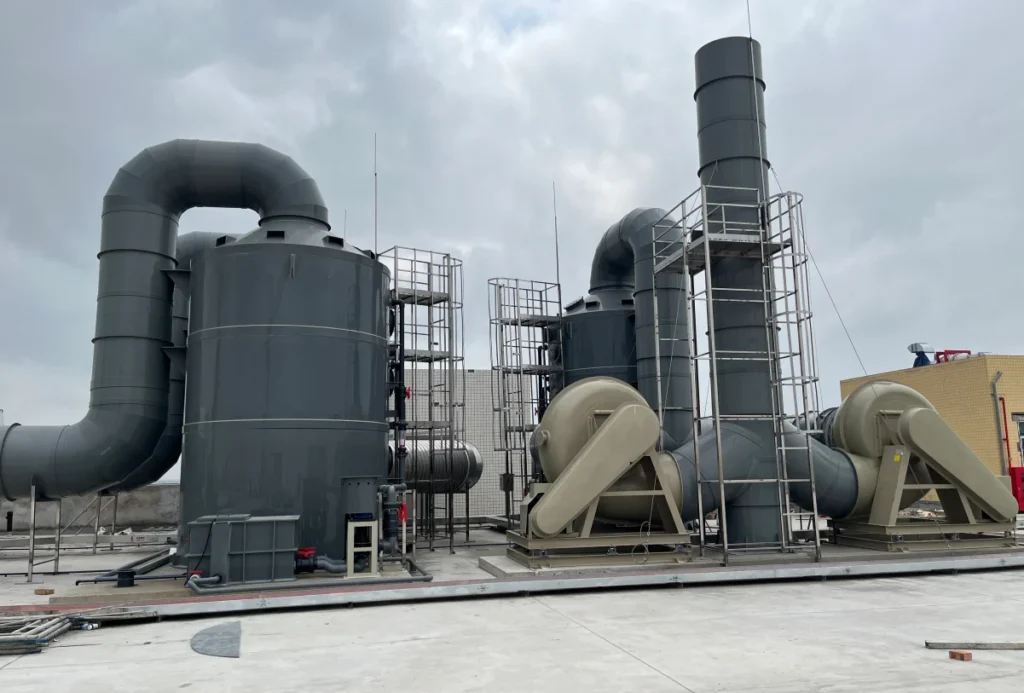
- Whatever the type, a corrosion-resistant FRP or PP build keeps the wheel working in acid and solvent service where steel fans fail — the same design choices, made in plastic.
What Are the Main Types of Centrifugal Fans?
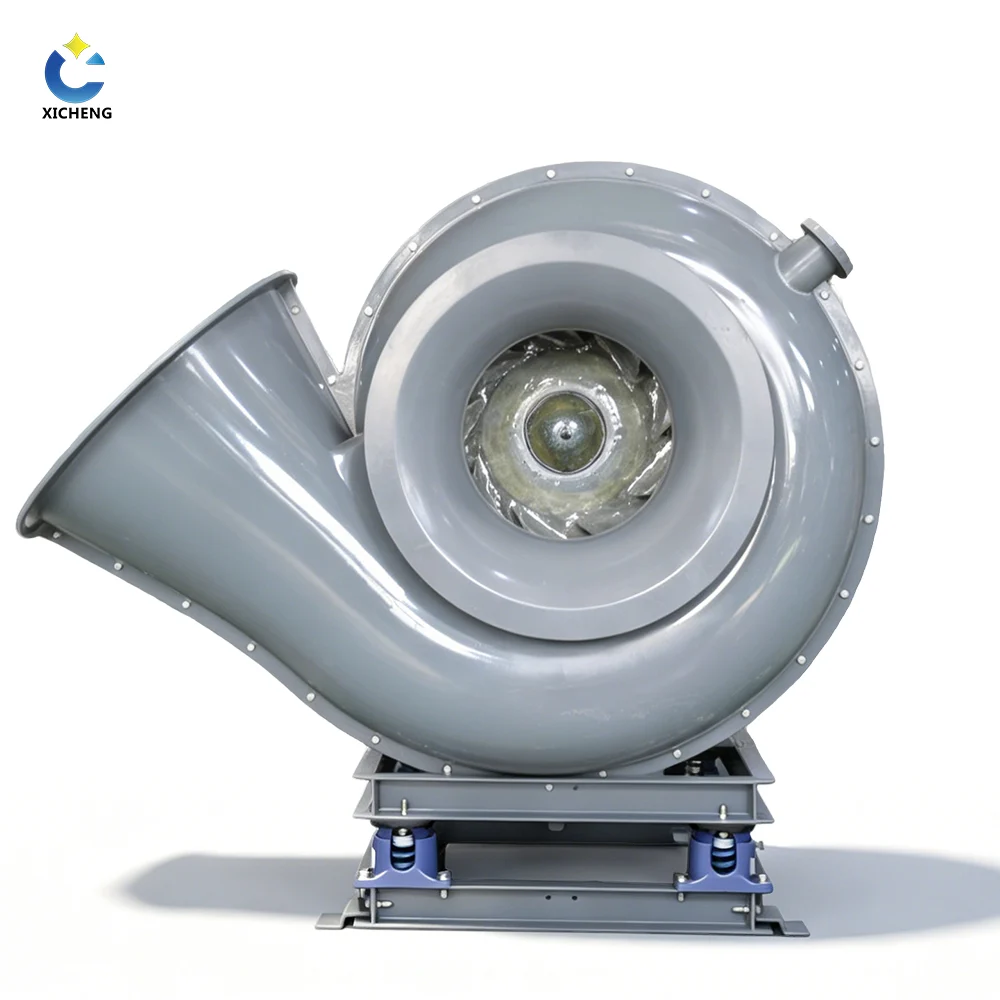
Every type of centrifugal fan draws air into the eye of a spinning impeller, throws it outward, and collects it in a scroll housing where velocity converts into static pressure. From there the families diverge. The industry classifies centrifugal fans by impeller blade design — the construction families documented in the standard centrifugal fan reference — because the blade shape alone decides volume, pressure, efficiency, self-cleaning ability, and how the fan behaves if the system resistance changes. Understanding the six wheel families below is the fastest way to read a fan catalog and pick the machine that suits a given duct system.
| Fan type | Blade design | Volume / pressure | Static efficiency | Air quality | Power curve |
|---|---|---|---|---|---|
| Forward-curved | Many short blades, curved with rotation | High volume / low pressure | up to 65% | Clean only | Overloading |
| Backward-inclined | Few long blades, angled against rotation | High volume / medium pressure | 80 – 90% | Clean or light dust | Non-overloading |
| Backward-curved | Solid curved blades against rotation | High volume / medium pressure | up to 84% | Clean | Non-overloading |
| Airfoil | Hollow wing-profile blades | High volume / medium pressure | up to 84% | Clean, dry | Non-overloading |
| Radial | Straight paddle blades, radial to hub | Medium volume / high pressure | 50 – 70% | Dirty, abrasive | Overloading |
| Radial-tip | Backward blade with a radial tip | Medium volume / high pressure | up to 78% | Moderate dust | Overloading |
Two fast rules from this table. First, efficiency climbs as blades get longer and smoother: backward-inclined and airfoil wheels dominate high-flow, high-efficiency duty, while the compact forward-curved wheel trades efficiency for footprint. Second, only the radial family is built for a dirty airstream — straight blades shed dust where curved pockets would pack with material. The rest of this guide walks through each type, the power-curve behavior, the construction variants, and finally how to choose with corrosion resistance in mind. For the operating principle behind all of them, start with our guide to what a centrifugal fan is and how it builds static pressure.
Forward-Curved Centrifugal Fans (Squirrel Cage)
Forward-curved fans carry a large number of small, shallow blades that curve in the direction of rotation, so the wheel cups the air as it spins. Packed densely around the hub, the assembly looks like a pet exercise wheel — the origin of the “squirrel cage” nickname. The geometry lets a small-diameter wheel move a large volume of air at modest speed, which makes forward-curved fans the most compact and the least expensive of the common types of centrifugal fans.
Of all the types of centrifugal fans, the forward-curved family is the one buyers reach for when floor space is the constraint. That single advantage explains its dominance in packaged blower units, furnace attachments, and compact cabinet fans where almost nothing else fits the envelope.
That compactness is bought with low pressure and low efficiency. Forward-curved wheels build only about 800–1,000 Pa (roughly 3–4 in. w.g.) of static pressure and peak near 65% efficiency, so they suit large, low-resistance systems: furnace blowers, small air-handling units, cleanroom recirculation, and packaged ventilation. They also refuse to clean themselves — the shallow cups trap dust, which unbalances the wheel — so they belong in clean-air service, and they are sensitive to operating point because their power draw keeps rising toward free delivery.
Where a forward-curved fan shines is first cost and space: it moves the most CFM per unit of installed volume of any centrifugal design. For a commercial HVAC blower that must sit inside a wall package, that matters more than a few percentage points of efficiency. Just understand the two trade-offs before you choose one for an industrial exhaust: it will not push against heavy duct resistance, and it will overload its motor if the system opens up. If your application needs pressure rather than pure volume, the backward-inclined family below is the industrial standard.
Backward-Inclined and Backward-Curved Fans
When engineers rank the types of centrifugal fans for ducted exhaust duty, the backward-inclined family usually tops the list — it pairs the best efficiency with a non-overloading motor curve. Backward-inclined fans are the workhorse of industrial exhaust. Their longer blades lean against the direction of rotation, which lets them develop medium-to-high pressure at high volume with the best efficiency of any centrifugal family — 80–90% at the design point. They have wide openings relative to their casing, run quietly, and carry a power curve that peaks near the middle of the range and then falls, so a skipped filter or an opened damper cannot overload the motor. For continuous-duty fume extraction, dust collection, and process ventilation, this wheel is usually the right answer.
The backward-inclined family splits into three wheel styles that differ in how much dirt and moisture they tolerate.
Airfoil Backward-Inclined Wheels
Airfoil blades are shaped like an aircraft wing and hollow inside, which delivers the highest efficiency and the quietest operation of the backward-inclined group. The hollow interior, though, collects condensation and erodes under particle impact, so airfoil wheels are intended for clean, dry air only — HVAC systems, office ventilation, and process supply where the air is filtered.
Single-Thickness and Solid Backward-Curved Wheels
Single-thickness blades are flat sheets, and solid backward-curved blades are curved plates of uniform cross-section. Both keep most of the backward-inclined efficiency while adding materially better tolerance for light dust and moisture, at a small performance cost. These are the variations used where the airstream carries trace particulate or humid breath from a scrubber, and they remain entirely self-limiting on the motor side because the non-overloading curve shape is unchanged.
One caution applies to the whole backward-inclined family: material can build up on the back side of the blades during operation, which puts the wheel out of balance over time. Washing and inspection schedules matter, and for genuinely dirty air you often want the radial family next, whose straight blades shed buildup instead of collecting it.
Radial and Radial-Tip Fans
Radial fans — also called radial blowers or paddle fans — carry straight, flat blades set radially to the hub, like the buckets on a paddle wheel. There is no curved pocket in which material can settle, which makes radial wheels genuinely self-cleaning and the only centrifugal family built for dirty, dusty, and abrasive airstreams. They are rugged, run at lower RPM per inch of water gauge, and develop high pressure at medium volume — the duty profile of a pneumatic conveyor, a dust collector, or a combustion-air blower.
The cost is efficiency. Straight blades throw the air with more turbulence than an airfoil, so radial wheels land at about 50–70% static efficiency and run louder than curved designs. When the airstream is clean, you rarely want a radial wheel; when it is full of sawdust, cement, or fibers, you cannot afford anything else.
Radial-Blower Variants: Paddle, Shrouded Paddle, and Backplate
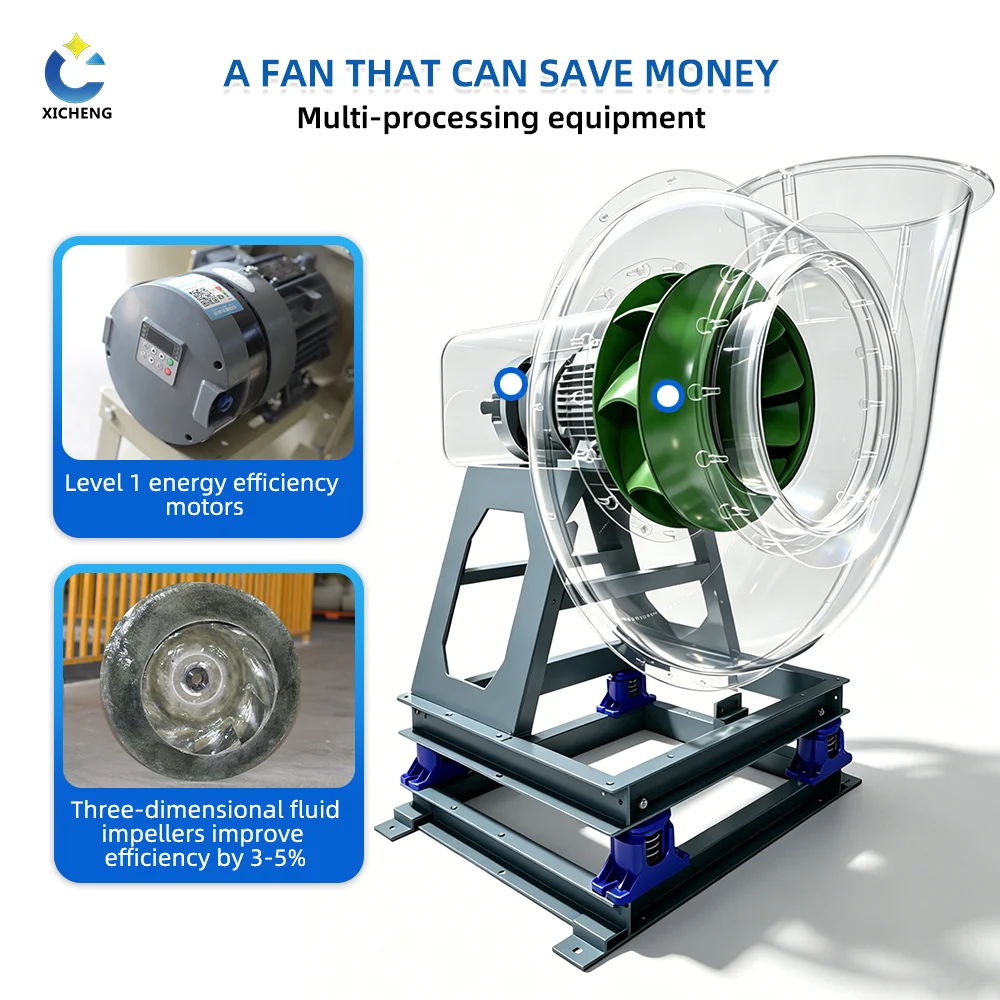
Manufacturers refine the basic radial blade into three wheels. The plain paddle wheel is the workhorse: wide flat blades, low cost, good for abrasive service. The shrouded paddle adds a rim on each side, which holds the air on the blades longer and recovers roughly 10% more efficiency, while the rims also stiffen the blades for higher pressure and speed. The radial backplate wheel bolts gussets between the blades and is the strongest wheel available — it is the choice for the heaviest material-handling duty, and the price of that strength is lower efficiency and more noise. Each of these is a legitimate answer to the question of which types of centrifugal fans suit an abrasive process.
Radial-Tip: The Intermediate Wheel
Radial-tip wheels blend the two families: most of each blade sits at a backward incline for strength and efficiency, then the tip turns outward to a radial orientation. The result is a wheel that reaches about 78% efficiency while still moving moderate material — the middle ground when backward-inclined blades would clog and a pure radial wheel would waste energy. Radial-tip fans are common on grain handling, sand conveying, and other semi-abrasive duties.
Airfoil Fans: The Highest-Efficiency Option
Airfoil wheels refine the backward-inclined profile into a true wing shape — a rounded leading edge tapering to a sharp trailing edge — so the air slides over the blade with minimal turbulence. That profile delivers the very best efficiency available in a centrifugal fan, around 84% static efficiency at the design point, along with the quietest operation and a non-overloading power curve. For clean-air systems, the airfoil wheel is the premium pick among the types of centrifugal fans, repaying its higher first cost through years of lower power draw. For large, continuous, clean-air systems the few points of efficiency saved on the horsepower bill pay for the higher wheel cost many times over the machine’s life. Energy codes in many jurisdictions now measure whole-system performance, and a high-efficiency wheel is the cheapest way to satisfy them.
The qualification on airfoil wheels is exactly the same as on the airfoil backward-inclined style: the hollow blade interior is exposed to the airstream, so it is intended for clean, dry, filtered air. Moisture condenses inside the blade and particles erode the thin wing section, so you never specify an airfoil wheel for a wet or dusty stream. Energy codes in several regions now judge whole-fan-system performance rather than individual component ratings — the philosophy laid out in the U.S. U.S. Department of Energy fan-system page — so the efficient wheel choice directly serves compliance. In corrosion-coated metal or in FRP/PP construction the profile keeps its efficiency, but the material choice belongs in the next decision: which type of centrifugal fan, and in which material, serves your environment.
Fan Curves: Overloading vs. Non-Overloading
The single most useful page in a fan catalog for a plant engineer is the power curve, and it divides the types of centrifugal fans into two camps. Reading it correctly prevents burned-out motors and confusing breakdowns.
On a forward-curved, radial, or radial-tip wheel, horsepower draw rises as the system resistance falls. Cool the system down, disconnect the duct, remove a filter, or let a damper fail open, and the motor keeps demanding more power until it trips the overload or burns out. These are called overloading-type fans, and they must be sized with the low-resistance end of the curve in mind.
On a backward-inclined, backward-curved, or airfoil wheel, horsepower climbs to a peak near the middle of the operating range and then falls as the fan approaches free delivery. An opened damper or a missing filter simply lets the airflow rise and the motor draw drop; the machine cannot overload itself. These are non-overloading-type fans, and they are why industrial exhaust engineers gravitate to the backward-inclined family whenever the system is ducted.
| Power-curve type | Wheel families | Behavior at low resistance | Specifier’s rule |
|---|---|---|---|
| Overloading | Forward-curved · Radial · Radial-tip | Motor draw rises toward free delivery; overload trip or burn-out risk | Size motor for the open-system end; protect with attention to dampers/filters |
| Non-overloading | Backward-inclined · Backward-curved · Airfoil | Power peaks mid-range then falls; cannot self-overload | Safe default for variable and ducted systems |
The other curve on the same page is the pressure curve: as static pressure rises, delivered CFM falls along the fan curve until the operating point where the fan curve crosses the system resistance curve. That intersection, not the free-air CFM, is the airflow you actually get. AMCA-certified performance data rated under the standard laboratory method let you compare brands fairly, and whenever a selection is in doubt, our centrifugal fan explainer walks the curve-reading logic in more detail. For the standards behind fan testing, the Air Movement and Control Association publishes the reference methods.
A responsible specifier adds a little margin at the fan anyway — five to ten percent on volume — because duct leaks and elbow geometry never match the drawing exactly. On an overloading fan that margin lands on the motor, so the motor is chosen for free-delivery draw; on a non-overloading fan the same margin simply shifts the operating point up the curve. Across the wide selection of types of centrifugal fans, that difference is what keeps the overloading family out of variable duct systems and makes the backward-inclined wheels the dependable default.
Construction, Naming, and Mounting Types
Beyond the wheel, centrifugal fans are grouped by how they are built and how they serve a system. The names below show up constantly in RFQs, and each maps to a specific application profile.
“Scroll Fan” and “Snail Fan”: The Same Machine
People searching for a scroll fan or a snail fan are almost always after the same product: a centrifugal fan with the spiral volute casing — the shape that collects the air and converts velocity into pressure. “Snail fan” is the common translation of the German Schneckenlüfter, used across Europe for the scroll-housed centrifugal fan, and the nickname survives because the housing genuinely resembles a snail shell. So when a buyer asks for a “radial fan,” a “scroll fan,” a “snail fan,” or a “centrifugal blower,” the engineering answer is the same machine in the same scroll housing — only the marketing language differs by region. Any of the wheel families above can be housed in that scroll.
Narrow, Inline, and Plug (Plenum) Fans
Narrow centrifugal fans pack a small-diameter wheel into a shallow casing, producing a compact package for tight mechanical rooms and drop ceilings. Inline centrifugal fans wrap the wheel inside a cylindrical duct section, so they install directly in the duct run and torque the airflow 90° inside the housing — ideal for retrofits where no roof penetration exists. Plug (plenum) fans run with no casing at all, sitting inside a large air-handling plenum where the surrounding chamber acts as the scroll; they are widely used in modern AHUs and are a key piece of the centrifugal HVAC fans family.
Centrifugal HVAC and Exhaust Fan Configurations
In HVAC, the dominant centrifugal configuration is the forward-curved squirrel-cage wheel inside an air-handling unit or furnace, moving high volume against the modest resistance of coils, filters, and supply duct. In rooftop exhaust, centrifugal fans appear as upblast units that blow contaminated or greasy air vertically away from the roof, downblast units that discharge down into the roof space for clean air, and sidewall units that push air horizontally out of a wall. Each of these is still one of the types of centrifugal fans — the same wheel engineering, in a mounting purpose-built for the building. When the duty is corrosion rather than comfort, the material of the scroll and wheel becomes the deciding factor, which the next section covers.
Code-driven projects lean on the exhaust side of this family. A centrifugal exhaust fan rated for outdoor duty carries a motor protected for weather and, on a contaminated airstream, a spark-resistant wheel from the radial family, while a grease-loading kitchen exhaust points to a wheel you can wash down. Whatever the mounting, the power-curve shape from the previous section still decides how much motor you need — an overloading wheel on a roof that loses its dampers behaves very differently from a non-overloading wheel. Those combinations, chosen from the types of centrifugal fans above, are what turn a generic blower into a building service that lasts decades.
How to Choose the Right Centrifugal Fan Type
Choosing among the types of centrifugal fans is a four-question exercise: what is in the air, how much pressure does the system need, how much volume, and is the atmosphere corrosive. Working through them in order narrows the field to one wheel in one material.
| Question | Answer → Fan family |
|---|---|
| Dirty or abrasive air? | Radial (self-cleaning) or radial-tip for semi-abrasive |
| Clean air, max efficiency? | Airfoil or backward-inclined (80–90%) |
| Clean air, max compactness / low cost? | Forward-curved (squirrel cage) |
| High pressure at medium volume, clean-ish? | Backward-inclined or radial-tip |
| Wet, humid, or lightly dusty, pressure needed? | Single-thickness backward-inclined |
Matching the Wheel to Your Airstream
Good practice matches the wheel to the airstream before anything else. A dust collector over a woodshop wants a radial wheel against the baghouse resistance; a clean-room supply and a big AHU want an airfoil or backward-inclined wheel for the energy bill; a small furnace or packaged ventilator wants the compact forward-curved wheel. Then confirm the static pressure at the required CFM against the catalog curve, remember the overloading/non-overloading rule from the previous section, and confirm the mount (inline, plug, roof, or free-standing).
Corrosion-Resistant FRP/PP Centrifugal Fans
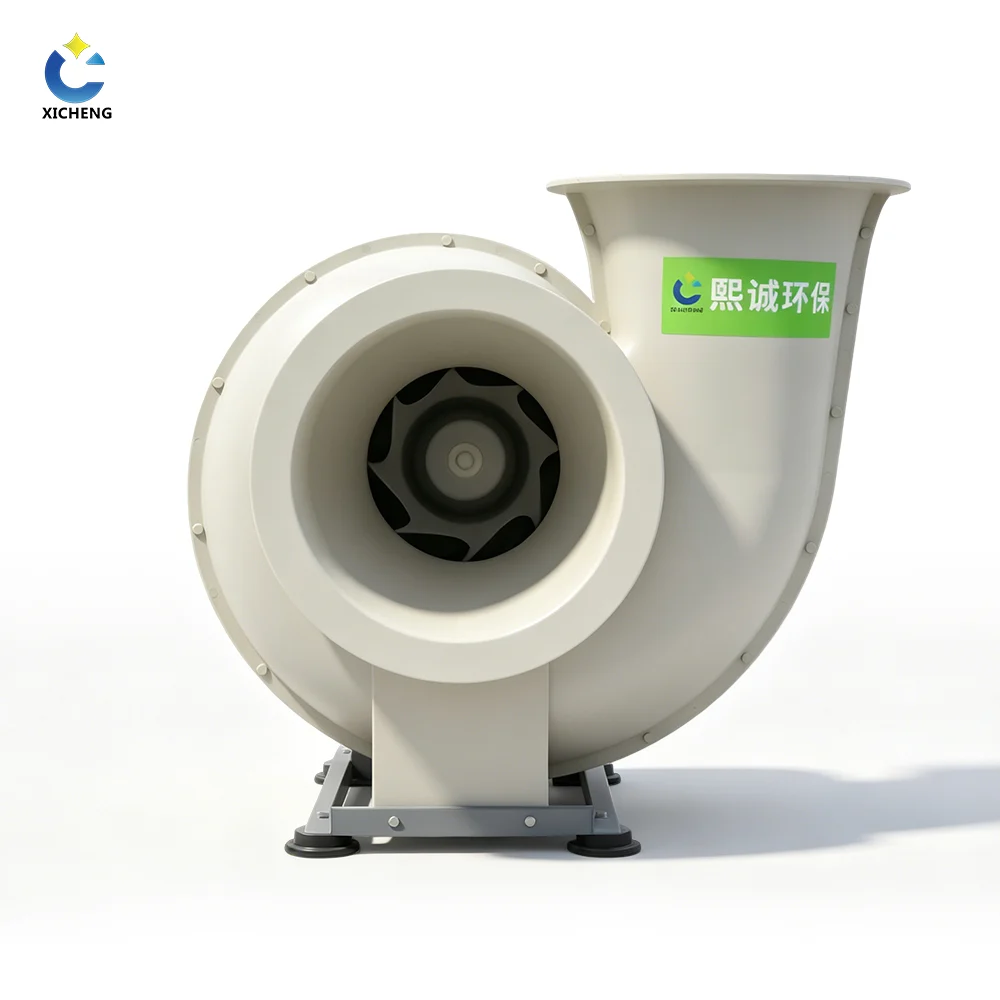
Every wheel family above can be manufactured in fiber-reinforced plastic, and when the airstream is wet, acid, or solvent-laden, it should be. An FRP or PP centrifugal fan keeps steel out of the gas path entirely: the molded wheel sheds corrosion the way a radial blade sheds dust, and the one-piece construction holds dynamic balance far longer than a welded metal assembly in chemical duty. Choose FRP fans for the hottest, most aggressive chemistry (up to roughly 250 °F) and PP fans for moderate temperatures at lower cost. The product lines at XICHENG FRP blowers and XICHENG PP blowers span the wheel types above — and when the same fan feeds a chemical scrubber, the scrubber pairing guide shows how the train fits together. The rest of the FRP/PP blower range covers the material and sizing details.
Centrifugal Fan Types FAQ
What is the most common type of centrifugal fan used in HVAC?
Forward-curved — the compact “squirrel cage” wheel — dominates commercial HVAC. Air handlers, fan coils, and furnace blowers use it because it delivers the most airflow per unit of installed space, which is exactly what a packaged mechanical closet needs, and its modest static pressure is enough for the coils, filters, and short supply runs inside a building. Airfoil and backward-inclined wheels take over in the larger building services where efficiency pays for itself.
Which type of centrifugal fan is the most efficient?
Airfoil and backward-inclined wheels, at roughly 84% and 80–90% static efficiency respectively, are the most efficient of the types of centrifugal fans. The airfoil profile is the top of the range, provided the air is clean and dry. Forward-curved wheels reach only about 65%, and radial wheels about 50–70%, because their blade shapes trade efficiency for compactness or for self-cleaning ability. The energy saving from the efficient wheel is usually worth much more than its higher first cost on a continuously running fan.
Which type of centrifugal fan handles dust and abrasive air?
The radial (paddle) family. Straight blades set radially to the hub carry no curved pockets where material can pack, so the wheel sheds dust as it spins — the definition of self-cleaning. Radial-tip wheels handle moderate material at better efficiency, and radial backplate wheels are the strongest for the heaviest conveying duty. Forward-curved wheels are the worst for dirt because their shallow cups fill and unbalance the wheel.
Are radial fans and centrifugal blowers the same thing?
Yes, with one nuance. In everyday catalog language, a “radial fan” is a centrifugal fan — radial describes the way the airflow exits the impeller, which is true of every centrifugal wheel, not just the paddle-blade family. An engineer asking for a “radial blower” or a “scroll fan” or a “snail fan” is generally after the same scroll-housed centrifugal machine. When the phrase refers to a specific wheel, though, “radial” usually means the straight-blade paddle wheel built for dust and abrasion.
What is the difference between forward-curved and backward-curved fans?
Forward-curved wheels have many small blades cupping in the direction of rotation; they move high volume at low pressure, reach about 65% efficiency, are compact and cheap, and have an overloading power curve. Backward-curved wheels have fewer, longer blades leaning against rotation; they reach up to 84% efficiency, build more pressure, run quieter, and have a non-overloading power curve that protects the motor. Choose forward-curved for compact low-pressure HVAC, backward-curved for industrial exhaust and efficiency.
When should I choose an FRP or PP centrifugal fan instead of a metal one?
Whenever the airstream is wet, acidic, chlorinated, solvent-laden, or salt-laden, an FRP or PP centrifugal fan outlasts painted steel because no metal touches the gas. FRP handles the hottest and most severe chemistry (to about 250 °F) and PP the moderate-temperature, cost-sensitive range. The wheel type should follow the airstream as usual — radial for dust, backward-inclined for efficiency — with the plastic construction answering the corrosion side.
Get a Quote for the Right Type of Centrifugal Fan
Every type of centrifugal fan XICHENG builds starts with the same four facts: what is in the airstream, the CFM your system needs, the static pressure it will meet, and the gas temperature. Give us those and our engineers will match the wheel family — backward-inclined for efficiency, radial for dust, forward-curved for compact clean-air — plus the FRP or PP material that survives your chemistry. The types of centrifugal fans above are all in our range, so the recommendation is a real match, not a compromise. We respond with a performance table you can check against your own fan curve, not just a nameplate rating.
Tell us about the application and we will recommend the wheel, the drive, and the corrosion-resistant build that fits your process. Contact XICHENG for a quote or a second opinion on your specs.