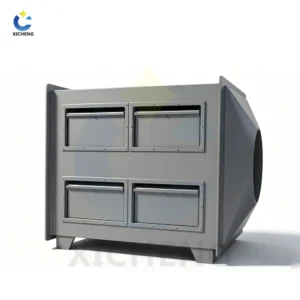
Industrial Activated Carbon Odor Control: 98%+ H₂S Removal Without the Fan Penalty
Let’s name the problem the way your neighbors experience it. Your stack is compliant on paper, your dust collector is doing its job, and yet the odor is still there — hydrogen sulfide off a wastewater pit, amine or solvent tang off a coating line, rendering or food-processing exhaust drifting past the fence line. Odor is the one emission a local community can measure with their own noses, and it is the fastest route from a working plant to a complaint file.
Surface filtration cannot solve it. A baghouse or a cartridge filter catches particulate; it does nothing to a gas molecule. Odor control is a molecular problem, and the only industrial workhorse for it is adsorption onto activated carbon — the same mechanism your process already relies on, sized and built correctly this time.
The Xicheng activated carbon odor control system is a purpose-built adsorption vessel: PP or FRP housing, engineered airflow distribution, zero-bypass sealing, and a carbon bed specified for the exact compounds coming off your process. It removes the odor at the fence line without making your exhaust fan pay for it.
Why Standard Odor Control Fails at Your Fence Line
When an EPC contractor or an EHS manager sources an activated carbon odor control unit, they are not buying a steel box full of charcoal. They are buying the certainty that the installation passes its first stack test and keeps passing. Three failure modes account for almost every activated carbon odor control system that underperforms. We engineered all three out.
1. The Pressure-Drop Penalty (Solved by Multi-Tier Bed Geometry)
The conventional design puts one thick, solid wall of carbon directly in the gas path. Your fan chokes on it, static pressure climbs, and the energy bill follows.
- Our engineering solution: a stacked, multi-tier layout of precision-spaced square carbon trays that raises the effective gas-to-carbon contact surface within the same physical footprint.
- The result: internal air resistance drops sharply, gases pass through at a controlled residence time instead of a forced one, and the fan runs at close to its design point instead of its limit.
2. Corrosive Meltdown (Solved by Pure PP and FRP Housings)
Stainless steel looks premium in a quotation until it meets hot, humid H₂S or acid-alkali vapors. Pitting and rust are not a maintenance problem; they are an eventual bypass leak and a failed inspection.
- Our engineering solution: 100% pure polypropylene (PP) or fiber-reinforced plastic (FRP) housings, fabricated in our own plants.
- The proof: our PP sheet is tested to 1,000 hours of continuous salt spray without degradation, and carries a validated field lifespan of 10+ years in aggressive chemical service.
3. The Air-Bypass Loophole (Solved by Sealed Slide Tracks)
If a gas molecule can find a one-millimeter gap between the carbon tray frame and the housing, it will take that path. This short-circuiting is why plants with brand-new equipment still smell.
- Our engineering solution: industrial-grade, tight-tolerance slide tracks paired with EPDM gaskets. Every cubic meter of gas is mechanically forced through the carbon matrix — zero bypass, no exceptions.
Engineering That Outlasts the Odor: Why Xicheng Polypropylene?
Odor-control duty is almost always wet, warm, and chemically aggressive — the three conditions that destroy generic housings fastest. An activated carbon odor control vessel therefore lives or dies on its material selection, which is not a line item on this equipment but the design itself.
- PP for the widest chemical resistance at the lowest weight. Polypropylene resists the acids, alkalis and salts found in most odor streams, and its low density keeps a large vessel structurally simple and easy to rig into a tight plant room. Continuous-service ceiling is 80 °C, which covers the overwhelming majority of odor-control duties.
- FRP where the duty runs hotter or the vessel runs larger. Fiberglass laminate carries the same corrosion resistance at higher temperature and in larger diameters, with the corrosion barrier specified separately from the structural laminate rather than lumped into one wall thickness.
- Built in our own plants, not bought in. Sheet extrusion, welding, tray fabrication and assembly all happen under our control, which is why we can warrant the body rather than the material.
If your stream is unusual — mercaptans, amines, siloxanes, mixed solvent vapor — the bed specification changes, not the housing. Tell us the compound list and we will match the carbon grade and impregnation to it. The same housing platform also serves as an activated carbon box, an activated carbon filter box, an industrial activated carbon filter, an activated carbon adsorption equipment unit, or an activated carbon adsorption tower, depending on how your project is specified — the platform is the same, the configuration is not.
Certified for Global Compliance
Odor complaints are a local matter; your compliance paperwork is an international one. Our manufacturing system is audited and our materials are independently tested, so the equipment you receive arrives with the documentation your customs broker and your environmental consultant both expect.
| Parameter | Specification |
|---|---|
| Primary function | Activated carbon odor control / molecular adsorption of odor and VOC compounds |
| Housing material | 100% pure PP (SGS tested), corrosion-proof FRP, or coated steel where specified |
| H₂S removal rate | ≥ 98.5% under continuous rated flow |
| Internal bed geometry | Multi-tier, easy-slide square carbon tray layout |
| Structural verification | 1,000-hour continuous salt spray resistance |
| Target compounds | Custom designs covering 40+ gas–reagent combinations |
| Main body lifespan | 10+ years in aggressive chemical environments |
| Quality system | ISO 9001 quality management, ISO 14001 environmental management |
| Market compliance | CE system certification; SGS-tested and RoHS-compliant materials |
| Warranty | 12 months on the housing and structure; 6 months on active carbon media |
Odor Control Carbon Filter Models
The table below is our standard drawer-platform range for activated carbon odor control service. Every row can be re-rated for a different face velocity, a different carbon depth, or a different impregnation — send us your airflow and we will confirm the selection rather than ask you to guess from the table.
| Air volume (m³/h) | Drawer position | Overall specification (mm, incl. reducers) | Qty of drawers | Drawer volume (m³) | Passage area (m²) | Thickness (mm) | Carbon blocks, 1 layer | Carbon blocks, 2 layers |
|---|---|---|---|---|---|---|---|---|
| 0–2,500 | Two layers, single-sided | 1250×870×1000 | 2 | 0.128 | 0.64 | 10 | 64 | 128 |
| 2,500–3,500 | Three layers, single-sided | 1350×870×1700 | 3 | 0.192 | 0.96 | 10 | 96 | 192 |
| 3,500–5,000 | Two layers, single-sided | 1750×870×1000 | 4 | 0.256 | 1.28 | 10 | 128 | 256 |
| 5,000–7,000 | Three layers, single-sided | 1800×870×1700 | 6 | 0.384 | 1.92 | 10 | 192 | 384 |
| 7,000–10,000 | Three layers, single-sided | 2350×870×1700 | 9 | 0.576 | 2.88 | 10 | 288 | 576 |
| 10,000–14,000 | Three layers, double-sided | 1800×1730×1700 | 12 | 0.768 | 3.84 | 10 | 384 | 768 |
| 14,000–18,000 | Four layers, double-sided | 2000×1730×2000 | 16 | 1.024 | 5.12 | 10 | 512 | 1,024 |
| 18,000–22,000 | Three layers, double-sided | 2350×1730×1700 | 18 | 1.152 | 5.76 | 10 | 576 | 1,152 |
| 22,000–28,000 | Three layers, double-sided | 2850×1730×1700 | 24 | 1.536 | 7.68 | 10 | 768 | 1,536 |
| 28,000–35,000 | Four layers, double-sided | 3100×1730×2000 | 32 | 2.048 | 10.24 | 12 | 1,024 | 2,048 |
| 35,000–45,000 | Four layers, double-sided | 3700×1730×2400 | 40 | 2.56 | 12.8 | 12 | 1,280 | 2,560 |
| 45,000–55,000 | Four layers, double-sided | 4200×1730×2400 | 48 | 3.072 | 15.36 | 12 | 1,536 | 3,072 |
| 55,000–60,000 | Five layers, double-sided | 4200×1730×2900 | 60 | 3.84 | 19.2 | 12 | 1,920 | 3,840 |
Factory-Direct Pricing and Turnkey Delivery
You buy from the plant that welds the vessel, not from a trading desk that re-quotes someone else’s catalogue. That is what makes factory-direct pricing possible on a custom-configured unit, and it is why our lead times hold when a project schedule slips.
Xicheng Environmental is a 17-year manufacturer operating 40+ production bases and offices across China, with 2 specialized production plants in Vietnam. That footprint is what lets us take a vessel from your P&ID to a crated, tested unit without sub-contracting the parts that matter.
How a project runs with us:
- Send the process data. Airflow, temperature, the compound list, target outlet concentration, and any space or flange constraints. A P&ID or CAD file is ideal; a spreadsheet is enough to start.
- We size and specify. Housing material, bed depth, carbon grade and impregnation, face velocity, and the resulting pressure drop — confirmed in writing before any metal or plastic is cut.
- You approve the drawing. Nozzle positions, flange dimensions, connection vectors and layout limits are frozen on a drawing you sign off.
- We fabricate and test. Extrusion, welding, tray fabrication and assembly in our own plants, with SGS material certification supplied with the unit.
- It ships and drops in. Complete with the documentation set your customs broker and environmental consultant need.
Because we also build wet scrubbers, PP and FRP ductwork, centrifugal fans, dampers and air valves, we can deliver the activated carbon odor control vessel as a stand-alone unit or as part of a complete exhaust train — one supplier, one interface, one point of responsibility.
The media inside the vessel is supplied loose or as pre-moulded blocks to match the tray geometry, with the grade specified from your compound list. For the grades, iodine values and factory-direct supply terms, see our activated carbon media page — we are a direct activated carbon manufacturer and supplier, so the fill and the housing come from the same plant.
Secure Your Fence-Line Odor Compliance Today
Odor is the emission your neighbors can measure without a permit or a laboratory. Every week an activated carbon odor control system runs undersized is another week of exposure to a complaint you cannot argue with. Send us your airflow and your compound list, and we will come back with a sized, priced, factory-direct proposal — normally within 24 hours.
- 🎯 Manufacturing Head Office: N0.34 Zhenxing Road (Shengtaian Heavy Industrial Park B), Loucun, Guangming New Dist, Shenzhen, Guangdong, China
- ☎️ Direct Hotline / WhatsApp: +86 18028775826
- 📬 Engineering Mailbox: xichengepltd@gmail.com
Frequently Asked Questions
Q: How do I know which carbon grade my odor stream needs?
A: It depends on the compound. For hydrocarbons, solvents, benzene and alcohols, a high-surface-area virgin carbon handles the duty by physical adsorption. For hydrogen sulfide, ammonia, mercaptans or amines, the carbon must be chemically impregnated so the gas reacts on the surface rather than merely condensing into a pore. Send us the compound list and we will specify the grade; the housing does not change.
Q: Will adding this unit increase my exhaust fan duty?
A: It adds pressure drop — that is unavoidable for any activated carbon odor control bed — but the multi-tier tray geometry keeps it far below a single-bed design of the same carbon mass. We publish the expected pressure drop with the sizing, so your fan selection is made against a number rather than an assumption. If your existing fan has no margin left, we will tell you before you order.
Q: How often does the carbon need replacing?
A: Under standard operating parameters our uniform airflow distribution eliminates dead zones and protects media life. Replacement is driven by breakthrough, not by a calendar — which is why we offer optional built-in gas sampling ports so your team can measure saturation directly instead of guessing.
Q: Can the vessel be built to fit an existing plant room?
A: Yes. Inlet and outlet orientation (top-in, side-out, vertical or horizontal flow), flange positions and overall envelope are all custom. Send a CAD file and we will match it rather than ask you to re-route ductwork around our standard footprint.
Q: Do you supply the carbon media as well as the housing?
A: Yes. The unit can be delivered empty for filling on site, or pre-loaded with the specified grade. Media carries a 6-month warranty and the housing carries 12 months.
Q: What if my site is in a hot or humid climate?
A: PP is rated for continuous service to 80 °C and does not corrode in humid air; FRP covers higher temperatures and larger diameters. For streams carrying liquid droplets, we recommend an upstream demister or wet scrubber to protect the dry carbon bed — see our activated carbon adsorption box guide for how that train is normally arranged, or our breakdown of activated carbon box technology for VOC and odor treatment.