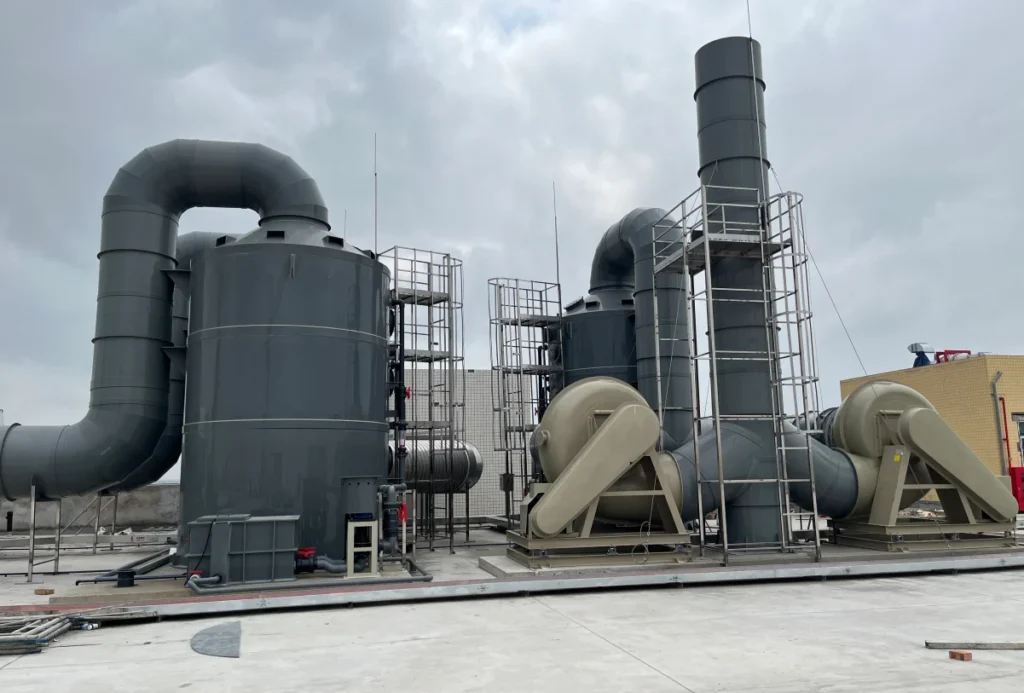
Key Takeaways
- A forward curved fan moves the most air per cubic foot of installed space of any centrifugal design — choose it when floor space and first cost matter more than efficiency.
- Static pressure decides the wheel: above roughly 1,000 Pa of system resistance, a backward curved fan takes over with 3,000–5,000+ Pa and 80–90% efficiency.
- Forward curved fans are overloading machines — if a duct opens, a filter comes out, or a damper fails, motor current climbs toward free delivery and can trip or burn the motor unless the motor was sized for the open system.
- For dirty or abrasive air, skip both curved wheels: the straight blades of a radial blade fan clean themselves.
- Curvature and corrosion resistance are two independent decisions — a molded polypropylene forward curved fan handles clean corrosive fume at low static, while FRP backward curved builds process pressure.
Forward Curved vs Backward Curved Fans: The Choice in One Read
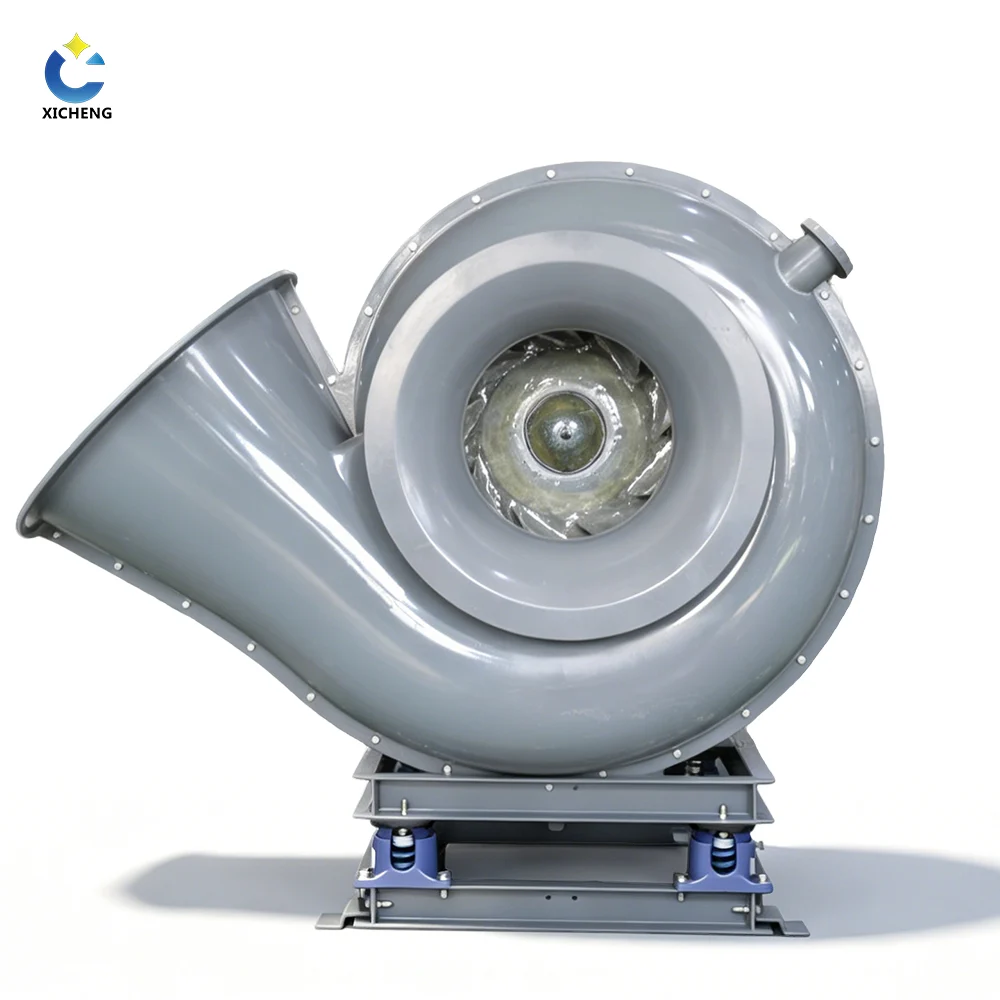
Open a packaged blower, a furnace cabinet, or a fan-coil unit and you will meet the same wheel: densely packed shallow blades that curve in the direction of rotation, nicknamed the squirrel cage. That is the forward curved fan, and it exists because it moves a large volume of air from the smallest possible footprint. Its counterpart, the backward curved fan, leans fewer, longer blades against the rotation and trades some compactness for dramatically more pressure and efficiency.
Neither wheel is “better”; each is the correct answer to a different duty. A forward curved fan wins when the air is clean, the resistance is low, the space is tight, and the run is short. A backward curved fan wins the moment the system behaves like a real duct: long pipe runs, filters, scrubber pressure drop, or airflow that changes with dampers. And when the air carries dust or abrasives, both curved wheels fail — the straight blades of a radial fan solve that problem instead.
Run these three self-checks before you read on:
- Clean air, low resistance, tight space → the forward curved fan is the compact, low-cost winner.
- Ducted exhaust, filters, or long runs → backward curved, for pressure headroom and a self-limiting motor.
- Dust, fibers, or abrasives in the stream → radial blade fan, the wheel that cleans itself.
The sections below put numbers on those three sentences: where each wheel peaks, the power-curve trap that burns motors, the payback math on efficiency, and how the same choice is made in corrosion-resistant plastic for fume and acid duty.
Throughout the guide, the figures quoted are typical single-stage values from published fan-catalogue data and AMCA-style testing: peak static efficiency, practical static pressure, and power-curve behaviour. Where your supplier certifies a fan under AMCA 210, compare brands on those curves rather than on catalogue pages that hide them. The aim is to make the question precise, so that the answer — forward curved, backward curved, or radial — is the one your duty actually needs.
What a Forward Curved Fan Actually Is
The forward curved fan earns its nickname from the shape of its blades. Many thin, shallow blades sit close together around the hub, and each blade curves in the direction the wheel spins, presenting a shallow pocket to the incoming air. As the impeller turns, every pocket scoops air across its face and throws it outward at high speed — a pattern that looks like a pet running wheel, which is why the trade calls it the squirrel cage, and why the same family is catalogued alongside its cousins in our guide to the types of centrifugal fans.
Because the forward curved fan pushes large airflow at modest wheel speed, its impeller diameter for a given job is typically far smaller than a backward curved wheel doing the same volume. That compactness is the real reason the type owns packaged air handling: furnaces, fan coils, kitchen extract, and cabinet blowers where floor space and first cost matter more than a few percentage points of efficiency.
Construction and Drives: How a Forward Curved Wheel Is Built
Manufacturers build forward curved wheels in single-inlet and double-inlet forms. The single-inlet unit draws air from one side and fits the thinnest envelope; the double-inlet unit pulls from both sides and nearly doubles the airflow from a casing only modestly wider, which is why double-inlet forward curved wheels dominate packaged heating and ventilating units. The wheel itself is light — stamped thin blades on a formed centre plate — so it starts easily, sits directly on the motor shaft in direct drive, and puts only modest loads on the bearings. Belt drive appears when a builder wants to change the outlet velocity without changing the wheel diameter, a layout still found on older furnace blowers.
In application, the forward curved family is the reason your kitchen extract, packaged air handler, and furnace-return register are small, quiet, and inexpensive to install. Remember the planning assumption behind them: short, low-resistance duct runs. Extend the duct, add a filter bank, or push the air through a packed scrubber, and this wheel runs out of pressure quickly — the exact moment the rest of this guide switches you to the backward curved family.
The performance boundaries follow from the same geometry. A forward curved fan builds roughly 800–1,000 Pa (about 3–4 inches of water) of static pressure — enough for short clean ducts, not for heavy process piping. Peak static efficiency lands near 65%, well below the 80% or more of the backward curved family. The shallow pockets are also the type’s weak point in dirty service: dust settles into the cups, builds up, and unbalances the wheel over time, so the forward curved fan belongs in clean air.
None of those limits are objections; they are selection criteria. The forward curved fan is quiet at its modest operating speed, economical to fabricate, and unbeatable on installed volume. What it cannot do is push against high resistance, and its power curve warns that if the system suddenly opens up, the motor must be ready. The physics behind that behaviour is the same velocity-to-pressure conversion explained step by step in how a centrifugal blower works, and the same principle of operation the centrifugal fan explainer sets out in one page.
The Backward Curved Counterpart: Efficiency and Headroom
Where the forward curved fan cups the air, the backward curved fan deflects it. Fewer, longer blades lean against the direction of rotation, and their trailing edges open away from the motion. Air leaves the wheel at a lower absolute speed but with far less slip and fewer eddy losses, which is why the backward curved family is the efficiency champion of centrifugal ventilation.
That change in blade lean buys three measurable things. First, efficiency: a backward curved wheel reaches 80–90% peak static efficiency, roughly twenty points ahead of the forward curved fan. Second, pressure: where a forward curved fan stops near 1,000 Pa, a backward curved wheel develops 3,000–5,000+ Pa in a single stage — enough for ducted industrial exhaust, scrubber systems, and baghouse legs. Third, motor safety: its power curve peaks in the middle of the range and then falls, so no failure of the system can force the motor past its rated draw.
A backward curved fan runs with its scroll casing for ducted service, or without it as a plug fan mounted directly into a plenum, which makes it flexible for awkward layouts. The wheel tolerates light dust and moisture reasonably well, and the solid-curved blade variant is the usual pick where a scrubber discharges humid air back into a stack. The many wheel styles within this family are set out in our types of centrifugal fans guide, and the same wheel is carried by the corrosion-resistant FRP blowers built for process gas.
The efficiency story carries into drive size. Because a backward curved wheel turns more of its input power into useful static pressure, the motor for a given duty is usually smaller — often a full frame size — than the motor a forward curved fan would need for the same point, an economy that appears again in the payback table below. Within the family, the highest-efficiency wheels are the airfoil and hollow-back designs, reserved for clean, dry air; the solid and single-thickness curved blades add tolerance for humidity and light fume while keeping most of the efficiency. That is the construction most often specified behind a scrubber, where the discharge carries moisture and traces of process chemistry.
In practice, the backward curved family is the default for the industries that exhaust continuously: paint and finishing shops, plastics processing, fume extraction from plating and anodising lines, and the suction side of scrubber and adsorption systems. When a plant’s maintenance report calls a fan “not on the list of problems in five years,” that fan is almost always backward curved, non-overloading, and sized honestly to the duct’s actual loss. When the ducting is short and the pressure is genuinely low, the same supplier will ring back and quietly suggest a forward curved unit instead — exactly the engineering habit this guide exists to encourage.
One caution balances the advantages: material can build up on the back face of the blades, so a backward curved wheel in any duty with particulate needs a wash and inspection schedule. When the air is genuinely dirty, neither curved family is the right tool, and the straight blades of a radial fan take over, covered in the next section.
Forward Curved vs Backward Curved: The Full Comparison
| Characteristic | Forward Curved Fan | Backward Curved Fan | Radial Blade Fan |
|---|---|---|---|
| Peak static efficiency | ~55–65% | 80–90% | 50–70% |
| Single-stage static pressure | ~800–1,000 Pa | 3,000–5,000+ Pa | Medium–high |
| Airflow per installed volume | Highest | Medium | Low–medium |
| Power curve | Overloading | Non-overloading | Overloading |
| Noise | Low | Moderate | High |
| Dirt tolerance | Clean air only | Light dust and moisture | Self-cleaning, abrasive |
The table sums up where each family sits. For most buyers the deciding rows are the second and the fourth: how much pressure the wheel can build, and whether the motor protects itself. A forward curved fan offers the best air per space, but a backward curved fan protects the drive and the operating budget. The full taxonomy these rows come from lives in the types of centrifugal fans guide.
One comparison rule keeps the table honest. In ducted service, judge fans on static efficiency rather than total efficiency: static efficiency excludes the velocity energy still carried in the airstream, so it rewards the wheel that recovers that energy in the volute instead of wasting it. The backward curved family is designed around exactly that recovery, which is why its static-efficiency lead over a forward curved wheel at the same duty point is a real engineering margin rather than a testing artefact. Where two suppliers publish different curves for the same wheel, the divergence is usually the test standard — AMCA 210 for most industrial fans — plus the operating point, because efficiency is a curve, not a single number.
The Specific-Speed Rule
Engineers summarize the same trade-off with a dimensionless number called specific speed. A forward curved fan is designed for high specific speed — large flow with small pressure rise — which is exactly a packaged air handler. A backward curved fan sits in the middle, comfortably handling high flow at genuinely high pressure. A radial blade fan lives at low specific speed, moving modest flow against large resistance. When someone asks which wheel they need, the specific-speed lens gives a defensible answer: match the wheel to the ratio of flow over pressure your system demands, not to habit.
Overloading Fans Burn Motors: The Real Scenario
Here is where a forward curved fan chooses its motor, and why that choice is so often the difference between a clean install and a burnt drive. On an overloading wheel, motor current rises as system resistance falls. Picture a fume extractor with a forward curved fan fitted with a filter: the unit was sized for the filter. When the filter is changed and one fail-open damper stays open, the resistance drops toward free delivery, current climbs, and the overload relay trips — repeatedly, or the motor burns if protection was relaxed. The forward curved fan is not to blame; the sizing rule is. The motor must be chosen for the open-system end of the curve.
The backward curved fan simply does not do this. Its power draw peaks mid-range and drops toward free delivery, so an opened damper or a missing filter raises airflow and lowers motor draw. That self-limiting behaviour is why variable-flow systems and automated dampers almost always specify the backward curved family.
The VFD is the modern footnote to the overloading rule. A variable-speed drive changes the fan’s speed; it does not change the shape of the power curve. If a variable-speed forward curved installation is run toward free delivery at high speed, the motor draw still climbs and the drive’s thermal rating is the element that trips first. The practical takeaway is identical: a forward curved installation should have its no-resistance operating point checked once, at commissioning, with both the relay and the drive set to the open-system draw rather than the design-point draw.
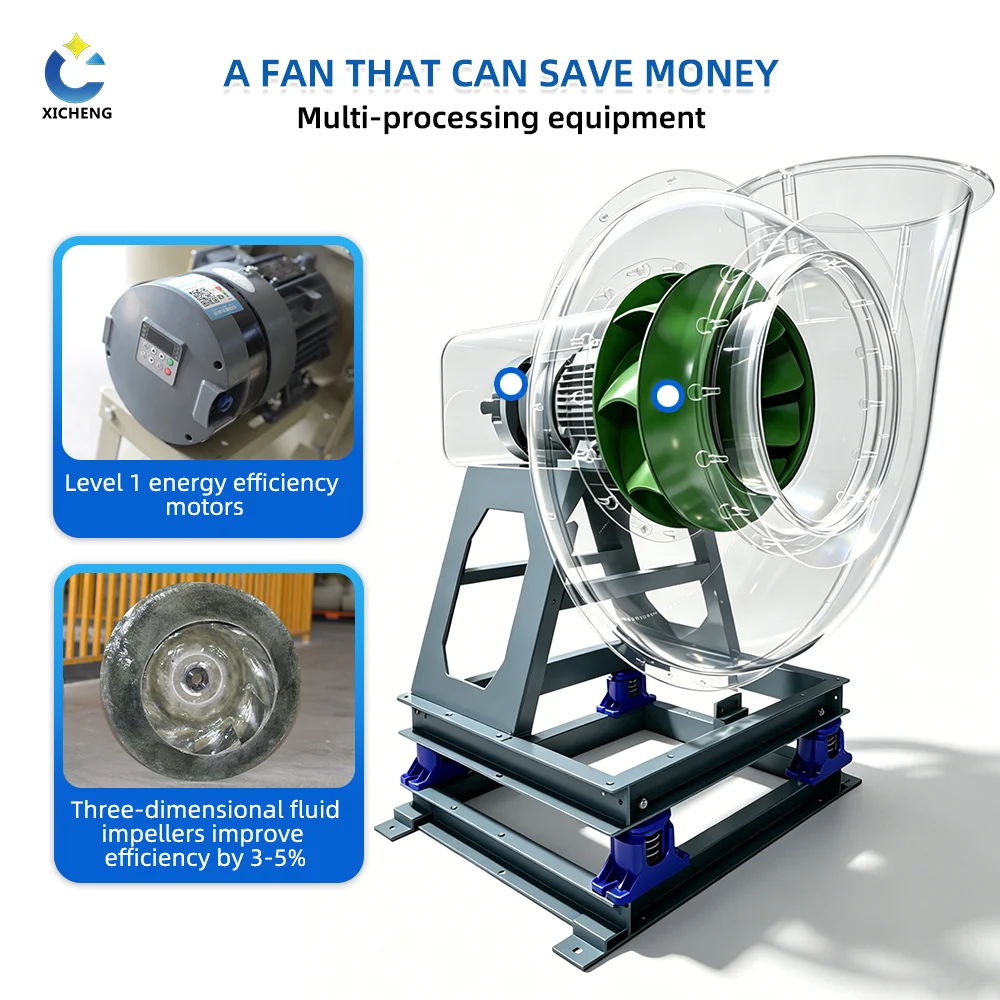
To read the pressure and power curves behind this decision, the explainer on how a centrifugal blower works walks through the operating-point intersection between the fan curve and the system curve. The construction and classification details are documented on Wikipedia’s centrifugal fan article.
When the Air Gets Dirty: Radial Blade Fans
Both the forward curved fan and the backward curved family share one weakness: curvature creates pockets and back faces where dust collects, and collected dust unbalances the wheel. When the airstream carries particulate, fibres, or abrasives, the correct wheel drops the curvature entirely.
A radial blade fan, also called a radial blower or paddle fan, sets straight flat blades outward from the hub like the buckets on a paddle wheel. There is no pocket and no back face, so air and particles simply shed off the blades — the wheel is genuinely self-cleaning. That simplicity makes the radial type the standard for dust collectors, pneumatic conveyors, sand and cement transfer, and combustion air.
The price of that ruggedness is efficiency and noise. Straight blades throw the air with more turbulence, so radial wheels land at roughly 50–70% static efficiency and run louder than either curved family. They also share the forward curved fan’s overloading power curve, so the motor must again be sized for the open-system end. The variants — plain paddle, shrouded paddle, and the bolts-on backup wheels for the heaviest duty — are catalogued in our types of centrifugal fans guide.
| Radial variant | Best duty |
|---|---|
| Plain paddle wheel | General dust and abrasive transfer; the best balance of cost and ruggedness |
| Shrouded paddle wheel | Higher pressure and speed, with about 10% more efficiency |
| Backplate wheel | Heaviest material handling; the strongest construction, louder and less efficient |
That table is the condensed selection logic for dirty air. For continuous conveying of abrasive material, the shrouded wheel recovers its extra cost through fewer blade failures; where cost and simplicity dominate, the plain paddle wins. For combustion air and heat-treating service — hot, clean, high-pressure — the radial family is chosen for headroom rather than dirt tolerance, and it still keeps the blades free of buildup, the property no curved fan can offer.
For buyers who need a middle ground between curved efficiency and radial toughness, the radial-tip wheel — blades mostly backward inclined with the tips turned outward — reaches about 78% efficiency while still handling moderate material. In genuinely abrasive service, the suppliers of the full FRP/PP blower range will steer the selection toward this family. Whatever wheel is eventually chosen, comparing its certified performance fairly relies on the standard methods published by the Air Movement and Control Association.
First Cost, Running Cost, and the Payback Math
A forward curved fan is cheap to buy and expensive to run. The wheel is smaller, the casing is smaller, and the fabrication is simple — which is why packaged equipment uses it. But the roughly 65% efficiency ceiling means the same delivered air power takes more input power from the line.
The arithmetic is straightforward. For a duty that needs, say, 15 kW of useful air power, a 65%-efficient forward curved fan draws about 23 kW from the line, while an 84%-efficient backward curved fan draws about 18 kW (65 ÷ 84 ≈ 1.29). That is about 5 kW of continuous difference. Run the fan 6,000 hours a year and the gap is roughly 30,000 kilowatt-hours — a real line item in any plant energy ledger.
| Cost axis | Forward curved fan | Backward curved fan |
|---|---|---|
| Wheel and casing first cost | Lower (smaller wheel) | Higher (larger wheel) |
| Input power, 15 kW duty | ~23 kW (65% eff) | ~18 kW (84% eff) |
| Motor sizing | Open-system end | Operating point |
| Energy, 6,000 h per year | ~138,000 kWh | ~108,000 kWh |
The payback arithmetic follows directly. Take the 5 kW difference from the worked example, run the fan 6,000 hours a year, and hold electricity at a typical North American industrial rate of roughly eight cents per kilowatt-hour: the 30,000 kWh the backward curved wheel saves each year is worth about 2,400 USD annually. The larger wheel and casing of the backward curved fan may add a few hundred to a few thousand dollars to the first order depending on frame size, and dividing that premium by the annual saving puts the payback within two seasons for any fan that runs near-continuously. For a blower that runs four hours a day, the same arithmetic stretches the payback over years — which is exactly why the intermittent duty keeps choosing the compact forward curved wheel.
Two other costs ride along. On a forward curved fan, the motor must be chosen for the open-system end of the power curve, so you carry a bigger motor than the duty point suggests. On a backward curved fan, the non-overloading curve lets you size the motor to the actual operating point, and smaller motors cost less and run cooler.
The decision rule that comes out of this is simple. First cost matters when a fan runs intermittently, moves little air, or sits inside a machine you sell at a price. Running cost matters when a blower runs around the clock — continuous fume extraction, dust collection, or a scrubber circuit. For the latter, the efficiency gap between the families usually repays the backward curved fan’s higher wheel price within a season; the U.S. Department of Energy fan sourcebook documents the systematic energy opportunity, and the curve economics behind the calculation are the same ones covered in how a centrifugal blower works.
Forward Curved Polypropylene Fans for Corrosive Air
When to Mold a Forward Curved Wheel in PP
A forward curved polypropylene fan is a natural pair. The dense array of thin shallow blades that gives the forward curved fan its compactness is awkward to fabricate in welded steel and trivial to mold in polypropylene: every pocket, blade, and inlet radius is reproduced exactly by thermoforming or extrusion welding, and the wheel comes out as one homogeneous corrosion-resistant part. That is why polypropylene forward curved fans are the workhorse of fume-cupboard exhaust, laboratory extract, and acid-wash ventilation — clean but chemically hostile air at low static pressure, where the space behind the bench is tight.
How the wheel is made matters on the shop floor as much as on the drawing. A polypropylene wheel is formed and welded: the blades are heated and fused to the hub and rim, producing a homogeneous part with no fasteners and, critically, no metal in the gas path. An FRP wheel is laid up from glass-fibre mat and resin over a tooled mould and then cured — a process that gives the composite its strength and lets the manufacturer build airfoil-shaped blades a welded metal shop cannot easily copy. In corrosive duty, inspection concentrates on the same three points for both constructions: weld or bond integrity at each blade root, surface wear in the scroll housing, and wheel balance after cleaning. With no steel to corrode, the hours a metal blower spends on painting and rust repair are spent, instead, on checking the moulded surfaces.
Use the forward curved fan in PP where the job is low-pressure fume removal with short duct runs. The choice is compact, quiet, and cheap, and the plastic shrugs off the chemistry that would eat a steel wheel. When the duty is the same but the pressure climbs, the backward curved family takes over in FRP instead.
When to Reach for FRP Backward Curved Instead
Fiberglass-reinforced construction adds the strength and temperature headroom that high-pressure process duty needs. A backward curved FRP wheel develops the 3,000+ Pa of static pressure a real ducted system demands, runs to roughly 250 °F against hot process gas, and holds its balance in aggressive chemistry. If the corrosive stream also carries light particulate, the same FRP casing can carry a radial-tip wheel without changing materials.
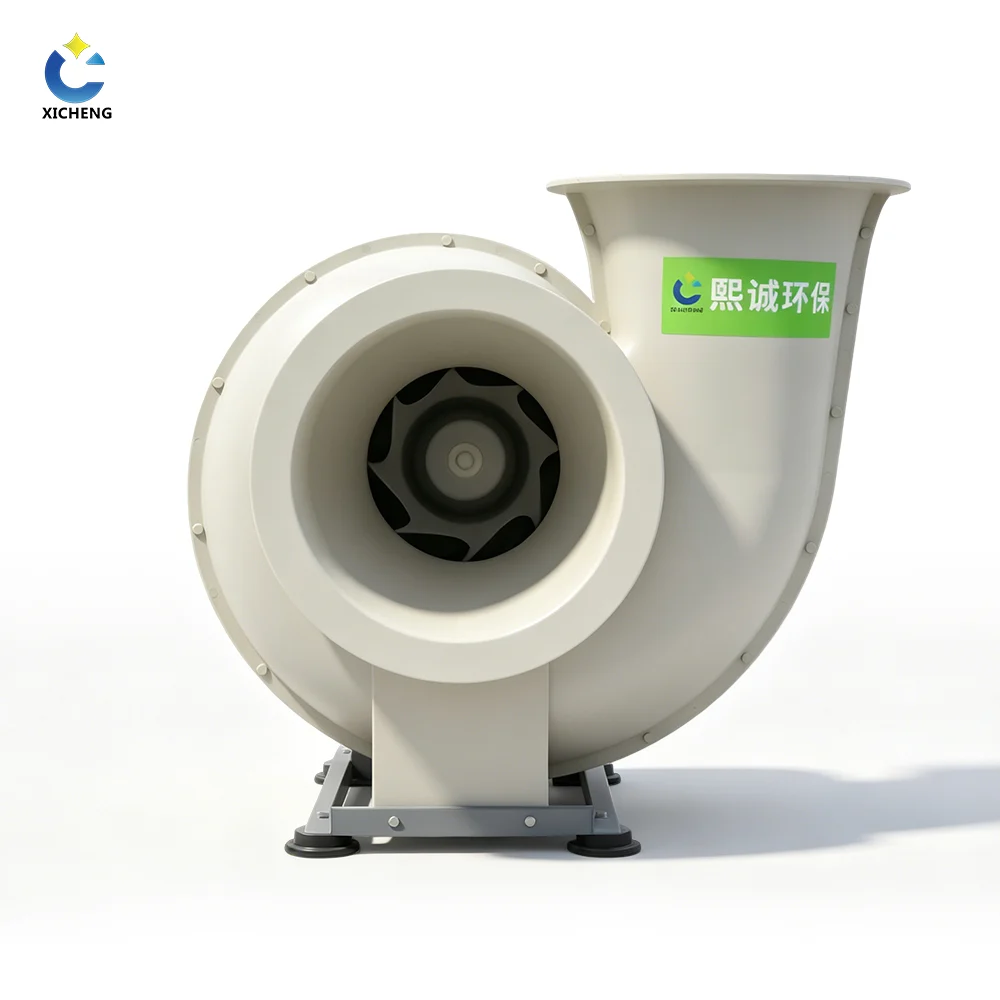
Notice that wheel curvature and material selection are two separate decisions. Curvature decides how much pressure and efficiency you get, and how you protect the motor; material decides whether the machine survives the chemistry at all. You can buy an efficient FRP blower with backward curved wheels for hot aggressive gas, or a compact polypropylene blower with a forward curved wheel for bench-level fume — the choice follows the duty, not the material. The XICHENG FRP blower line and PP blower line span the wheel families, and the full FRP/PP blower range lets the sizing conversation start from your static pressure and airflow rather than from a default wheel.
Forward Curved Fan FAQ
What is the difference between a forward curved and a backward curved fan?
A forward curved fan uses many shallow blades that curve in the direction of rotation, moving large airflow in a small footprint at modest pressure — around 800–1,000 Pa — and roughly 65% efficiency. A backward curved fan uses fewer, longer blades leaning against the rotation, trading footprint for 80–90% efficiency, 3,000–5,000+ Pa of pressure, and a non-overloading motor curve.
Is a forward curved fan better than a backward curved fan?
It depends on the duty. The forward curved fan is better where space and first cost dominate: packaged air handling, furnace and fan-coil units, short clean ducts, and low-static fume extract. The backward curved fan is better for ducted industrial exhaust, filters, scrubbers, long runs, and any system whose resistance or airflow changes.
Can a forward curved fan handle dust or abrasive air?
No. The shallow pockets that move the air also trap dust, which builds up and unbalances the wheel. For particulate-laden or abrasive streams, choose a radial blade fan or a radial-tip wheel instead; both shed material instead of collecting it.
Do forward curved fans overload their motor?
Yes — forward curved fans are the overloading type. Motor current rises as system resistance falls, so if a damper opens, a filter is removed, or a duct is detached, the motor draw climbs toward free delivery. Size the motor for the open-system end of the power curve and keep the overload protection active.
Can forward curved fans handle corrosive air?
Yes, when the wheel is molded in the right corrosion-resistant material. A polypropylene forward curved fan serves clean corrosive fume at low static pressure — fume cupboards, lab exhaust, acid wash — while FRP backward curved wheels carry the higher-pressure corrosive duty. The curvature decision and the material decision are independent.
How much pressure can a forward curved fan build?
Roughly 800–1,000 Pa, about 3–4 inches of water, in a single stage. Beyond that, a backward curved fan is the practical choice; the same rule holds in plastic, so sizing always starts from your system’s static pressure.
Should I choose a forward curved or backward curved fan for a scrubber circuit?
A scrubber presents two different duty points. On the intake side, before the media, the duct is short and the pressure loss is low, so a forward curved wheel is adequate and compact. After the packing, the pressure drop climbs and the discharge duct grows, and there the backward curved fan is the dependable match. The rule of thumb stays uncompromising: if the total system static pressure at the operating point exceeds about 1,000 Pa, spec the backward curved family; the corrosion-material logic from the FRP/PP section above applies unchanged in either case.
If a fan selection for a corrosive or fume-laden process is stalling because the choice between a forward curved fan and a backward curved wheel feels like guesswork, send your airflow, static pressure, and gas temperature to the XICHENG EP team. We will size the correct wheel family — and, if the chemistry demands it, the correct FRP or PP material to carry it — so the blower that arrives fits both your duct and the atmosphere it has to survive.