

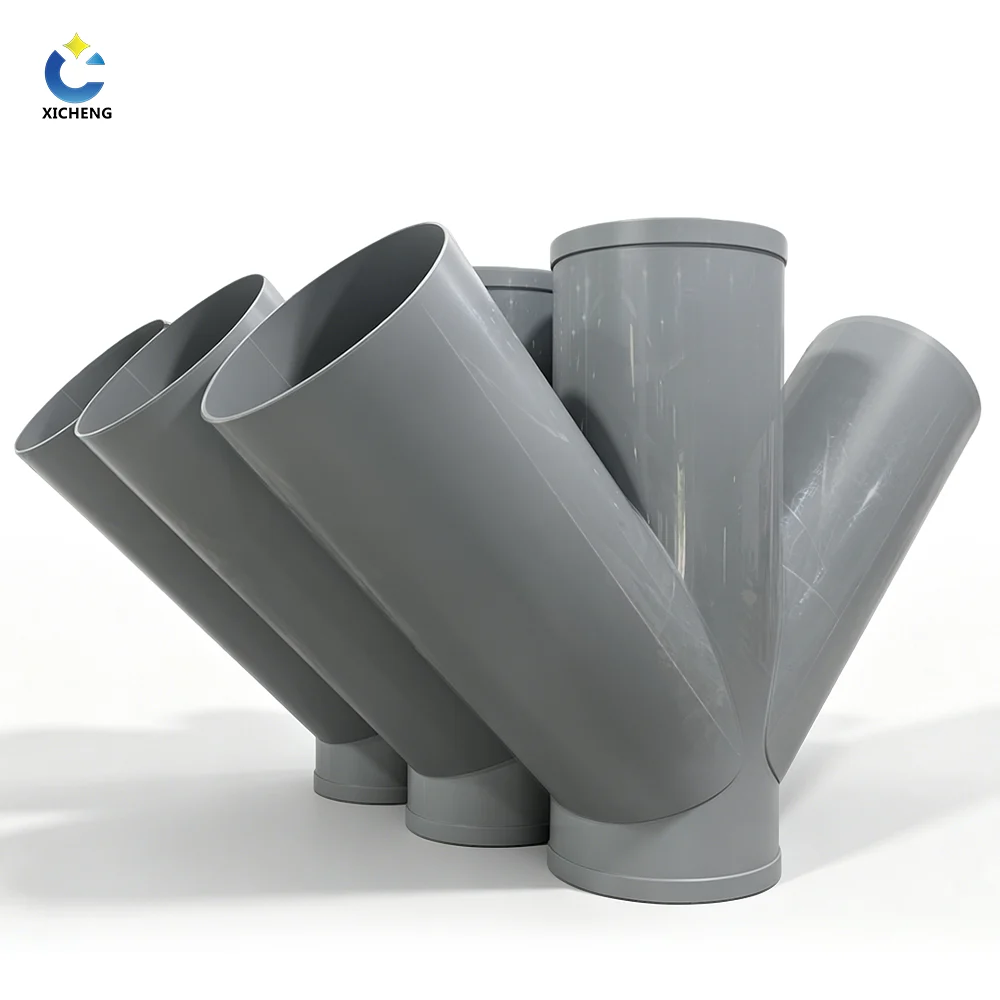
Duct Cross — Four-Way PP and PVC Duct Junction
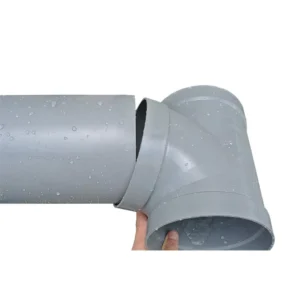
A duct cross connects four duct sections at a single junction point — two on the main run, two on the branch, all at 90 degrees. A single duct cross replaces two tees installed back-to-back, eliminating one complete joint from the duct network. Every joint eliminated is a potential leak point removed, an installation hour saved, and a future maintenance inspection crossed off the schedule.
Xicheng manufactures duct crosses in polypropylene and PVC. Standard-diameter equal crosses — where all four ports share the same diameter — are injection-molded as single-piece components. Reducing crosses — where the branch ports are smaller than the main run — and non-standard diameter combinations are hand-welded by PP fabrication specialists. Both manufacturing routes operate under ISO 9001 quality control with full-penetration weld inspection on every fabricated fitting.
One Fitting Instead of Two: Why It Matters
Two tees installed in series to create a four-way junction require four welds or flange connections between the tees. Each connection is a potential leak path. Each weld is a potential failure point under thermal cycling. Each flange is a gasket that will eventually need replacement.
A single duct cross eliminates the intermediate connection entirely. The four ports are integrated into one fitting. There are two connections to the main run and two to the branch — the same number of connections as a single tee — but with double the airflow distribution.
In a congested duct run where every fitting competes for space, a single cross also saves linear distance. Two tees in series occupy roughly twice the length of a single cross, assuming standard socket depths. In a service shaft where duct length is measured in millimeters of available clearance, that saved space may be the difference between a buildable installation and a redesign.
Equal Cross vs. Reducing Cross
An equal cross has all four ports at the same diameter. It is used where the main run and both branches carry similar airflow volumes — a central distribution point in a symmetrical duct network, or a header intersection where flow in both directions must be balanced.
A reducing cross has the branch ports at a smaller diameter than the main run. The geometry is more complex — the branch openings intersect the main run at a smaller diameter, requiring a transition at each branch port — but the function is the same: a single four-way junction with smaller branch lines serving individual equipment drops or less critical duct runs.
Standard equal crosses in common diameters from 110mm to 500mm are injection-molded and available from inventory. Reducing crosses and non-standard diameters are fabricated to order.
The Intersection Geometry: Where Four Ports Meet
The intersection of four duct ports in a single fitting creates the most geometrically complex junction in any ventilation system. In a round duct cross, the four openings intersect at the center of the fitting, where the internal surfaces of all four ports meet. The intersection must be smooth — no internal projections, no weld beads protruding into the flow path, no crevices where particulate can accumulate.
An injection-molded duct cross achieves this with a single mold cavity. All four ports and the central intersection are formed simultaneously from one shot of molten polymer. The internal surfaces are continuous. There are no joints anywhere in the fitting.
A hand-welded duct cross requires the fabrication specialist to build the intersection from individually cut and fitted pieces. The main run body is fabricated first. The branch ports are cut into the main run at the correct diameter and angle. The branch cylinders are welded into the openings. Each weld at the intersection must penetrate fully through the material thickness — a partial weld at the intersection of four ports is a guaranteed leak path under pressure.
Technical Specifications
| Parameter | Specification |
|---|---|
| Material | Virgin-grade PP (Polypropylene), PVC |
| Type | Equal cross and reducing cross |
| Port Configuration | Four ports at 90 degrees |
| Injection-Molded | Single-piece, equal-diameter crosses up to 500mm |
| Hand-Welded | Reducing crosses and non-standard diameters |
| Weld Type | Full-penetration, matched-material PP rod |
| Density (PP) | 0.90 to 0.91 g/cm3 |
| Operating Temperature (PP) | -10-degrees-Celsius to 90-degrees-Celsius |
| Operating Temperature (PVC) | 0-degrees-Celsius to 60-degrees-Celsius |
| Connection | Socket weld, butt weld, flanged |
| Certifications | ISO 9001, ISO 14001; SGS tested |
| Custom | Non-standard diameters, reducing combinations |
Where Duct Crosses Distribute Airflow
A chemical processing plant installed equal-cross PP duct crosses at the intersection of two main exhaust headers serving separate production halls. Each cross connected four 400mm ducts in a grid configuration, distributing the combined exhaust flow to a central scrubber system. The single-cross design eliminated twelve intermediate flange connections compared to a twin-tee configuration — twelve gaskets that would have required periodic replacement in an environment where access required scheduled shutdown.
An electronics manufacturing facility used reducing-cross PP duct crosses to connect individual workstation extraction drops to a grid of overhead headers. The main-run ports were 250mm. The branch ports were 160mm, serving smaller-diameter drops to each workstation. The reducing crosses were fabricated to order because the 250mm by 160mm diameter combination was not available as a standard injection-molded fitting.
A wastewater treatment plant installed duct crosses in an odor control distribution network where space constraints in the equipment gallery prevented the use of twin-tee configurations. The single-cross design fit within the available clearance and reduced the total number of flange connections in the system by approximately thirty percent.
Global Compliance and Industrial Trust: Why Customers Choose Xicheng
A duct cross is the most geometrically complex standard fitting in any duct catalog. Get the intersection right — smooth internal surfaces, full-penetration welds, concentric port alignment — and the fitting performs invisibly for the life of the system. Get it wrong and every port connection is a potential leak source.
Xicheng Environmental operates over 40 production bases and offices across China, with 2 dedicated manufacturing facilities in Vietnam. Standard injection-molded crosses ship from inventory. Custom crosses — reducing configurations, non-standard diameters, specialized flange patterns — are fabricated to order by PP welding specialists averaging eight years of exclusive polypropylene experience.
Certifications are independently audited: ISO 9001 for quality management, ISO 14001 for environmental management. Raw materials are SGS tested with current documentation for every order.
One-Stop Engineering Support: From Spec to Shipment
A duct cross has four ports. Each port has a diameter, a connection type, and a flange standard. All four must be correct. Any one that is wrong means the fitting does not connect — and a cross that does not fit at one port does not fit at all.
Here is how Xicheng handles every order:
- Specification Review. Send us the main-run diameter, branch diameter (if different), connection type, and exhaust gas composition. We confirm material compatibility and whether the configuration is available as a standard injection-molded cross or requires fabrication.
- Certified Manufacturing. Production under ISO 9001 and ISO 14001. Hand-welded crosses receive individual weld inspection at every port intersection — the four points where a partial weld means a guaranteed leak.
- Complete Documentation. SGS test reports, certificate of origin, packing list, and commercial invoice. Container loading photographs before departure. Tracking information the day your shipment leaves.
- Engineering Access. Direct contact with our engineers by phone, email, or WhatsApp.
Frequently Asked Questions
Q: When should I use a duct cross instead of two tees?
A: Use a duct cross when you need a four-way junction at a single point and the installation space allows the fitting to be installed as one unit. A single cross eliminates the intermediate connection required between two tees, reducing potential leak points and installation labor. Use two tees when the branch lines must be separated by a minimum straight duct length for airflow or access reasons.
Q: What is the difference between an equal cross and a reducing cross?
A: An equal cross has all four ports at the same diameter. A reducing cross has the main-run ports at one diameter and the branch ports at a smaller diameter. Choose an equal cross when all connected ducts carry similar airflow. Choose a reducing cross when the branch lines serve less airflow than the main run.
Q: Can you produce a cross with different diameters on all four ports?
A: Yes. A cross with four different port diameters is technically feasible as a custom fabrication. Send us the four diameters and we confirm feasibility and lead time. This is an uncommon configuration — most applications use equal or reducing crosses with two distinct diameters.
Q: What is the lead time?
A: Standard injection-molded equal crosses ship within 5 to 7 working days. Custom-fabricated crosses — reducing configurations or non-standard diameters — require 12 to 20 working days depending on complexity.
Send us your duct diameters, port configuration, and exhaust gas composition. Our engineering team will confirm material compatibility — and you will have a quotation within 48 hours.
Contact Xicheng Environmental Today.
- 🎯 Address: No.34 Zhenxing Road (Shengtaian Heavy Industrial Park B), Loucun, Guangming New Dist, Shenzhen, Guangdong, China
- ☎️ Phone/WhatsApp: +86 18028775826
- 🗺️ Email: xichengepltd@gmail.com
Reviews
There are no reviews yet.