

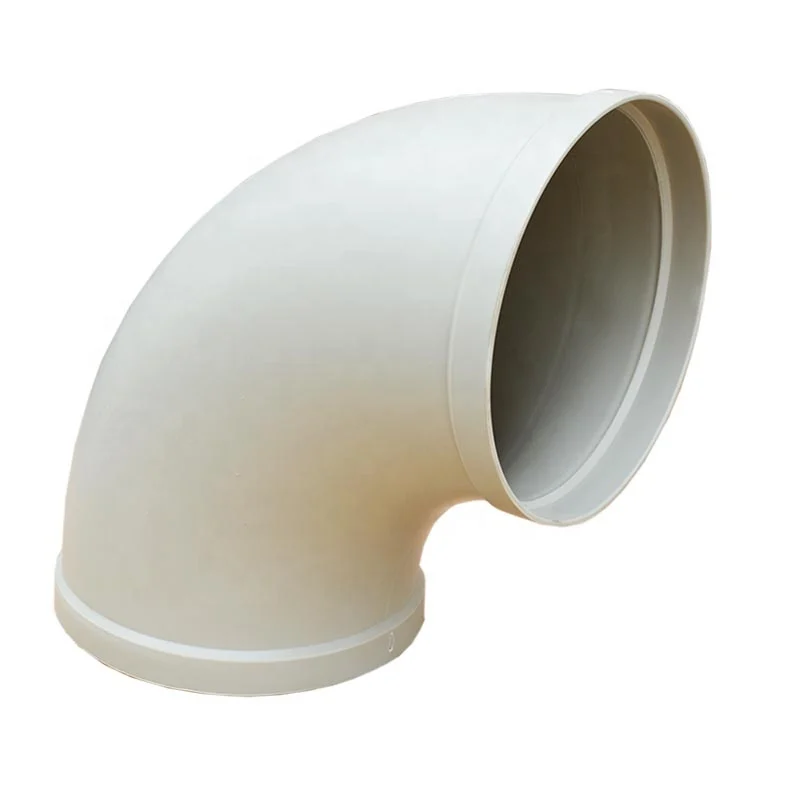
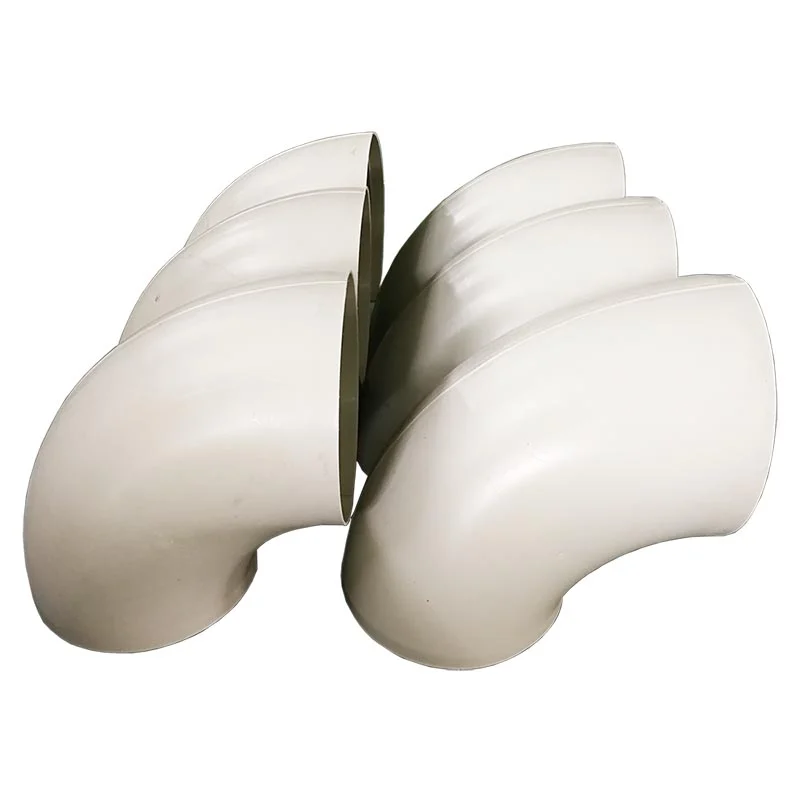
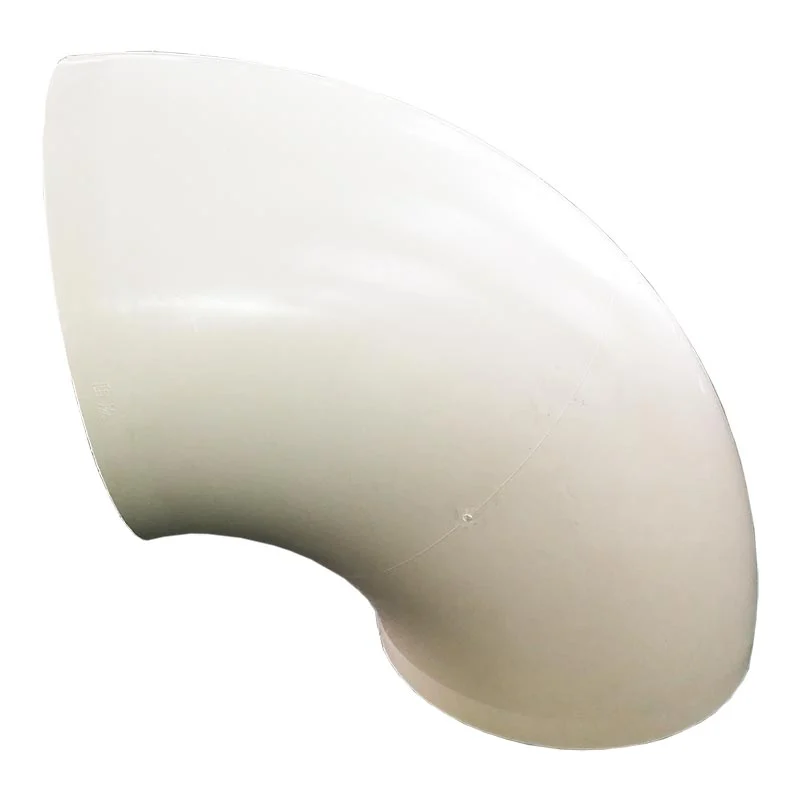
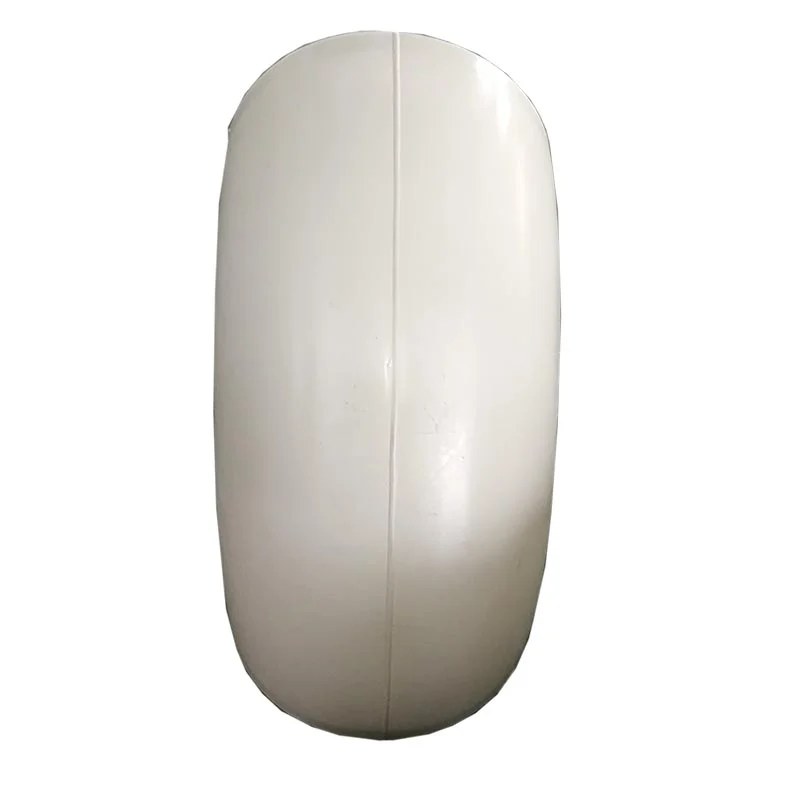


90 Degree Duct Elbow — PP and PVC Ventilation Elbow
In an exhaust system with forty directional changes, every 90-degree bend adds static pressure that accumulates downstream. Fan horsepower, duct diameter, and operating energy cost are all calculated from the sum of these losses. A poorly manufactured 90-degree elbow with an irregular inner radius adds more resistance than the design accounts for — and the fan runs harder, every hour, for the life of the system.
Xicheng manufactures 90-degree duct elbows in polypropylene and PVC. Injection-molded versions are formed as single-piece components — no internal weld bead, no surface discontinuity at the inner radius where airflow velocity peaks and corrosive mist impinges. Hand-welded versions are fabricated by PP welding specialists for diameters and flange configurations beyond molding capacity. Both share the same virgin-grade materials and ISO 9001 inspection standards.
The inner radius of a 90-degree bend is the highest-stress point in any duct elbow. Airflow accelerates around the turn, particulate impacts the surface, and chemical mist concentrates at the point of maximum impingement. In a galvanized steel bend, this is where the zinc fails first. In a fabricated elbow with an internal weld bead, this is where particulate lodges and initiates localized corrosion. In an injection-molded PP elbow, the inner radius is chemically and structurally identical to every other point on the part — no coating to strip, no seam to open.
The 90-Degree Turn: Where Pressure Drop and Corrosion Converge
A 90-degree elbow imposes roughly twice the pressure drop of a 45-degree elbow of the same diameter. In a single bend, the difference is negligible. In a system with forty 90-degree bends between the extraction hood and the exhaust fan, the accumulated pressure drop determines whether the fan operates at 80 percent of rated capacity or struggles to maintain design flow.
This is not a theoretical concern. It is a daily reality in multi-story chemical plants where duct risers run through service shafts with a 90-degree bend at every floor penetration. In electroplating lines where each tank station requires an individual extraction drop with a 90-degree turn into the main header. In pharmaceutical facilities where fume hood exhaust networks route through interstitial spaces with multiple directional changes between the laboratory and the rooftop fan.
Every one of those bends is a point where corrosive exhaust contacts the duct wall at elevated velocity. The combination of chemical attack and mechanical erosion at the inner radius is what separates a five-year elbow from an eighteen-month elbow.
Two Manufacturing Routes, One Criterion: What Happens at the Inner Radius
Injection-molded 90-degree elbows are produced as single, seamless parts. The inner radius is as smooth as the outer wall. There is no weld bead to trap particulate. No heat-affected zone with altered crystallinity. No surface irregularity to initiate corrosion. For diameters that match standard tooling, this is the optimal manufacturing method — lowest failure risk, fastest lead time, lowest per-unit cost at volume.
Hand-welded 90-degree elbows are fabricated when the required diameter, flange pattern, or angle configuration exceeds molding capacity. The weld quality determines the elbow’s service life. A full-penetration hot-gas weld using matched-material PP rod produces a joint with the same chemical resistance as the parent sheet. A superficial bead that does not penetrate the full material thickness creates a subsurface gap that propagates into a crack under thermal cycling.
Xicheng’s PP fabrication specialists average eight years of experience with polypropylene welding specifically — not general plastic fabrication, not occasional PP work mixed with other materials. Every weld is inspected for full penetration as part of ISO 9001 quality control. For diameters under 500mm where standard tooling is available, Xicheng offers injection-molded elbows as a cost-effective alternative with faster lead times and zero-weld construction.
Technical Specifications
| Parameter | Specification |
|---|---|
| Material | Virgin-grade PP (Polypropylene), PVC |
| Angle | 90-degree |
| Injection-Molded | Single-piece, no internal joints |
| Hand-Welded | Full-penetration, matched-material PP rod |
| Density (PP) | 0.90 to 0.91 g/cm3 |
| Operating Temperature (PP) | -10-degrees-Celsius to 90-degrees-Celsius |
| Operating Temperature (PVC) | 0-degrees-Celsius to 60-degrees-Celsius |
| Chemical Resistance (PP) | HCl below 80%, H2SO4 below 75%, HNO3 below 20% at 60-degrees-Celsius |
| Connection | Socket weld, butt weld, flanged |
| Certifications | ISO 9001, ISO 14001; SGS tested |
| Custom | Non-standard diameters, flange patterns, wall thicknesses |
Where 90-Degree Elbows Fail — and How Ours Survive
A metal finishing plant in Southeast Asia replaced 120 galvanized steel 90-degree bends with injection-molded PP elbows after documenting failure at the inner radius of every steel bend within 18 months of installation. Acid mist impingement at the high-velocity inner curve stripped the zinc coating in a consistent pattern across all 120 units. The PP replacements have exceeded four years without a single corrosion-related failure.
An electronics manufacturer running a mixed-acid etching exhaust system replaced fabricated PP bends with injection-molded versions after discovering that accumulated particulate at internal weld beads was absorbing acid from the exhaust stream and creating localized chemical attack zones. The smooth-bore injection-molded replacements eliminated the accumulation sites.
A chemical plant requiring 500mm 90-degree bends on reactor vent headers — a diameter beyond molding capacity — specified hand-welded elbows with a mandatory full-penetration weld inspection before shipment. The inspection protocol, developed with Xicheng’s engineering team, identified and rejected two non-conforming welds before the elbows left the factory.
Global Compliance and Industrial Trust: Why Customers Choose Xicheng
When a 90-degree elbow fails, the most expensive consequence is not the replacement part. It is the production downtime. The compliance violation. The hours your EHS team spends documenting an incident that a properly specified fitting would have prevented.
That is the calculation behind every order we ship — and behind the manufacturing infrastructure we have built to deliver on time.
Xicheng Environmental operates over 40 production bases and offices across China, with 2 dedicated manufacturing facilities in Vietnam. We maintain inventory of standard injection-molded elbows for immediate dispatch, and our fabrication team produces custom hand-welded elbows to order without the lead time penalty of custom tooling.
Every product and process is independently certified: ISO 9001 governs our quality management system. ISO 14001 governs our environmental management. SGS testing covers our PP sheets, PPS, PP pipes, and PVC sheets — the raw materials that become your duct fittings.
We have shipped custom ventilation components to chemical processors, electronics manufacturers, electroplating operations, food production facilities, textile mills, and heavy industrial plants in over 50 countries. The 90-degree elbows in your system may have been manufactured on the same production line as those currently operating in a pharmaceutical facility in the Middle East or a wastewater treatment plant in Africa.
One-Stop Engineering Support: From Spec to Shipment
Ordering a fitting from an overseas supplier should not feel like sending requirements into a void. You need confirmation that the material is correct for your exhaust chemistry. You need a delivery date you can schedule against. You need documentation that clears customs without delay.
Here is how Xicheng handles every order:
- Specification Review. Send us your duct diameter, exhaust gas composition, and operating temperature. We confirm that PP or PVC is the correct material, or recommend an alternative. If your dimensions match standard injection-molded tooling, we tell you — it saves you money and lead time. If they do not, we quote hand-welded fabrication.
- Manufacturing Under Certification. Production runs under ISO 9001 and ISO 14001. Hand-welded elbows receive full-penetration weld inspection. Material traceability is maintained from incoming sheet or resin to finished fitting.
- Documentation That Works. SGS test reports. Certificate of origin. Packing list. Commercial invoice. Container loading photographs before departure. Tracking information the day your shipment leaves.
- Direct Engineering Access. Questions during installation do not go through a sales representative who forwards them to someone else. You reach our engineers by phone, email, or WhatsApp. If a fitting is not right, we fix it — directly, not through a chain of intermediaries.
Frequently Asked Questions
Q: How does a 90-degree elbow affect my exhaust fan sizing?
A: Every 90-degree bend adds static pressure that the fan must overcome. In a system with thirty or more bends, the cumulative pressure drop from 90-degree elbows can account for 20 to 30 percent of the total system static pressure. Using long-radius elbows where space permits, or substituting 45-degree elbows where duct routing allows, reduces fan operating costs over the system’s lifetime.
Q: What fails first in a 90-degree PP elbow — the material or the manufacturing?
A: Manufacturing defects — specifically incomplete weld penetration — account for the majority of non-corrosion elbow failures. A properly manufactured PP elbow in a correctly specified chemical environment does not have a predictable corrosion failure point. The material itself is chemically inert to the acids for which it is rated.
Q: Can I get a 90-degree elbow to match my existing ductwork?
A: Yes. If your existing ductwork uses non-standard diameters or flange patterns, send us the measurements. We fabricate 90-degree elbows to match. This is a routine order — not a special request.
Q: What is the lead time?
A: Standard injection-molded 90-degree elbows ship within 5 to 7 working days. Hand-welded standard diameters ship within 7 to 10 working days. Custom specifications require 12 to 18 working days.
Send us your duct diameter and exhaust gas composition. Our engineering team will confirm material compatibility and recommend the appropriate manufacturing method. You will receive a quotation within 48 hours.
Contact Xicheng Environmental Today.
- 🎯 Address: No.34 Zhenxing Road (Shengtaian Heavy Industrial Park B), Loucun, Guangming New Dist, Shenzhen, Guangdong, China
- ☎️ Phone/WhatsApp: +86 18028775826
- 🗺️ Email: xichengepltd@gmail.com


Reviews
There are no reviews yet.