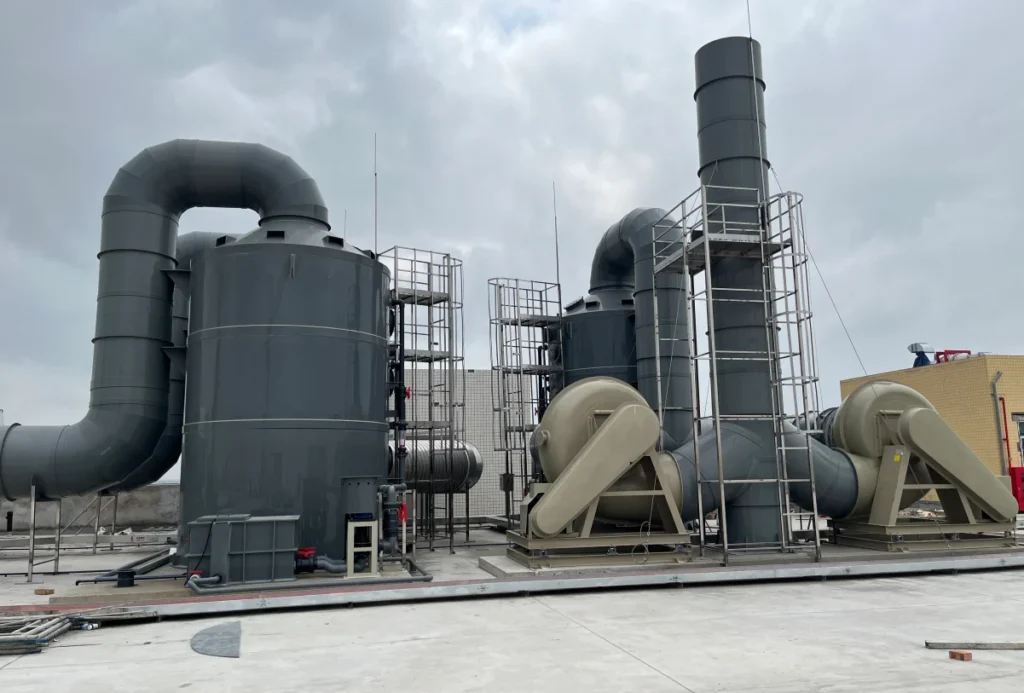
Every engineer who has specified air pollution control equipment has faced the same decision: do you need the highest possible removal efficiency, or do you need a system that runs for years without clogging, cracking, or demanding a full-time maintenance crew? A spray tower scrubber is the answer when reliability and simplicity matter more than chasing the last few percentage points of mass-transfer performance. This guide covers what a spray tower scrubber is, how it works, what it can and cannot remove, and – most important – how to decide whether it is the right air pollution control device for your exhaust stream.
Key Takeaways
- A spray tower scrubber is the most mechanically reliable wet scrubber type for difficult gas streams. Its open-chamber design – with no internal packing, trays, or moving parts – eliminates the plugging and scaling failures that drive packed bed maintenance costs. When your exhaust contains solids-forming contaminants, hydrolyzing particulates, or sticky compounds, the spray tower is not a compromise; it is the only configuration that runs continuously without derating.
- Design parameters are interdependent – optimize the system, not individual variables. Gas velocity sets the tower diameter. Droplet size (500-1,000 um) determines collection surface area. L/G ratio controls absorption efficiency but drives pumping cost. Pressure drop – typically under 2.5 cm WC – keeps fan power low over the equipment’s life. Changing any one parameter shifts the others, and the optimum is found through iterative mass-balance calculations, not a catalog lookup table.
- Material selection is a lifecycle decision, not a purchase-price decision. PP handles most acid and alkali fumes below 80 degC at the lowest capital cost. FRP with a properly specified corrosion barrier extends the temperature range to 110 degC and handles strong oxidizers that attack PP. Stainless steel serves high-temperature streams above 110 degC but fails rapidly in HCl or HF service regardless of temperature. A $5,000 material saving on a PP tower that fails in 3 years because the exhaust contains ketones is a $25,000 problem when you factor in downtime, replacement, and lost production.
- Spray towers, packed beds, and venturis are complementary technologies – choose based on the pollutant, not the preference. If removing coarse particulate and highly soluble gases from a fouling-prone stream, start with a spray tower. If the target is low-solubility VOCs requiring >97% removal from a clean gas stream, go directly to a packed bed. If sub-micron fume is the primary problem, a venturi is the right first stage. For complex exhaust streams, the best system is often a combination – spray tower for bulk removal, packed bed or venturi for polishing.
What Is a Spray Tower Scrubber?
A spray tower scrubber – also called a spray chamber, spray column, or spray tower wet scrubber – is a vertical gas-liquid contact device that removes gaseous pollutants and particulate matter from industrial exhaust streams. It belongs to the wet scrubber family but uses a fundamentally different internal design: an empty cylindrical or rectangular vessel with no internal packing, trays, or moving parts except the spray nozzles.
How Spray Towers Differ from Other Wet Scrubbers
The defining difference between a spray tower and other wet scrubber types is the open-chamber design. A packed bed scrubber forces gas through layers of structured or random packing media to create gas-liquid contact surface. A tray tower channels gas through perforated plates with a liquid layer. A venturi scrubber uses a constricted throat to shear liquid into fine droplets at high gas velocity.
A spray tower does none of these things. Contaminated gas enters at the bottom and rises through an empty vessel. Scrubbing liquid – water, a caustic solution, or an acid reagent – is atomized through spray nozzles mounted at one or more levels and falls downward under gravity. Contact happens entirely on the surface of the falling droplets. There is no media to plug, no constricted throat to erode, and no tray to foul. This design choice trades some mass-transfer efficiency for exceptional mechanical reliability, which is why spray towers are the preferred wet scrubber for gas streams that contain solids-forming contaminants, sticky particulates, or highly corrosive compounds.
Open-Chamber Design – Simplicity as a Feature
The absence of internal obstructions means a spray tower can handle gas streams that would blind a packed bed within hours. When an exhaust contains calcium compounds, polymerization byproducts, or particulates that hydrolyze into cement-like solids, the open-chamber geometry is not a compromise – it is the only practical choice. Spray towers also tolerate higher inlet particulate loadings than packed beds without derating, and the pressure drop across the vessel stays low and predictable over the operating life of the equipment.
Key Terminology Every Buyer Should Know
Before diving into design parameters and selection criteria, three terms deserve clear definitions because they appear throughout every specification conversation.
- Spray tower absorber: When the primary function is gas absorption rather than particulate collection, the equipment is sometimes called a spray tower absorber or spray absorber. The distinction matters because absorption-dominated applications drive different nozzle and L/G ratio choices than particulate-dominated ones.
- Countercurrent flow: The standard configuration in which gas moves upward against the downward spray of liquid. It exposes the cleanest gas – at the top of the tower – to the freshest scrubbing liquid, which maximizes the concentration gradient that drives absorption.
- Mist eliminator: A demisting section at the gas outlet that removes entrained liquid droplets before the cleaned gas is discharged. Without it, the tower would simply exchange one pollutant stream for another – a water mist plume.
How Does a Spray Tower Scrubber Work?
The spray tower working principle is straightforward: bring contaminated gas into contact with liquid droplets, let the pollutants transfer from the gas phase into the liquid phase, then separate the cleaned gas from the liquid. What makes the engineering interesting is how each step is optimized for different pollutants and operating conditions.
Countercurrent Flow – Gas Up, Liquid Down
The most common configuration is countercurrent flow. Dirty gas enters through an inlet near the bottom of the cylindrical vessel and rises at a controlled velocity – typically 0.3 to 1.2 m/s (1 to 4 ft/s). Scrubbing liquid is pumped from a sump at the base of the tower to spray headers mounted at one or more levels, where nozzles atomize it into a downward-directed droplet field.
Countercurrent operation matters for a specific thermodynamic reason: it places the outlet gas – which carries the lowest remaining pollutant concentration – in contact with the freshest scrubbing liquid, which has the highest capacity to absorb additional pollutants. This arrangement sustains the largest possible concentration driving force across the full height of the tower, which directly increases absorption efficiency. In a cocurrent arrangement, by contrast, both phases move in the same direction and the driving force decays rapidly as they approach equilibrium.
Why Countercurrent Maximizes Absorption Efficiency
For highly soluble gases like HCl or ammonia, even a modest countercurrent contact path achieves better than 95% removal. For less soluble gases like SO2 or H2S, a chemical reagent – sodium hydroxide, lime slurry, or sodium hypochlorite – is added to the scrubbing liquid. The chemical reaction consumes the dissolved gas on the liquid side, which keeps the effective concentration near zero and sustains the driving force regardless of physical solubility limits. This is the same principle that makes flue gas desulfurization spray towers achieve over 90% SO2 removal in power plant applications; EPA reports that spray towers applied to inorganic gases remove 95 to 99 percent, and that SO2 removal ranges from 80 to greater than 99 percent, with most current applications above 90 percent (EPA-452/F-03-016, Spray-Chamber / Spray-Tower Wet Scrubber).
How Pollutants Are Actually Captured
Pollutant removal inside a spray tower happens through two distinct mechanisms that operate simultaneously but target different types of contaminants.
Particulate Removal – Inertial Impaction
A particle carried in the gas stream cannot follow the flow streamlines around a liquid droplet because its inertia carries it across the streamlines and into collision with the droplet surface. This mechanism – inertial impaction – is most effective for particles larger than approximately 5 to 10 um. EPA’s cost manual gives the matching collection figures – removal can be as great as 90 percent for particles larger than 5 um, but falls to 40 to 60 percent or lower for simple spray towers (EPA Cost Manual, Section 6, Chapter 2). Smaller particles tend to follow the gas streamlines around the droplet and escape capture. Droplet diameter is the controlling variable: a 500 um droplet generated by a standard spray nozzle provides far less impaction surface than the 10-50 um droplets produced by a venturi throat, which is exactly why spray towers are classified as low-energy scrubbers and venturi scrubbers are classified as high-energy ones.
Gas Absorption – Physical Dissolution and Chemical Reaction
For gaseous pollutants, the removal path is absorption. The pollutant molecule diffuses from the bulk gas phase to the gas-liquid interface, dissolves into the liquid, and – if a reactive chemical is present – is immediately consumed by a neutralization or oxidation reaction. Hydrogen chloride (HCl) absorbs into water almost instantly because its Henry’s Law constant is notably favorable. Sulfur dioxide (SO2) absorbs more slowly unless the scrubbing liquid is maintained at an alkaline pH, typically using caustic soda (NaOH) or limestone slurry. Ammonia (NH3) absorbs well into acidic solutions. Each pollutant-absorbent pair has its own mass-transfer characteristics, and the spray tower’s performance depends on matching the liquid chemistry to the target pollutant.
The Recirculation Loop – Mist Elimination to Liquid Return
After the gas passes through the spray zone, it carries entrained droplets that must be removed before discharge. A mist eliminator – typically a chevron vane or mesh pad – sits above the top spray level and coalesces droplets, which drain back into the sump. EPA gives mist eliminator performance on wet scrubbers as removing between 90 and 99 percent of the liquid droplets from the waste gas stream (EPA Cost Manual, Section 6, Chapter 2). The scrubbing liquid, now loaded with captured pollutants, collects in the sump at the base. A portion is continuously bled off for wastewater treatment, while the majority is recirculated through the pump back to the spray headers. Fresh makeup water and reagent are added to maintain the target liquid chemistry and compensate for evaporation and blowdown losses.
Spray Tower Scrubber Design Parameters
When an engineer sits down to size a spray tower scrubber, four parameters dominate the calculation: gas velocity, droplet size distribution, liquid-to-gas ratio, and pressure drop. Each one creates a trade-off between removal efficiency, vessel size, and operating cost. Getting them right means the difference between a system that meets its performance guarantee and one that sends under-treated gas up the stack. For the step-by-step calculation of each parameter, see our spray tower design guide. For how the same velocity check differs between a gas–liquid separator and a packed absorber, see our scrubber sizing calculation guide.
Gas Velocity and Tower Sizing
Gas velocity through the tower cross-section – typically 0.3 to 1.2 m/s (1 to 4 ft/s) – is the first number fixed in any design calculation. The tower diameter follows directly from the design gas flow rate divided by the chosen velocity. A tower handling 50,000 m3/h at a conservative 0.8 m/s needs a vessel diameter of approximately 4.7 meters. Push the velocity to 1.2 m/s and the same flow fits in a 3.8-meter diameter – a substantial capital cost saving.
For reference, EPA’s fact sheet for this device type gives the typical gas flow range for spray tower wet scrubbers as 1,500 to 100,000 scfm (EPA-452/F-03-016, Spray-Chamber / Spray-Tower Wet Scrubber).
Why 0.3-1.2 m/s Is the Sweet Spot
Go slower than 0.3 m/s and the vessel becomes impractically large and expensive. Go faster than 1.2 m/s and two problems emerge: droplet entrainment increases sharply because the upward gas velocity approaches the terminal settling velocity of the spray droplets, and gas-liquid contact time shortens, which reduces absorption efficiency. The 0.3-1.2 m/s range represents decades of empirical optimization across thousands of industrial installations. Within that range, the specific choice depends on the pollutant: particulate-dominated applications trend toward the lower end to reduce droplet carryover, while absorption of highly soluble gases can tolerate the upper end.
Droplet Size – Nozzle Selection and Spray Pattern
Droplet diameter is the single most influential variable for removal efficiency, yet it is also the one most often underspecified in procurement documents. Standard spray tower nozzles produce droplets in the 500-1,000 um range. Compare that to a venturi scrubber, which shears liquid into 10-50 um droplets, and you immediately see why venturis capture sub-micron particles and spray towers do not. Droplet size is a deliberate control point rather than a by-product of nozzle choice: EPA describes the droplet size generated by the spray nozzles as being controlled to maximize liquid-particle contact and, with it, scrubber collection efficiency (EPA-452/F-03-016, Spray-Chamber / Spray-Tower Wet Scrubber).
500-1,000 um Droplets – The Engineering Trade-off
Smaller droplets create more total liquid surface area per unit volume of scrubbing liquid, which increases both the probability of particle-droplet collision and the gas-liquid interfacial area available for absorption. If smaller is better, why not use the finest mist possible? Because droplets smaller than roughly 500 um are easily entrained upward by the gas flow and carried into the mist eliminator without doing useful work. Droplets larger than 1,000 um have such low surface-to-volume ratios that they act more like falling stones than effective collectors. The 500-1,000 um window balances collection surface area against mechanical stability. Nozzle type – full-cone, hollow-cone, or spiral – and operating pressure determine the actual droplet size distribution, and nozzle selection should be validated with the manufacturer’s spray characterization data, not assumed from catalog values.
Liquid-to-Gas Ratio – How Much Water Is Enough?
The liquid-to-gas ratio (L/G), expressed in L/m3 or gal/1,000 ft3, quantifies how much scrubbing liquid is circulated per unit volume of gas treated. For gas absorption applications, typical values range from 0.07 to 2.70 L/m3. For particulate collection, values of approximately 5 gal/1,000 ft3 (0.67 L/m3) are common, with higher ratios required for finer particles – EPA puts the fine-PM requirement at over 20 gallons of liquid per 1,000 cubic feet, roughly 2.7 L/m3, and notes that this is where spray tower operating costs climb (EPA Cost Manual, Section 6, Chapter 2). Increasing the L/G ratio improves removal efficiency – more liquid means more droplet surface area – but raises pumping power, water consumption, and wastewater treatment costs. The economic optimum is rarely the technical maximum.
Pressure Drop – The Spray Tower’s Biggest Advantage
A spray tower’s pressure drop is exceptionally low: typically less than 2.5 cm (1 inch) of water column for particulate applications, and 1.3 to 7.6 cm for gas absorption. A venturi scrubber, by comparison, routinely operates at 25 to over 100 cm of water column. Because fan power consumption is directly proportional to pressure drop, the spray tower’s low resistance translates into years of lower electricity bills. For a 50,000 m3/h system, the annual fan energy savings of a spray tower over a venturi can run into tens of thousands of dollars – a figure that often pays for the tower itself over the equipment’s service life.
Types and Flow Configurations
Not all spray towers are the same. Flow direction, number of spray stages, and structural variations create a family of configurations, each suited to different pollutant loads, space constraints, and performance targets.
Countercurrent vs. Cocurrent vs. Crosscurrent
The three fundamental flow arrangements define how the gas phase and liquid phase move relative to each other – and each one solves a different engineering problem.
Countercurrent flow is the default configuration for most industrial spray tower scrubbers. Gas rises from the bottom; liquid sprays downward from the top. This arrangement puts the cleanest gas in contact with the freshest scrubbing liquid, maximizing the concentration gradient across the entire tower height. It achieves the highest single-stage absorption efficiency and is the preferred choice for gas absorption applications.
Cocurrent flow sends both gas and liquid in the same direction – usually downward. The key advantage is that higher gas velocities are possible without droplet entrainment, because the gas is not fighting gravity to keep droplets suspended. A cocurrent tower can be physically smaller than a countercurrent tower for the same gas flow rate. The trade-off is lower absorption efficiency because the concentration driving force decays as both phases approach equilibrium together.
Crosscurrent flow – also called horizontal spray – moves the gas horizontally through one or more spray sections while liquid falls vertically. This arrangement allows the liquid flow rate to be varied independently in each section, which can be useful for staged scrubbing with different reagents or concentrations. Crosscurrent towers also fit into low-headroom installations where a tall vertical vessel is impractical.
When Cocurrent or Crosscurrent Makes More Sense
Cocurrent flow is worth considering when floor space is tight, when the pollutant is highly soluble so efficiency loss is negligible, or when the inlet gas is hot enough that quenching and scrubbing can be combined in a single vessel. Crosscurrent configurations work well for retrofits into existing ductwork where vertical clearance is limited, or when the scrubbing objective is primarily particulate removal rather than gas absorption.
Single-Stage vs. Multi-Stage Design
A single-stage spray tower has one bank of spray nozzles at a single elevation. It is the simplest and least expensive configuration, adequate for moderate removal requirements – for example, capturing coarse particulates above 10 um or absorbing highly soluble gases like HCl.
A multi-stage tower mounts two or more spray levels at different heights, each served by its own pump or a common header. Each stage functions as an additional equilibrium contact step. An experimental optimization study on a pilot spray tower for ammonia removal reported its highest efficiency – 97.92 percent – with three nozzle stages working together, a sulfuric acid scrubbing solution and 12 bar nozzle pressure (Jafari et al., “Experimental optimization of a spray tower for ammonia removal,” Atmospheric Pollution Research 9(4): 783-790, 2018), well beyond what a single stage achieved in the same test program. Multi-stage designs are standard in flue gas desulfurization, where SO2 removal targets above 90% require multiple contact stages.
Common Variants at a Glance
Several specialized spray tower configurations address specific operating challenges. A cyclonic spray tower adds a tangential gas inlet, which imparts a swirling motion that centrifugally separates larger droplets and increases gas-liquid contact time. A caustic spray tower is a spray tower optimized for acid gas neutralization using sodium hydroxide as the scrubbing reagent – common in chemical processing and electroplating exhaust treatment. A packed spray tower combines a spray section with a bed of random or structured packing below it, using the spray for initial contact and the packing for polishing removal – a hybrid approach that captures much of the packed bed’s efficiency while retaining the spray section’s resistance to plugging.
Construction Materials – Selecting the Right Body
Material selection is not an afterthought in spray tower specification. The wrong material choice can transform a straightforward air pollution control installation into a recurring maintenance headache – or a corrosion failure that takes the entire exhaust treatment system offline. The three primary material families – polypropylene, fiberglass-reinforced plastic, and stainless steel – each serve a distinct temperature and chemical compatibility window.
Polypropylene (PP) – Lightweight, Wide Chemical Resistance
Polypropylene is the most common construction material for spray tower scrubbers handling acid and alkali fumes at moderate temperatures. It resists a broad spectrum of chemicals – hydrochloric acid, sulfuric acid, sodium hydroxide, and most organic solvents – at concentrations and temperatures routinely encountered in chemical processing, electroplating, and laboratory exhaust applications. PP towers are fabricated by hot-gas welding of sheet stock, which produces homogeneous joints with chemical resistance equivalent to the base material. The material is lightweight, which reduces structural support requirements and simplifies installation.
Temperature Limits and When PP Falls Short
PP’s practical operating ceiling is approximately 80 degC for continuous service. Above that temperature, the material softens and loses mechanical strength. It also has poor UV resistance unless stabilized with carbon black or UV inhibitors, which limits its use in unshaded outdoor installations. For exhaust streams above 80 degC or applications involving aromatic hydrocarbons, ketones, or chlorinated solvents that attack polypropylene, the specification moves to FRP or stainless steel.
Fiberglass-Reinforced Plastic (FRP) – Corrosion Champion
FRP is the material of choice when the exhaust stream combines high corrosivity with temperatures beyond PP’s capability. A properly specified FRP spray tower operates continuously at temperatures from -20 degC to 110 degC, and the resin system – typically isophthalic polyester, vinyl ester, or epoxy – can be selected to match the specific chemical environment. Vinyl ester resins, for example, provide superior resistance to chlorine gas, strong oxidizing acids, and caustic solutions at elevated temperatures compared to standard polyester resins. EPA’s cost manual reaches the same conclusion from the cost side: where acids and other corrosive materials are involved, scrubber construction can be of fiberglass, PVC-type plastics or other less costly corrosion-resistant materials (EPA Cost Manual, Section 5.2, Chapter 1).
FRP Layering, Resin Types, and Temperature Ceiling
The structural integrity of an FRP tower depends on the laminate schedule – the sequence and orientation of glass fiber reinforcement layers – and the quality of the corrosion barrier (also called the veil or liner layer) on the inner surface. The corrosion barrier, typically 2.5-5.0 mm thick with a high resin-to-glass ratio, provides the chemical resistance. The structural layers behind it carry the mechanical loads. A common specification error is to focus on the structural laminate while overlooking the resin type in the corrosion barrier, which is the layer that contacts the exhaust stream. FRP’s temperature ceiling is fundamentally limited by the heat deflection temperature of the resin system, not the glass reinforcement, and operating near that ceiling for extended periods causes irreversible loss of mechanical properties.
Stainless Steel (SS304/SS316) – For High-Temperature Streams
When gas inlet temperatures exceed 110 degC – dryer exhausts, furnace off-gases, or incinerator tail gas – neither PP nor FRP can serve. Stainless steel, typically SS304 or SS316L, becomes the default material. SS316L adds molybdenum for improved pitting resistance in chloride-containing environments. The trade-off is cost: a stainless steel tower costs 2 to 4 times more than an equivalent FRP vessel, and certain acids – hydrochloric and hydrofluoric in particular – attack stainless steel aggressively regardless of temperature.
Material Selection Compatibility Table
| Material | Max Continuous Temp | Good For | Avoid With |
|---|---|---|---|
| PP | 80 degC | HCl, H2SO4, NaOH, plating fumes | Aromatics, ketones, chlorinated solvents, UV exposure |
| FRP (vinyl ester) | 110 degC | Cl2, strong oxidizers, mixed acids, outdoor use | High-abrasion streams without abrasion-resistant liner |
| FRP (isophthalic) | 95 degC | General acid/alkali, cost-sensitive projects | Strong oxidizers, chlorine gas |
| SS304 | 180 degC+ | High-temperature, non-chloride streams | HCl, HF, chlorides |
| SS316L | 180 degC+ | High-temperature with moderate chlorides | HCl, HF at high concentrations |
The cost ranking from lowest to highest is roughly: PP < FRP (isophthalic) < FRP (vinyl ester) < SS304 < SS316L. Operating cost - maintenance frequency, downtime risk, and anticipated service life - should be weighed alongside the initial purchase price. For a scrubber handling mixed acid fumes at 60 degC from a chemical reactor, an FRP tower with a vinyl ester corrosion barrier will likely outlast a PP tower by several years, making the higher capital cost a net win over the equipment lifecycle.
Industrial Applications of Spray Tower Scrubbers
Spray tower scrubbers appear across a wider range of industries than almost any other air pollution control technology. Their tolerance for corrosive, high-particulate, and fouling-prone gas streams opens application spaces that are effectively closed to packed beds and venturis. For an industry-by-industry breakdown, see the application of spray tower guide.
Flue Gas Desulfurization (FGD) at Power Plants
Flue gas desulfurization is the single largest application for spray tower absorbers by total installed gas flow capacity. In a coal- or oil-fired power plant, the flue gas leaving the boiler contains sulfur dioxide at concentrations typically ranging from 200 to 2,000 ppmv. It enters the spray tower at 120-180 degC, is quenched to its adiabatic saturation temperature by contact with the scrubbing slurry, and rises through multiple spray levels where a limestone (CaCO3) or lime (Ca(OH)2) slurry absorbs the SO2.
The chemistry is well established: SO2 dissolves into the aqueous phase, reacts with dissolved calcium to form calcium sulfite (CaSO3), which is then oxidized to calcium sulfate (CaSO4.2H2O) – gypsum – in the sump. A typical FGD spray tower achieves over 90% SO2 removal efficiency with three to five spray levels and an L/G ratio of 8-12 L/m3. EPA’s FGD fact sheet puts achievable SO2 reduction for scrubbing systems at 50 to 98 percent overall, with limestone systems limited to approximately 90 percent and lime systems reaching up to 95 percent at significantly higher reagent cost (EPA fact sheet, Flue Gas Desulfurization for SO2 Control). The spray tower’s open design is essential here because gypsum scaling on internal surfaces is a constant operational challenge; a packed bed in the same service would blind within weeks.
SO2 Removal Chemistry in Practice
The key operating variable is slurry pH, maintained between 5.0 and 6.0 for limestone-based systems. Below pH 4.5, SO2 absorption efficiency drops steeply. Above pH 6.0, limestone dissolution slows and unreacted reagent passes through the system. pH control is automated through reagent feed rate adjustment, and the gypsum byproduct is continuously removed from the sump through a bleed stream, dewatered, and either sold for wallboard production or landfilled.
Chemical Processing – HCl, HF, and Acid Gas Scrubbing
Chemical manufacturing plants use spray tower scrubbers to treat reactor vents, tank breather emissions, and process off-gases. The pollutants – hydrogen chloride, hydrogen fluoride, sulfur dioxide, nitrogen oxides, chlorine – vary by process, but the scrubbing approach follows a common template: an alkaline scrubbing solution, typically 5-15% sodium hydroxide by weight, is circulated through the tower at a rate determined by the acid gas loading and the target removal efficiency.
HCl scrubbing is among the simplest applications because HCl has notably high water solubility. Even plain water achieves better than 95% removal at modest L/G ratios. Adding caustic to the scrubbing liquid improves removal to over 99% and produces sodium chloride as the reaction product, which is discharged in the blowdown stream. HF scrubbing follows a similar pattern, though the reaction product – calcium fluoride when lime is used – is a sparingly soluble solid that requires careful sump agitation and solids handling design. For the complete chemical processing system, see the chemical scrubber system guide.
Specialty Applications
Spray towers serve niche roles across food processing odor control – where potassium permanganate or sodium hypochlorite solutions oxidize reduced sulfur compounds – pharmaceutical intermediate manufacturing, semiconductor exhaust abatement, and electroplating acid mist control. In each case, the spray tower’s open geometry handles the particular solids-forming or corrosive characteristics of the exhaust stream that disqualify packed bed alternatives. Where the target pollutant is a toxic compound, the toxic gas scrubber guide details the design and compliance requirements.
Spray Tower Advantages and Limitations
No air pollution control technology is universally the right answer. A spray tower scrubber makes three engineering promises that no other wet scrubber type matches – and it has three genuine limitations that should disqualify it from certain applications.
The Case for Spray Towers
Spray towers earn their place in industrial air pollution control through an unusual combination of mechanical simplicity, low operating cost, and tolerance for difficult gas streams.
Low Capital Cost
Spray tower capital costs range from approximately $1,800 to $8,000 per sm3/sec of gas flow capacity, placing them at the low end of the wet scrubber cost spectrum. The open internal geometry means less material, less fabrication labor, and no expensive packing media to purchase and install. For a 10 sm3/sec (approximately 21,000 cfm) system, a spray tower might cost $20,000-$80,000 in equipment alone, compared to $40,000-$150,000 for an equivalent packed bed system with corrosion-resistant packing. EPA’s published capital-cost ranges for the same two device types, expressed in the same per-unit-capacity terms, are $4,200 to $13,000 per sm3/s for a spray tower and $23,000 to $117,000 per sm3/s for a packed bed (EPA-452/F-03-016; EPA-452/F-03-015). The cost advantage narrows or disappears when high L/G ratios or exotic materials of construction are required, but for the majority of industrial applications, the spray tower is the lowest-first-cost wet scrubber option.
Note on cost, performance and material-limit figures. The cost figures, efficiency ranges, pressure-drop values and material temperature limits quoted in this guide are Xicheng engineering estimates and typical vendor ranges, not published price data; actual values depend on gas flow, materials of construction, reagent, site conditions and scope. Where a figure comes from a published source, that source is linked inline and listed under Sources at the end of this article. For published cost methodology and per-device capital-cost ranges, see the EPA Air Pollution Control Cost Manual and the EPA-452/F technology fact sheets cited in this article.
Open Design = No Plugging, Low Maintenance
The open-chamber geometry eliminates the dominant failure mode of packed bed scrubbers: media plugging. When an exhaust stream carries particulates that hydrolyze, polymerize, or crystallize on contact with water – calcium compounds from kiln exhaust, ammonium chloride from chemical reactor vents, starch particles from food dryers – a packed bed acts as a filter, trapping solids in the void spaces between media elements until the pressure drop becomes unacceptable and the system must be shut down for cleaning. A spray tower, with nothing between the inlet and outlet except moving droplets, tolerates these streams indefinitely. The only routine maintenance items are the spray nozzles – which should be inspected for erosion and plugging every 3-6 months – and the recirculation pump.
Handles Corrosive and Flammable Dust Streams Safely
Because water is continuously present throughout the vessel, a spray tower inherently suppresses the ignition risks associated with combustible dusts. The wetted surfaces and high humidity environment make flame propagation through the vessel effectively impossible, which is why spray towers are often specified for exhaust streams from processes handling aluminum, magnesium, or organic dusts that pose deflagration hazards in dry collection equipment.
Where Spray Towers Fall Short
Recognizing the technology’s limitations is as important as understanding its strengths.
Lower Mass-Transfer Efficiency vs. Packed Bed
A spray tower’s gas-liquid contact surface area is limited to the surface area of the droplets in flight. A packed bed creates orders of magnitude more wetted surface area per unit volume through the packing media’s internal geometry. For gas absorption applications where the pollutant has low solubility or where removal above 99% is required, a packed bed – or a spray tower followed by a packed polishing section – will outperform a spray tower alone. The efficiency gap widens as the target pollutant becomes less soluble: for HCl (extremely soluble), the difference is small; for SO2 (moderately soluble), it is significant; for VOCs with low water solubility, a spray tower with plain water achieves negligible removal. Where the target compounds are hazardous air pollutants rather than acid gases, EPA’s remediation guidance notes that wet scrubbers are generally effective for HAP control when used in combination with another control device such as an incinerator or a carbon adsorber (Spray-Chamber / Spray-Tower Wet Scrubber fact sheet, Federal Remediation Technologies Roundtable).
Fine Particle Limitation and Liquid Waste Cost
Particles smaller than approximately 5 um are not effectively collected by spray tower droplets because they follow the gas streamlines around the droplet rather than impacting on its surface. If the exhaust contains sub-micron fume, a venturi scrubber – with its much higher relative velocity between gas and liquid – or a wet electrostatic precipitator is the appropriate technology. Every pound of pollutant captured in a spray tower exits the system as a component of a liquid waste stream, and this is a cost that should be modeled upfront. The cost of wastewater treatment – neutralization, solids settling, sludge dewatering, and discharge permitting – can exceed the operating cost of the scrubber itself, and this cost should be modeled in any lifetime economic comparison, not estimated after procurement.
Spray Tower vs. Packed Bed vs. Venturi Scrubber
Choosing between a spray tower, a packed bed, and a venturi is rarely a close call once the pollutant characteristics and operating constraints are laid out clearly. Each technology optimizes for a different variable.
Head-to-Head Comparison
| Parameter | Spray Tower | Packed Bed | Venturi |
|---|---|---|---|
| Removal efficiency (gas) | 85-99% (solubility-dependent) | 96-99% | 70-90% (gas removal not primary function) |
| Removal efficiency (PM) | 70-90% (>10 um); poor <5 um | 50-80% (PM not primary function) | 95-99% (>1 um) |
| Pressure drop | 1.3-7.6 cm WC | 5-25 cm WC | 25-100+ cm WC |
| Capital cost | Low ($1,800-$8,000/sm3/s) | Moderate ($4,000-$15,000/sm3/s) | Moderate-High |
| Fouling resistance | Excellent (no internal surfaces to foul) | Poor (packing traps solids) | Moderate (throat can erode or plug) |
| Mass-transfer efficiency | Lowest of the three | Highest | Moderate |
| Maintenance intensity | Low (nozzles only) | Moderate (packing replacement every 3-7 years) | Moderate (throat erosion, pump wear) |
| Best for | High-solubility gases, fouling streams, coarse PM, FGD | High-efficiency gas absorption, low-solubility gases, odor control | Fine particulate, sub-micron fume, high-inlet-loading dust |
The comparison table reveals a pattern that is not obvious from specification sheets alone: the technologies are complementary, not competing. A spray tower upstream of a packed bed serves as a pre-scrubber, removing bulk contaminants and quenching hot gas so the packed bed downstream can operate under cleaner, cooler conditions. A venturi upstream of a spray tower captures fine particulates first, then the spray tower absorbs the soluble gases. Both device types have published capability ranges: packed beds typically handle 500 to 75,000 scfm with 95 to 99 percent removal of inorganic gases, with particulate removal limited by the packing’s tendency to plug (EPA-452/F-03-015), while venturis handle 500 to 100,000 scfm with 70 to greater than 99 percent PM removal and perform best in the 0.5 to 5 um range (EPA-452/F-03-017). System-level thinking – rather than single-device comparisons – often produces the best total cost of ownership.
When to Choose a Spray Tower
A spray tower is the right starting point when at least two of these conditions are true: the pollutant gases are highly water-soluble or reactive with a simple chemical reagent, the particulate loading is heavy and coarse, the gas stream contains solids-forming or fouling contaminants, capital cost is the primary constraint, and the permitted emission limit can be met with 90-95% removal rather than 99%+. FGD systems choose spray towers for exactly this combination of reasons. Chemical plant acid gas scrubbers handling mixed HCl and particulate choose spray towers because the alternative – a packed bed – would become a maintenance liability within months.
When to Upgrade – Packed Bed or Venturi Makes More Sense
Move to a packed bed scrubber when the target pollutant has low water solubility – VOCs, H2S, mercaptans – and high (>97%) removal efficiency is required, or when the exhaust stream is clean enough (low particulate, no scaling tendency) that the packing will not foul. Move to a venturi scrubber when fine particulate below 5 um is the primary target, when inlet dust loading exceeds what a spray tower can handle in a single pass, or when the exhaust stream is hot and dry enough that evaporative cooling in the venturi throat can be combined with particulate collection. For mixed pollutant streams – for example, a thermal oxidizer exhaust containing both sub-micron metal oxide fume and acid gases – the right answer is often a venturi followed by a packed bed, not a single device trying to do both jobs poorly.
Selection and Sizing – A Practical 6-Step Checklist
A spray tower specification that starts with a catalog cutsheet and ends with a purchase order skips the engineering steps that determine whether the system will meet its performance targets. The following six questions force the necessary discipline before any supplier conversation begins. The wet scrubber design guide covers the underlying design methodology across wet scrubber types.
6 Questions to Answer Before You Specify
1. What pollutants are you removing – and in what concentrations? List every target compound with its inlet concentration and the required outlet concentration. A tower sized for HCl at 500 ppmv is not the same tower as one sized for HCl at 5,000 ppmv plus SO2 at 200 ppmv and particulate at 150 mg/Nm3. Mixed pollutant streams require a mass balance that accounts for competing absorption rates, possible chemical interactions between reagents, and the effect of particulate loading on liquid quality.
2. What is the actual gas flow rate – not the nameplate rating? Process exhaust flows are frequently overstated in initial inquiries because the plant’s design documents quote the fan’s maximum capacity, not the normal operating point. Measure the real flow rate at the scrubber inlet location under typical production conditions. If measurement is not possible, use the fan curve and the measured pressure drop across the existing ductwork to estimate actual flow. Oversizing a spray tower wastes capital; undersizing creates a compliance liability.
3. What is the gas temperature and humidity at the inlet? Temperature determines material selection and whether a quench section is needed upstream. Humidity determines how much water evaporates in the tower – and therefore the makeup water rate. Hot, dry gas entering a spray tower loses water rapidly through evaporation, which concentrates dissolved solids in the recirculating liquid and can cause scaling on the mist eliminator if not managed through the blowdown rate.
4. What removal efficiency does your permit require? Do not design for “the best available” unless the permit demands it. If the permit allows 95% removal and a spray tower delivers 96% at half the capital cost of a packed bed, the packed bed is engineering overkill. Conversely, if the permit demands 99% removal of a moderately soluble gas, a spray tower alone may not meet the requirement regardless of how it is sized.
5. What is your budget – capital and operating – over 10 years? A spray tower’s capital cost advantage can be eroded by higher operating costs if the application requires high L/G ratios, expensive chemical reagents, or substantial wastewater treatment. Build a 10-year net present value model that includes equipment cost, installation, chemicals, electricity, water, wastewater disposal, and expected maintenance labor. The lowest-first-cost option is not always the lowest lifecycle cost.
6. What are the site constraints – footprint, height, weight, and access? Spray towers need vertical clearance for the vessel height plus mist eliminator access. A countercurrent tower handling 50,000 m3/h may be 8-14 meters tall. If headroom is limited, a cocurrent or crosscurrent configuration may fit. If weight is a constraint on an upper floor or roof, PP and FRP offer substantial weight savings over stainless steel.
Pollutant Type -> Gas Flow -> Temperature -> Efficiency -> Budget -> Regulations
These six factors form a sequential decision logic. Start at the pollutant: what you are removing determines the scrubbing chemistry, which determines the material, which constrains the temperature range. Then size the tower: gas flow sets the diameter, target efficiency sets the height and number of spray stages. Finally, validate: does the resulting specification fit the budget and the site? If not, iterate – adjust L/G, consider staging, or evaluate whether a hybrid configuration (spray + packed polishing section) hits the targets within the constraints.
How to Evaluate a Spray Tower Supplier
Not all manufacturers deliver the same value, and price alone is a poor selection criterion for equipment with a 10-15 year service life.
5 Questions to Ask Before Signing a Purchase Order
“Can you provide performance data from an installation with a similar pollutant profile to ours?” A supplier who has built towers for acid gas scrubbing but not for your specific pollutant mix may not understand the chemistry well enough to guarantee performance. Ask for references you can contact.
“What material certifications do you provide for wetted parts?” Demand Material Test Reports (MTRs) for the resin system in FRP towers, the grade certification for PP sheet, and the mill test certificates for stainless steel. If a supplier cannot produce these, walk away.
“What is your design margin on gas velocity and L/G ratio?” A credible manufacturer includes a 10-20% margin above the theoretical design point to account for production rate fluctuations, seasonal temperature variations, and gradual nozzle wear. Insist on seeing the design calculations, not just the final dimensions.
“What is the guaranteed pressure drop at design flow – and what happens above design flow?” The pressure drop guarantee matters for fan sizing and energy cost projections. Also ask about turndown: how low can the gas flow go before the spray pattern degrades and removal efficiency drops?
“What spare parts do you recommend we keep on the shelf – and what is the lead time for non-stock items?” At minimum, keep a spare set of spray nozzles and gaskets. For critical processes, a spare recirculation pump may be justified. Lead times for replacement FRP sections or custom-fabricated internals can extend to 8-12 weeks; factor this into your maintenance planning.
Browse our wet scrubber product range or the customizable wet scrubber for site-specific duty, and see chemical waste gas treatment for the integrated treatment approach. Our engineering team can review your gas characterization and confirm whether a spray tower is the right first pass for your exhaust stream.
Operation, Maintenance, and Troubleshooting
A spray tower scrubber’s open design reduces maintenance burden dramatically compared to packed bed or tray tower alternatives, but neglect the few items that do need attention and the performance curve eventually bends downward. The three maintenance domains – nozzles, liquid chemistry, and mechanical components – each have their own inspection rhythm and failure signature.
Nozzle Inspection and Replacement Schedule
Spray nozzles are the only internal components that directly contact the process gas stream, and they are the single point of failure for the entire scrubbing process. Erosion from suspended solids in recycled liquid gradually enlarges the nozzle orifice, which shifts the droplet size distribution toward larger droplets and reduces collection surface area. Plugging – from scale fragments, debris, or solids settling during shutdown – can blind individual nozzles, creating untreated gas bypass channels through the spray field.
Inspect nozzles every 3 months in clean service (clean gas, filtered recirculation liquid) and every 1-2 months in dirty service (high particulate loading, scaling tendency). Look for uneven spray patterns – a nozzle that streams rather than atomizes is either partially plugged or eroded beyond its useful tolerance. Replace brass or stainless steel nozzles when the orifice diameter has increased by 15% from the as-new dimension. Replace plastic nozzles annually regardless of apparent condition; UV degradation and thermal cycling cause micro-cracking that is invisible to the naked eye but compromises spray pattern uniformity.
Scrubbing Liquid Chemistry Management
The scrubbing liquid is not a set-and-forget utility. Three parameters must be monitored and controlled continuously or at least daily:
pH is the primary control variable for any chemically enhanced scrubbing system. A pH sensor in the recirculation line or sump controls the reagent metering pump. For caustic scrubbing of acid gases, the setpoint is typically pH 7-9. Drift below pH 6 indicates inadequate reagent feed; drift above pH 10 wastes chemical and can cause scaling from carbonate precipitation if hard water is used for makeup.
Total dissolved solids (TDS) build up as reaction products accumulate in the recirculating liquid. When TDS approaches the solubility limit of the least-soluble salt in the system, scaling begins – first in the sump, then on the mist eliminator, and eventually on the spray nozzles. The blowdown rate – the fraction of recirculating liquid discharged to waste – must be set high enough to keep TDS below that threshold. A conductivity meter provides a practical surrogate for TDS measurement.
Liquid level in the sump must be maintained within the pump suction range. Low level – from inadequate makeup water or excessive blowdown – starves the pump and can cause cavitation damage. High level – from a failed makeup valve or a blocked blowdown line – can flood the gas inlet and back liquid into the upstream ductwork.
5 Common Failure Modes and How to Fix Them
| Symptom | Likely Cause | Fix |
|---|---|---|
| Gradual drop in removal efficiency | Nozzle erosion enlarging droplet size | Measure orifice diameters; replace nozzles exceeding 15% wear |
| Sudden pressure drop increase | Mist eliminator scaling or blockage | Inspect and clean eliminator; increase blowdown rate to reduce TDS |
| Visible plume from stack | Mist eliminator damage or bypass; insufficient demisting | Replace eliminator media; check for gaps in eliminator panel seals |
| Pump cavitation noise | Low sump level; blocked suction strainer; air leak in suction line | Check level control; clean strainer; inspect suction line gaskets |
| Corrosion at liquid line or below | Inadequate corrosion barrier in FRP; wrong resin for chemical environment | Inspect barrier thickness ultrasonically; if thinned, schedule re-lining during next shutdown |
Frequently Asked Questions
What pollutants can a spray tower scrubber remove?
A spray tower scrubber removes acid gases (HCl, HF, SO2, NOx), alkaline vapors (NH3), water-soluble VOCs (alcohols, aldehydes, some ketones), and coarse particulates above approximately 5-10 um. It is not effective for non-water-soluble VOCs such as benzene, toluene, or chlorinated solvents without specialized scrubbing additives. Sulfur compounds including hydrogen sulfide can be removed with an oxidizing scrubbing solution – sodium hypochlorite or potassium permanganate. The specific chemistry of the pollutant-scrubbing liquid pair determines the achievable removal efficiency, and a competent manufacturer should provide performance guarantees tied to your specific inlet conditions, not generic removal percentages.
How long does a spray tower last?
A properly specified and maintained spray tower has a service life of 10 to 15 years, with the vessel itself often outlasting the surrounding equipment. PP towers in clean chemical service routinely exceed 12 years. FRP towers with a correctly specified corrosion barrier reach 15-20 years before the barrier requires inspection and possible re-lining. Stainless steel towers in non-chloride, non-HCl service can exceed 20 years. The components that require replacement during the equipment lifecycle are the spray nozzles (1-3 year interval, depending on service), the recirculation pump mechanical seal (2-5 years), and gaskets (5-8 years).
Can spray towers handle high-temperature gases?
Yes – with limits that depend on the material of construction. An FRP spray tower handles sustained inlet temperatures up to 110 degC with a vinyl ester resin system; a PP tower should not exceed 80 degC continuous. For gas streams above 110 degC, stainless steel (SS304 or SS316L) is the standard material choice, with service temperatures up to 180 degC and beyond. Gas streams above approximately 370 degC require a quench section – usually a water spray or venturi upstream of the main tower – to bring the temperature into the tower’s operating range before the gas contacts the main vessel.
What is the difference between a spray tower and a packed scrubber?
The fundamental difference is in how gas-liquid contact is created. A spray tower uses only the surface area of falling droplets; a packed bed forces gas through a bed of structured or random media that creates a much larger wetted surface area per unit volume. This means packed beds achieve higher mass-transfer efficiency – important for low-solubility gases – but are susceptible to plugging when the gas stream carries particulates or scale-forming compounds. A spray tower tolerates those streams indefinitely. In practice, spray towers and packed beds are often used in series: the spray tower handles the dirty, hot, high-particulate inlet and the packed bed provides the polishing removal downstream.
How do I choose the right material – PP, FRP, or SS?
The material decision follows the gas stream chemistry and temperature. PP covers the broadest range of acid and alkali environments at the lowest cost, with an 80 degC ceiling. FRP extends the temperature range to 110 degC and handles strong oxidizers (chlorine, concentrated sulfuric) that attack PP, but costs 1.5-2x more. Stainless steel serves above 110 degC and in abrasive streams, at 3-4x the cost of PP, but fails rapidly in hydrochloric or hydrofluoric acid service. If your exhaust stream contains HCl or HF, SS is the wrong answer regardless of temperature. When in doubt, provide a complete gas composition and temperature profile to your scrubber supplier and ask for a written material recommendation with supporting corrosion data.
Sources
- U.S. EPA – EPA-452/F-03-016, Air Pollution Control Technology Fact Sheet: Spray-Chamber / Spray-Tower Wet Scrubber.
- U.S. EPA, Office of Air Quality Planning and Standards – Air Pollution Control Cost Manual, Section 6, Chapter 2: Wet Scrubbers for Particulate Matter.
- U.S. EPA – Air Pollution Control Technology Fact Sheet: Flue Gas Desulfurization (FGD) for SO2 Control.
- M. J. Jafari, A. H. Matin, A. Rahmati, M. Rezazadeh, and D. Panahi – “Experimental optimization of a spray tower for ammonia removal,” Atmospheric Pollution Research 9(4): 783-790 (2018). DOI: 10.1016/j.apr.2017.12.003.
- U.S. EPA, Office of Air Quality Planning and Standards – Air Pollution Control Cost Manual, Section 5.2, Chapter 1: Wet Scrubbers for Acid Gas.
- U.S. EPA – EPA-452/F-03-015, Air Pollution Control Technology Fact Sheet: Packed-Bed / Packed-Tower Wet Scrubber.
- Federal Remediation Technologies Roundtable (U.S. EPA / DoD / DOE / DOI) – Spray-Chamber / Spray-Tower Wet Scrubber Fact Sheet.
- U.S. EPA – EPA-452/F-03-017, Air Pollution Control Technology Fact Sheet: Venturi Scrubber.