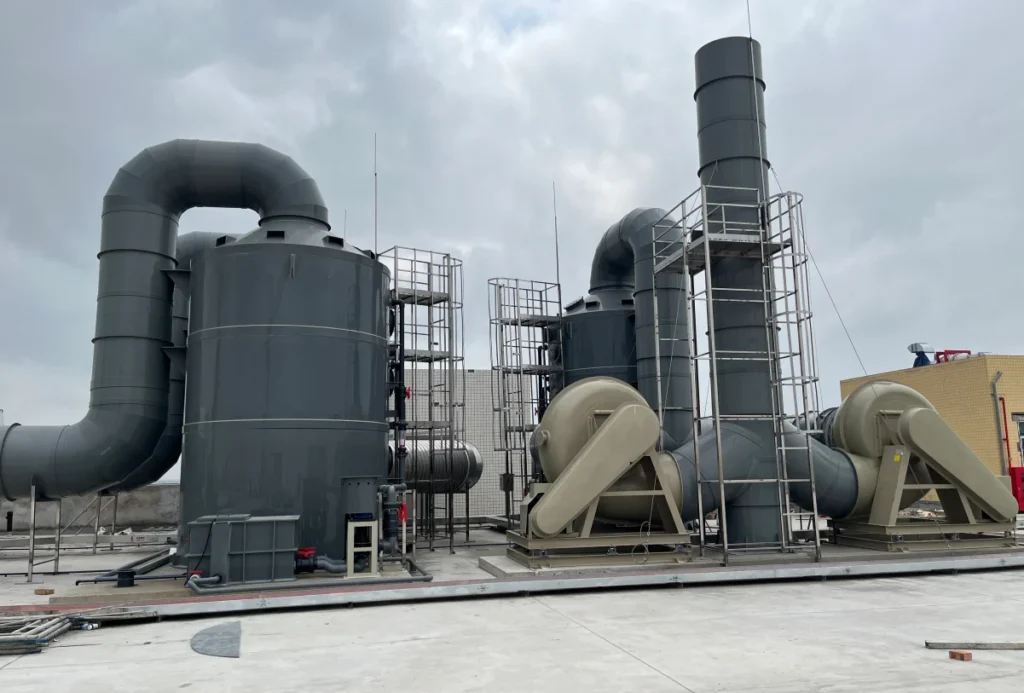
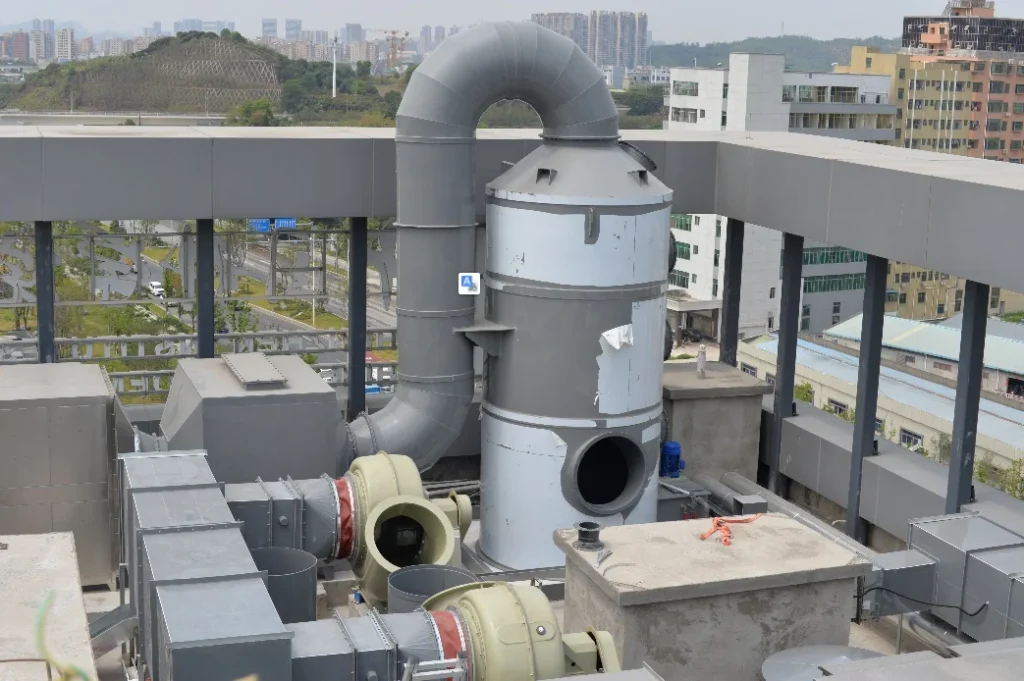
An incinerator spray tower is a critical component in the flue gas treatment system of every municipal, hazardous, and medical waste incinerator. The exhaust from waste combustion contains acid gases at concentrations that vary with the waste composition, particulate loads that fluctuate with the combustion conditions, and temperature swings from 200-300°C at the boiler outlet to near-saturation after wet scrubbing. The spray tower must handle all these variations while maintaining the gas temperature within the window required for effective acid gas absorption and protecting downstream equipment from corrosion. This guide covers the design parameters, operating principles, and selection criteria for incinerator spray tower systems across the full range of waste incineration applications.
The Role of the Incinerator Spray Tower in Flue Gas Treatment
The incinerator spray tower serves three simultaneous functions in a waste-to-energy or incineration flue gas train: quenching the hot gas to saturation temperature, absorbing acid gases from the combustion process, and removing a portion of the particulate matter before the gas reaches the baghouse or wet ESP.
Gas Quenching — Cooling from 200-300°C to Saturation
Flue gas leaving the waste heat boiler of a municipal solid waste incinerator typically exits at 180-250°C. After the economizer section, the gas temperature is 160-200°C. The first function of the spray tower is to cool this gas to its adiabatic saturation temperature of 60-80°C by evaporating water droplets injected through spray nozzles.
The quenching process is thermodynamically efficient: each kilogram of water evaporated removes approximately 2,260 kJ of thermal energy from the gas. For a typical MSW incinerator processing 200 tonnes per day with a flue gas flow of 40,000 m3/h, the quench section requires approximately 3,000-5,000 L/h of water to cool the gas from 180°C to 70°C.
The quench must be controlled precisely. If the water flow is too low, the gas leaves the quench section above the saturation temperature, reducing the acid gas absorption efficiency in the downstream scrubber section. If the water flow is too high, the gas can become supersaturated, causing water condensation on downstream components and accelerating corrosion.
Acid Gas Absorption — HCl and SO2 Removal
The second function of the incinerator spray tower is acid gas absorption. MSW combustion produces flue gas containing 500-2,000 ppm HCl from the combustion of PVC and other chlorinated plastics, and 50-400 ppm SO2 from sulfur-containing waste. A spray tower with caustic soda recirculation achieves 95-99% HCl removal and 85-95% SO2 removal at an L/G ratio of 0.5-1.5 L/m3. The same absorption principles apply across toxic gas scrubber systems and chemical scrubber systems used in related applications.
The absorption occurs primarily in the lower section of the spray tower, where the gas has been cooled to near-saturation and the liquid droplets provide a large interfacial area for mass transfer. The high solubility of HCl in water means that even plain water achieves 90%+ removal. SO2 requires alkaline conditions, and the recirculating scrubbing solution is maintained at pH 7-9 using caustic soda addition.
Particulate Pre-Removal and Downstream Protection
The spray tower captures 50-70% of the fly ash and particulate matter carried over from the combustion chamber. The captured particulates settle into the sump and are removed as a slurry. This pre-removal protects the downstream baghouse or wet ESP from excessive solids loading and reduces the frequency of bag cleaning cycles.
The temperature control function is equally important for downstream protection. By maintaining the gas temperature at 65-75°C, the spray tower prevents the baghouse from operating above its design temperature and prevents condensation in the ductwork that would cause corrosion.
Design Parameters for Incinerator Spray Towers
Designing an incinerator spray tower requires addressing the unique combination of high inlet temperature, variable acid gas loading, and particulate content that characterizes incinerator flue gas.
Gas Velocity and Tower Sizing
The gas velocity through the spray tower determines the vessel cross-section and the gas-liquid contact efficiency. For incinerator spray towers, the velocity is typically 0.6-1.2 m/s in the absorption section. Below 0.6 m/s, the tower diameter becomes impractically large for gas flows above 40,000 m3/h. Above 1.2 m/s, droplet entrainment increases and the pressure drop rises.
The quench section, where the gas is hottest, is sized for a higher velocity of 1.5-3.0 m/s because the gas volume is larger at the higher temperature. As the gas cools, the volumetric flow decreases, and the velocity drops to the target range for the absorption section below.
A typical MSW incinerator spray tower processing 40,000 m3/h at 180°C inlet has a quench section diameter of 2.0-2.5 m and an absorption section diameter of 3.0-4.0 m. The total vessel height, including the quench zone, the absorption zone, and the sump, ranges from 12-20 m.
Liquid-to-Gas Ratio and Approach Temperature
The L/G ratio in an incinerator spray tower serves dual purposes: providing the water flow required for gas cooling and supplying the liquid surface area for acid gas absorption. For the quench function, the L/G ratio is determined by the energy balance: the water flow must be sufficient to evaporate and cool the gas to the target approach temperature of 5-15°C above saturation.
For the absorption function, the L/G ratio must be high enough to maintain the target approach temperature while providing excess liquid for chemical reaction. The total L/G ratio for a combined quench-absorption spray tower ranges from 0.8-2.0 L/m3. At an L/G of 1.0 L/m3, a spray tower achieves 90-95% HCl removal. At 1.5 L/m3, the removal increases to 95-99%.
Nozzle Selection for Quench and Absorption
The nozzle requirements differ between the quench and absorption sections. Quench nozzles must produce fine droplets (100-300 um) to maximize the evaporation surface area and achieve rapid gas cooling. Full-cone spray nozzles at 3-7 bar pressure are standard for quench service.
Absorption nozzles require larger droplets (500-1,000 um) to avoid droplet carryover and to provide adequate momentum for gas-liquid contact. Hollow-cone or full-cone nozzles at 1-3 bar are standard. The dual-nozzle configuration allows independent optimization of each function.
Material Selection for Corrosive High-Temperature Service
Material selection is the most critical design decision for incinerator spray towers because the vessel must withstand both high temperature at the inlet and highly corrosive acid conditions at the outlet.
Quench section materials. The gas entering the quench section at 180-250°C is above the acid dew point. Once water is injected and the gas cools, the quench section walls are exposed to condensing acid. Stainless steel (SS316L) or Hastelloy is used in the quench zone, often with a refractory or acid-brick lining for thermal protection.
Absorption section materials. Below the quench zone, where the gas has cooled to 60-80°C, FRP with a vinyl ester resin system is the standard material. PP is acceptable at the lower end of the temperature range but is not recommended where the gas temperature can exceed 80°C. The vessel wall thickness must include a corrosion allowance of 3-6 mm for the anticipated 10-15 year service life.
Incinerator Spray Tower Configurations
The incinerator spray tower can be configured in several flow arrangements. The choice depends on the gas temperature, the required removal efficiency, and the integration with the rest of the flue gas treatment system.
Countercurrent Spray Tower
The countercurrent configuration is the standard for incinerator spray towers. Hot gas enters at the bottom and rises through the descending spray of scrubbing liquid. The countercurrent arrangement places the cleanest gas at the top in contact with the freshest scrubbing liquid, maximizing the concentration gradient for acid gas absorption.
For MSW incineration, the countercurrent spray tower achieves 95-99% HCl removal and 85-95% SO2 removal at an L/G ratio of 1.0-1.5 L/m3. The gas velocity is kept at 0.6-1.0 m/s in the absorption section, and the total vessel height ranges from 15-25 m depending on the number of spray levels and the required residence time.
Cocurrent Quench Tower
Some incinerator designs use a cocurrent quench section upstream of the countercurrent absorption section. In the cocurrent quench, both the hot gas and the quench water flow downward, allowing higher gas velocities of 2-5 m/s without droplet entrainment because the gas and liquid are moving in the same direction.
The cocurrent quench is more compact than a countercurrent design for the same cooling duty. The vessel diameter can be reduced by 15-30%. The trade-off is that the temperature driving force for evaporation decays more rapidly because both phases approach equilibrium together, requiring more precise water flow control.
Spray Dryer and Semi-Dry Systems
In a spray dryer absorber configuration, a lime slurry is atomized into the hot flue gas instead of water. The water in the slurry evaporates, cooling the gas, while the lime reacts with the acid gases to form dry reaction products. The SDA is followed by a baghouse that captures the reaction products and any unreacted lime.
The SDA configuration is chosen when the facility wants to avoid the liquid effluent that a wet spray tower produces. The dry reaction product is captured in the baghouse and disposed of as a solid. The SDA achieves 90-95% HCl removal and 80-90% SO2 removal at a lime stoichiometric ratio of 1.5-2.5.
Integration with Dry Sorbent Injection and Baghouse
Many incinerator flue gas treatment systems use a hybrid approach: an incinerator spray tower for quench and bulk acid gas removal, followed by dry sorbent injection and a baghouse for polishing. The spray tower removes 90-95% of the HCl and 50-70% of the fly ash. The remaining HCl is captured by dry lime injection into the duct upstream of the baghouse, where the reaction products are captured on the bag filter cake.
This hybrid configuration is common in European MSW incinerators where the emission limits for HCl are below 10 mg/Nm3. The wet spray tower handles the bulk removal, and the dry polishing stage ensures compliance with the stringent standard.
Performance: Temperature and Removal Efficiency
The performance of an incinerator spray tower is directly tied to the gas temperature at each stage of the tower. Understanding this relationship is essential for specifying the system and troubleshooting operating problems.
HCl Removal: 95-99% Across the Temperature Range
HCl is highly soluble in water across the full temperature range of incinerator spray tower operation. At 60°C, the Henry’s law constant for HCl is approximately 0.01 atm/mol fraction, meaning the equilibrium concentration of HCl in the gas phase above a neutral-pH scrubbing solution is effectively zero. A spray tower operating at an L/G of 1.0 L/m3 achieves 95% HCl removal regardless of the inlet concentration between 100-2,000 ppm.
To reach 99% removal for compliance with limits below 10 mg/Nm3, the L/G ratio must be increased to 1.5-2.0 L/m3, or a second spray level must be added. The second spray level provides a polishing stage where the freshest scrubbing solution contacts the nearly-clean gas, driving the outlet concentration to the minimum achievable level.
SO2 Removal: Approach Temperature Dependence
SO2 removal is more temperature-dependent than HCl because SO2 is less soluble in water. At 60°C and neutral pH, the Henry’s law constant for SO2 is approximately 50 atm/mol fraction. This means that a significant partial pressure of SO2 remains in the gas phase even after contact with the scrubbing solution.
The incinerator spray tower outlet temperature determines the approach to saturation, which directly controls the SO2 removal efficiency. At an approach temperature of 15°C, a spray tower achieves 80-85% SO2 removal at pH 7. Reducing the approach to 5°C increases the removal to 90-95%. The improvement comes from two effects: the closer approach temperature indicates longer gas-liquid contact time, and the lower absolute temperature increases the SO2 equilibrium solubility.
Using caustic soda to maintain the scrubbing solution at pH 8-9 increases SO2 removal by 10-15 percentage points compared to neutral-pH water at the same L/G ratio. The chemical reaction between SO2 and NaOH consumes the dissolved SO2 on the liquid side, keeping the effective concentration near zero. For incinerators burning high-sulfur waste, maintaining a pH above 8 is essential for achieving the required SO2 removal efficiency.
Heavy Metal and Dioxin Control
The spray tower captures 50-80% of particulate mercury and 30-50% of elemental mercury. For dioxins and furans, the spray tower captures 40-60% of the particle-bound fraction. Complete mercury and dioxin control requires activated carbon injection upstream of the baghouse, placed after the spray tower so the carbon is not wetted by the spray.
Opacity and Particulate Carryover
The visible stack plume from an incinerator spray tower is primarily condensed water vapor. A properly designed mist eliminator at the tower outlet captures 99% of droplets above 10 um, preventing liquid carryover that would cause a visible plume and potential opacity violations.
Industrial Applications by Waste Type
The incinerator spray tower serves different waste incineration sectors, each with characteristic flue gas compositions and regulatory requirements that affect the tower design.
Municipal Solid Waste Incineration
MSW incinerators represent the largest installed base of incinerator spray towers. A typical MSW plant processing 200-500 tonnes per day generates 30,000-80,000 m3/h of flue gas containing 500-2,000 ppm HCl, 50-400 ppm SO2, 100-500 mg/Nm3 of particulate, and trace heavy metals and dioxins.
The standard flue gas treatment train for MSW incineration consists of a spray tower for quench and acid gas removal, activated carbon injection for mercury and dioxin control, and a baghouse for particulate capture. HCl removal efficiency of 95-99% and SO2 removal of 85-95% are required to meet the EU Industrial Emissions Directive limit of 10 mg/Nm3 for HCl and 50 mg/Nm3 for SO2. Related wet scrubber dust collector and H2S scrubber system configurations are used in adjacent applications where particulate and sulfur compound control are required.
Hazardous Waste Incineration
Hazardous waste incinerators burn a wider range of waste compositions, producing flue gas with higher and more variable pollutant concentrations. HCl levels can reach 5,000 ppm, SO2 levels can reach 1,000 ppm, and the gas may contain chlorine gas, phosgene, and other toxic combustion byproducts.
The spray tower for hazardous waste incineration must be designed with a higher L/G ratio of 1.5-3.0 L/m3 and a larger corrosion allowance. The quench section is often constructed of Hastelloy or lined with acid-resistant brick. Two-stage scrubbing, with an acid stage followed by a caustic stage, is standard for handling the wide range of acid gas loads.
Medical Waste Incineration
Medical waste incinerators are smaller, typically processing 10-50 tonnes per day. The flue gas contains high HCl levels from PVC medical waste, often 1,000-3,000 ppm, and may contain mercury from broken thermometers and dental amalgam. The gas flow rate varies significantly during the batch cycle, with peak flows during the charging phase and lower flows during the burn-down phase.
The spray tower for medical waste incineration is typically a packaged unit with an integral quench section and a packed bed scrubber in a single vessel. The gas flow is 5,000-20,000 m3/h, and the required HCl removal is 95-99% to meet the EPA Medical Waste Incinerator MACT standard of 15 ppmv or 99% removal.
Sludge and Biomass Incineration
Sewage sludge incinerators and biomass combustion plants produce flue gas with lower HCl levels of 50-200 ppm but higher moisture content of 30-50% by volume. The spray tower operates at a lower L/G ratio of 0.5-1.0 L/m3 because the gas has higher inherent moisture content, requiring less evaporative cooling. SO2 levels from biomass combustion range from 50-200 ppm depending on the sulfur content of the fuel.
How to Select an Incinerator Spray Tower
Selecting an incinerator spray tower requires matching the tower design to the waste type, the gas flow, the pollutant load, the regulatory requirements, and the site constraints.
Selection Criteria
The gas flow rate and temperature at the spray tower inlet determine the vessel diameter and the quench water flow. The acid gas concentration determines the L/G ratio and the scrubbing solution chemistry. The applicable emission standard determines the required removal efficiency and the number of spray stages.
For an MSW incinerator with 40,000 m3/h flue gas at 180°C, 1,000 ppm HCl, and 200 ppm SO2, requiring EU IED compliance (HCl 10 mg/Nm3, SO2 50 mg/Nm3), the spray tower specification would be a countercurrent design with two spray levels, an L/G ratio of 1.2 L/m3, a quench section constructed of SS316L, and an absorption section of FRP vinyl ester. The total vessel height would be 16-20 m with a diameter of 3.0-3.5 m.
For a medical waste incinerator with 10,000 m3/h, 2,000 ppm HCl, and a 99% removal requirement, the spray tower would be a packed bed scrubber with 50 mm PP packing, an L/G of 1.5 L/m3, and a mist eliminator for droplet capture. The smaller size allows a packaged unit that can be factory-assembled and shipped as a single vessel.
Manufacturer and Supplier Evaluation
When evaluating an incinerator spray tower manufacturer or incinerator spray tower supplier, request proven references in the specific waste incineration sector, the design methodology for quench section sizing including the evaporation calculation, the material certification for all wetted components, the performance guarantee format with liquidated damages, and the aftermarket support capabilities including spare parts availability and service response time.
For incinerators in China operating under GB 18485, which sets HCl limits at 50 mg/Nm3 and SO2 at 80 mg/Nm3 for MSW incineration, the spray tower design follows the same principles but can operate at a slightly lower L/G ratio of 0.8-1.2 L/m3. The incinerator spray tower china market has grown significantly with the expansion of the waste-to-energy sector, and local manufacturers offer competitive options for the domestic market.
Cost Considerations
The installed cost of an incinerator spray tower for a 40,000 m3/h MSW plant ranges from $300,000-600,000 for the vessel, nozzles, and internal components, excluding the recirculation pump, piping, and instrumentation. The total installed cost including ancillary systems is $500,000-1,000,000. Annual operating cost is $50,000-150,000 including caustic soda, water, power, and maintenance. The operating cost is dominated by caustic soda consumption, which typically accounts for 40-60% of the total. Power consumption for the recirculation pump and the fan adds 20-30%, and maintenance adds 10-20%. For comparison with adjacent applications, see the aluminum smelter wet scrubber outlet temperature and paint booth wet scrubber systems guides. Browse our wet scrubber product range or contact our engineering team for a preliminary incinerator spray tower design for your specific waste type and capacity.
FAQ
What is an incinerator spray tower?
An incinerator spray tower is a vertical vessel that quenches hot flue gas from 200-300°C to 60-80°C by evaporating water droplets, while simultaneously absorbing acid gases such as HCl and SO2 into a recirculating alkaline scrubbing solution.
What removal efficiency does an incinerator spray tower achieve?
A well-designed spray tower achieves 95-99% HCl removal and 85-95% SO2 removal at an L/G ratio of 1.0-1.5 L/m3 with caustic soda scrubbing. The exact efficiency depends on the gas temperature, the approach to saturation, and the scrubbing solution pH.
What materials are used in incinerator spray towers?
The quench section, where the gas is hottest, uses stainless steel SS316L or Hastelloy with refractory or acid-brick lining. The absorption section below the quench uses FRP with vinyl ester resin or polypropylene for temperatures below 80°C.
How does an incinerator spray tower differ from a spray dryer absorber?
A wet spray tower uses water or caustic solution and produces liquid effluent. A spray dryer absorber uses lime slurry that dries to a powder, producing no liquid waste. The spray dryer must be followed by a baghouse to capture the dry reaction products. Both configurations are used in incineration, with the choice depending on the wastewater treatment capacity and the disposal options.
What is the role of the quench section?
The quench section cools the hot flue gas from 180-250°C to near its saturation temperature of 60-80°C by injecting fine water droplets that evaporate. The rapid cooling prevents the formation of dioxins in the 200-400°C temperature window and protects downstream equipment from thermal damage. The quench water flow must be precisely controlled to achieve the target outlet temperature without causing supersaturation.
How do I select an incinerator spray tower manufacturer?
When evaluating an incinerator spray tower manufacturer or incinerator spray tower supplier, verify references in your specific waste incineration sector, review the design methodology for quench and absorption sections, confirm the material certifications, and request a performance guarantee with defined testing and acceptance criteria. For the Chinese market, local incinerator spray tower china manufacturers offer cost-competitive options with proven experience in the rapidly expanding waste-to-energy sector.
Key Takeaways
- The incinerator spray tower serves three simultaneous functions: quenching hot flue gas from 200-300°C to 60-80°C, absorbing 95-99% of HCl and 85-95% of SO2, and pre-removing 50-70% of fly ash before the gas reaches the baghouse.
- Quench section design is the most critical element. SS316L or Hastelloy with acid-brick lining is required for the 180-250°C inlet zone, while FRP vinyl ester is standard for the 60-80°C absorption section.
- CO2 removal efficiency is strongly dependent on the approach temperature. Reducing the approach from 15°C to 5°C increases SO2 removal from 80-85% to 90-95% by improving gas-liquid contact and increasing SO2 solubility.
- MSW, hazardous, medical, and sludge incineration each produce characteristic pollutant loads that affect the spray tower L/G ratio, the material selection, and the number of spray stages required.
- The hybrid wet-dry configuration combining a spray tower with dry sorbent injection and a baghouse is the standard approach for achieving HCl limits below 10 mg/Nm3 in European waste-to-energy plants.