Key Takeaways
- The material decision for a PP FRP centrifugal blower starts with temperature: polypropylene serves to roughly 190 °F, fiberglass-reinforced plastic to roughly 250 °F. Stay inside the tier, then match the chemistry.
- Within each temperature tier, chemistry decides. PP is a broad alloy for aqueous acids, bases, and salts, but it fails on strong oxidizers — hot concentrated sulfuric acid, wet chlorine, boiling nitric acid — and on some organic solvents, exactly the cases where FRP takes over.
- A PP FRP centrifugal blower is a real, listed product, not a category error: a polypropylene impeller inside an FRP casing, or an FRP shell with a polypropylene liner. The hybrid buys a moldable complex wheel plus a stiff, hot-duty housing, and it is what the keyword phrase actually means in the market.
- Polypropylene is cheaper at first purchase; FRP returns more years in hot, pressurized, round-the-clock service. Compare the lifecycle cost — replacement frequency and downtime — not the ticket price.
- Both plastics need special formulations for the hard environments: flame-retardant polypropylene or carbon-impregnated conductive PP for explosion-rated zones, UV-stabilized PP and gel-coated FRP for outdoor service.
PP FRP Centrifugal Blower: The Material Decision in One Read
The most frequent buying question in corrosion-resistant air handling is not which wheel but which plastic. The label PP FRP centrifugal blower turns up on vendor catalogues and supplier directories with a line of material text and nothing else — yet the two halves of that name carry different temperature limits, different chemical tolerances, different stiffness, and different first costs. This guide converts that one-line material spec into a decision sequence you can run against your own duty: temperature first, then chemistry, then pressure and safety, then the lifetime cost.
Neither polypropylene nor fiberglass-reinforced plastic is universally better. PP resists a wider spread of everyday aqueous chemistry at lower weight and lower cost, while FRP holds more temperature and more pressure and shrugs off the aggressive oxidizers that soften PP wall stock. For a large share of fume scrubber and acid-plant duty the strongest answer is not one of the two but a PP-FRP hybrid — a polypropylene impeller inside a fiberglass casing that keeps the complex wheel cheap to mold and the housing strong enough at temperature.
Run these three self-checks before reading further:
- Stream temperature at the fan inlet below about 190 °F and the media is aqueous acid, base, or salt — polypropylene serves the duty at the lowest first cost.
- Inlet above about 190 °F, or wet chlorine, a strong oxidizing acid, or high static pressure — the FRP family, with the resin grade selected against the specific chemistry.
- Neither tier plainly fits — pressurized hot solvent, low-temperature but wet chlorine, or explosion-rated — a specialist-resin build or a carbon-impregnated conductive PP wheel, reviewed with the manufacturer.
The sections that follow put numbers on those three branches. The FRP full-build guide and the polypropylene full-build guide carry the deep documentation for each material; this page keeps the choice logic itself: temperature, chemistry, pressure, safety, lifetime cost, and the hybrid construction that often settles the argument. Figures quoted are typical catalogue values from published fan data and AMCA-style testing; where a supplier certifies a fan under AMCA 210, compare on those curves rather than on a paragraph of material text.
The Temperature Ladder: Why PP and FRP Sit on Different Rungs
Temperature is the first filter in any thermoplastic selection, because every plastic loses strength as it warms and there is no chemistry fix for softening. The polypropylene vs fiberglass fan question is, before anything else, a temperature question: the two materials occupy different rungs of the same ladder, and the rung your stream sits on eliminates one of them immediately.
| Material | Continuous service limit | What happens beyond it |
|---|---|---|
| PVC | ≈140 °F (~60 °C) | Deforms under duct positive or negative pressure; safe only as a low-temperature reference |
| Polypropylene (PP) | ≈190 °F (~90 °C) | Softens and creeps in stages; brief excursions are tolerable, sustained exposure loses wall strength |
| FRP (isophthalic / vinyl-ester resin) | ≈250 °F (~121 °C) | Resin starts to degrade; a matched high-heat resin system can extend the ceiling |
| 304 / 316 stainless steel | Steam and high-temperature capable | Used as the upper comparison bound — and subject to pitting and stress-corrosion cracking in chloride service |
Read the ladder as a decision, not a decor piece. If the gas or vapor at the fan inlet sits at 210 °F continuously, the polypropylene rung is ruled out before any chemistry discussion — an FRP fan is the only plastic answer on this page, and the common stainless alternative brings its own chloride pitting problem that the resin does not share. If the duty runs at 120 °F, both rungs are open, and the temperature column simply hands the decision to the chemistry section below.
Two temperature behaviours deserve a precise definition, because they are where the polypropylene vs fiberglass fan comparison usually goes wrong in practice. The first is short excursions. A polypropylene blower on a process that spikes to 220 °F for twenty minutes during a warm-up cycle is not automatically a failed spec; PP tolerates brief over-temperature before mechanical loss sets in. The second is sustained service: weeks of 200 °F creep at the trickle of hot gas slowly relaxes the wall and the wheel, and no catalogue margin saves a PP fan from that. Define the duty as continuous hours rather than a peak reading, then put that figure on the ladder.
The value in the hybrid build starts to appear right here. If the impulse is “the stream is too hot for PP,” the temperature ladder says the FRP rung carries the housing; it does not automatically say the impeller must be FRP too. A molded polypropylene wheel inside a fiberglass casing — the PP FRP centrifugal blower form that most distributors actually list — runs the housing on the 250 °F rung while the wheel stays on the lower rung where its chemistry and its cheap geometry earn their keep. Temperature sets the tier; it does not settle which sub-assembly uses which material.
Chemical Matching: The Blind Spots That Decide the Material
Temperature separates PP and FRP into two rungs; chemistry decides which one of them survives the actual stream. The useful mental model is not “which material is more corrosion-resistant” — each has chemicals it shrugs off and chemicals it does not — but a pair of blind spots. PP and FRP cover different failures, and the smart selection is the one that hands each chemical family to the plastic that tolerates it.
What polypropylene does well. PP is the quiet workhorse of aqueous corrosion service. It tolerates almost the entire spread of everyday inorganic chemistry — hydrochloric, sulfuric, phosphoric, and nitric acids at moderate concentration, sodium and potassium hydroxide, ammonium and sodium salts, bleach at ambient temperature — in wet media up to roughly 60–80 °C. It is notably good where streams deposit solids: crystalline salts cling less to a smooth PP surface, which is why PP is standard for fume-cupboard and plating-tank exhaust where mist carries salt residue.
Where polypropylene fails. PP has two hard stops. Strong oxidizing media attack it thermally and chemically at once: hot concentrated sulfuric acid, concentrated or fuming nitric acid, and wet chlorine or bromine vapor at significant concentration erode and swell plain PP. Organic solvents are the second stop — aromatic and halogenated solvents (toluene, xylene, chlorinated degreasers) swell the amorphous phase of PP and soften it even at low temperature. When either family is in the stream, PP is the wrong answer regardless of how mild the pressure or the temperature is.
What fiberglass-reinforced plastic does well. The FRP family is chosen for the aggressive side of the spectrum: wet chlorine and chlor-alkali service, bleach and hypochlorite streams, oxidizing acids, and combinations of heat with acid that would soften a PP wall in months. The corrosion barrier comes from the resin, not the glass — isophthalic polyester resin covers the everyday acid/alkali range, vinyl-ester resin extends it to stronger oxidizers and chlorinated service, and bisphenol-based resins go further still. Because the resin system can be swapped at the lay-up stage, FRP is the material that scales up the chemical severity axis.
Where FRP needs care. FRP is not universal either. Hydrofluoric acid attacks the glass itself and demands a special glass-free or specialty-resin construction. Over-concentration of organic solvent, especially warm, can attack the resin matrix even when the glass is untouched. And FRP is sold in grades: the same “fiberglass fan” can carry an isophthalic resin or a premium vinyl ester, with a very different service envelope and price. When a supplier quotes an FRP fan for a challenging medium, the resin grade is the detail to pin down.
That pair of blind spots is why the polypropylene vs fiberglass fan comparison usually produces a short answer: if the stream is aqueous acid, base, or salt below 190 °F, PP wins on cost and weight; if the stream is wet chlorine, a strong oxidizer, or a hot solvent-laden medium, FRP wins on survival. The short answer stops being adequate when a stream spans both — hot, chlorine-bearing acid with low-pressure duty — because then neither single material is ideal and the decision moves to the hybrid build described below.
PP vs FRP Blower: The Full Comparison
| Characteristic | Polypropylene (PP) blower | FRP blower |
|---|---|---|
| Continuous temperature limit | ≈190 °F (~90 °C) | ≈250 °F (~121 °C), more with a high-heat resin grade |
| Broad chemical range | Near-universal aqueous acids, bases, salts to 60–80 °C; good with solid-laden mist | Wide acids, bases, chlorine family, oxidizers, many solvents; resin-grade dependent |
| Weak points | Hot concentrated sulfuric/nitric, wet chlorine, aromatic and chlorinated solvents | Hydrofluoric acid (needs specialty), over-concentrated warm solvent, over-temp oxidizing service |
| Construction and stiffness | Injection-molded and welded; light, ductile, cheap complex wheels; low stiffness calls for thicker casing | Laminated glass/resin; stiff and strong; large high-pressure casings to 30 in WG and beyond |
| Flame and static | Inherently flammable (UL 94 HB); flame-retardant or carbon-filled conductive grades | Flame-retardant resin lines; conductive veil or coating for static service |
| First cost and life | Lower first cost; long life in steady moderate aqueous duty | Higher first cost; returns longer service in hot, pressurized, continuous duty |
The FRP vs PP blower question, in its shortest form, is answered by four rows of that table: temperature limit, the weak-point row (which settles most chemical questions), construction stiffness for pressure, and the cost-versus-life pair at the bottom. Read the table once with your own numbers — inlet temperature, exact chemical list, static pressure, running hours — and most duties resolve to a single material before any supplier is contacted.
Three nuances keep the table honest. First, the chemical rows are breadth descriptions, not guarantees: the correct way to confirm either material against a specific stream is the manufacturer’s corrosion-resistance chart, keyed to temperature and concentration, not the catalogue blurb. Second, stiffness is the pressure column that buyers miss. A polypropylene casing at high static pressure gets thick and heavy; FRP carries the same pressure in a thinner, stiffer laminate, which is why large high-pressure corrosive exhaust almost always lands FRP. Third, neither material excuses the wrong metal: the steel counterparts of this table — galvanized and carbon steel — corrode in acid service, and even 304/316 stainless pits in wet chloride fume where a vinyl-ester FRP keeps running for years.
For the pressure headroom half of the comparison, the wheel-family logic runs in parallel with the material logic: an FRP or PP blower comes in forward-curved and backward-curved forms, and which curvature you need is decided by static pressure and efficiency before the plastic is chosen. The more pressure the duty demands, the more FRP’s stiffness earns its higher price.
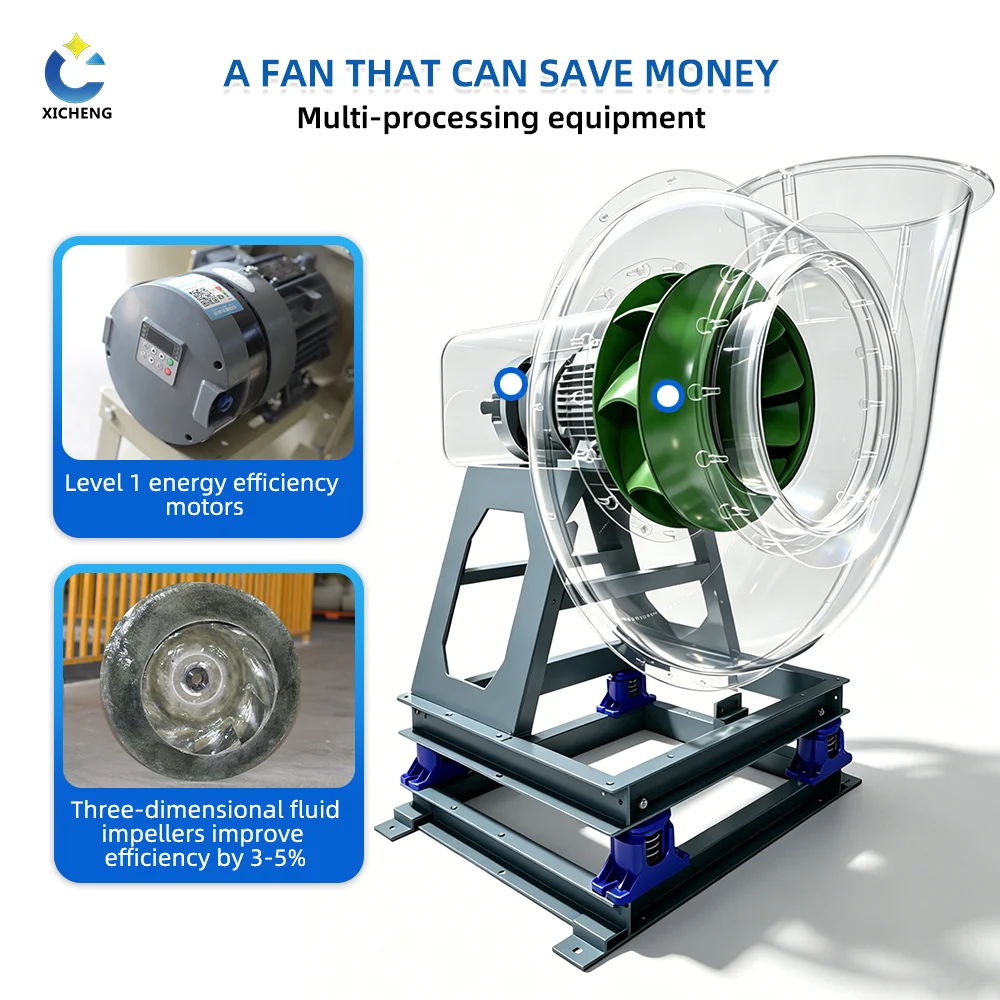
The anatomy behind the two constructions is documented separately. FRP blowers are laid up from glass-fibre mat and resin over a mould and cured into a continuous laminate with no metal in the wetted path; polypropylene blowers are molded and hot-welded from sheet and grade-specific alloys. The base materials themselves are covered by Wikipedia’s glass-reinforced plastic article and the polypropylene page for background reading on fibre loading and resin chemistry.
What Is a PP FRP Centrifugal Blower? The Hybrid Build
Here is the piece the marketing directories never explain: in the market, a PP FRP centrifugal blower is most often not “either PP or FRP” — it is both at once, a hybrid construction that pairs each plastic with the job it performs best. The phrase is not a confused mixture of two words; it names a real engineering configuration, and once you see it, the keyword question resolves cleanly.
Configuration One: Polypropylene Impeller, FRP Casing
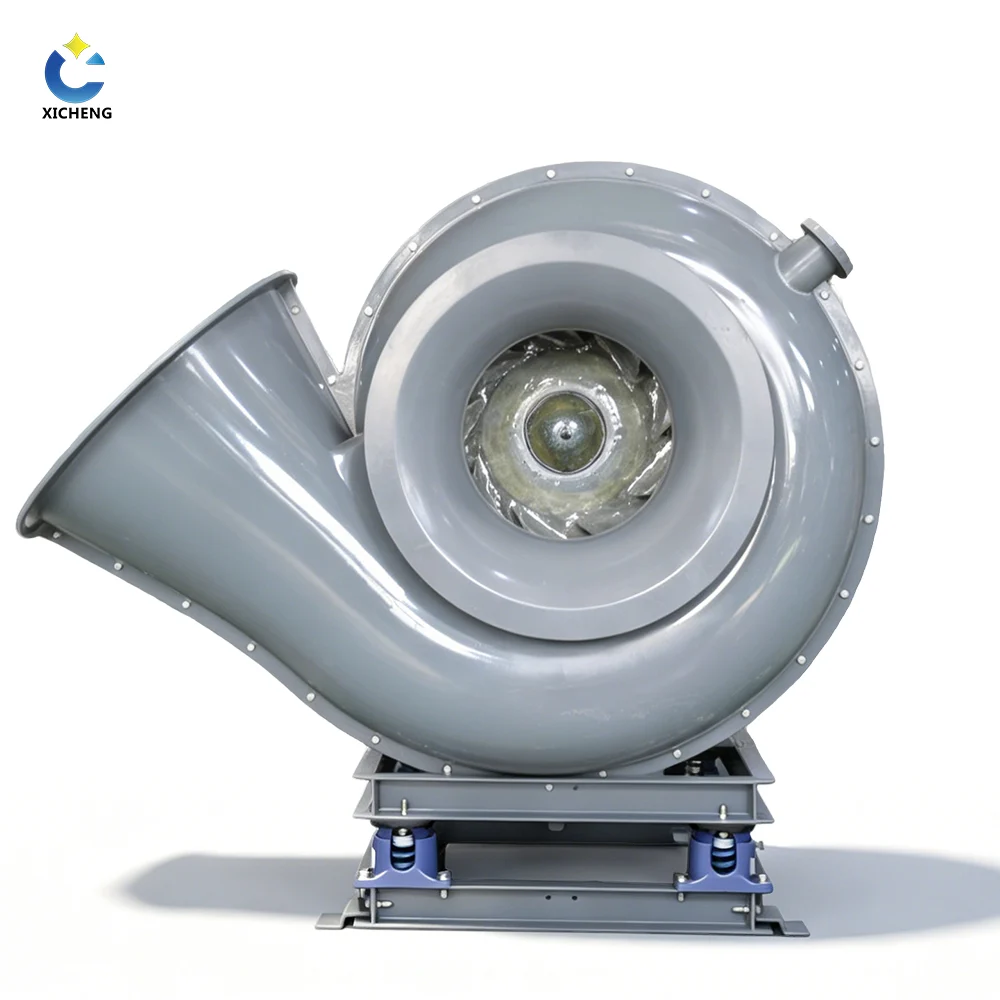
The common form pairs a molded polypropylene wheel with a fiberglass-reinforced casing. The impeller is the difficult geometry — dense arrays of shallow forward-curved blades, or the flat plates of a radial wheel — and injection molding or stacked blade-welding reproduces those shapes exactly in PP at a fraction of the labour an FRP hand lay-up would cost. The casing is the pressure member: an FRP scroll for a PP FRP centrifugal blower carries higher static pressure and more temperature headroom than a welded PP shell of the same wall would, so the hybrid gets the cheap, precisely molded wheel and the stiff, hot-duty housing in one machine.
Configuration Two: FRP Shell, Polypropylene Lining
The reverse form is used where the structural load is severe but the immediate wetted surface favors PP. A fiberglass shell gives the strength, while a polypropylene liner presents the chemically broad, deposit-shedding surface to the stream. This matters when a stream is mechanically dirty or salt-bearing — PP holds its smoothness and release behaviour where a bare resin would slowly erode — and the FRP carries the pressure that plain PP wall stock could not.
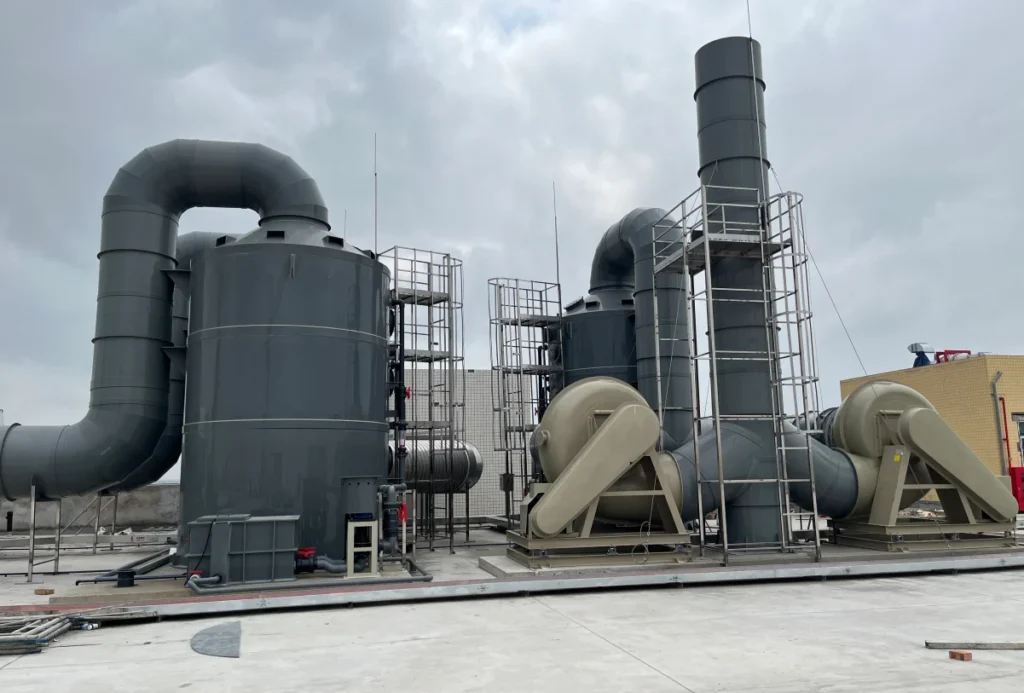
A PP FRP centrifugal blower fan specified this way is the standard engineering entry point for medium-pressure corrosive duty: fume scrubber discharge, plating exhaust, acid-storage ventilation, chlor-alkali peripheral air handling. The impeller stays on PP’s cheap rung, the casing climbs to FRP’s temperature and pressure rung, and the buyer pays for the combination rather than for a fully premium FRP wheel.
When the Hybrid Makes Sense — and When It Does Not
Choose the hybrid when the duty splits down the middle: moderate-to-high static pressure with aqueous chemistry that PP handles comfortably, or a casing that will see more heat than the wheel. Choose it when first cost matters and the impeller would be the expensive half to build in FRP. Avoid it when the chemistry is the deciding factor across the whole machine — a solvent-laden or strongly oxidizing stream calls for a single full-FRP build in the right resin, because lining a casing does not protect a PP wheel from solvent swell. Avoid it, too, when the operating point genuinely lives above the PP tier: at 230 °F the wheel reaches its limit even if the shell is happy, and the correct machine is all-FRP.
That boundary check is also the practical reading of the keyword. When a spec sheet or an inquiry asks for a PP FRP centrifugal blower fan, the buyer is almost always describing the hybrid — a polypropylene wheel on one rung, an FRP casing on the other — rather than forcing a choice between a plain PP fan and a plain FRP fan. Asking the supplier ‘which of the four builds is standard for this stream’ is the fastest way to discover what the catalogue shorthand actually means.
However the materials are combined, the performance claims deserve the same discipline. A hybrid PP FRP centrifugal blower is still a centrifugal fan, and its pressure, airflow, and efficiency are a curve, not a single number. Comparing two suppliers means comparing certified curves — AMCA publishes the test standards industrial fans are rated under — plus the resin grade and the welding or laminating method. The material decision gets you the right plastic; the curve gets you the right machine.
First Cost, Lifespan, and the Replacement Math
The last two rows of the comparison table — first cost and life — are where most real purchases are actually settled, and they pull in opposite directions, so they have to be read as one number: the cost per year of installed, operating machine, not the invoice.
Polypropylene wins the first-cost column for a simple structural reason. PP sheet, PP welding rod, and injection-molded wheels are cheap, the fabrication is mechanical, and a PP fan of a given air duty is lighter to ship and hang. Two identical duties will typically quote the PP FRP centrifugal blower hybrid — or the plain PP machine — 20–40% below the fully premium FRP equivalent, and on a small moderate-duty fume cupboard extractor that gap is often the deciding factor on its own.
Fiberglass-reinforced plastic wins the life column in the duties where it is chosen honestly. FRP costs more to lay up because it is a skilled process — resin, veil, glass mats, cure schedule, flame-retardant and UV finishing — but in continuous hot or pressurized service that premium buys years. A PP wall at the top of its temperature band creeps and loses strength on a schedule measured in seasons; an FRP laminate at the same duty keeps its modulus for a decade-plus, which is why scrubber discharge blowers and stack fans on round-the-clock service routinely carry an FRP price tag with a lifecycle stamp of approval. The steel alternative is the sharp reminder of what both plastics are winning against: painted carbon steel corrodes in wet acid service within a season, and stainless pitting starts where a resin wall is untouched.
Run the replacement math for a light continuous duty — a 5,000 CFM fume extractor on 4,000 hours a year, say, running a modest 190 °F aqueous stream. A plain PP blower at a 30% lower first cost may need its casing refreshed after six years near its temperature ceiling; the FRP machine typically outlives that by a wide margin. The PP decision gives back its saving at the moment of replacement, plus a season of lost production while the swap happens. Multiply across five scrubbers in a line and the lifecycle number on the FRP side stops looking premium. The U.S. Department of Energy’s fan-system assessment guide frames the same logic at plant scale, treating first cost, operating cost, and lifecycle cost as parts of one decision rather than separate line items.
The honest summary is therefore short. For intermittent, low-temperature, budget-driven aqueous duty, polypropylene is simply the economic answer and the hybrid adds strength where the casing needs it. For continuous, hot, pressurized, or chloride-heavy service, FRP pays its higher entry price back in years of unbroken operation. Everything else — ATEX, UV exposure, solvent content — is a spec overlay that both materials handle with a grade change rather than a life pivot.
Corrosion Resistant Polypropylene Fans: When PP Wins
For the volume of corrosive-duty ventilation sold, corrosion resistant polypropylene fans are the default answer, and the default is correct more often than the marketing suggests. A PP fan is the right machine whenever the stream is aqueous acid, base, or salt below roughly 190 °F, the static pressure is moderate, and the buyer cares about weight, first cost, and the price of a complex wheel. That is fume-cupboard exhaust, plating- and anodizing-tank ventilation, laboratory extract, acid-storage buildings, and a large share of scrubber intake duty.
The PP wins multiply on the shop floor rather than on paper. A molded polypropylene impeller reproduces dense blade geometry exactly, the whole machine is lighter to support and easier to install in tight spaces, and the run cost of a PP FRP centrifugal blower built with a PP wheel stays low even as the casing, if needed, climbs to FRP. The corrosion resistance is not a coating that can chip — it is the wall material itself, homogeneous from blade to casing flange, with no painted surface to fail and no metal in the gas path.
When FRP Takes the Duty Instead
Corrosion resistant polypropylene fans lose the job only at the edges of their envelope, and the edges are precise. Inlet temperature above the 190 °F rung; a stream that is wet chlorine, chlorine dioxide, or a strong oxidizing acid; static pressure high enough that an FRP laminate carries the casing more cheaply than a thickened PP shell; or a flow large enough that the stiffness of glass-reinforced plastic wins the structural argument. The FRP line holds the 250 °F rung, handles the oxidizers and chlorinated service PP cannot, and builds the big high-pressure machines. The full build detail is the FRP blower guide’s subject; this page only needs the boundary.
Flame, Static, and UV: The Procurement Hard Points
Safety and outdoor service are where both materials stop being interchangeable, and each has its own spec to remember.
Flame. Polypropylene is inherently combustible, carrying a UL 94 HB rating, and flame-retardant PP grades reduce but do not remove the risk. FRP resin systems, by contrast, can be formulated with flame-retardant chemistry and low flame-spread laminates for duct and fan service where fire codes apply — which is why high-risk installations often specify FRP not for its corrosion but for its fire behaviour. If a code demands a flame-spread rating, put the resin grade on the datasheet before the price.
Static and explosion zones. For gas streams that are flammable or solvent-bearing, static charge on a non-conductive plastic wall is a real ignition source. The standard fix is a conductive alloy: carbon-impregnated polypropylene (CIP) bleeds charge through the wall and is the routine ATEX-grade choice for explosion-rated PP FRP centrifugal blower builds running a PP wheel. The FRP equivalent uses a conductive veil or coating to the same end. Ask for the grade by name — “conductive PP” or “ATEX version” — because a standard PP fan is not inherently safe in a classified zone.
UV. Exposed polypropylene degrades under sunlight without a UV stabilizer or carbon fill, while FRP wears a gel coat and veil that shield the laminate from the sun. Outdoor machines need the UV-specific grade regardless of which material is chosen; indoor fume duty rarely raises the question.
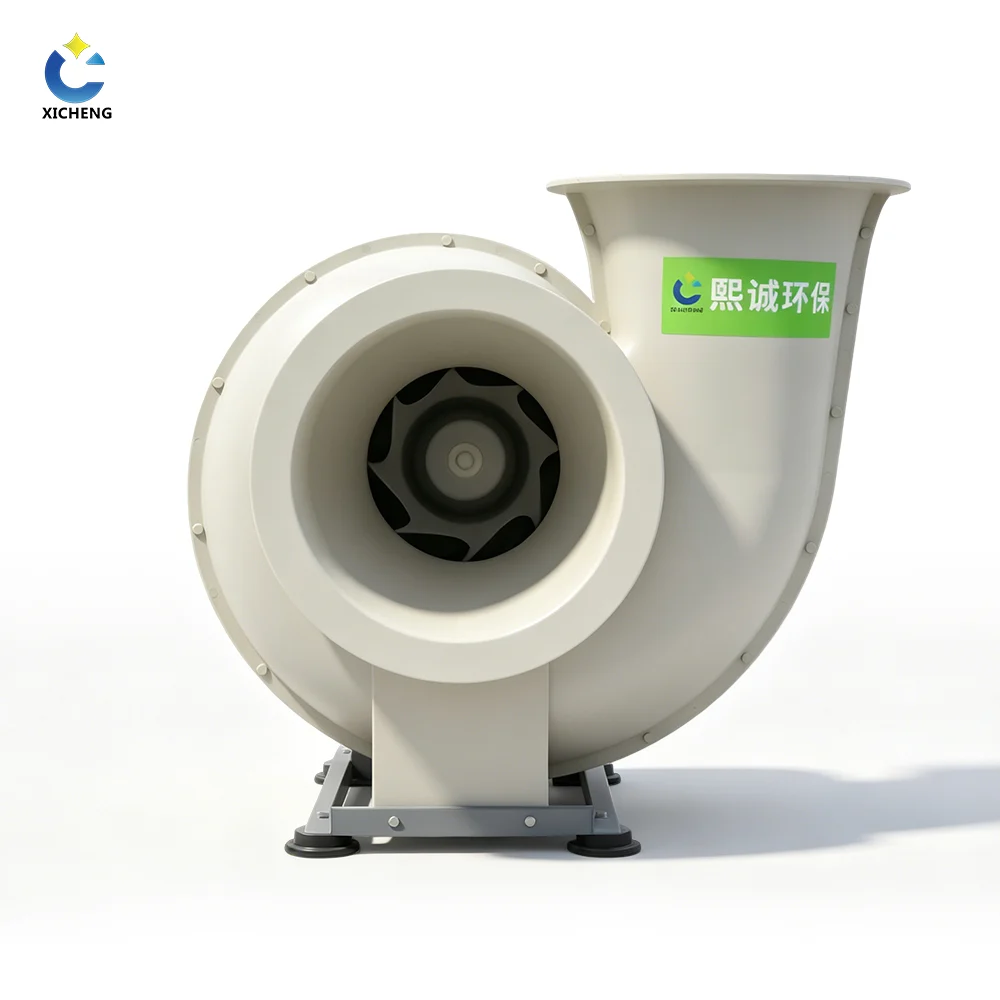
With the boundary clear, the purchase shortcut is shorter than it looks. For the aqueous, moderate-temperature service that PP covers, order from the PP blower line; for the hot, pressurized, oxidizer-heavy service that PP cannot cover, the FRP blower line, and for the duties that split down the middle — PP wheel, FRP casing — the full FRP/PP blower range covers the hybrid without forcing either extreme. The polypropylene blower guide carries the deep application material for the PP half of this decision.
PP vs FRP Blower FAQ
Which material takes higher temperatures, PP or FRP?
FRP. Fiberglass-reinforced plastic runs continuously to roughly 250 °F (~121 °C), and matched high-heat resin grades push higher still. Polypropylene serves to roughly 190 °F (~90 °C); beyond that it creeps and loses wall strength on a real schedule. Temperature is the first filter of the whole decision.
Can a PP fan handle concentrated sulfuric acid or wet chlorine?
Not the strong versions. Polypropylene surfaces handle dilute-to-moderate sulfuric acid at ambient temperature, but hot concentrated sulfuric acid, fuming nitric, and wet chlorine or bromine vapor at significant concentration attack PP thermally and chemically. Those streams move the decision firmly to FRP, with a resin grade selected for the specific oxidizer.
What chemicals attack fiberglass-reinforced plastic?
Hydrofluoric acid attacks the glass itself and needs a specialty, glass-free construction. Over-concentrated warm organic solvent can attack the resin matrix, and sustained strong-oxidizer-plus-high-temperature service demands the right resin grade — isophthalic polyester, vinyl ester, or bisphenol, in ascending order of aggression. FRP is not one material; the resin grade is the spec that matters.
Is a PP FRP centrifugal blower one plastic or both?
Both, in a hybrid build. A PP FRP centrifugal blower pairs a molded polypropylene impeller with a fiberglass-reinforced casing, or an FRP shell with a polypropylene liner. The wheel gets PP’s cheap, exact molding and broad aqueous chemistry; the casing gets FRP’s stiffness, pressure, and 250 °F headroom. It is the real market meaning of the phrase.
Is polypropylene or FRP cheaper?
Polypropylene, at first purchase — typically 20–40% below a fully premium FRP equivalent because PP sheet, welding, and molded wheels are cheap and light. The cost question has to be read with the life column though: in hot, pressurized, round-the-clock service FRP returns its higher entry price in years of unbroken operation. The FRP vs pp blower price comparison that stops at the invoice is the most common misread in the purchase.
Which lasts longer, a PP or FRP blower?
In the duty each is chosen for, both last well. Grey area is where they diverge: a PP machine run near its 190 °F ceiling continuously will creep and need refreshing on a schedule of years, while an FRP laminate at the same duty keeps its stiffness for a decade-plus. Intermittent low-temperature aqueous service favors PP economics; continuous hot pressurized service favors FRP life.
How do I choose a PP FRP centrifugal blower for an explosive or ATEX zone?
Start from the static charge, not the corrosion. A standard non-conductive plastic wall is an ignition source in a classified zone, so specify a conductive alloy — carbon-impregnated polypropylene (CIP) for a PP wheel, or a conductive veil or coating on FRP — and confirm the drive and seals for the zone class. Flame-retardant construction references UL 94 and flame-spread data; in code-driven installations the FRP flame-spread rating often decides the material before corrosion does.
Whether the answer to your duty is polypropylene, fiberglass, or a PP FRP centrifugal blower hybrid, the decision needs a corrosion-resistance confirmation against your exact stream and a certified performance curve — not a catalogue line. Send the inlet temperature, the chemical list, the static pressure, and the running hours to XICHENG and the sizing conversation starts from those four numbers. Contact XICHENG for a material and blower recommendation for your corrosive exhaust duty.