Key Takeaways
- A coating on a metal fan is the first thing to fail in corrosive service — the wetted wall of genuine corrosion resistant blowers is made of the corrosion-resistant material itself, not painted with it.
- Classify the environment before choosing the material: chemical acid or alkali, chlorides and chlorine, galvanizing and acid-wash mist, solvents, marine humidity, or hot oxidizing gases each point to a different tier of the material spectrum.
- The spectrum has six tiers — coated steel, PVC, polypropylene, FRP, stainless steel, and specialty alloys — and nearly every corrosive duty lands on one of the middle three.
- Corrosion resistant blowers are overwhelmingly centrifugal, because that form builds the 1–30 in WG of static pressure that scrubbers, fume hoods, and process vents demand.
- Before you order, verify the resin grade, the wet-path material statement, the conductive or flame-retardant options, and the certified performance curve — a catalogue line of material text proves none of them.
Corrosion Resistant Blowers: The Material Decision in One Read
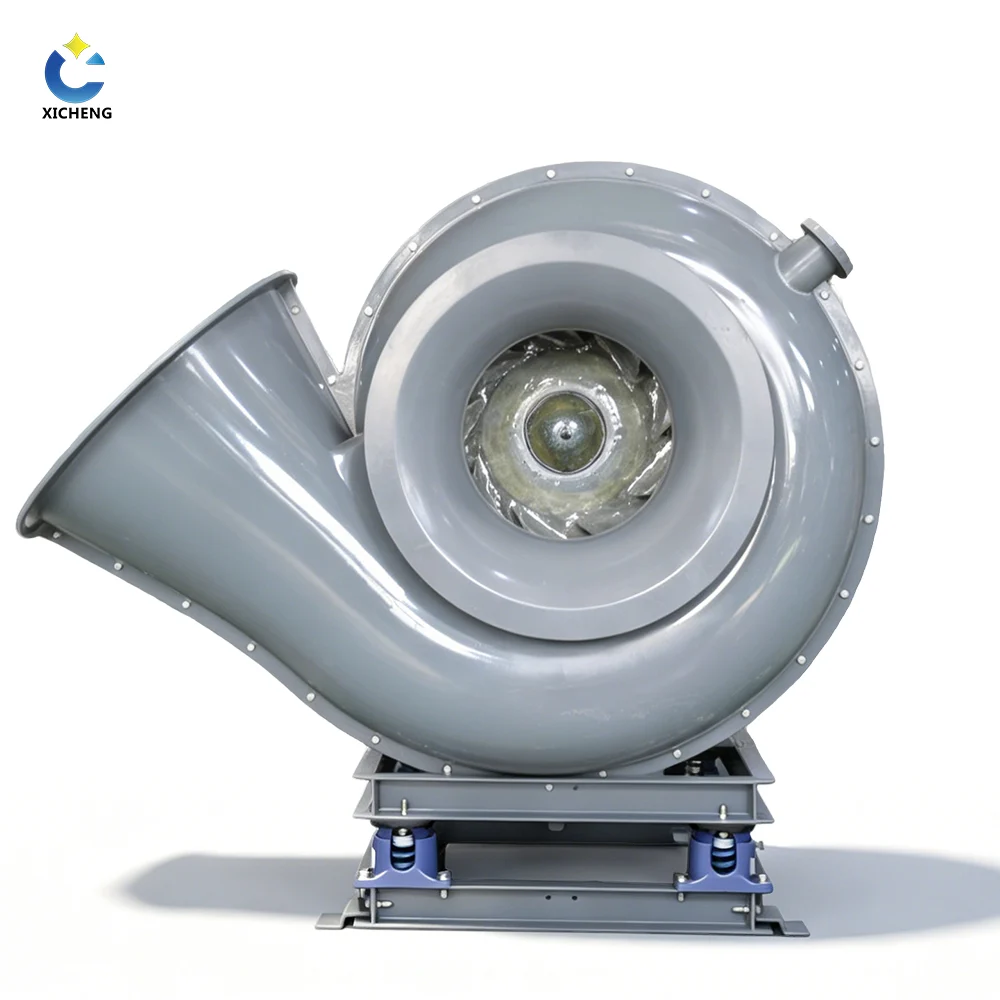
Search most engineers’ first query — corrosion resistant blowers — and you meet a wall of catalogue pages selling coated steel: epoxy coat, powder coat, rubber lining, galvanizing. Read them carefully and you discover why so many of those machines are replaced within a season of real service. A coating is a skin on a metal body; the metal keeps rusting under it, the coating chips at flange bolts and blade roots, and the whole assembly fails from the inside out. The engineering question is not “how do we coat the metal” but “what should the wetted machine be made of”, and the answer starts with the environment the blower lives in, not with a paint swatch.
The honest selection path for a chemical plant, plating line, acid-wash bay, or wastewater lift station runs in four steps. Classify the corrosive environment — which chemical families, at what temperature, under how much static pressure. Match that environment to the material spectrum, from coated steel at one end to specialty alloys at the other. Choose the fan form — centrifugal for ducted pressure, axial for volume, inline for tight runs, roof or wall mounts for building ventilation. Then verify the supplier: resin grade, wet-path material, certification, and a real performance curve. Run those four steps in order and any corrosion resistant blowers purchase resolves itself; that sequence is the whole of this guide, and it is the sequence the catalogue pages never walk you through.
Run these three self-checks before the deeper sections:
- Inlet stream is aqueous acid, base, or salt below roughly 190 °F with moderate duct resistance — polypropylene serves the duty at the lowest first cost, with FRP as the upgrade when pressure or temperature climbs.
- The stream is wet chlorine, a strong oxidizer, a solvent, or sits above 250 °F — the FRP family with a matched resin grade, or a specialty alloy for the extreme high-temperature corner.
- The wetted parts currently rust, pit, or scale out within a year — the fastest fix is usually not better coating but a switch to a plastic or fiberglass machine whose wall is corrosion-resistant through its whole thickness.
Everything below depends on one principle, stated once and kept throughout: in corrosive air handling the material of the wetted components is the corrosion resistance. The FRP blower guide documents the fiberglass side of that principle and the polypropylene blower guide the polypropylene side; this page keeps the classification and the spectrum that tell you which side you are on.
What Makes a Blower Truly Corrosion Resistant
Corrosion resistant blowers earn their name from one property: the material that touches the airstream stays intact through the chemistry and the temperature of that stream for years, not months. Everything else — the frame, the bearings, the drive — is support equipment that either stays out of the gas path or gets its own protection. When corrosion failures happen, they happen on the wetted surfaces first, which is why the spec that matters is the material of the wheel, the housing, and the inlet.
The coating trap is the most expensive misunderstanding in this category, and it is why so many corrosion resistant blowers fail in their first season. Corrosion resistant fans that are coated-steel machines fail in a specific way: the coating is the thinnest layer in the system, it chips at welds, flange bolts, and blade edges, and once moisture reaches bare steel under the chip, the corrosion is invisible until the weakening is measured in reduced airflow. Galvanizing buys decades outdoors and almost nothing against wet acid or chloride fume. Epoxy and rubber linings help only for as long as the film is perfect, and a fan wheel flexes. Every blade flex, every start-up, every cleaning cycle is a point where the film surrenders. A solid plastic or fiberglass wall has no film to lose.
Metal fans fail along three recognizable paths, and naming them makes the material choice concrete. Plain carbon steel rusts dramatically and quickly in wet acid or chloride service — rust that also contaminates the process air being exhausted. Stainless steel resists, then fails locally: 304 and 316 develop pitting and stress-corrosion cracking in chloride and chlorine atmospheres, and a single pit can grow into a crack that takes the wheel. And any two dissimilar metals in a wet conductive atmosphere create galvanic corrosion, which is why “no metal in the airstream” is not a slogan but a design requirement. Each of these three paths is eliminated at once by making the wetted wall a homogeneous non-metallic material rather than a protected metal.
Construction and upkeep separate the solid-wall machine from the protected-metal one on the shop floor as much as on paper. A plastic or fiberglass blower is welded and bonded — polypropylene sheet fused into homogeneous walls, FRP laminated from glass and resin over a mould, both with no paint system to repaint and no weld spots that rust first. Maintenance on a solid-wall fan means checking weld or bond integrity at blade roots, the corrosion barrier of the FRP surface, and wheel balance after cleaning — measured in hours, not in the coating-touch-up cycle that occupies the maintenance log of a coated-steel unit. That difference, not the catalogue photograph, is why “low corrosion maintenance” translates into real budget hours once the machine is installed.
That is what the best corrosion resistant fans vendors mean when they state that every part exposed to the airstream is constructed of the corrosion-resistant material itself. The polymer choice and the fiber reinforcement then carry the whole duty. The two-material decision that follows — polypropylene versus fiberglass-reinforced plastic — is worked through in full in the PP or FRP material choice guide; this guide positions that choice inside the wider environment and material spectrum.
Classify the Environment Before Choosing the Material
Every sourcing conversation in this category should begin with the same one-line discipline: name the environment first, then let it pick the material. Corrosion failures are rarely “the fan rusted” — they are “the fan met hot chloride fume”, “the fan met wet chlorine dioxide”, “the fan met concentrated solvent vapor,” and each of those sentences points to a different rung of the material ladder. A classification table turns the chemistry on your shower card into a material recommendation in one glance, and a corrosion resistant blowers spec that skips this step is a gamble.
| Environment family | Typical duty | Recommended material tier |
|---|---|---|
| Chemical acids and alkalis | Hydrochloric, sulfuric, phosphoric acid fume; caustic vapor at moderate temperature | PP for aqueous service to ~190 °F; FRP for the stronger or hotter duty |
| Chlorides and chlorine | Wet chlorine, hypochlorite, chlor-alkali cell exhaust | FRP with vinyl-ester resin; avoid stainless pitting and PP softening |
| Galvanizing and acid-wash | Pickling line, degreasing, hexavalent chrome and zinc chloride mist | PP centrifugal for the compact low-pressure hoods; FRP where high vent pressure appears |
| Organic solvents | Toluene, xylene, ketone, chlorinated degreasers | FRP with a matched resin; PP swells in aromatic and chlorinated solvent |
| High humidity and marine | Humid plant air, coastal exposure, indoor pools, saline washdown | FRP (fire-retardant resin) or stainless for the specific salt load |
| Hot oxidizing gases | Hot acid vapor, oxidizer-laden process gas above about 250 °F | Specialty-resin FRP, or a specialty alloy for the extreme corner |
Read the table as a filter, not a formula. Most duties present a mix — a plating line vents warm sulfuric acid fume carrying chrome mist, which is simultaneously the first and third rows — and the answer is then the tier that survives the worst member of the combination. When two rows disagree, the hotter, more oxidative, or more solvent-heavy row wins. The chemical-specific detail behind each row is the subject of the dedicated chemical-exhaust guide; here the classification is what matters for choosing the machine family.
The classifying habit also protects against the two most common buying errors. The first is buying on a single chemical: a vendor says “PP handles acid” and the buyer orders PP for a stream that is actually warm chlorinated solvent, where PP swells. The second is buying on the metal that “handles everything”: an all-purpose coated-steel unit that fails every one of the six rows on different timetables. Classifying first, then matching the tier, collapses both errors into a single visible step.
Worked example, the one every plating shop recognises. A nickel-plating line vents warm sulfuric acid fume carrying drag-out chrome mist. The first row of the table says PP for aqueous acid to roughly 190 °F; the chrome-mist presence and the intermittently hot hood air pull toward FRP. Neither row alone decides, so the combination rule applies — the worst member wins — and the honest spec is either a PP-FRP hybrid build or a modest vinyl-ester FRP fan, both of them dramatically safer than the coated-steel unit the shop has already replaced twice in three years. That walk through the rows is the whole skill of this category, and it is a skill no catalogue page teaches.
The Corrosion-Resistant Material Spectrum: Six Tiers
Between “paint the metal” and “cast it in titanium” sits a spectrum of six material tiers that cover virtually every industrial corrosive duty. The naming logic for corrosion resistant blowers is exactly this spectrum: each tier is a wetted-wall material with a temperature ceiling, a chemical envelope, a stiffness, and a first cost, and the tier you pick is the one whose envelope contains your environment row at your operating temperature.
| Tier | Temperature ceiling | Chemical envelope | Best before | First cost |
|---|---|---|---|---|
| Coated steel | Wide, but film-limited | Protective film only; fails at chips, welds, chloride | Dry indoor or light corrosion duty | Lowest |
| PVC | ≈140 °F | Good dilute acid/alkali at low temperature | Light fume duct at ambient temperature | Low |
| Polypropylene (PP) | ≈190 °F | Near-universal aqueous acids, bases, salts; weak vs strong oxidizers and aromatic solvents | Fume cupboard, plating, acid-wash hood, moderate duct | Low |
| FRP | ≈250 °F | Wide acids, bases, chlorine family, oxidizers, many solvents; resin-grade dependent | Wet chlorine, strong oxidizer, hot pressurized exhaust, big flows | Moderate |
| Stainless steel (304/316) | High-temperature capable | Good broadly, but pits and stress-corrosion cracks in chloride service | High temperature without chlorides | High |
| Specialty alloys | Highest | The extreme hot-oxidizing corner metals cannot otherwise serve | High temperature plus aggressive chemistry of no other answer | Highest |
Few decisions actually climb the whole ladder. Nearly every fume, plating, acid-wash, and scrubber duty lands on one of the middle three tiers — PP for the aqueous moderate-temperature volume, FRP for the aggressive chemistry and the pressure, and PVC only for the light cold edge. The coated-steel tier exists mainly as the warning rung, and the alloy tiers exist for the engineering corner where process temperature alone rules out every plastic.
Within the FRP tier the word “fiberglass” hides a real material family, and the difference is the resin, not the glass. Isophthalic polyester resin covers the everyday acid and alkali range; vinyl-ester resin extends the envelope to chlorides, hypochlorite, and stronger oxidizers; bisphenol-based resins go further still. The same catalogue model can be laid up in any of them, so the resin grade is a spec line, not a given — and it is a mismatch of resin to chemistry that explains most “FRP fan failed” stories. For corrosion-resistant air blowers carrying wet chlorine or mixed oxidizer duty, ask the resin grade out loud and write it on the order.
Watch a careful specifier walk the ladder and the pattern is visible in seconds. They read the temperature first: if the inlet sits above roughly 250 °F at sustained hours, the plastics exit and the question becomes stainless versus alloy, with chloride pitting steering them past 304. Below 250 °F they read the chemistry — wet chlorine or a strong oxidizer pushes to FRP with vinyl-ester resin; plain aqueous acid at low pressure falls to PP; solvent content vetoes PP twice over. Then they read the pressure — high static reinforces FRP’s stiffness against a PP casing that would need thickening. In practice the ladder is walked top-down by temperature, then left-to-right by chemistry, and only a minority of duties ever reach beyond FRP.
The lifecycle argument runs the same way. Cheap first cost on the wrong tier repeats itself every replacement season; a moderate first cost on the right tier compounds into years of unbroken service. The tier column that matters is therefore not the price tag but the match between your environment row and the material envelope. The base science of the two most used tiers is summarized on Wikipedia’s glass-reinforced plastic article, with the fan-machine context on the fan article for reference; the FRP and PP build guides on this site carry the applied detail, and the PP-or-FRP decision guide settles the two-tier choice directly.
Corrosion Resistant Centrifugal Fans: The Workhorse Form
When corrosion meets ductwork, the machine is almost always a centrifugal fan: the practical corrosion resistant blowers shape for any ducted exhaust. Corrosion resistant centrifugal fans own this territory because corrosive exhaust is rarely a straight-through draft — it is a fume cupboard, a scrubber, a filter, a stack, each adding resistance that the wheel must overcome in static pressure, typically from 1 to 30 in WG. A centrifugal wheel builds that pressure with a compact footprint; an axial fan moves volume instead, at low pressure, and loses the argument the moment the duct runs long or a scrubber gets involved.
| Configuration | Strength | Typical corrosive duty |
|---|---|---|
| Centrifugal | 1–30 in WG static pressure, duct-matching | Chemical fume exhaust, scrubbers, process ventilation |
| Axial | High airflow at low pressure | Cooling towers, direct air exchange, odor-control draft |
| Inline centrifugal | Centrifugal pressure in an axial footprint | Confined duct runs, retrofit into existing duct |
| Roof and wall exhaust | Building ventilation, weather-protected | Fume discharge to atmosphere, fresh-air supply |
Make the same choice inside the centrifugal family as for any industrial fan: forward-curved wheels move the most air per footprint at low pressure, backward-curved wheels deliver 80–90% efficiency and 3,000–5,000+ Pa, and radial blades handle dirty or abrasive streams. The curvature decision and the corrosion-material decision are independent — you can order a forward-curved polypropylene wheel for bench-level fume or a backward-curved FRP wheel for hot pressurized gas, and either way the machine stays a corrosion resistant blowers build only while its wetted wall matches the chemistry. The full wheel taxonomy lives in the types of centrifugal fans guide, the operating physics in how a centrifugal blower works, and the curved-wheel trade-off in the forward curved vs backward curved decision guide.
Whatever the form, judge the machine on certified performance data. Corrosion resistance guarantees survival; it does not guarantee airflow, and a corrosion resistant centrifugal fan whose curve is wrong for your duct is a chemical-resistant motor load and little else. Industrial fans are rated under the standards AMCA publishes — AMCA 210 for the performance test — and the same discipline applies in plastic and fiberglass as in steel: compare suppliers on the curve at your operating point, not on catalogue page numbers.
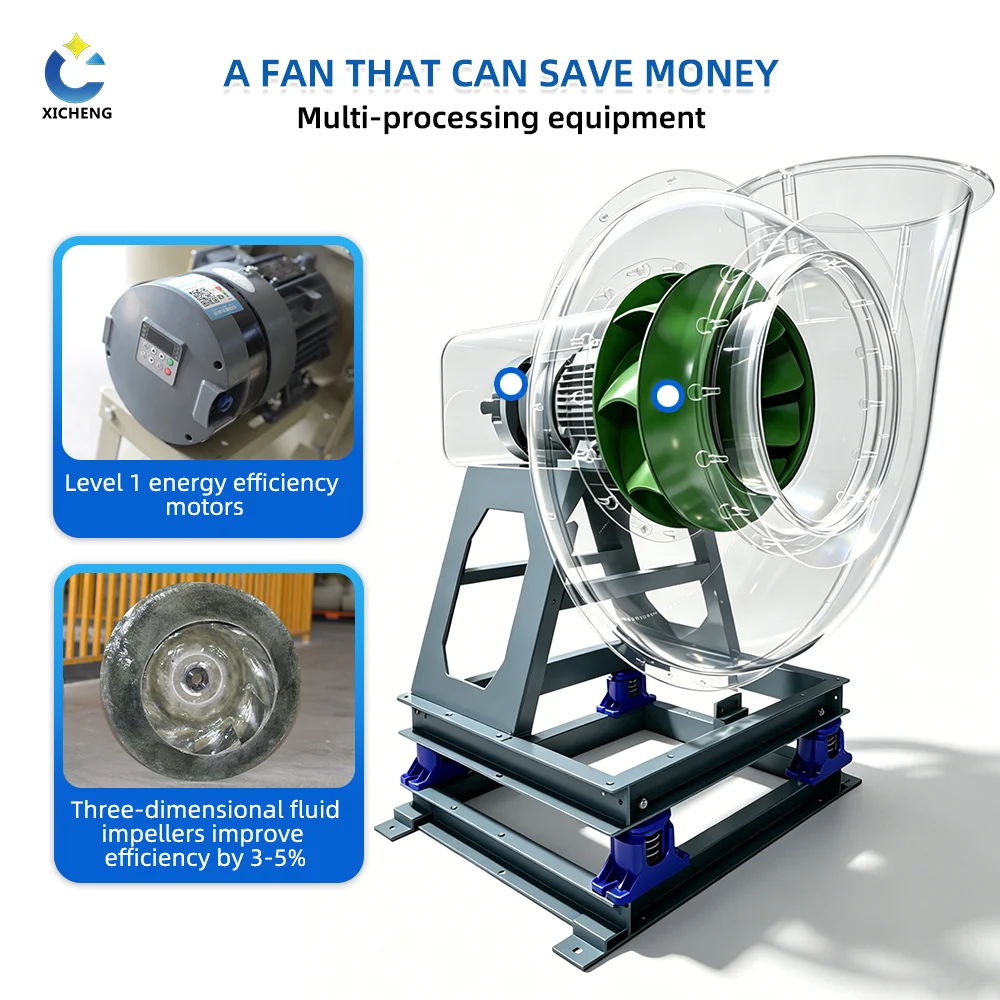
Two engineering rules matter more in corrosive service than the category suggests, because they decide motor size and electricity bills rather than material. The first is static pressure: corrosive exhaust nearly always runs a real system — a filter, a scrubber, a stack — so the fan must be selected on total static pressure at the operating point, and the wheel family follows that number. The second is the power curve: backward-curved wheels are non-overloading, motor current peaking mid-range and falling toward free delivery, while forward-curved wheels are overloading machines whose motor must be sized for the open end of the system. A corrosion-resistant installation that ignores either rule underperforms or trips its protection no matter how well the material survives.
Chemical, Plating, and Acid-Wash Duty
The industry names on a supplier’s application list are not decoration; they map one-to-one onto the environment rows above, and a real vendor says which rows it builds for. Chemical processing plants use corrosion resistant fans throughout the operation wherever a gas or vapor needs moving — reactor and storage-tank vents, centrifuge and dryer exhaust, neutralization and scrubber circuits. The stream is usually the table’s first row: warm acid or alkali vapor at moderate pressure, which is PP-or-FRP territory inside the corrosion resistant blowers family, depending on temperature and whether the media is wet chlorine.
Plating and acid-wash lines are the densest corrosive-fan population per square metre of any industry. Every tank — nickel, chrome, zinc, anodising, pickling, degreasing — vents acid and chrome mist that condenses on the first cool surface it meets, which is why the hood-to-fan path must be short, upward-sloped for drainage, and built of a material that rinses clean. Corrosion resistant fans on plating lines are typically compact polypropylene centrifugal units under the benches, facing 190 °F aqueous chemistry with salt residue that PP sheds and steel would collect and corrode; where the vent necks up to a scrubber, the fan steps to FRP.
Wastewater and food processing are the two volume markets that rarely appear in the marketing. Wastewater facilities are the largest user segment for fiberglass fans, deployed on scrubber exhaust, odor-control systems, and wet-well ventilation where hydrogen sulfide and humid air do their damage; semiconductor cleanrooms need FRP on chemical-vapour tool exhaust and acid-waste vent; food and beverage plants put corrosion-resistant units on washdown areas where moisture and cleaning chemicals corrode metal alternatives. Whatever the sector, the ventilation serving the space should match the compliance lane of the industry — the general-industry ventilation requirements of OSHA 29 CFR 1910.94 are a useful floor for exhaust ducting and fan placement in manufacturing environments.
Two installation habits decide service life before the material ever does. Condensation is the first: warm acid vapor moving through a cooler duct and fan body deposits liquid that pools at low points, so the hood-to-fan path should slope upward, drain at the lowest point, and never let a puddle sit on a wheel or inlet cone. The second is the intake-versus-discharge question — whether the fan pushes or pulls decides whether the scrubber train, the duct joints, and the fan casing all share the same corrosive medium or only part of it. Both habits are where “corrosion-resistant equipment” becomes “a corrosion-resistant system”, and both are free.
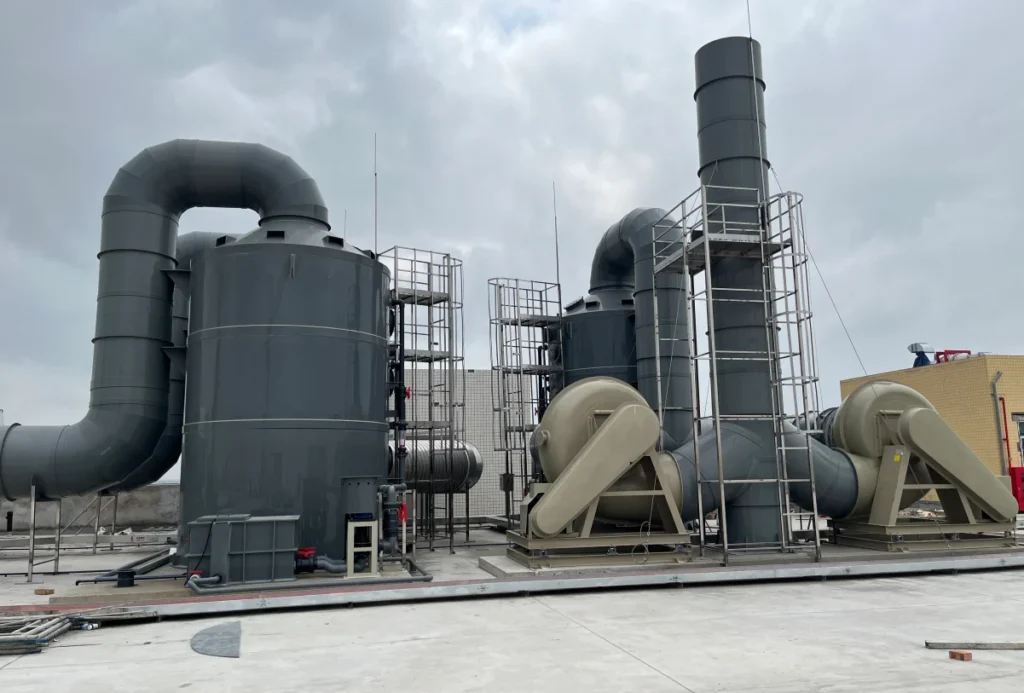
Every one of these duties is a system, not a fan. The fan sits at one end of a train — hood, duct, scrubber or filter, fan, stack — and the same corrosion logic that protects the fan also protects the duct and the scrubber shell. When the fan feeds a wet scrubber, the scrubber body and the fan should be specified from the same material family so the whole train fails together slowly rather than piecemeal. The industrial wet scrubber line on this site covers that matching, and the FRP/PP blower range covers the fan tiers beneath it.
Flame, Static, and Temperature: The Overlays
Three further requirements ride on top of the material-synthesis decision and change the grade even when the tier stays the same, so finish any corrosion resistant blowers spec with all three checked. Treat them as overlay checklist items rather than separate material families.
Flame. The resin in fiberglass fans can be formulated fire-retardant at the lay-up stage, and several manufacturers build their whole fibre line that way — a genuine advantage where local fire codes or corporate standards ask for a low flame-spread duct-and-fan assembly. Polypropylene is inherently combustible at a UL 94 HB rating; flame-retardant PP grades reduce the risk without reaching fiberglass’s flame-spread performance. If the duty runs solvent vapor or sits inside a building with fire-rating rules, name the resin and the flame-spread value on the datasheet before the price.
Static and explosion zones. A non-conductive plastic wall moving solvent-bearing or flammable vapor is an ignition surface unless the charge bleeds away. The established fix is a conductive alloy — carbon-impregnated polypropylene (CIP) for PP wheels, conductive veil or coating for FRP — and the phrase to write on the spec is “conductive” or “ATEX version”. Two distinct concepts conceal under “explosion proof”: spark resistance, which keeps the airstream itself from igniting, and explosion-proof electrical construction, which contains any spark from the motor and wiring. Both belong in the order for a classified zone.
Temperature. The temperature ceiling is the hardest overlay because it silently disqualifies: PP to roughly 190 °F, FRP to roughly 250 °F with matched resin, PVC far below. Corrosion-resistant air blowers that survive the chemistry perfectly will still creep and soften if the inlet runs hot — the temperature column of the spectrum table was the first filter for a reason. Selecting the tier on temperature, then overlaying chemistry, flame, and static in that order, reproduces the decision logic of the full material guides without repeating them: the FRP blower guide for the fiberglass build, the polypropylene blower guide for the PP build, and the PP versus FRP choice guide for the two-tier decision itself.
Corrosion Resistant Blower FAQ
What is the difference between a coated-steel blower and a truly corrosion resistant blower?
A coated-steel machine carries a protective film over a metal body; the film chips at welds and blade edges, moisture reaches the steel, and corrosion proceeds invisibly. A truly corrosion resistant blower is made of the corrosion-resistant material itself throughout the wetted wall — polypropylene, fiberglass-reinforced plastic, or the right alloy — so there is no film to lose and no substrate to creep under it.
Which material is best for corrosion resistant fans?
It depends on the environment, not on a ranking. Polypropylene serves aqueous acids, bases, and salts below roughly 190 °F at the lowest first cost. FRP extends the envelope to roughly 250 °F and to wet chlorine, strong oxidizers, and many solvents. Stainless and specialty alloys cover the high-temperature corner. Classify the stream first, then let the spectrum choose the tier.
Can corrosion resistant blowers handle wet chlorine or strong oxidizing acid?
Yes, when the tier is specified for it. FRP with a vinyl-ester or bisphenol resin is the standard answer for wet chlorine, hypochlorite, and chlor-alkali service, and for the strong oxidizers that soften polypropylene. The resin grade, not the word “fiberglass”, is the specification that carries the duty.
Are corrosion resistant blowers explosion-proof?
Not by default. A non-conductive plastic wall moving flammable or solvent-bearing vapor is an ignition surface unless the charge bleeds away. Spec a conductive construction — carbon-impregnated polypropylene or a conductive veil on FRP — plus explosion-rated electrical components for a classified zone, and keep the two concepts separate: spark resistance in the airstream versus explosion-proof motor and wiring.
How long do corrosion resistant FRP and PP fans last?
In the duty each is chosen for, both last years. Metal fails by pitting and stress-corrosion cracking in chloride atmospheres; the composite matrix of FRP and the homogeneous wall of PP take those same exposures with minimal degradation. Actual service life is set by matching the tier to the chemistry and the continuous temperature, which is why the classification table at the top of this page decides life more than the vendor’s guarantee does.
Which is better for a plating or acid-wash line — polypropylene or FRP?
For the bench-level hood duty under 190 °F with aqueous acid and salt mist, polypropylene centrifugal fans are the economic, corrosion-resistant answer and the standard on plating lines. When the line’s vent pressure climbs, the temperature rises, or the stream picks up chrome mist and oxidizers, the machine steps to FRP. The shared logic: classify the specific tank chemistry, then pick the tier the worst member of the stream demands.
Corrosion Resistant Industrial Fans for Harsh Environments: Supplier Checklist
When a plant engineer searches corrosion resistant industrial fans for harsh environments suppliers, the results are directory pages and catalogue blurbs — never an answer to the actual question, which is “how do I tell a real corrosion-resistant fan from a painted one”. The six checks below are the difference between a genuine corrosion resistant blowers spec and a painted metal gamble. Take them to any supplier, from a global FRP house to a regional fabricator, and the machine that survives your environment will separate itself from the machine that does not.
- Wet-path material statement. Ask the supplier to state, in writing, the material of every part that contacts the airstream — wheel, housing, inlet, shafts, fasteners. The answer to “do you guarantee no metal in the gas path” should be a single sentence, not a brochure.
- Resin grade and construction. For FRP, the resin is the spec: isophthalic polyester, vinyl ester, or bisphenol. Ask which one, and whether the corrosion barrier includes a veil and resin-rich surface. For PP, ask the alloy shade and whether it is flame-retardant or carbon-filled conductive where required.
- Temperature in continuous terms. The datasheet peak is not the duty. Confirm the continuous operating temperature of the fan against your inlet at sustained hours, not the one-time excursion figure.
- Certified performance, not catalogue pages. Ask for the performance curve at your operating point and the test standard behind it. Corrosion resistance proves survival; AMCA-rated or independently tested curves prove the airflow.
- Explosion and static options by name. For classified zones, confirm conductive construction — carbon-impregnated PP or conductive veil on FRP — and the electrical classification of the drive, written on the order.
- Delivery, spares, and support. Ask lead time for the resin and size you need, the availability of spare wheels and housings, and who answers a corrosion-resistance question in engineering rather than sales.
Beware the answer that is a coating. A corrosion resistant fans supplier who responds to “what material is the wheel” with “epoxy-sealed steel” is selling the first tier of the spectrum, the one every other row of this guide disqualified. That tier has its place — dry indoor duty — and it is not the place of a chemical, chloride, or acid-wash stream. The honest plays are the solid-walled tiers, which is why the FRP blower line and the PP blower line are built wall-in-material, and why the full FRP/PP blower range exists at all.
The last check is economic and it is the one the supplier checklist protects. Lifecycle cost in corrosive service is dominated by replacement frequency, not invoice price: the wrong tier re-purchased every season outspends the right tier bought once. The U.S. Department of Energy’s fan-system assessment guide makes exactly this point about treating fans as systems with lifecycle cost, a logic that applies unchanged when the corrosion-resistance part of “system” is added on top. Corrosion resistant blowers correctly matched to their environment, even at mid-tier price, are the cheapest machines you will ever buy; the cheapest invoice is usually the most expensive one on the ledger.
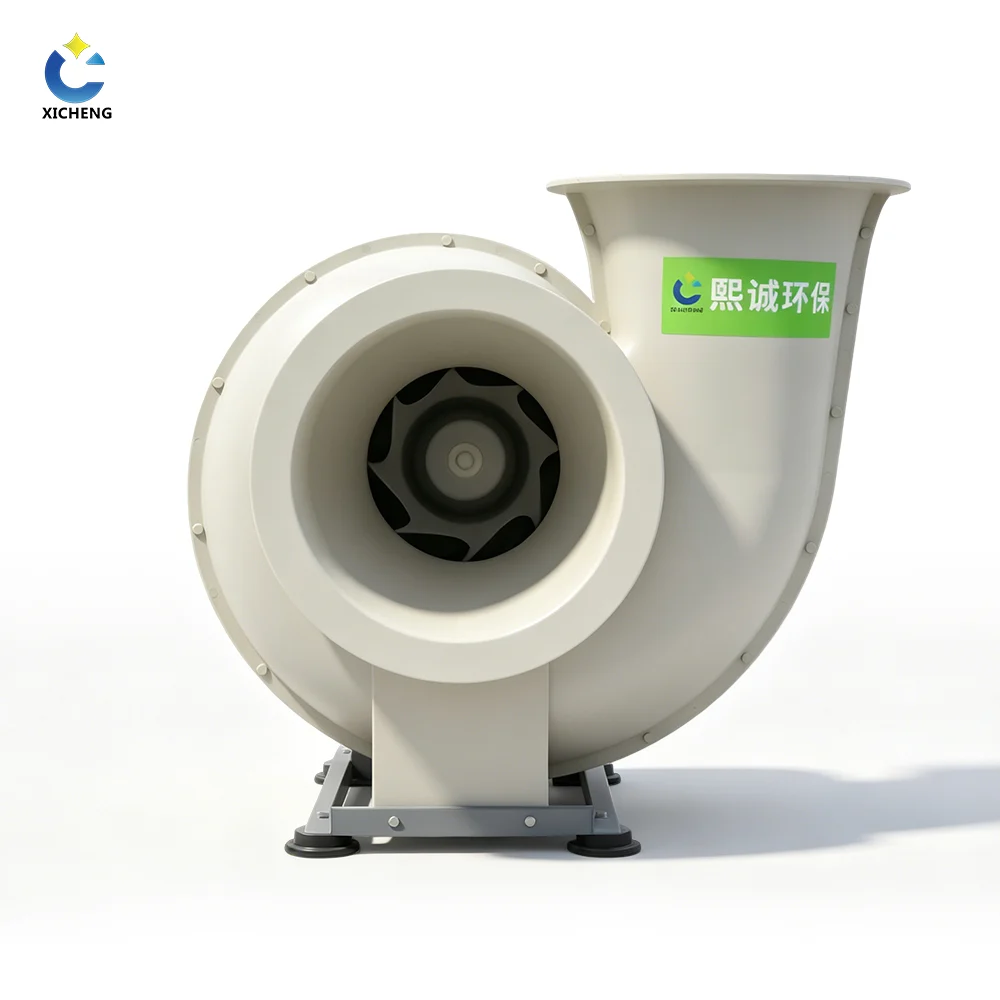
The material spectrum, the environment rows, and the six-point supplier checklist are the whole answer to corrosive air handling in one assembly. Send XICHENG the environment — the chemical list, the inlet temperature, the static pressure, and the running hours — and the specification starts from the classification that decides the machine, not from a catalogue default. Contact XICHENG for a recommendation among corrosion resistant blowers matched to your corrosive exhaust duty.