The words “poly water tank” describe at least three different products, and none of the pages that rank for them is selling a welded polypropylene tank. That matters before a single dimension is chosen, because the polymer, the manufacturing route and the service limits all follow from which product you are actually buying.
This page is about water service specifically: what polypropylene contributes when the liquid is water, what it does not contribute, and the four conditions under which it earns its place against the cheaper rotomoulded alternative. The general material comparison belongs to the polypropylene tank guide and is not repeated here.
What is not covered here is volume. Whether the tank should exist at all, how large it has to be, and which of the six jobs it is doing in the plant are set out in the industrial water storage tank guide.
Key takeaways
- “Poly water tank” in search results almost always means a rotomoulded polyethylene tank; “polypropylene water tank” usually means a moulded container of a few hundred gallons. A fabricated PP tank is a third product that neither phrase describes.
- Water is a benign medium. Polypropylene’s chemical resistance earns nothing in water service, so the material choice has to be justified on temperature, size, shape and what else is dissolved in the water.
- ASTM D1998-21 puts the continuous service ceiling for rotomoulded polyethylene tanks below 66 °C for Type I and below 60 °C for Type II, and sends anything hotter to other standards. That is the one line polypropylene crosses decisively.
- The size ceiling that comparison pages attribute to “PP tanks” belongs to the moulding process, not to the polymer. Welded PP has a different ceiling, set by transport rather than by a mould.
- NSF/ANSI 61 is a health-effects standard. It explicitly does not establish microbial growth support requirements, so a certified tank can still grow algae.
- Freezing expands the same mass of water by about 9 %, and polypropylene’s linear expansion is 8–10×10−5 °C−1. Both are design loads, not maintenance items.
- For ambient potable water in a standard cylinder, a rotomoulded PE tank is cheaper and adequate. Polypropylene wins when the duty leaves that envelope.
What a “Poly Water Tank” Actually Is in the Catalogue
The phrase is a category error waiting to happen. Three products answer to it, they are made by three different processes, and their size ranges barely overlap. A buyer who lands on the wrong one is not comparing prices for the same thing; they are comparing a moulded vessel against a welded one.
Three different products answer to the same three words
The first is the rotomoulded polyethylene tank. Polyethylene powder is loaded into a hollow mould, the mould is rotated in an oven until the powder fuses against the inner wall, and the result is a seamless one-piece shell with no weld anywhere. This is the product behind almost every result for “poly water tank”: the farm, rainwater and rural water tanks sold by agricultural retailers. Walls are uniform, shapes come from moulds, and the category has its own standard, ASTM D1998-21, which covers flat-bottom upright cylindrical tanks of 1,900 L (500 US gal) and up.
The second is the moulded polypropylene container. These are laboratory and chemical containers, made by injection moulding or thermoforming, and they run from a few litres to a few hundred gallons. They are excellent at what they do, and they are the reason a comparison page can state that polypropylene tanks stop at a few hundred gallons without being obviously wrong. The statement is accurate for this product and false for the third.
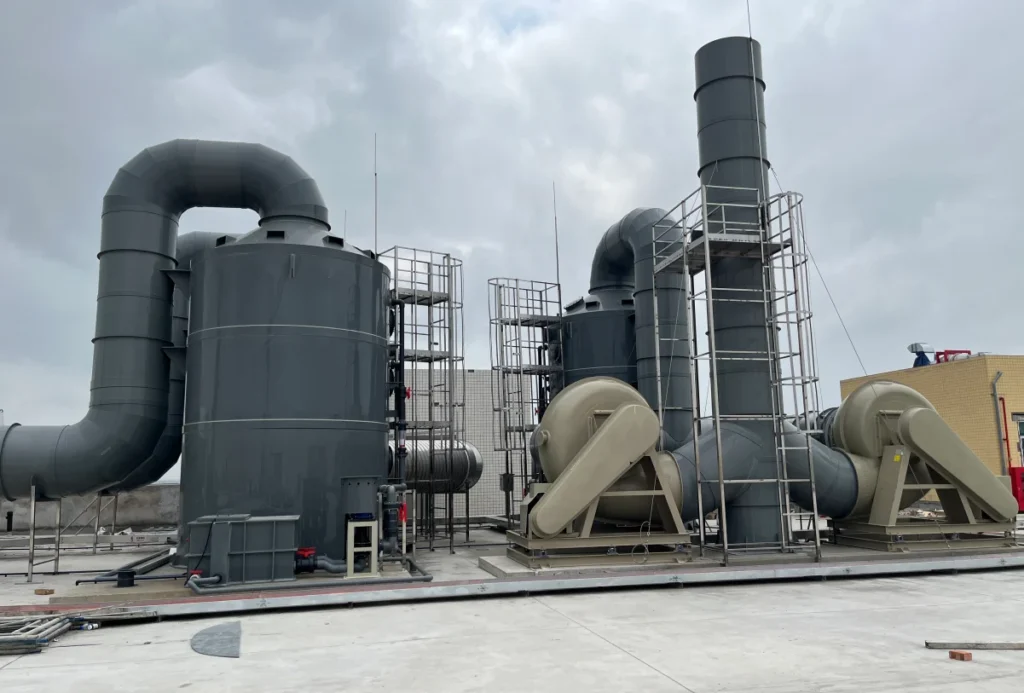
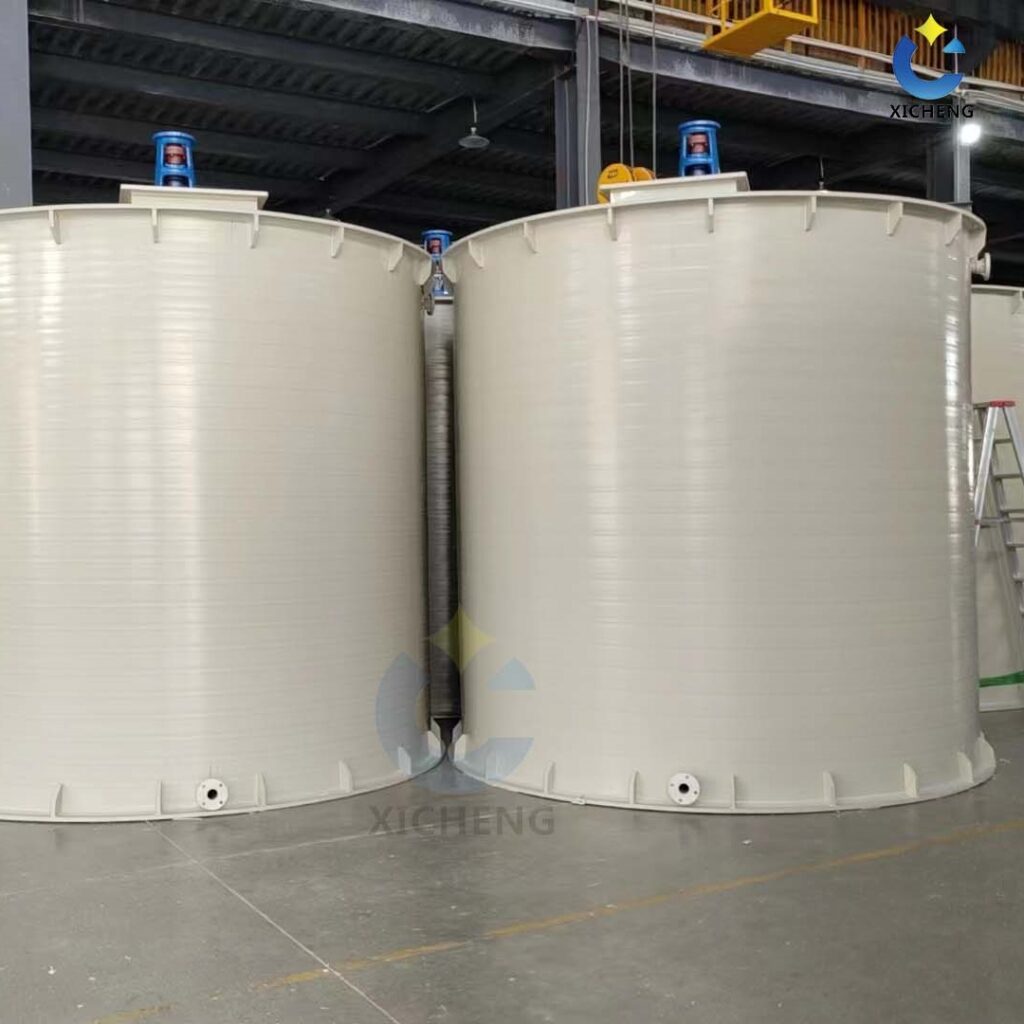
The third is the fabricated polypropylene tank. Sheet is cut, formed and welded into a vessel, usually in a workshop, to dimensions that come from the customer rather than from a mould. This is the product this site builds: 5 mm to 30 mm PP-H sheet, 50 litres to more than 100,000 litres, vertical, horizontal or rectangular. It has no mould ceiling because there is no mould.
The mismatch between the three is not academic. They carry different price bases, different lead times and different delivery routes. A moulded tank is bought from a stock list and shipped by courier; a welded tank is quoted from a drawing and shipped by freight. A buyer who compares a retail price per gallon against a fabricated quotation is comparing two different industries, and the comparison will always favour the product that was never going to meet the duty.
Why the top-ranking comparison says PP stops at a few hundred gallons
One of the most-read polyethylene-versus-polypropylene comparisons on the open web states plainly that polyethylene tanks reach 20,000 gallons while polypropylene tanks may only reach a few hundred. Read as a statement about materials, it is misleading. Read as a statement about manufacturing, it is exactly right, and the distinction is the whole point of this section.
Rotational moulding needs a mould. A mould is a large steel or aluminium tool, it makes one shape, and its cost is amortised over the units sold from it. A 20,000-gallon mould is a serious capital item, which is why the largest sizes carry a price premium and a longer lead time, and why the retail range clusters around a few standard sizes. Polypropylene containers are moulded too, so they inherit the same logic and stop earlier, because a 500-gallon PP container has to compete with a much cheaper PE tank.
Welding has no tooling cost at all. The equipment is a welding gun, a trimming table and a press brake, and the same workshop can build a 500-litre tank on Monday and a 50,000-litre tank the following month. What limits a welded tank is not the mould but the truck, the door and the crane. That is a completely different constraint, and it is the subject of a later section.
What “poly” does not tell you
“Poly” is a prefix, not a specification. Polyethylene, polypropylene, polycarbonate, polyvinyl chloride and polyurethane are all “poly” something, and they behave nothing alike. A buyer who specifies “poly” has specified a word.
Three things actually determine what arrives on site: which polymer, which manufacturing route, and which wall thickness. The polymer decides chemical resistance and temperature. The route decides shape, size and whether the shell has a weld. The wall decides how the tank behaves under its own hydrostatic load. None of the three is visible in the phrase “poly water tank”, and only the first is visible in “polypropylene”.
For water service the second and third matter more than buyers expect, because water is the one duty where the polymer choice is almost settled and the structural choices are not.
Water Is the Easy Duty, So Material Choice Is Not About Corrosion
Every chemical resistance chart in the industry uses water as its reference. Both polyethylene and polypropylene are rated for water service without qualification, and polypropylene absorbs less than 0.01 % of its own mass in 24 hours of immersion. There is no corrosion argument to make here, and pretending otherwise is how a water tank page turns into a chemical tank page.
What water does and does not attack
Water does not attack either polymer. What it does is carry things: dissolved oxygen, hardness, chloride, silica, and whatever the process added upstream. Those passengers matter, but they matter to the water’s quality rather than to the tank’s wall. A polypropylene tank holding demineralised water and a polypropylene tank holding town water have the same wall thickness calculation; they differ in what the water is for.
The passengers matter far more to the alternatives than to polypropylene. Chloride is the classic case: it is harmless to PP at any concentration found in water, and it is the ion that pits stainless steel. Demineralised and reverse-osmosis water are the other, because water with almost no dissolved solids is aggressive to metals and to concrete while remaining completely inert to polypropylene. The choice of a plastic tank for water is therefore often made not because the water attacks plastic, but because the water attacks everything else in the plant.
The practical consequence is liberating. Once corrosion is off the table, the specification stops being a chemistry exercise and becomes a structural and thermal one. That is a much more tractable problem, and it is where the real differences between the products in the previous section show up.
The four things that actually decide a water tank
The first is temperature, continuous and peak. This is the only one of the four that can rule a material out entirely, and it is treated in its own section below.
The second is volume and footprint: how much water, and what shape the room will accept. A 15,000-litre tank can be short and wide or tall and narrow, and the two are not interchangeable on a site with a low ceiling or a narrow door.
The third is what else is in the water. Potable water, demineralised water, reverse-osmosis permeate, process water carrying cleaning chemicals and wastewater are five different duties that happen to share a name.
The fourth is where the tank sits: indoors or outdoors, under ultraviolet light or not, in a heated plant room or on a slab that freezes, on a floor or on a stand. Each of these adds a load that has nothing to do with the liquid.
Where PP’s chemical resistance earns nothing
For ambient potable water in a standard cylindrical shape, polypropylene’s chemical advantage over polyethylene is exactly zero. Both materials are inert to the water, both are available in food-contact grades, and both will outlast the building if they are specified correctly. On that duty, the rotomoulded polyethylene tank is cheaper, comes in standard sizes off a shelf, and is the honest recommendation.
This is worth saying plainly because it is the point most supplier pages avoid. A page that argues for polypropylene on every water duty is not a specification guide; it is a catalogue with paragraphs. Polypropylene starts to earn its place only when one of the four factors above leaves the envelope that a moulded PE tank can cover, and the next four sections are about exactly those cases.
Temperature: The One Line PP Crosses That Rotomoulded PE Cannot
Temperature is the only factor on the list that can remove a material from consideration rather than merely penalise it. It is also the factor where the published limits are unusually clear, because the polyethylene tank industry wrote its ceiling into its own standard. For a polypropylene water tank, this is the section that decides whether the product is appropriate at all.
What ASTM D1998-21 actually permits
ASTM D1998-21 is the standard specification for polyethylene upright storage tanks: flat-bottom, cylindrical, moulded in one piece by rotational moulding, for above-ground vertical installation at atmospheric pressure. Its scope clause is explicit about temperature. Continuous service must be below 66 °C (150 °F) for Type I tanks and below 60 °C (140 °F) for Type II tanks. The clause after it says that service beyond that scope, including higher-temperature service, falls outside the standard and requires other sources to be consulted.
Two things follow. The first is that 66 °C is not a rule about water; it is the boundary of a product category. The second is that the boundary is honest: the standard is telling you that above that line, the design method it contains no longer applies. A rotomoulded PE tank is not forbidden above 66 °C. It is simply no longer covered by the document that says how to design it.
This matters for anyone specifying hot water, because the alternative is not “PE with a thicker wall”. It is a different material and a different design route.
What polypropylene does at the same temperature
Polypropylene homopolymer melts between 160 °C and 165 °C and has a Vicat softening temperature of 152 °C. Those are resin properties, measured on the bulk material, and they are not a service temperature. A tank is a loaded structure, not a cup: the question is not when the polymer softens but how much of its strength it retains while carrying a column of water for years.
Our own working ceiling for polypropylene in water service is 95 °C, which is the same figure published on our PP water tanks page. It is an engineering figure, not a clause in a standard, and it is deliberately well below the Vicat point because the design stress at 95 °C is a fraction of the room-temperature value.
There is a counter-intuitive detail here. Water at 95 °C has a density of 961.9 kg/m³ against about 998 kg/m³ at 20 °C, so the same column of hot water is roughly 3.6 % lighter and the hydrostatic head is slightly lower. The wall still has to be thicker, because the polymer loses far more strength at temperature than the water loses weight. Anyone who reasons from the weight of the liquid alone will under-design a hot water tank.
The cold end, where PP is the weaker material
The comparison runs the other way at the bottom of the range. Polypropylene homopolymer has a brittleness temperature between −10 °C and 0 °C, which means it becomes progressively less tolerant of impact as it approaches that band. Our published service range starts at −10 °C for that reason. ASTM D1998, by contrast, requires a low-temperature impact test on rotomoulded polyethylene tanks, because polyethylene keeps its toughness much further down.
The honest summary is that polypropylene wins the hot end and polyethylene wins the cold end. An outdoor water tank in a climate with hard frost is not a natural polypropylene application unless the tank is insulated, heated or drained for the winter. A tank holding water at 80 °C is not a polyethylene application at all.
The water duties that fall on the PP side
The duties that sit above the polyethylene ceiling are more common in industry than the retail market suggests. Hot water storage and distribution, clean-in-place and wash water, boiler feed make-up that has been deaerated and is still hot, process hot water, hot demineralised or reverse-osmosis water, solar thermal buffer vessels and pasteuriser or steriliser water all live in the 60–95 °C band.
There is a second group that is hot and slightly aggressive at the same time: chlorinated hot water, hot water carrying caustic or acid cleaning chemistry, and rinse water from a plating or pickling line. Those duties would rule out polyethylene twice over, and they are where a fabricated polypropylene tank is not merely adequate but the only sensible choice among thermoplastics. Once the stream is more acid than water, the sizing question belongs to the acid storage tank article; what matters here is that the temperature still rules out polyethylene before the chemistry is even considered.
Temperature cycling deserves its own line, because it is easy to miss on a datasheet. A tank filled with 85 °C water and then cooled overnight sees its wall contract and its contents contract at different rates, and the welds absorb the difference. That is a fatigue load rather than a static one, and it accumulates. The design answer is the same as for any cyclic duty: keep a margin on the wall thickness, keep the stiffening continuous, and avoid a sharp change of section where the movement concentrates.
| Duty temperature | What the water is doing | Material route | Why |
|---|---|---|---|
| Ambient to 40 °C | Potable, rainwater, irrigation, general storage | Rotomoulded PE is adequate and cheaper | Inside the D1998-21 scope; no thermal penalty |
| 40 to 60 °C | Warm process water, pre-heated feed | Either, decided by size and shape | Still inside the PE ceiling, but close to it |
| 60 to 66 °C | Hot process water, some CIP | Fabricated PP preferred | At or beyond the Type II limit of 60 °C |
| 66 to 95 °C | Hot water storage, CIP, boiler make-up, pasteuriser water | Fabricated PP | Outside the D1998-21 scope entirely |
| Below −10 °C ambient | Outdoor tanks in hard frost | PE, or PP with insulation and freeze protection | PP homopolymer embrittles near −10 °C |
Size and Shape: 4,000 Gallons and the Mould Ceiling
Volume is where the keyword data and the engineering meet. A large share of the search demand for poly water tanks is expressed in US gallons, and one size in particular recurs: 4,000 gallons. It is worth converting that number properly before designing anything around it.
4,000 US gallons in real units
One US gallon is 3.785 litres, so 4,000 US gal is 15,141.6 litres, or about 15.1 m³. That is the figure to quote to a fabricator working in metric.
There is a trap in the word “gallon”. An imperial gallon is 4.546 litres, so 4,000 imperial gallons is 18,184 litres, which is 20 % more water in the same nominal size. For a tank this is not a rounding difference; it is the difference between a vessel that fits the slab and one that does not. Any quotation that says “4,000 gallons” without saying which gallon is incomplete, and on an export enquiry it is worth confirming in litres or cubic metres in writing.
What a 4,000-gallon tank looks like as a cylinder
Volume alone does not determine a tank. The same 15.1 m³ can be a squat vessel or a tall one, and the choice is driven by the floor area and the headroom available. The table below is simple geometry: a vertical cylinder of diameter D and height H, working volume 15.14 m³, at three height-to-diameter ratios.
| Height / diameter | Diameter | Working height | Footprint | What it suits |
|---|---|---|---|---|
| 1.0 | 2.68 m | 2.68 m | 5.65 m² | Low ceiling, large floor area |
| 1.5 | 2.34 m | 3.51 m | 4.31 m² | The usual compromise |
| 2.0 | 2.13 m | 4.26 m | 3.56 m² | Small floor area, tall headroom |
These are working dimensions, not overall dimensions. A real tank adds freeboard above the water line, a base or skirt below it, and in most cases a manway and a vent on top. A vessel quoted as 3.5 m of water will stand taller than 3.5 m in the plant room, and the headroom check has to use the overall height.
The mould ceiling is a shape limit before it is a size limit
The size ceiling that comparison pages attribute to polypropylene is really a shape ceiling, and it applies to polyethylene rotomoulding just as much. A mould produces one geometry. If the available space is a 1.2 m by 2.4 m alcove between two columns, no mould exists for it, and no amount of shopping will produce one at a sensible price.
A fabricated tank is built to the room rather than to the catalogue. That is the practical meaning of the word “custom”, and it is the reason a rectangular PP tank can occupy a plant room that no cylindrical moulded tank could use efficiently. The structural price of the rectangular form is real and is covered in the rectangular plastic tank article; for water at modest head, it is usually a price worth paying.
Fabrication’s own ceiling is transport, not the workshop
Fabrication has a ceiling too, and pretending otherwise would be the same mistake in the opposite direction. A welded tank can be built much larger than it can be delivered. The limit is the truck, the site access, the door width and the crane, not the welding table.
We build from 50 litres to more than 100,000 litres, and the sequence for the upper end is different: the vessel is designed to be split into sections that fit the transport envelope and welded together on site, with the joint locations chosen so that they can be inspected afterwards. The question to ask early is not “how big can you make it” but “how big can you deliver and install it”. The fabrication route itself is set out in plastic tank fabrication.
Rectangular, when the room decides
Water tanks in plant rooms are often rectangular for the same reason filing cabinets are: the room is rectangular and the corners are free storage. A rectangular PP tank uses that space; a cylinder leaves the corners empty.
The engineering consequence is that a flat wall carries load in bending rather than in membrane tension, so the wall needs stiffening and the stiffening needs a support structure beneath it. For a water tank with two or three metres of head, that is manageable. For a tall tank, the cylinder is structurally more efficient per litre and should usually win. The choice is a room-and-height decision, not a material one.
Horizontal and low-profile, when headroom is the constraint
Water tanks are often installed where the ceiling is low: under a mezzanine, in a basement plant room, on a trailer, or beneath a deck. A vertical cylinder is the most efficient shape per litre and also the tallest, so a room with two metres of clearance forces the choice towards a horizontal cylinder or a low rectangular tank.
The structural cost is real. A horizontal cylinder carries longitudinal bending between its supports on top of the hoop stress, so it needs saddles and a wall that can span them. A low rectangular tank carries its side load in bending across flat walls, which need stiffening. Neither is difficult, and both have to be designed rather than assumed. The trade between the two postures is set out in the vertical poly tank article.
Potable Water: What Certification Covers and What It Leaves to You
Potable water is the duty where buyers ask the most questions and get the least useful answers. The word “certified” is used loosely in this market, and the standard behind it covers less than most people assume. For a polypropylene water tank in drinking water service, reading its scope clause is the fastest way to understand what you are actually buying.
NSF/ANSI 61 is a health-effects standard
NSF/ANSI 61, Drinking Water System Components – Health Effects, establishes minimum health-effects requirements for the chemical contaminants and impurities that are indirectly imparted to drinking water from products, components and materials used in drinking water systems. In plain terms, it is about what the material leaches into the water.
That is a narrow and important job. The standard exists so that a pipe, a gasket, a valve or a tank wall does not add a harmful substance to drinking water over its service life. It is a materials-toxicity standard, and it is the right one to ask about when the water is for people to drink.
What it explicitly does not cover
The same scope clause states that the standard does not establish performance, taste and odour, or microbial growth support requirements for drinking water system products, components or materials. That sentence is the most useful one on this page for anyone who has ever found green water in a storage tank.
A tank certified to NSF/ANSI 61 is certified not to leach harmful substances. It is not certified to keep water clear, to prevent algae, to hold its shape, or to be the right size. Those are separate questions with separate answers, and a supplier who treats the certificate as a general quality mark is telling you something about their sales process rather than their product.
Taste and odour fall on the same side of the line. The scope clause excludes them explicitly, which means a compliant material can still give water a plastic taste, particularly when it is new, warm and has been standing. In practice that is a function of resin grade, cure and the first fill, and it is dealt with by flushing a new tank before it enters service and by choosing a resin intended for potable use rather than one intended for industrial duty.
The food-contact resin specification behind it
Behind the certification sits a resin specification. In the United States, polypropylene intended for food contact is described in 21 CFR 177.1520, which lists the polymer together with a density range, a melting-point range and limits on extractable material. For polypropylene the density window is 0.880–0.913 g/cm³, the melting point window is 160–180 °C, and the extractable fraction is limited to 6.4 % at reflux temperature and 9.8 % at 25 °C.
The lesson is that “food grade” is a specification with numbers attached, not an adjective. Ask for the resin grade, the certificate and the batch traceability, and the answer will tell you whether the claim is real. A supplier who can only offer the adjective has not specified anything.
Algae is a light problem, not a certification problem
Algae needs two things: light and nutrients. A storage tank can control the first completely. Natural polypropylene is translucent, which is convenient for seeing a level and unhelpful for keeping water clear, because light reaching the water supports photosynthesis on the wall. An opaque grade, pigmented white or black, excludes it. A closed top excludes the light path from above.
Ultraviolet stabilisation is a different measure with a different purpose. It protects the polymer from sunlight-induced degradation, so the tank does not chalk and crack outdoors. It does not stop algae, because algae is not damaging the plastic; it is growing in the water. The two are routinely confused in product literature, and the confusion leads buyers to expect a UV-stabilised tank to stay clear.
The practical combination for a potable water tank is an opaque wall, a closed or lidded top, no stagnant layer that sits warm for weeks, and whatever residual disinfection the site already uses. None of those is covered by a health-effects certificate, and all of them matter more to the water than the certificate does.
The gasket and the fittings are in scope too
NSF/ANSI 61 does not stop at the shell. Its scope includes joining and sealing materials such as gaskets, adhesives and lubricants, and nonmetallic potable water materials generally. Every wetted component in the installation is in scope: the outlet gasket, the thread sealant, the float valve, the level sensor, the vent screen.
So “the tank is certified” is not the same as “the installation is certified”. A certified shell fitted with an uncertified gasket is an uncertified assembly. This is the reason the poly tank fittings choice is a potable-water decision and not only a mechanical one, and it is worth asking for the certificate on the small parts, where it is most often missing.
Freezing, Expansion and the Loads Water Puts on Its Own Tank
Water is chemically gentle and physically demanding. It changes density with temperature, it expands when it freezes, and it arrives through pipes with momentum. None of these is a corrosion problem, and all of them are design loads that a water tank has to survive.
What freezing does to a full tank
Ice at 0 °C has a density of 916.2 kg/m³. Water at the same temperature is close to 999.8 kg/m³. The same mass therefore occupies about 9 % more volume as ice than as liquid, and that expansion has to go somewhere.
In an open tank it goes upward, which is harmless. In a tank with a sealed lid and a full water line, it has nowhere to go, so something yields: the lid, a fitting, a weld, or the wall. The failure is rarely dramatic and often shows up as a weeping joint the following spring rather than a burst vessel, which is why it is easy to overlook until it happens twice.
The fixes are simple and all of them are about giving the expansion a path: leave freeboard, do not seal a tank that can freeze, drain the exposed top connection, or keep the tank above freezing with insulation and trace heating. A tank that is drained for the winter needs no freeze allowance at all.
Thermal expansion of the shell
Polypropylene’s coefficient of linear thermal expansion is 8–10×10−5 per °C. On a 3 m wall, a 10 °C change moves each dimension by 2.4–3.0 mm. That is small against the wall itself and large against a rigid pipe connection.
The movement does not disappear because the tank is bolted down. It either flexes the wall, loads the nozzle, or travels down the pipe. Long straight runs from a tank nozzle should have an expansion loop or a flexible section, and a tank should not be treated as a structural anchor for the pipework. The same figure explains why a large tank installed outdoors in a climate with a wide day-night swing needs its connections designed rather than merely fitted.
Freeboard, and why a sealed lid is the wrong answer
Freeboard is the space between the normal water line and the top of the tank, and it does three jobs at once. It gives the fill valve room to shut off before the tank overflows, it gives the liquid room to expand thermally, and it gives a surge somewhere to go. A tank designed with no freeboard has spent all three allowances on capacity.
A sealed lid converts a vented atmospheric tank into a pressure vessel it was never designed to be. The wall thickness of a static thermoplastic tank is calculated for hydrostatic head, not for internal pressure, and the standard for welded thermoplastic tanks is explicitly a standard for non-pressurised vessels. If a tank must be closed for hygiene or odour, it still needs a vent sized for the fill and draw rates.
| Water temperature | Density | Head per metre of depth | Against 20 °C |
|---|---|---|---|
| 4 °C | 1,000.0 kg/m³ | 9.81 kPa | +0.2 % |
| 20 °C | 998.2 kg/m³ | 9.79 kPa | reference |
| 60 °C | 983.2 kg/m³ | 9.65 kPa | −1.5 % |
| 80 °C | 971.8 kg/m³ | 9.53 kPa | −2.6 % |
| 95 °C | 961.9 kg/m³ | 9.44 kPa | −3.6 % |
Note on the figures — the densities are from Engineering ToolBox’s water density table; the head per metre is the density multiplied by standard gravity, and the comparison column is simple arithmetic against the 20 °C row. They describe the liquid, not the tank. The wall is governed by the material’s strength at temperature, which falls much faster than the density does.
Surge from a float valve
A float valve closes quickly. The column of water in the supply pipe is moving when it does, and that momentum has to be absorbed somewhere. On a large tank with a high fill rate, the resulting surge can briefly exceed the static head by a significant multiple, and it arrives at the inlet nozzle, which is often the smallest and least supported connection on the tank.
The countermeasures are unglamorous and effective: size the fill line for the valve rather than for the tank, use a slow-closing valve where the supply pressure is high, and support and anchor the inlet so that the surge load has a path into the structure. A tank that hammers every time it fills is telling you the fill line is oversized for its valve.
Condensation, insulation and the water on the outside
A cold water tank in a warm, humid plant room will sweat. Moisture condenses on the outside of the wall wherever the surface temperature falls below the dew point, and on a large tank that becomes a steady drip onto the floor, the base and whatever is stored beneath. It is not a leak and it is not a defect in the tank; it is physics, and it is common enough that a floor drain is part of the installation rather than an afterthought.
The remedies are insulation, ventilation or a drained floor. Insulation on a potable water tank also keeps the water cooler in summer, which slows biological growth, and warmer in winter, which reduces the freeze risk described above. It is worth deciding early, because insulation changes the outside dimensions and therefore the space the tank actually needs.
Specifying a Poly Water Tank: Five Inputs and One Honest Fork
Specifying a polypropylene water tank for water service reduces to five inputs once the material question is settled. They are the same five that decide any fabricated tank, but in water service the temperature and chemistry answers are often simpler than buyers expect, which makes the structural answers matter more.
The five inputs
The first is volume, working rather than nominal, with the peak and the average stated separately. A tank sized for the peak with no allowance for freeboard is a tank that overflows on its best day.
The second is temperature, continuous and peak, and whether it cycles. A tank that sees 85 °C every afternoon and ambient water at night is a different design from one that holds 85 °C continuously, because the cycling loads the welds.
The third is the water itself: potable, demineralised, reverse-osmosis permeate, process water with cleaning chemicals, or wastewater. This decides the resin grade and the gasket material, and for potable service it decides which certificates are required.
The fourth is footprint and headroom, including the delivery route. The tank has to arrive, and it has to stand up once it is inside.
The fifth is connections: inlet, outlet, overflow, drain, level indication and vent, with sizes and positions. In water service the overflow is the one most often left until late, and it is the one that protects the tank from its own fill valve.
If the water has to be contained when the tank fails, that is a sixth decision and a different design. It is covered in the double wall tank article rather than here, because the annulus is a separate structural problem.
The honest fork: when rotomoulded PE is the right buy
If the water is potable or near-potable, at ambient temperature, in a standard cylindrical shape, within the range a mould covers, and nobody expects to modify the tank later, then a rotomoulded polyethylene tank is cheaper, available from stock, and entirely adequate. We do not build those tanks, and we will say so rather than quote a fabricated vessel for a duty that does not need one.
A fabricated polypropylene water tank earns its place when the duty leaves that envelope in one of four directions: the water is hotter than the polyethylene ceiling; the shape has to fit a room that no mould matches; the volume is beyond what can be moulded or delivered as one piece; or the water is not really water, but a process stream that happens to be mostly water. Any one of the four is enough. Two of them together make the decision obvious.
What we build, and what we need to quote
We fabricate PP-H tanks from 5 mm to 30 mm sheet, from 50 litres to more than 100,000 litres, in vertical cylindrical, horizontal and rectangular forms, with connections welded in during fabrication rather than retro-fitted on site. The wall thickness is calculated from the vessel height and the specific gravity of the contents, with stiffening where the span requires it, and the design route follows the welded thermoplastic tank standards rather than the rotomoulded polyethylene one.
The drawing that comes back is not a catalogue outline. It carries the overall and working dimensions, the wall thickness and stiffening layout, the nozzle schedule with sizes and elevations, the base or support arrangement and the lifting points. Those are the items that get checked on site before delivery, and they are the ones most often missing from a quotation that consists of a price and a photograph.
For a quotation we need the five inputs above plus the delivery location. Send them and the reply is a dimensioned drawing and a price, not a guess. If the honest answer is that a moulded polyethylene tank would serve you better, that is what you will be told.
Frequently Asked Questions
Is a polypropylene water tank safe for drinking water?
The material can be. Polypropylene intended for food contact is specified in 21 CFR 177.1520 by density, melting point and extractable limits, and a tank used for drinking water should carry NSF/ANSI 61 certification for the shell and for every wetted component. The certificate covers what the material leaches into the water. It does not cover taste, odour or microbial growth.
What is the difference between a poly water tank and a polypropylene water tank?
In the market, “poly water tank” almost always means a rotomoulded polyethylene tank, and “polypropylene water tank” usually means a moulded PP container of a few hundred gallons. A fabricated polypropylene tank is welded from sheet and runs from 50 litres to more than 100,000 litres. It shares the name but not the process or the size range.
Can a polypropylene tank hold hot water?
Yes, up to our working ceiling of 95 °C. The comparison is against rotomoulded polyethylene, which ASTM D1998-21 limits to below 66 °C for Type I and below 60 °C for Type II continuous service. Above those temperatures that standard no longer applies, so the design moves to a welded thermoplastic tank instead.
How much does a 4,000 gallon water tank weigh?
The water alone weighs about 15,142 kg, because 4,000 US gal is 15,141.6 litres and water is close to 1 kg per litre. That is roughly 148.5 kN. On four legs the static share is about 37 kN per leg before the shell, the fittings and wind load are added, so the stand has to be rated for the real installation rather than for this average.
Do poly water tanks grow algae?
They can. Algae needs light and nutrients, and a translucent wall admits the light. An opaque pigmented grade and a closed top remove the light path. NSF/ANSI 61 does not prevent it, because the standard explicitly does not establish microbial growth support requirements for the materials it covers.
Can a poly water tank be used outdoors?
Yes, with two provisions. The grade must be UV-stabilised, which protects the polymer from sunlight but does nothing about algae. And in a climate with hard frost, polypropylene homopolymer becomes brittle near −10 °C, so an outdoor PP tank needs insulation, heat or draining for the winter.
Sources
- ASTM International. ASTM D1998-21: Standard Specification for Polyethylene Upright Storage Tanks. Scope clauses 1.1–1.3. store.astm.org/d1998-21.html
- British Standards Institution. BS EN 12573-1:2000, Welded static non-pressurized thermoplastic tanks — General principles, and the related parts −2 (vertical cylindrical tanks), −3 (single skin rectangular tanks) and −4 (flanged joints). knowledge.bsigroup.com
- INEOS Olefins & Polymers. Typical Engineering Properties of Polypropylene. Density, modulus, DSC melting point, Vicat softening temperature, brittleness temperature, coefficient of linear thermal expansion and water absorption. ineos.com
- NSF International. NSF/ANSI 61: Drinking Water System Components – Health Effects, scope statement. nsf.org
- U.S. Code of Federal Regulations. 21 CFR 177.1520, Olefin polymers, table item 1.1a (polypropylene). ecfr.gov
- The Engineering ToolBox. Water Density, Specific Weight and Thermal Expansion Coefficients. engineeringtoolbox.com
- The Engineering ToolBox. Ice — Thermal Properties. Density of ice at 0 °C. engineeringtoolbox.com