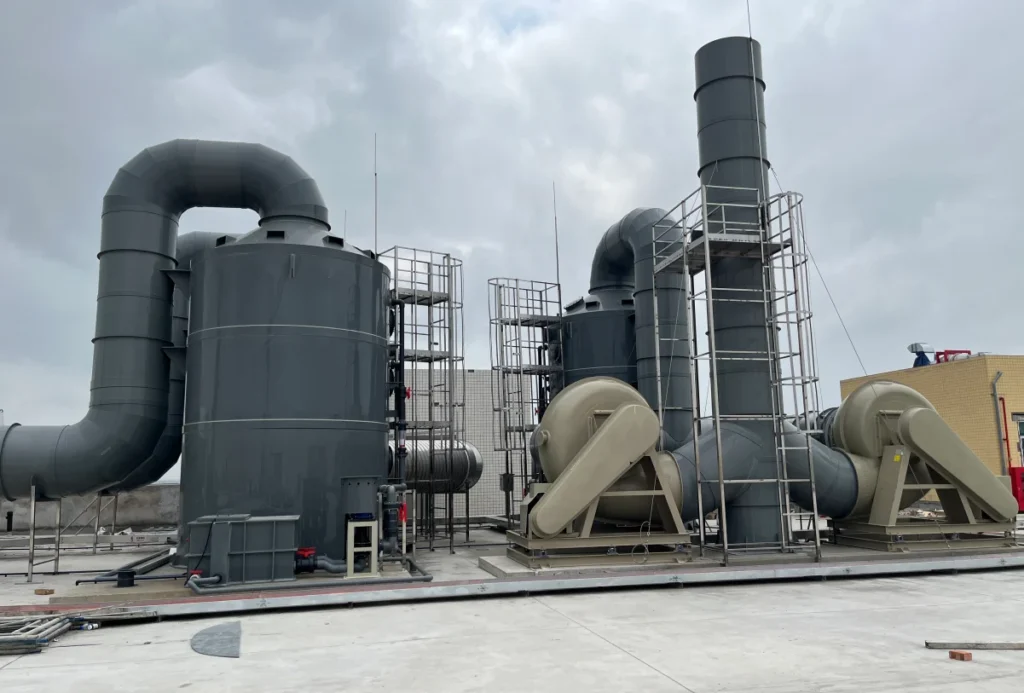
Most plastic tank enquiries arrive already decided. There is a volume, a rough sketch and a date; the material, the wall thickness and the weld schedule are still open, and they stay open until somebody asks the three questions the sketch cannot answer. That order is backwards, because in a fabricated tank the first decision is not the size. It is the sheet.
This page works through plastic tank fabrication in the order a sheet travels through a shop: material, temperature, thickness, cutting, forming, welding, testing, freight. Each step commits the one after it. A 20 mm wall commits the heating time, the cooling time, the rib spacing and the crane that lifts the finished shell; change the material at drawing stage and all four move with it.
It covers the fabricated route only — thermoplastic sheet, cut, formed and welded. Rotomolded and blow-molded tanks are a different method with different limits, and one section below says plainly where a mould still wins. Several numbers here come from two places a buyer can check: ASTM D1998, the U.S. specification that most plastic tank pages quote, and the DVS technical codes for thermoplastic tanks and welding, which are what a fabricated vessel is actually designed and inspected against.
Key Takeaways
- ASTM D1998 looks like the plastic tank standard and is not one for this product. Its scope is flat-bottom, upright tanks of one-piece construction by rotational molding, 1900 L (500 gal) and up, with continuous service held below 66 °C (150 °F) for Type I and below 60 °C (140 °F) for Type II. A welded polypropylene tank at 95 °C is outside that scope twice over.
- A fabricated tank is a structure with seams, and every seam is a quality event. The primary seams are heated-tool butt welds; extrusion welding reinforces a corner or a nozzle, it does not replace the structural seam.
- Wall thickness is derived from the pressure at the bottom, the design specific gravity and the allowable stress at the design temperature. It is not selected from a range, and the range on a supplier page is an output, not an input.
- Height costs more than volume. Doubling liquid height doubles the pressure at the bottom, where the shell, the base seam and the foundation are all working hardest; a squat tank and a tall tank of the same volume are not the same tank.
- Weld quality is a schedule before it is a skill. For PE-HMW sheet the published guide values are a 200–210 °C element, heating time of 20–25 s per mm of thickness, change-over under 3 s and cooling of 1.5 min per mm — so a 20 mm seam spends half an hour cooling before the next pass can load it.
- There is no product standard to fall back on at the end, so the test plan has to be written into the order: bend coupons from production seams, dimensional checks, and a hydrostatic hold at a stated level for a stated time.
- Freight charges for volume and awkwardness, not mass. A tank that cannot travel in one piece is built in segments and welded on site, and the site weld is a second qualification. We warrant the tank body and its welds for 12 months, and we do not rent tanks.
What Plastic Tank Fabrication Can and Cannot Build
Plastic tank fabrication begins with flat sheet and ends with a vessel whose seams are the only thing holding it together. Custom plastic tank fabrication is not a catalogue order with the size changed; it is a drawing, a material grade and a weld schedule that did not exist before the enquiry. The sheet is cut to a developed pattern, formed into a shell, and joined by melting both edges and letting them re-solidify as one material. Nothing is cast and nothing is molded: the wall thickness is whatever was specified, everywhere, and the shape is whatever the drawing says.
That single fact explains both the strengths and the costs of the method. A mould imposes its own geometry on every tank it makes; a fabricated tank has no mould, so it has no mould cost and no mould limit. It also has no mould to hide a mistake in.
Where a Fabricated Tank Wins Over a Molded One
Five conditions put a duty outside what a mould can do economically, and any one of them is enough to bring the work to a sheet shop. Fabricated plastic tanks — fabricated poly tanks in the shorter trade usage — win on any single one of them.
Size beyond the tooling. Rotomolded tanks are made in steel moulds, one mould per size and shape, and the mould is a capital item before the first tank exists. Fabrication has no such step, which is why very large vessels — the ones that travel by permit or not at all — are welded.
Geometry that is not a cylinder. Rectangular tanks, tanks with internal baffles, a sump in one corner, a jacket, a sloped floor, a tank that shares a wall with a building: fabricated sheet goes where a mould will not. In trade catalogues this whole category is listed as custom and plastic process tanks, and the phrase is doing real work — a process tank is a tank with something extra inside it.
Wall thickness chosen for a duty. A molded tank has a wall thickness its mould was designed for. A fabricated tank can carry 20 mm in the bottom course and 12 mm in the top, or a local doubler plate under a heavy nozzle.
Temperature above what molded polyethylene allows. ASTM D1998 holds continuous service below 66 °C for Type I and 60 °C for Type II. Above that, the molding route runs out of published basis while polypropylene sheet does not.
Repair and modification. A welded tank can be cut open, re-welded, re-nozzled and re-tested. A molded one cannot be altered without weakening the wall it was molded from.
Where Molding Is Still the Better Answer
Saying so is not a concession; it saves the buyer a quotation round. If the duty is a standard cylindrical tank above roughly 500 gallons, at atmospheric pressure, below 60 °C, in a resin that suits the contents, rotomolding will usually be cheaper per unit and will have no seams to inspect. Blow molding owns the drum and the small portable tank. Both processes get cheaper as volume rises, because the tooling is spread over more units.
Fabrication wins when one of the five conditions above is outside the mould envelope, and it loses when none of them is. A buyer who is quoted a fabricated tank for a standard 1,000-gallon water duty at ambient temperature should ask why.
What This Page Leaves to Our Other Guides
The geometry of the vessel belongs elsewhere and is not repeated here. Vertical shells and their support are set out in vertical poly tank design; flat walls and the bending they carry, in rectangular plastic tank design; the outlet angle and the ring support, in cone bottom tank design; the rim that an open vessel loses, in open top tank design; and the annulus and leak detection, in double wall tank design.
Material chemistry is treated in the polypropylene tank guide, and the chemical side of storage in plastic chemical storage tanks and acid storage tank selection. This page stays on the making: what the shop does to the sheet, in what order, and how anyone can tell afterwards whether it was done properly.
Three Decisions Before Any Sheet Is Cut
Material, temperature and thickness are one decision wearing three hats. The material sets the allowable stress, the temperature reduces that stress, and the thickness is what remains after the two have been applied to the pressure at the bottom of the tank. Choose any one of them first and the other two follow whether or not anyone has checked.
Material: PP-H, PP-B, HDPE, PVC, and Where PVDF Stops Paying
PP-H, the homopolymer, is the default for hot chemical duty. It is the stiffest of the common tank sheet materials, and stiffness is what resists the slow sag that eventually becomes a wall failure. PP-B, the block copolymer, trades some of that stiffness for impact strength at low temperature, which matters for a tank that is filled cold, drained, and knocked about between campaigns.
The two grades are not interchangeable at the weld. DVS 2207-11 sets weldability inside a melt-flow group — MFR 190/5 between 0.4 and 1.0 g/10 min — and two sheets of the same polymer from different lots can sit outside it. That is why a material certificate carrying the MFR is worth more than a datasheet carrying the trade name. Most polypropylene tanks manufacturers quote a grade name and stop there. Ask for the MFR instead: the melt-flow rate is the number that decides whether one sheet will fuse to another, and it is the first thing that separates polypropylene tank manufacturers who fabricate from those who resell.
HDPE is cheaper, tougher at low temperature and well suited to water and to many chemicals at ambient temperature. Custom polyethylene tanks and custom hdpe tanks are, in most cases, a request for exactly that duty: ambient, aqueous, and standard in shape. Its temperature ceiling is the one written into ASTM D1998 for molded tanks, and a fabricated tank inherits the same material limit even though the standard does not cover it. We do not build polyethylene tanks: when a duty sits inside HDPE’s window, a molder usually serves it better, and this page says so rather than quoting around it. The same holds for polyethylene tanks manufacturers generally — the resin grade matters more than the brand on the door.
PVC-U is a room-temperature material for aqueous duty. It is rigid and it welds well, and it softens at a temperature well below the polyolefins, which rules it out of most process duties. PVDF sits above polypropylene on both chemical resistance and temperature and is the answer when the duty defeats PP twice over; it also costs several times as much per square metre of sheet, so it stops paying as soon as PP would have survived.
| Material | Service temperature basis | Stiffness and creep | Primary weld | Our position |
|---|---|---|---|---|
| PP-H (homopolymer) | Our fabricated tanks are rated −10 °C to 95 °C; published chemical-resistance tables stop at 60 °C | Highest of the polyolefins; the best resistance to slow sag at temperature | Heated-tool butt, with extrusion reinforcement | What we build for hot and chemical duty |
| PP-B (block copolymer) | Same window, with better impact behaviour at low temperature | Lower stiffness than PP-H at the same wall | Heated-tool butt, with extrusion reinforcement | Built when the duty is cold and impact-loaded |
| HDPE | ASTM D1998 caps molded PE below 66 °C (Type I) and 60 °C (Type II) | Softer, and creeps earlier than PP under the same load | Heated-tool butt, with extrusion reinforcement | Not a tank we supply |
| PVC-U | Room-temperature aqueous duty; softens well below PP | Rigid but brittle, and sensitive to impact | Hot-gas and butt | Not a tank we supply |
| PVDF | Above PP on both chemical resistance and temperature | High for a thermoplastic sheet | Heated-tool butt, with extrusion reinforcement | Quoted only where PP fails the chemical |
Note on the figures — The 66 °C and 60 °C limits and the 1900 L (500 gal) lower capacity bound are quoted from the scope of ASTM D1998-21 and apply to rotational-molded polyethylene tanks; they are used here as the moulded-PE reference point, not as a specification for welded tanks. The −10 °C to 95 °C rating is ours, stated as a stiffness limit for the tanks we fabricate, and is not taken from a standard. The MFR group is from DVS 2207-11 as summarised in the SIMONA welding guide.
Temperature: What “High Temperature” Actually Costs
Plastic high temp tank fabrication is not a search for a polymer that will not melt. Polypropylene melts far above any tank duty; the limit is stiffness. As the material warms it creeps under a steady load, and the wall that was straight at 20 °C bows at 80 °C under the same head of liquid.
So temperature enters the design twice. First it lowers the allowable stress taken from the DVS 2205-1 characteristic values, which are tabulated by temperature precisely because the material does not behave the same way across the range. Second it lowers the chemical resistance, which is why a rating table printed with 20 °C and 60 °C columns gives a different verdict in each. A duty between 60 °C and 95 °C therefore sits inside our structural rating and outside the published chemical evidence, and we quote that band against a stated duty and a written material position rather than by interpolating between two columns.
The cost of temperature is paid in millimetres and in rib spacing, not in a different polymer, until the point where the chemical itself fails. A 90 °C duty in PP-H at a given volume needs a thicker wall or closer ribs than the same duty at 40 °C, and that is the whole of the price.
Thickness: A Number You Derive, Not a Range You Pick From
The pressure a wall sees at any depth is the head of liquid above it: p = ρgh. For a thin cylindrical shell, the hoop stress is σ = pD / 2t, so the thickness that keeps that stress at or below the allowable value is t = pD / 2σallow.
Three ratios follow directly and none of them needs a number to be useful. Double the liquid height and the pressure at the bottom doubles. Double the diameter and the thickness doubles at the same stress. Change from water at a specific gravity of 1.0 to a liquid at 1.5 and every pressure in the tank rises by half.
The allowable stress σallow comes from the DVS 2205-1 characteristic values for the material group at the design temperature, and it is then reduced twice: by a welding factor for the seam, and by a reduction coefficient for the medium. Both are published in the same code family. That is why a thickness quoted without a stated design temperature and specific gravity is not a design, it is a number.
The Build Sequence, Verified Step by Step
Plastic tank fabrication has one irreversible point, and it arrives early. Up to the first structural weld, a mistake costs a sheet. After it, a mistake costs the geometry: the shell is welded, the bottom is on, the nozzles are cut, and the only remaining correction is a repair that has to be tested.
Cutting and Edge Preparation
Sheet is cut on a CNC router or a panel saw from a developed pattern, with the kerf allowed for and the edges left square. Two details decide more than the machine does. The first is the weld face: it has to be clean, dry and free of the release agent or dust that the sheet picked up in storage, because contamination at the interface is the most common cause of a seam that looks sound and is not. The second is orientation — the direction the sheet was rolled in, and the residual stress that came with it, affects how the piece behaves when it is heated and formed, so seams are laid out rather than left to fall where the cutting plan puts them.
Forming: Bending, Rolling, and Springback
Flat panels become walls, and a rolled sheet becomes a shell. Both processes warm the material and both are limited by how far it can be bent before the outside face is stretched past what it will take. A tight radius is not a shortcut for a sharper corner; it is a stress raiser that the service load will find.
Rolling leaves the shell open along one longitudinal seam, and that seam is usually the longest single weld in the tank. The diameter is set by the roll, not by the weld: the shell springs back when the rolls release it, and the weld closes a shape that has already decided what it wants to be. A shell that is out of round cannot be welded into round.
Primary Seams: Heated-Tool Butt Welding
The structural seams — shell length, shell-to-bottom, and the bottom itself — are made by heated-tool butt welding, and DVS 2207-1 describes the cycle in five stages: alignment, heating, change-over, joining, and cooling under pressure. The published guide values for high-molecular-weight PE sheet put the element at 200–210 °C, the heating time at 20–25 s per mm of sheet thickness, the change-over below 3 s, and the cooling time at 1.5 min per mm.
Those figures explain why a shop schedules around cooling rather than welding. A 20 mm seam heats for 400 to 500 seconds, then cools for half an hour before it can be loaded. A tank with a few tens of metres of structural seam is scheduled around the cooling clock, not the welding gun, and any promise that compresses that wait is either using a shorter cooling time than the material allows or is moving the tank before the seam has stopped changing.
The change-over limit is the one to watch in a quotation. In the three seconds between lifting the heating element and applying joining pressure, the melted surface begins to solidify. A machine that takes longer produces a joint that looks complete and is cold at the interface, and no amount of extrusion welding over the top repairs what happened underneath.
Secondary Seams: Extrusion, Hot-Gas, and Fillet
Extrusion welding feeds a rod of the same polymer through a heated barrel and deposits it into a prepared groove; PP rod is commonly supplied at 4 mm diameter. It is used where a butt weld cannot reach: the inside corner between wall and bottom, the collar around a nozzle, the reinforcement over a vertical seam. Hot-gas welding, run at 210–240 °C for PP-H, PP-B and PP-R, handles tacking, small details, and repairs.
Neither is a structural seam by default. An extrusion weld is often described as if it were, and it can be structural where it is specified, sized and tested as one; it is not structural because it was applied generously over a corner. The distinction matters at the nozzle and at the base fillet, which are exactly the places where a leak is hardest to reach later.
Nozzles, Collars, and Reinforcement
A nozzle is a hole cut into a stressed membrane, and the collar around it restores the load path that the hole interrupted. The weld that joins the collar is often the thinnest structural weld in the tank, and it is made in the most awkward position. Flange flatness matters as much as weld quality: a gasket cannot seal against a flange that was welded on a curve. Where the connection has to be made after the shell is closed, a bulkhead fitting does the same job without hot work, and the comparison between the three routes is on the fittings page.
The fittings themselves — flanges, sockets, valves and the reinforcement around them — are a subject of their own, covered in poly tank fittings, and the rule that applies here is only that the nozzle schedule should exist before the shell is welded, not after.
Base, Rim, and Lifting Points
A flat bottom spreads the contents over the foundation, and it needs the foundation to be flat. A gap under the base turns dead weight into bending, and bending under a full tank is what makes a bottom crack along a seam rather than in the middle of a panel. The base-to-wall joint carries the entire contents plus the weight of the shell above it, which is why it is the one seam that gets the most attention and the most testing.
The top is the opposite problem. A closed tank keeps its ring; an open tank loses it, and the rim has to be stiffened or the shell has to be thicker. Lifting points must transfer into ribs or into the base frame, never into the shell as a local patch: a lug welded to a 12 mm wall will lift the tank once.
| Weld method | Where it belongs in a tank | Where it must not be the primary seam | What acceptance looks like |
|---|---|---|---|
| Heated-tool butt | Shell length seams, shell-to-bottom, bottom panels, large structural joints | — | Bead geometry and alignment, bend coupon from a production seam, weld log with element temperature and stage times |
| Extrusion (fillet or cap) | Inside corners, nozzle collars, reinforcement over vertical seams | Any joint carrying hoop tension on its own | Continuous deposit with no porosity, correct rod grade, visual and bend checks on coupons where specified |
| Hot-gas | Tacking, small details, repairs, non-structural attachments | Structural seams of any length | Visible fusion at the root, no overheating discolouration, operator qualification |
| Socket or fusion (pipe and fittings) | Piping connections to nozzles, small-bore penetrations | Shell seams | Fusion bead and insertion depth, pressure test with the piping |
How a Welded Water Storage Tank Gets Its Wall Thickness
Water is the cleanest example to work through because the numbers are familiar: a specific gravity of 1.0, no chemical attack, and a service temperature that does not move the allowable stress much. If the wall is wrong for water it will be wrong for everything else.
The Pressure the Wall Actually Sees
Hydrostatic pressure rises linearly with depth. Four metres of water puts about 39 kPa (5.7 psi) on the bottom, and one metre of water is 9.81 kPa, or 1.42 psi. The same four metres of a liquid with a specific gravity of 1.5 puts about 59 kPa on the bottom.
The consequence is that height, not volume, sets the stress. Two welded water storage tanks of roughly 20 m³ — one four metres tall and two and a half metres across, one two metres tall and three and a half metres across — do not share a bottom wall. The tall one carries twice the pressure at the base with less circumference to share it around.
Wall, Rib, and Hoop: Where the Load Goes
Hoop tension in the shell is the product of pressure and diameter, and the wall resists it in direct tension. The ribs do a different job: they shorten the unsupported span of shell between them, and they take the bending that comes from wind, from seismic load, and from the shell’s own tendency to bow outward between supports. A rib does not make the sheet stronger; it changes the span the sheet has to carry.
That gives the designer two levers with different costs. Thicker sheet raises the material cost of every square metre. Closer ribs raise the labour cost and take up space around the tank. Which one wins depends on the duty and the site, and a quotation that offers only one of them has not made the comparison.
Freeboard, Overflow, and the Top Course
The level the tank is designed for is the overflow level, not the nominal capacity. A tank sold as 20 m³ that is filled to the brim to get 20 m³ has no freeboard, and every filling event puts the design head above the number the wall was calculated for. Freeboard also covers the wave from a sudden fill, foam from an aerated stream, and the operating band of any level control.
The top course is usually the thinnest part of a welded water storage tank and the part where an open vessel needs its rim. Both facts come from the same place: there is almost no pressure up there, and almost all of the stiffness requirement.
Testing, and What “Passed” Actually Proves
There is no ASTM specification for a fabricated thermoplastic tank. ASTM D1998 is the standard most buyers have heard of, and its scope is rotational-molded one-piece tanks, so a welded vessel cannot claim compliance with it at all. What exists instead is a code family for the welds (DVS 2203) and a calculation code for the structure (DVS 2205). The test plan is therefore written into the order, and its quality depends on how specifically it was written.
Visual and Dimensional Checks
The first check costs nothing and finds most of the problems. Bead height and width against the weld parameter sheet, no undercut at the toe of the seam, no discolouration that indicates the element ran hot, no visible porosity in an extrusion cap. Then the dimensions: overall height, diameter, nozzle positions and elevations, flange orientation, and the flatness of the bottom. A nozzle 20 mm off the drawing is a piping problem at site, and it is cheaper to find here.
Destructive Weld Tests
DVS 2203-1 sets out the testing of welded joints in thermoplastic sheets and pipes, and DVS 2203-5 describes the technological bend test used for routine control. A coupon is cut from a production seam, bent around a former, and judged on the bending angle reached and on where it breaks: a break in the parent material, away from the seam, is the result that proves fusion; a break along the interface is the result that condemns it.
The acceptance angle is not one number. The minimum bending angle falls as the sheet gets thicker — for HDPE in the SIMONA data, 87° at 3 mm down to 20° at 30 mm — which is why a thick-wall tank needs its own coupon rather than the shop’s usual value. Coupons come from the tank being built, on the day it is built, not from a demonstration piece.
Hydrostatic and Air Testing
Water is the only test medium that loads the whole structure the way service will: bottom, base seam, shell, nozzle collars, all at once, at the design head. The tank is filled to the specified level, held, and every seam inspected while it is under load. The hold time has to be a stated number in the order; on a fabricated tank it is a project specification, because there is no product standard to default to.
Air testing a large tank is a different proposition. Compressed air stores energy, and a seam that lets go under air can move sheet rather than weep, so air is used for small-bore connections and for leak location on a joint already proven by water, not as a substitute for the hydrostatic test.
Documentation That Travels With the Tank
Four documents make a tank auditable later: the material certificate with the MFR and the sheet thickness, the weld log with element temperature and the timing of each stage, the coupon results, and the hydrostatic record with the level and the duration. A tank without them is a tank whose history has to be taken on trust at the first repair.
Shipping, Site Assembly, and What Drives Freight Cost
Poly tank shipping cost is decided on the drawing, not at the loading dock. Freight for a fabricated tank is charged on volume and on awkwardness, and both of those are consequences of a design decision taken weeks earlier.
One Piece or Segmented
A tank that fits the road travels in one piece, braced and protected, and needs a crane at each end. A tank that does not fit is built in segments, shipped flat or in curved sections, and welded on site. The second option is not a shipping workaround; it is a different project with a different quality plan, because the last seams are made in a place with weather and without the shop’s tooling.
What Freight Actually Charges For
Four things, and weight is the least of them. Volume, because a tank is mostly air and carriers price the space it takes. Stackability, because a tank cannot be stacked, so it consumes a trailer that could have carried two loads of something else. Oversize, because width and height beyond the road envelope bring permits, escorts and a route survey. And handling, because a crane or a forklift is needed at both ends and the empty trailer still has to get home.
The lever a buyer has is the design. A tank sized to the transport envelope costs less to deliver than one designed just past it, and a segmented design costs less to deliver and more to build and test. Asking for the freight implication at quotation stage is cheaper than discovering it at the loading dock.
Site Welding and Handover
Site welding needs a flat and stable foundation, power, shelter from wind and rain, and enough access for the sheet, the machine and the welder. The seams made on site go through the same stages as the shop seams, and the tank goes through the hydrostatic test again, because the joints that were added are the joints that have not been proved. The handover package gains a site weld log and a second test record.
Buying: Rent, Stock, or Fabricate
There are three ways to put a plastic tank on a site, and only one of them is a fabrication decision. The other two are a scheduling decision and a stock decision, and the money is in knowing which one the duty actually is.
When Rental Beats Fabrication
Rental serves a temporary need in a standard size. A nationwide poly tank rental company delivers a tank from a fleet, collects it at the end of the term, and carries the maintenance and the compliance paperwork in between. For a six-week campaign, a planned outage, or a bridging volume while a permanent tank is built, that is often cheaper than owning, and it is always faster.
Rental stops working when the duty leaves the fleet’s envelope. A tank with an unusual nozzle layout, a chemical the rental fleet does not carry, a temperature outside the poly tanks’ rating, or a service expected to run for years: poly tank rental for commercial projects is priced on availability, and availability is exactly what a non-standard duty does not have. We do not rent tanks; we build the ones that have to be built.
What to Send in an RFQ
A quotation is only as good as the data behind it, and most of the missing data is not technical — it is a number nobody thought to write down.
| Item | What to state | Why it moves the design |
|---|---|---|
| Contents and specific gravity | The liquid, its concentration, and the specific gravity at the operating temperature | Sets the hydrostatic pressure at the bottom and selects the material family |
| Temperature | Normal, maximum, and minimum, including cleaning and steaming | Reduces the allowable stress and can move the duty outside published resistance data |
| Volume and level | Working volume, and the overflow or high-level alarm elevation | The wall is designed to the overflow level, not the nominal capacity |
| Space envelope | Height, diameter or footprint, and every obstruction within the tank’s envelope | Decides aspect ratio, which decides bottom pressure at a given volume |
| Nozzle schedule | Size, service, orientation and elevation for every connection, with flange standard | Each penetration is a stress concentration and must exist before the shell is welded |
| Foundation and loads | Foundation type, flatness, and whether wind or seismic design applies | Rib spacing and base design follow the support and the lateral load |
| Inspection and documents | Coupon tests, hold time and level for the hydrostatic test, and the documents required at handover | There is no default product standard to fall back on, so the order must name the tests |
| Delivery and access | Site address, access route, crane availability, and whether the tank must travel in one piece | Decides one-piece against segmented, and the freight structure follows |
How Long a Fabricated Tank Actually Takes
The welding is rarely the long pole. A custom poly tank runs through drawing approval, sheet procurement in the specified grade and thickness, cutting and forming, welding with its cooling clock, testing, and freight. Sheet availability in an unusual grade or thickness is the item that most often moves a date, and it is the item a buyer can influence by accepting a standard grade early rather than holding out for a specific lot.
The quotation stage is where all of this can still be changed cheaply. The drawing and quotation work for custom poly tanks starts with the engineering team, and the standard vessels we fabricate are listed under PP chemical storage tanks, with the sheet they are built from under PP plastic sheet.
Sources
- ASTM International — ASTM D1998-21, Standard Specification for Polyethylene Upright Storage Tanks (scope: flat-bottom, upright, cylindrical tanks molded in one-piece construction by rotational molding, above ground, atmospheric pressure, capacities from 1900 L (500 gal) up; continuous service below 66 °C (150 °F) for Type I and below 60 °C (140 °F) for Type II; low-temperature impact, dart drop, visual inspection and water test required; excludes portable tanks, pressures other than atmospheric, and liquids heated above their flash points).
- DVS — German Welding Society — DVS 2205-1, Calculation of tanks and apparatus made of thermoplastics — Characteristic values (characteristic values by material group for polyethylene, polypropylene, PVC and fluoropolymers; welding factors and reduction coefficients for media; basis for the allowable stress at design temperature).
- DVS Media — DVS Technical Codes and Bulletins, Volume 5: Calculation of thermoplastic tanks and apparatus (part list for DVS 2205-1 characteristic values and supplements, DVS 2205-2 for vertical round non-pressurised tanks, and the supplements covering flat roofs, welded stationary tanks in buildings, flat-bottomed and vertical-skirt tanks in earthquake regions, shell construction, and ring-supported conical bottoms).
- DVS — DVS 2207-1, Welding of thermoplastics — Heated tool butt welding of pipes, pipeline components, fittings and sheets (English text; the five-stage cycle of alignment, heating, change-over, joining and cooling, and the scope of heated-tool butt, socket and tapping-tee welding).
- DVS Media — DVS Technical Codes and Bulletins, Volume 3: Testing of welded joints (DVS 2203-1, testing of welded joints of thermoplastic sheets and pipes; DVS 2203-5, technological bend test, including specimen dimensions by sheet thickness).
- SIMONA AG — Welding Guide for Thermoplastic Semi-Finished Products (guide values for heated-element butt welding of high-molecular-weight PE sheet: element 200–210 °C, heating time 20–25 s per mm of thickness, change-over under 3 s, cooling 1.5 min per mm; hot-gas welding temperatures of 210–240 °C for PP-H, PP-B and PP-R; weldability of PP grades within MFR group 006/012 per DVS 2207-11; DVS 2203-5 bend test set-up and minimum bending angles by material and sample thickness).
- INEOS Olefins & Polymers USA — Typical Engineering Properties of High Density Polyethylene (density 0.930–0.965 g/cm³; Vicat softening temperature 132 °C for homopolymer and 112–130 °C for copolymer; basis for the statement that HDPE’s softening range sits well below a welded PP duty).