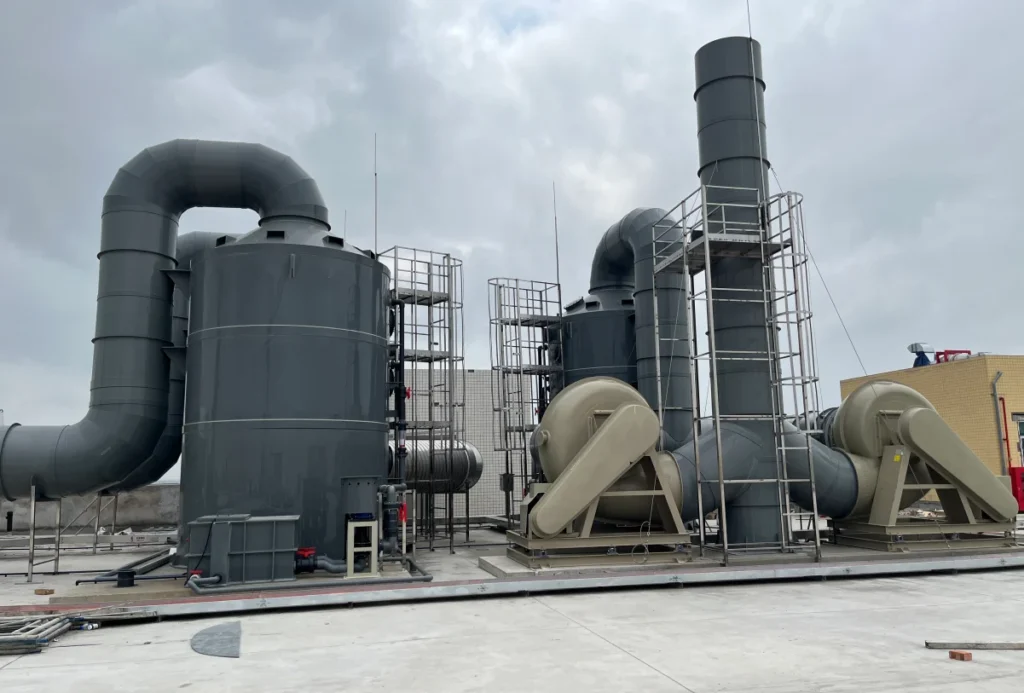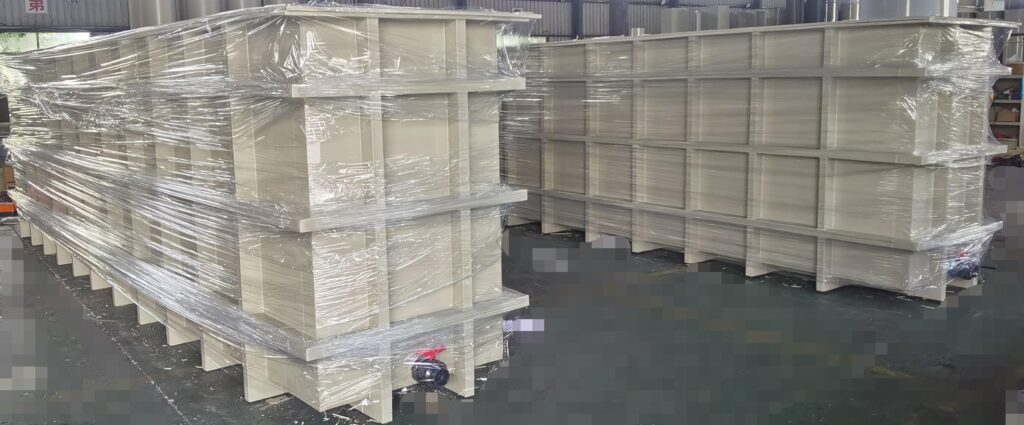
Plastic chemical storage tanks are usually specified in the wrong order. The tank gets chosen first — a shape, a volume, a price from a catalogue — and the chemical is checked afterwards against whichever resistance chart happens to be on the supplier’s website. That order explains most of the tank replacements we are asked to quote. The wall was sound, the weld was sound, and the medium was wrong.
This guide works the other way round. It starts from the chemical and its service conditions and treats the tank as the output of that reading. Four inputs do most of the work — the exact chemical, its concentration, its service temperature and its specific gravity — and any one of them can flip a conclusion on its own, which is why the same acid at two strengths is two different tank problems. From there it covers the two engineering questions that decide whether plastic chemical storage tanks are acceptable on a site at all: how they vent, and what contains them if they leak.
It also sets the material choice against the four families that actually compete for these duties — steel, FRP, stainless and the plastics — and says where each one loses ground. The page stays at specification level. For the material science behind polypropylene itself, see our polypropylene tank guide; for the vessels, the PP chemical storage tanks range. If the duty is already settled, the shop drawing and quote are the next step.
Key Takeaways
- For plastic chemical storage tanks the chemical decides the tank, not the other way round. Four inputs — exact chemical identity, concentration, service temperature and specific gravity — each change the answer independently.
- Specific gravity is the input most often left off an enquiry, and it scales the load almost linearly. At 1.9 specific gravity, the same wall carries roughly 1.9 times the hoop stress it carries in water.
- In U.S. OSHA terms an atmospheric tank is one designed for pressures from atmospheric up to 0.5 p.s.i.g. Its normal vent has three accepted sizing routes and a hard floor of 1¼ inch nominal inside diameter.
- Secondary containment is two rules, not one number. Hazardous-waste containers use 10% of container volume or the largest container; flammable-liquid diking uses the largest tank assuming a full tank. Different scopes, different figures, both correct.
- Polypropylene is the default for acids, alkalis and plating chemistry. For aromatic and chlorinated solvents and strong oxidizing acids, no polyolefin is acceptable at elevated temperature, and changing from PP to HDPE does not fix it.
- We warrant the tank body and welds for 12 months. Service life depends on the duty, and we do not rent tanks.
What Plastic Chemical Storage Tanks Actually Cover
Two words in that phrase are doing far more work than buyers expect. Plastic is not one material: polypropylene, high-density polyethylene, crosslinked polyethylene, PVC, CPVC and PVDF are six different polymers with six different resistance profiles and six different fabrication routes. Chemical is not one hazard either: a 10% acid, a 78% acid, a caustic, a hypochlorite and an aromatic solvent are five separate engineering problems that happen to share a storage vessel. The hypochlorite one has its own guide, because that solution decomposes as it sits and the vessel has to serve the reaction: the poly bleach tank article.
The Four Inputs That Decide Whether Plastic Is Allowed at All
Before shape, size or price, four facts about the medium settle the question for every plastic chemical storage tank. The exact chemical identity, its concentration, its service temperature and its specific gravity. Get all four right and the material and wall become a calculation. Get one wrong and the rest of the specification is decoration.
This is not a formality. A tank specified for 10% sulphuric acid is a different tank from one specified for 78% sulphuric acid at 60 °C, and a supplier who quotes the same vessel for both has not read the duty. The resistance data exists; the discipline of applying it at the right concentration and the right temperature is what is usually missing.
What This Page Deliberately Leaves Out
Three subjects belong to other pages and are not repeated here. The polymer science of polypropylene — crystallinity, homopolymer versus copolymer, why it melts at a range rather than a point — sits in our polypropylene tank guide. The geometry of individual tank types — cone-bottom, open-top, double-wall, vertical, rectangular — is treated in separate pages built around each form. The flat-wall arithmetic behind the rectangular case is in the rectangular plastic tank case. The top edge itself, which is the one part an open vessel cannot share with a closed one, has open top tank design to itself. And capacity selection against throughput belongs with the sizing work on the main guide and on the product pages.
What remains is the part that most published material skips: reading a medium into a venting requirement, a containment requirement and a wall thickness. That is where the engineering actually sits, and it is where plastic chemical storage tanks either pass or do not.
Start With the Chemical, Not the Tank: A Four-Input Method
The method below is the one we apply to every enquiry, in this order. It is deliberately unfashionable: none of the four inputs costs anything to obtain, and all four are routinely missing from the enquiries that arrive by email.
Input 1 — the Exact Chemical, Not the Trade Name
Trade names hide chemistry. A proprietary cleaner, a pickling additive, a produced-water blend or a plating brightener may be a single substance, a mixture of three, or a mixture that changes formulation between batches. Resistance data is published for substances, not for brands, so a trade name cannot be looked up and a mixture cannot be assumed to behave like its main ingredient.
Ask the supplier for the safety data sheet and work from Section 3, which lists the composition, and Section 9, which gives the physical and chemical properties. If the formulation is confidential, the manufacturer can usually still state the chemical family and the pH band, and that is enough to rule materials in or out even when it is not enough to design the wall.
Input 2 — Concentration: the Same Acid at 10% and at 78%
Concentration is the input that most often reverses a conclusion, and it does so in both directions. On the published five-point scale for polypropylene, sulphuric acid at 10% is rated 1 at 20 °C and 1 at 60 °C — excellent at both temperatures. Sulphuric acid at 78% is rated 2 at 20 °C but 4 at 60 °C. At 93% it is 3 at 20 °C and 4 at 60 °C. The same acid, the same polymer, three different outcomes.
The reason is not mysterious. Dilute aqueous acids present the polymer with a mild environment and a lot of water; concentrated acids present a much more aggressive one, and raising the temperature accelerates whatever attack is already possible. A specification that says “sulphuric acid duty” and nothing else has specified nothing. Which concentration band survives which material, acid family by acid family, is worked through in the acid storage tank guide.
Input 3 — Service Temperature, and Why the Chart Has Only Two Columns
The resistance tables most suppliers quote are published at two temperatures, 20 °C and 60 °C, and nothing in between. That is a limitation to be respected rather than worked around. Interpolating a rating at 40 °C produces a number that no source supports, and a design based on it is a design based on an invention.
The honest way to use a two-column chart is to read the gap. Where a rating holds across both columns, the service has margin at both temperatures. Where it drops from 1 to 2, or from 2 to 4, the chemical is telling you that temperature is the controlling variable and that the duty needs to be pinned to a number, not a range. Our own fabricated tanks are rated for service from −10 °C to 95 °C, which is a stiffness limit rather than a melting limit; the crystalline melting range for polypropylene is 160–180 °C, so the wall never approaches melt. What fails first is deflection.
Input 4 — Specific Gravity and Suspended Solids
Specific gravity is the fourth input and the one most often absent, because water is the mental default and water sits at 1.0. It is treated at length in its own section below, but the short version belongs here: every load in the tank — the hydrostatic pressure at the base, the hoop stress in the shell, the bearing pressure on the base plate, the load on the support ring — scales with it almost linearly. A tank designed against water and then filled with a liquid at 1.9 specific gravity is carrying nearly double the load it was drawn for.
Suspended solids matter for a different reason. A slurry settles, and a settled bed loads the base plate locally rather than uniformly, which is a bearing problem rather than a pressure problem. If the duty includes solids that can settle, say so on the enquiry; the base detail changes.
What We Ask You to Send Before We Quote a Material
Five fields on one sheet: the chemical name and concentration band, the maximum and normal service temperature, the specific gravity at service temperature, any suspended solids and their nature, and whether the medium is flammable. With those five, a material recommendation is a reasoned answer rather than a preference, and a quotation can be issued in 48 hours. Without them, the quotation is a range and the drawing is a revision waiting to happen.
Our engineering team will tell you when the answer is that plastic is the wrong material. That happens more often than a sales page would suggest, and it is cheaper for everyone than a tank that fails in its second year.
Plastic Against Steel, FRP and Stainless
The competitor for plastic chemical storage tanks is rarely another plastic tank. It is steel, glass-fibre-reinforced plastic, or stainless. Each of those is the right answer for some duties, and pretending otherwise makes a supplier easy to dismiss. What follows is where each one genuinely wins, and the four duties where the plastics are the only sensible option.
Where Steel Still Wins, and We Will Say So
Carbon steel wins on one thing above all: cost at large volume in a benign duty. A hydrocarbon that steel tolerates, stored in a vessel of several hundred cubic metres, is a steel vessel. Above a certain size, the price per cubic metre of a welded thermoplastic shell stops competing with a steel shell that needs no special alloy, and the corrosion allowance is cheaper than the polymer thickness.
Steel also wins where the medium is genuinely a pressure duty. Our tanks are atmospheric vessels; a process that needs to run above the atmospheric ceiling is a pressure vessel problem, and steel is built for it. If a duty turns out to be a pressure duty, the correct answer is not a thicker plastic wall.
FRP’s Real Boundary
Glass-fibre-reinforced plastic occupies the middle ground: better corrosion resistance than carbon steel, lower cost than stainless at moderate size, and a fabrication route that handles large diameters well. Its boundary is in the resin and in the inspection. The chemical performance is the resin’s performance, not the glass’s, so a resistance claim about “FRP” is really a claim about a specific resin system, and it is only as good as that.
The second boundary is repairability and inspection. A thermoplastic shell is homogeneous and can be re-welded; a laminate is layered, and a defect between layers is not visible from the outside. For a duty where the medium is marginal for the material, that difference matters more than the price.
Stainless Steel: Cost, Chlorides, and the Wrong First Choice
Stainless steel is the material buyers reach for when they want to be certain, and for some duties that instinct is right. It is the wrong first choice when the medium carries chlorides, because chloride stress-corrosion cracking is a stainless failure mode that does not improve with grade selection in the way buyers expect, and it can appear in an application that a corrosion chart calls acceptable.
Cost is the second issue. For an atmospheric chemical storage duty, an equivalent stainless vessel typically costs well above a fabricated polypropylene one — our own figure is 30–50% higher for equivalent capacity — and a polypropylene shell is roughly 70% lighter than the steel vessel it replaces, which matters for the support structure and the foundation as much as for the tank.
Where that cost sits is a question about the build rather than the polymer, and the fabrication route behind a polypropylene vessel breaks it down.
Four Cases Where Plastic Is the Only Sensible Answer
First, dilute and moderate acids and alkalis at ambient to warm temperature, where the resistance data has margin at both chart columns and the tank is atmospheric. Second, plating, pickling and surface-treatment lines, where the chemistry is aggressive, the volumes are moderate and the vessels are often custom-shaped to a line layout — a specification we build regularly in our PP chemical storage tanks range. Third, hypochlorite and other oxidizing duties where the concentration and temperature sit inside the rating. Fourth, any duty where the tank must be inspected, repaired or modified on site, because a welded thermoplastic shell can be re-welded and a laminate cannot be re-laminated to the same standard.
Choosing the Plastic: PP, HDPE, XLPE, PVC/CPVC and PVDF
Once plastic is the right family, the next question is which plastic. The five below cover almost every duty we are quoted, and the differences that matter are temperature ceiling, resistance to the aggressive families, and how the material behaves when it has to be fabricated into a large welded shell.
PP — the Default for Acids and Plating Chemistry
Polypropylene is our default for chemical storage, and the reasons are published rather than promotional. The U.S. food-contact specification for olefin polymers puts polypropylene at a density of 0.880–0.913 g/cm³ and a melting range of 160–180 °C; the published resistance data describes it as more resistant to organic solvents than other common plastic pipe materials and particularly resistant to sulfur-bearing compounds, while being only slightly less rigid than PVC. It welds well, holds stiffness to a higher temperature than polyethylene, and takes the acid and alkali duties that make up most of the chemical storage market.
Its boundary is equally well published and should be learned: strong oxidizing acids, chlorinated solvents and aromatic hydrocarbons. Nitric acid at 65% is rated unacceptable at both 20 °C and 60 °C; chloroform, carbon tetrachloride and methylene chloride the same. Where those appear, the answer is not “more PP”. It is a different material or a different process design.
For plating, pickling and immersion lines specifically, the vessel geometry usually matters as much as the material — see the tanks we build for pickling and plating lines. How the acid, its concentration and the bath temperature settle the material is set out in our pickling tank design guide.
HDPE — Where It Genuinely Beats PP, and Where We Tell You No
High-density polyethylene is the other polyolefin in this conversation, and it is not a lesser version of polypropylene. A major HDPE resin data sheet gives a density of 0.930–0.965 g/cm³, a DSC melting point of 135 °C for the homopolymer and 110–134 °C for copolymers, and a Vicat softening point of 132 °C for the homopolymer. Set against polypropylene’s 160–180 °C melting range, that is a materially lower temperature ceiling.
HDPE’s advantages are toughness and impact behaviour, especially in the cold, which is why it dominates the rotational-moulded tank market and why it is the right material for buried or heavily handled vessels. Its disadvantages for our work are the temperature ceiling and the fact that rotational moulding carries a size ceiling that sheet fabrication does not.
We do not build polyethylene tanks, and we say so rather than quoting one. If a duty genuinely calls for HDPE — a cold, tough, moulded application — the honest recommendation is a moulded HDPE supplier, not a polypropylene vessel stretched past its duty.
XLPE — What Crosslinking Buys and What It Costs
Crosslinked polyethylene is polyethylene with its polymer chains chemically linked, which raises its resistance to stress cracking and improves its behaviour under sustained load at temperature. In the moulded tank market it is sold as an upgrade over ordinary HDPE for aggressive or elevated-temperature duties.
It is not a material we fabricate into welded sheet vessels, and the practical consequence for a buyer is that XLPE arrives as a moulded product with the associated size ceiling. Treat any XLPE recommendation as a moulded-vessel recommendation and check the size limit before designing the installation around it.
PVC and CPVC — the Chlorinated-Service Pair
Polyvinyl chloride and chlorinated polyvinyl chloride sit in a different chemical space from the polyolefins. The chlorine in the chain changes what the polymer resists, and the chlorinated grades raise the temperature ceiling over standard PVC. They are common in piping and in smaller vessels.
Their practical limitation for tank work is fabrication. PVC and CPVC are less forgiving to weld into a large shell than polypropylene or polyethylene, and the joint quality that a large vessel depends on is harder to guarantee. They also carry their own solvent sensitivities, so a chart that shows PVC resisting a chemical that attacks PP does not mean PVC is the better tank material for that duty — only that the resistance question has a different answer.
PVDF — When Budget Is Not the Constraint
Polyvinylidene fluoride is a fluoropolymer, and it is the material of last resort for the duties where the polyolefins and the vinyls both fail: aggressive oxidizing environments and many of the solvents that attack PP. It also holds properties to a substantially higher temperature than polypropylene.
It is expensive, both as a material and as a fabrication, and the fabricated-vessel cost is a multiple of a polypropylene vessel of the same size. The right question is not “is PVDF better” — on chemical resistance it usually is — but whether the duty justifies the multiple. Where a small, critical vessel has to survive a medium nothing else tolerates, it does.
Material Shortlist by Chemical Family
The table below is our engineering shortlist, not a published rating. Where a resistance figure exists in the sources listed at the foot of this page, it is quoted at the stated temperature and not interpolated.
| Chemical family | First choice | Consider | Avoid |
|---|---|---|---|
| Dilute mineral acids (10% range) | PP | HDPE, PVC | — |
| Concentrated sulphuric acid >70% | PP at low temperature only | PVDF | PP above 60 °C |
| Alkalis and caustic | PP | HDPE | — |
| Hypochlorite and bleaching duties | PP | PVDF for elevated temperature | PP at sustained high temperature |
| Strong oxidizing acids (nitric 65%) | PVDF | — | All polyolefins |
| Aromatic hydrocarbons | PVDF | — | All polyolefins |
| Chlorinated solvents | PVDF | — | All polyolefins, PVC |
| Food and potable water | Natural PP | HDPE, XLPE | Pigmented or regrind sheet |
For the vessels that result from this shortlist, the polypropylene tank range covers the standard forms and the custom work.
Specific Gravity: the Number That Redesigns the Whole Tank
Of the four inputs, specific gravity is the one that changes the drawing most and appears on enquiries least. The reason is habit rather than difficulty: water is the default mental model, water is 1.0, and every load in a tank is proportional to it.
What SG Actually Changes Inside the Tank
Four loads, and all four move together. The hydrostatic pressure at the base rises in proportion to specific gravity. The hoop stress in the shell rises with that pressure. The bearing pressure on the base plate rises with the total mass. And the load transferred to the support ring, the skirt or the plinth — and from there to the foundation — rises with the same mass. A design that was checked against water is checked against the lightest case it will ever see.
Worked Comparison: 1.9 Specific Gravity Against 1.0 on the Same Tank
Take a vertical cylindrical tank with an internal diameter of 1,800 mm and a liquid depth of 2,000 mm, which gives a working volume of about 5.09 m³. These are our own worked figures on a stated geometry, not a quotation.
At a specific gravity of 1.0 the pressure at the base is 1,000 × 9.81 × 2.0, about 19.6 kPa, and the contents weigh about 5.1 tonnes. At 1.9 the base pressure is 1,900 × 9.81 × 2.0, about 37.3 kPa, and the contents weigh about 9.7 tonnes. Almost exactly double, as the arithmetic implies.
The consequence for the wall follows from the thin-wall relationship for hoop stress, σ = pD/(2t). Pressure appears in the numerator and thickness in the denominator, so at a fixed wall the stress rises by the same factor as the pressure — roughly 1.9 times. To hold the same margin at the same diameter, the wall has to go up by about the same factor, or the diameter has to come down, or the shell has to be stiffened externally. None of those is free, and none of them appears in a quotation that was priced against water.
Where the Load Lands: Wall, Ring Stiffeners, Support, Foundation
The wall is the visible part and the one buyers think about. The ring stiffeners are where a heavy liquid actually announces itself: as pressure rises, the shell wants to bulge, and the stiffening that keeps a circular section circular has to be re-checked, not just made thicker. The base plate carries the whole mass and needs its own bearing check. And the support — skirt, legs, ring beam or plinth — transfers the mass to the foundation, which has its own allowable bearing pressure.
In practice, doubling the specific gravity of a duty usually changes the tank more at the base and at the support than at the top of the shell. For plastic chemical storage tanks, a specification that only adjusts the wall thickness has addressed a third of the problem.
Which Specific Gravity Number We Need, and at Which Temperature
We need the specific gravity at the service temperature, not at 20 °C, because liquids expand and density falls as they warm. We need it for the maximum concentration the tank will ever see, not the nominal one, because the tank will be filled to whatever the process actually produces. And we need it to be the liquid’s own figure — from Section 9 of the safety data sheet, or from the supplier — rather than an assumption based on a similar-sounding chemical.
Where the duty involves metering or dosing rather than storage alone, the same figure drives the pump and the pipe sizing as well, which is why dosing tanks are specified from the same four inputs; our chemical dosing tanks are quoted on that basis.
Venting an Atmospheric Chemical Tank: Three Accepted Routes
Venting is the part of a tank specification that is most often left to the fabricator and most often under-specified. The physics is simple — a tank that is filled must let air out, and a tank that is emptied must let air in — and the rules that follow from it are specific. We use the U.S. OSHA regulation for flammable liquids as the reference framework below, because it is published in full, it is clause-numbered, and its logic applies to any atmospheric tank even where the medium is not flammable.
What “Atmospheric” Means, and the Design-Pressure Ceiling That Follows
The regulation draws the line in a definition: an atmospheric tank is one designed to operate at pressures from atmospheric through 0.5 p.s.i.g. A low-pressure tank is designed for above 0.5 and not more than 15 p.s.i.g., and a pressure vessel is anything above 15 p.s.i.g. The three categories are not stylistic — each carries a different set of requirements, and a tank cannot be moved between them by closing a valve.
A fabricated polypropylene storage tank is an atmospheric vessel. That is not a limitation we are apologising for; it is the category the material is designed for, and it defines what the vent has to do.
The Floor Nobody Quotes: 1¼ Inch Nominal Inside Diameter
The regulation requires atmospheric tanks to be adequately vented so that filling or emptying, and changes in atmospheric temperature, cannot develop a vacuum or a pressure that distorts a cone roof or exceeds the design pressure of the tank. It then gives three ways to size the normal vent. The third is the one worth memorising, because it is a floor rather than a method: the vent must be at least as large as the filling or withdrawal connection, whichever is larger, and in no case less than 1¼ inch nominal inside diameter (about 32 mm on our conversion; the regulation states 1¼ inch).
That floor is missed constantly in practice, because a small tank with a small fill line looks like it needs a small vent. A half-inch vent on a one-inch fill is not a vent; it is a restriction that turns the tank into a pressure vessel every time it is filled.
Route 1, Route 2, Route 3: the Three Accepted Sizing Paths
The first route is a recognised venting standard: the regulation names American Petroleum Institute Standard 2000 (1968), Venting Atmospheric and Low-Pressure Storage Tanks, incorporated by reference. The second is any other accepted standard — which in practice means a national or industry standard appropriate to the duty. The third is the fill-connection rule described above.
The choice between them is not a quality ranking. A vendor who tells you that only the first route is acceptable is overstating the regulation; one who sizes by eye is ignoring it. What the routes have in common is that the vent ends up sized against a flow rate, not against a tank volume.
Multiple Simultaneous Fill and Withdrawal
Where a tank has more than one fill or withdrawal connection and simultaneous filling or withdrawal can occur, the vent must be sized on the maximum anticipated simultaneous flow. This is the clause that catches multi-point installations — a tank fed by a pump while simultaneously drawn down by a process line is seeing the sum of both flows through the vent, not the larger of the two.
It also catches the tank that is filled from a road tanker while the process continues to draw from it. That is a normal operating condition in a plant, and it is not a normal assumption in a tank quotation.
Emergency Relief for Fire Exposure: Wetted Area, Not Tank Volume
Normal venting handles filling and emptying. Emergency relief handles fire, and it is sized on a completely different basis. Every aboveground storage tank is required to have some form of construction or device that relieves excessive internal pressure caused by exposure to fire, and where the relief depends entirely on devices, the combined capacity of the normal and emergency vents must be enough to prevent rupture of the shell or bottom of a vertical tank, or the shell or heads of a horizontal one.
The quantity that drives the calculation is wetted area, defined specifically: 55% of the total exposed area of a sphere or spheroid, 75% of the total exposed area of a horizontal tank, and the first 30 feet above grade of the exposed shell area of a vertical tank — about 9.14 m on our conversion, from a regulation written in feet. The total capacity is then read from the regulation’s tabulated relationship between wetted area and cubic feet of free air per hour.
For vertical tanks, the regulation also lists construction options that provide relief without a device — a floating roof, a lifter roof, or a weak roof-to-shell seam, with the seam required to fail in preference to any other. Plastic chemical storage tanks do not use a weak seam; they use a relief device or an appropriately designed manway cover.
Normally-Closed Venting for Flammable Liquids
Where the stored liquid is flammable, the vent changes character. For Category 1 flammable liquids, venting devices must be normally closed except when venting to pressure or vacuum. For Category 2 liquids, and Category 3 liquids with a flashpoint below 100 °F (37.8 °C), the requirement is normally-closed devices or approved flame arresters.
There is a narrow exemption worth knowing, because it is often misquoted as a general permission: crude petroleum tanks of 3,000 barrels or less in crude-producing areas, and outside aboveground atmospheric tanks under 1,000 gallons capacity — about 3,785 litres on our conversion — containing other than Category 1 liquids, may have open vents. Everything outside those two cases needs more than an open pipe.
Why a Plastic Tank’s Vent Must Be Impossible to Plug
A thermoplastic tank is more sensitive to overpressure and vacuum than a steel tank of the same size, because the wall that carries the pressure is the same wall that has to hold its shape. A blocked vent on a plastic vessel shows up quickly as a bulged or collapsed shell, and the failure is not graceful.
The design response is threefold: make the vent oversized relative to the fill connection rather than matched to it, protect the open end from debris and from being capped by a well-meaning operator, and where the duty is flammable, use a device that is normally closed rather than one that is normally open. A vent that can be plugged is not a vent.
Secondary Containment: Two Rules, Not One Number
Asked how much containment plastic chemical storage tanks need, most suppliers quote a percentage. That answer is usually one of two different rules, applied outside the scope it belongs to. The two are worth separating properly, because they answer different questions and neither is a universal requirement.
Rule Set A — Hazardous-Waste Containers: 10% or the Largest Container
The first rule appears in the U.S. hazardous-waste regulations for permitted storage facilities, and it concerns containers. The containment system must have sufficient capacity to contain 10% of the volume of containers or the volume of the largest container, whichever is greater; containers that do not contain free liquids need not be considered in that determination.
Two things about that sentence are routinely lost. First, it is a container rule, written for drums and totes in a permitted facility, not a tank rule. Second, the “10%” is not the requirement — the requirement is the greater of 10% and the largest container, which for a small number of large containers is almost always the largest container. A site quoting “10%” as the standard has usually not read the second half of the sentence.
Rule Set B — Flammable-Liquid Diking: the Largest Tank, Assumed Full
The second rule appears in the flammable-liquids regulation and concerns tanks. The volumetric capacity of a diked area must not be less than the greatest amount of liquid that can be released from the largest tank within the diked area, assuming a full tank. Where the enclosure holds more than one tank, the required capacity is calculated by deducting the volume of the other tanks below the height of the dike.
Note what that means numerically. There is no percentage in it at all: the requirement is the full contents of the largest tank, with the other tanks credited only for the volume they displace below the dike height. For a single large tank, the diked area must hold the entire tank.
Which Rule Set Applies to Your Site
The distinction is scope, not severity. If the installation is a permitted hazardous-waste storage facility storing containers, the container rule applies. If it stores flammable liquids in aboveground tanks, the tank-diking rule applies. If it is a general chemical store — acids, caustics, hypochlorite — neither of those U.S. rules is directly binding, and the requirement comes from your own jurisdiction, your insurer or your environmental permit.
That last case is the one where a supplier is most tempted to invent a number. We will not. Where no authority applies to the duty, we say so and design to whatever the customer’s own rules or risk assessment specify. Where an authority does apply, we cite the clause.
Diked-Wall Construction
The regulation also prescribes how the dike itself is built, and these details are useful even where the rule does not bind, because they describe what a containment wall has to do. Walls must be of earth, steel, concrete or solid masonry, designed to be liquidtight and to withstand a full hydrostatic head — the pressure of a full dike, not a nominal one. Earthen walls 3 feet or more in height (about 0.91 m) must have a flat section at the top not less than 2 feet wide (about 0.61 m). And diked walls are restricted to an average height of 6 feet above interior grade (about 1.83 m).
Two consequences follow for plastic installations. A dike has to be able to hold the liquid, which means the wall material, not just the volume, is part of the design. And the 6-foot average keeps containment volumes achievable without turning the bund into a structure that obstructs access to the tank.
Double-Wall Plastic Tanks as the Containment Itself
A double-wall plastic chemical storage tank is a containment solution rather than a tank with a second shell bolted on. The inner vessel holds the chemical; the annulus holds whatever leaves the inner vessel. For duties where a bund is impractical — indoors, on a raised slab, in a plant room — a double-wall vessel puts the containment where the risk is instead of around it.
The design questions are the same ones a bund raises: what volume the annulus must hold, whether the annulus is accessible for inspection, and how the inner vessel is supported so that the outer shell is not carrying the contents. Those are answered on the drawing, not on the order form. How the third one settles out, including what the outer shell carries on the day the inner one fails, is worked through in double wall tank design. Our polypropylene tank range includes double-wall forms for these duties.
Leak Detection: What a Double-Wall Tank Can and Cannot Tell You
A double-wall tank does not detect anything by itself. It provides a space where a leak from the inner vessel can be seen or sampled, and the usefulness of that space depends on how it is arranged: whether it is visible, whether there is a low point that collects, and whether anyone looks.
What we will not claim is that a double-wall tank “detects leaks”. Detection depends on the medium, the leak rate, the arrangement of the annulus and the inspection regime. What the double wall guarantees is that the contents are still inside the vessel envelope while someone finds out.
Matching the Tank to the Duty: Bulk, Process, Farm and Horizontal
Duty shapes a plastic chemical storage tank as much as chemistry does. The same chemical stored in bulk, metered into a process, mixed on a farm pad or fitted under a low roof produces four different tanks, and the differences are in geometry, access and connections rather than in the material.
Bulk Storage — High Volume, High Specific Gravity
Bulk storage is where specific gravity does its damage, because volume and specific gravity multiply. A large plastic chemical storage tank holding a dense liquid concentrates load at the base and at the support, and it is the case where the ring stiffening and the foundation check matter most. Bulk tanks also have the longest vent runs and the largest fill connections, which is where the vent sizing floor becomes a practical constraint rather than a formality.
In-Process and Day Tanks
Process and day tanks are smaller, more frequently filled and more likely to have several connections operating at once. That combination makes the simultaneous-flow venting rule the governing clause, and it makes the fill geometry — where the pipe enters, whether it can be emptied, whether it can be cleaned — more important than the wall. Metered feed duties sit here too, and they are quoted from the same four inputs as storage. The dose-to-volume chain behind those inputs, and the suction arrangement that makes the pump behave, are set out in the chemical dosing tank guide.
Farm Chemical Tanks: Agrochemicals and the Mixing Pad
Agricultural chemical storage is its own duty, and it is not a smaller version of industrial storage. Agrochemicals are frequently formulated products rather than single substances, so the resistance question has to be answered from the safety data sheet rather than from a chart. They are often handled outdoors, which puts ultraviolet exposure and rainwater ingress into the specification. And they are often mixed on a pad, which makes containment and spill response part of the tank installation rather than a separate project.
The practical specification consequences are a colour and stabilisation decision, a vent that keeps rain out, and a containment arrangement agreed before the pad is poured.
Horizontal and Low-Profile Tanks — When Headroom Decides
Where headroom is the constraint, a horizontal or low-profile vessel solves a problem that no amount of material selection can. The trade-off is the load path: a horizontal tank puts the contents on a saddle or cradle rather than a flat base, and the wetted-area basis for emergency relief is different for a horizontal tank than for a vertical one. The tank is still atmospheric, but the supports and the relief calculation are not interchangeable. The orientation question itself — footprint against headroom, with the arithmetic — is set out in vertical tank orientation.
Duty Table: Which Geometry Each Duty Rules In or Out
As with the material table, this is our engineering guidance rather than a published standard.
| Duty | Geometry that fits | Geometry to avoid | Governing issue |
|---|---|---|---|
| Bulk storage, high volume | Vertical cylindrical | Low-profile | Base load and specific gravity |
| Metered feed | Small vertical with dosing connections | Large bulk form | Connection count, simultaneous flow |
| Agrochemical mixing | Vertical with rain-protected vent | Open-top | UV, rainwater, containment |
| Low headroom | Horizontal or rectangular | Tall vertical | Saddle load path, wetted area |
| Solids that settle | Cone-bottom | Flat-bottom | Base bearing, drainability |
| Immersion line | Rectangular open-top | Closed cylindrical | Access, working depth |
Where a duty calls for an immersion line or a tank shaped to a line layout, the vessels we build for pickling and plating lines are specified to the line rather than to a standard size. Where the duty is metered feed, the chemical dosing tanks are specified from the same four inputs.
Warranty, Colour and Rent-or-Buy: the Commercial Questions
Three questions arrive with almost every enquiry for plastic chemical storage tanks and are rarely answered straight. They are worth answering straight here.
What Our 12-Month Warranty Covers, and What Voids It
We warrant the tank body and the welds for 12 months. That covers material and workmanship: a defective sheet, a weld that fails under its design load, a manufacturing fault. It does not cover chemical suitability, because suitability is a specification decision taken before the tank is built, and a warranty cannot convert a tank specified for the wrong medium into the right one.
What voids it in practice is a duty the tank was never specified for: a different chemical, a higher concentration, a higher temperature, a specific gravity above the figure on the enquiry, or a base that was not built to the drawing. The warranty and the specification have to be read together.
Colour: Natural, White, Black, and UV Stabilisation
Colour is a specification decision, not a cosmetic one. Natural, unpigmented polypropylene is the form covered by the food-contact specification for olefin polymers, which allows the olefin polymers it lists to be used as articles or components of articles intended for contact with food. For a food or potable duty, natural sheet is the starting point, and the full additive package — pigments, stabilisers, processing aids — is a separate compliance question. Regrind from a non-food duty is not food grade.
Outdoors, the decision changes. Ultraviolet light degrades polyolefins, and carbon black in a dark sheet is the conventional way to protect them; the alternative is a UV stabiliser package in a lighter sheet. The trade-off is real: a dark, carbon-black sheet gives the best UV protection and is not a natural food-contact colour, while a natural sheet is the food-contact choice and needs stabilisation if it stands in the sun. That is why we will not name a colour without knowing where the tank stands.
Rent or Buy — the Honest Version
We do not rent tanks, and saying so is more useful than quoting a rental we cannot supply. The rental market exists for reasons that are legitimate: a short-term campaign, an emergency replacement while a damaged tank is repaired, a temporary duty during a plant modification, or a trial before a permanent installation is committed. In those cases renting is often the better commercial decision, and a rental supplier is the right call.
Buying wins where the duty is fixed and long. A chemical storage duty that will run for years, at a specified concentration and temperature, is a specification problem, and the value of a purchased tank lies in it being drawn to that specification — the wall, the stiffening, the vent, the connections and the containment sized to the medium. A rented vessel is a general-purpose vessel, and a general-purpose vessel is the wrong answer to a specific duty.
What to Send for a Same-Week Quotation
The five inputs from the selection method, plus the installation facts: working volume and any future increase, the footprint and headroom available, the route into the room, the connection list and sizes, how the contents will be drained, where the tank will stand and what it will stand on, and the delivery point. With those, a drawing and a price take 48 hours and standard lead time runs 7–10 days, extending to 2–3 weeks for a custom vessel.
Frequently Asked Questions
What is a plastic chemical storage tank made of?
Plastic chemical storage tanks are almost always built from one of six polymers: polypropylene, high-density polyethylene, crosslinked polyethylene, PVC, CPVC or PVDF. Polypropylene is the most common for acid, alkali and plating duties because it holds stiffness to a higher temperature than polyethylene and welds well into large shells. A specification that says only “plastic” or “poly” has not specified a material.
Can a plastic tank hold acids?
Many can, at the right concentration and temperature, and the qualifier is the whole answer. On the published polypropylene scale, sulphuric acid at 10% is rated excellent at both 20 °C and 60 °C, while the same acid at 78% drops from acceptable at 20 °C to unacceptable at 60 °C. Nitric acid at 65% is unacceptable at both. The concentration and the temperature have to be stated before the question can be answered.
What specific gravity can a plastic chemical tank handle?
There is no fixed ceiling for plastic chemical storage tanks; there is a calculation. Specific gravity enters the hydrostatic pressure at the base, the hoop stress in the shell, the bearing pressure on the base plate and the load on the support and foundation. At 1.9 specific gravity, a wall that was checked against water is carrying roughly 1.9 times the stress, so the wall, the stiffening and the support all have to be re-checked rather than assumed. Tell us the specific gravity at service temperature and the tank is designed against it.
Does a plastic chemical tank need a vent?
Yes. Any tank that is filled or emptied, and any tank whose contents change temperature, has to let air in and out. In the U.S. flammable-liquids regulation, an atmospheric tank’s normal vent must be at least as large as the filling or withdrawal connection and in no case less than 1¼ inch nominal inside diameter, unless it is sized to a recognised venting standard. Where multiple connections can operate at once, the vent is sized on the maximum simultaneous flow.
Do I need secondary containment for a plastic chemical tank?
It depends on the duty and the jurisdiction, and the two rules in common use have different scopes. Hazardous-waste containers in a permitted storage facility fall under a rule requiring 10% of container volume or the largest container, whichever is greater. Flammable liquids in aboveground tanks fall under a diking rule requiring the full contents of the largest tank. A general chemical store may fall under neither, and then the requirement comes from your own permit, insurer or risk assessment.
What sizes are available?
Standard fabricated sizes run from small day tanks through to vessels in the several cubic metres, including common request points such as 500 litre and 50 US gallon (about 189 litres). The practical limit is transport rather than material: a vessel that has to travel by road and pass through a doorway is constrained by the route, and where the finished tank will not fit we build it in sections and weld on site.
What colours are available?
Natural, white, and dark or carbon-black sheets are the usual options. The choice is functional. Natural unpigmented polypropylene is the form covered by the food-contact specification for olefin polymers, so it is the starting point for food and potable duties. Carbon black in a dark sheet is the conventional ultraviolet protection for outdoor service. Tell us where the tank stands and what it holds, and the colour follows from that.
Can I rent a plastic chemical storage tank?
Not from us — we build and sell tanks and do not operate a rental fleet. Renting is a legitimate choice for a short campaign, an emergency replacement, a temporary duty during a plant modification, or a trial before a permanent installation. For a fixed, long-running duty at a specified concentration and temperature, a purchased vessel drawn to that specification is usually the better decision, because a rented vessel is a general-purpose one.
Get a Plastic Chemical Storage Tank Built to Your Duty
Start with the chemistry. Name the substance, the concentration band, the maximum service temperature and the specific gravity at that temperature. Those four settle the material, and they settle it before anyone talks about litres. If the medium sits outside the resistance band, or the temperature is above 95 °C, the answer is a different material and no wall thickness changes it.
Then settle the installation: footprint, headroom, the route in, the connection list, how the tank drains, and what it stands on. Those answers choose the form before any sizing begins. Venting and containment follow from the duty and the local rules, and where an authority applies we cite the clause rather than a percentage.
Send us those facts and we will come back with a drawing and a price. Start from the polypropylene tank range, or go straight to the form that fits: our PP chemical storage tanks for bulk and process storage, dosing tanks for metered feed, or pickling and plating tanks for immersion lines. If you would rather describe the duty than the drawing, talk to our engineering team.
We have been fabricating industrial plastic equipment since 2009, which is 17 years. Our fabricated plastic chemical storage tanks use 5 mm to 30 mm sheet, hydrostatic testing at 1.5 times design head, ultrasonic inspection of thick-section welds and a working tolerance of ±2 mm. We operate more than 40 production bases and offices, and hold ISO 9001, ISO 14001, CE, SGS and RoHS.
Note on the figures — Venting, containment and tank-pressure figures are quoted from U.S. federal regulations, which are written in imperial units; metric values in brackets are our own conversions and the original figure is always given. Chemical-resistance ratings are the published values at 20 °C and 60 °C only, with no interpolation between them. Resin density and melting data are specification or manufacturer typical values rather than guarantees for a finished part. The specific-gravity example is our own worked calculation on the dimensions stated, not a quotation. Wall thickness, test pressure, tolerance, lead time, warranty, the weight comparison with steel and the cost comparison with stainless steel are our own manufacturing and product figures, not third-party standards.
Sources
- U.S. Electronic Code of Federal Regulations — 29 CFR 1910.106 — Flammable liquids (atmospheric tank defined at (a)(2) as designed for pressures from atmospheric through 0.5 p.s.i.g.; normal venting and the three sizing routes, including the 1¼ inch nominal inside diameter floor, at (b)(2)(iv); emergency relief for fire exposure, wetted-area basis and the tabulated capacity relationship at (b)(2)(v); diked-area volumetric capacity and wall construction at (b)(2)(vii)(c)).
- U.S. Electronic Code of Federal Regulations — 40 CFR 264.175 — Containment (containment capacity for hazardous-waste containers: 10% of the volume of containers or the volume of the largest container, whichever is greater; containers that do not contain free liquids need not be counted).
- U.S. Electronic Code of Federal Regulations — 21 CFR 177.1520 — Olefin polymers (polypropylene density 0.880–0.913 g/cm³ and melting range 160–180 °C; polyethylene density 0.85–1.00 g/cm³ with no melting-point specification in the table; olefin polymers cleared for use in contact with food).
- INEOS Olefins & Polymers USA — Typical Engineering Properties of High Density Polyethylene (HDPE density 0.930–0.965 g/cm³; DSC melting point 135 °C homopolymer and 110–134 °C copolymer; Vicat softening temperature 132 °C homopolymer and 112–130 °C copolymer).
- The Engineering ToolBox — PP Polypropylene — Chemical Resistance (five-point attack rating scale; resistance ratings at 20 °C and 60 °C; polypropylene is more resistant to organic solvents than other common plastic pipe materials and has superior resistance to sulfur-bearing compounds).