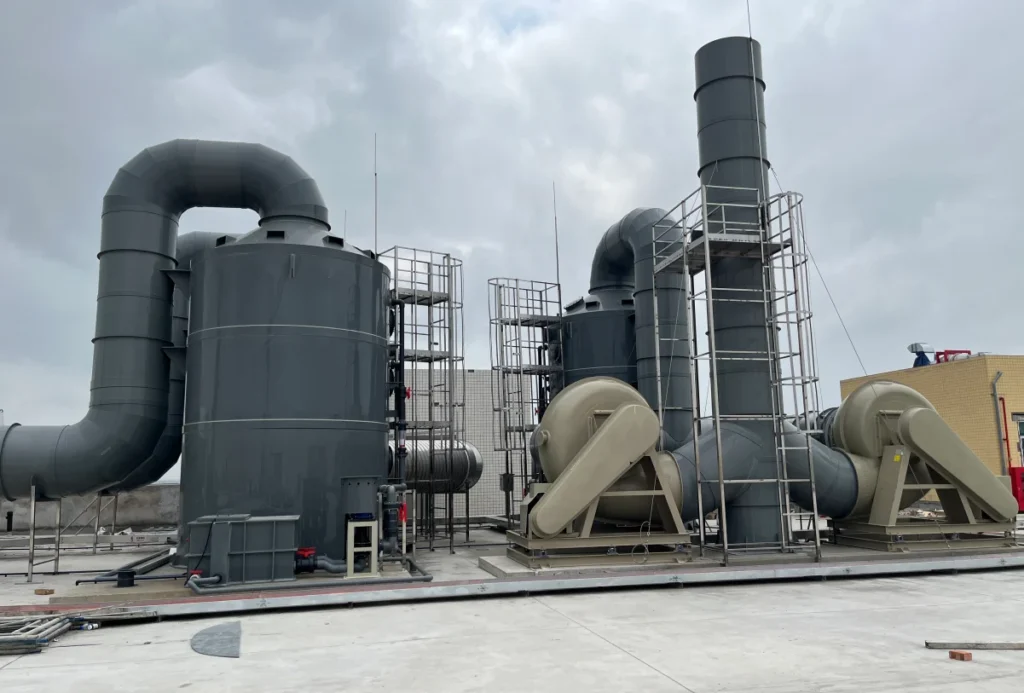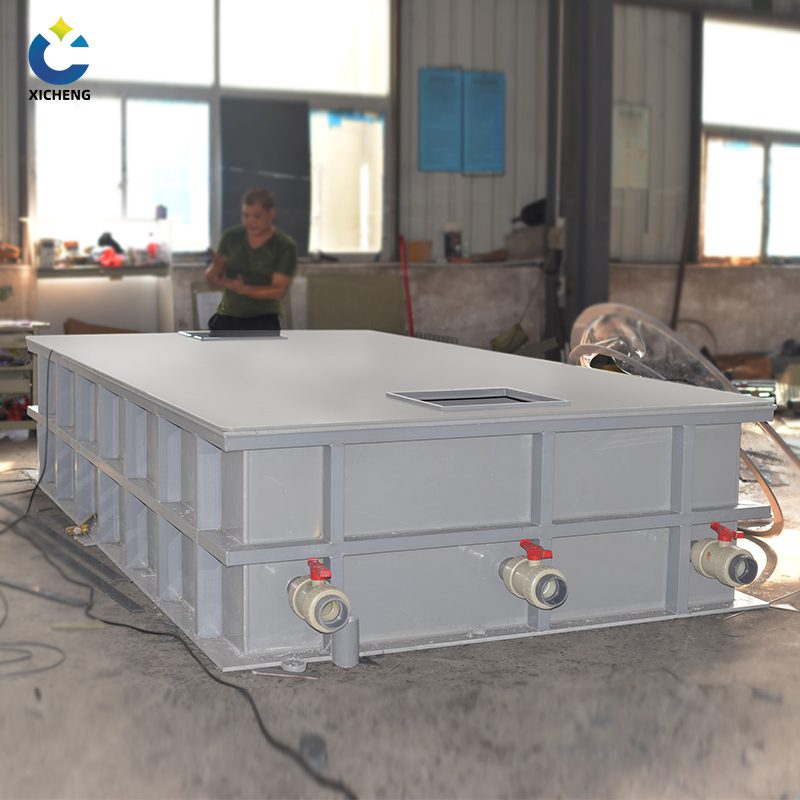
A pickling tank is not a storage tank that happens to hold acid. The acid is the least of the difference. The vessel that does nothing but hold the acid is a different specification again, collected in our acid storage tank guide. A pickling tank is opened several times a shift, loaded with parts that arrive cold, drained and refilled on a schedule set by the line rather than by the chemistry, and asked to hold its shape while hydrogen leaves the bath and acid mist leaves the surface. Those are four separate loads. A vessel sized for the fifth one — holding a volume of liquid — is the wrong vessel.
This guide treats the tank as the output of three inputs: the acid and its concentration, the temperature the bath actually runs at, and the envelope of the part that has to go in. Those three settle the material, the wall, the freeboard and the fume arrangement. This page takes them in that order, then works through the parts that fail before the wall does, and closes on sizing, heat, fume and the duties where these tanks are specified.
Key Takeaways
- A pickling tank is sized by the workpiece and the bath temperature, not by the volume of acid it holds. Freeboard, crane clearance and the acid line usually set the shell long before the litres do.
- Published polypropylene resistance data stops at 60 °C. Above that there is no rating to quote, only the manufacturer’s service limit — which is why a heated sulfuric bath is a different specification from an ambient hydrochloric one.
- Hydrochloric acid is used at ambient temperature and fumes as soon as it is heated; sulfuric acid is heated on purpose and is the bath that punishes an over-long soak. That single difference drives the hood, the duct and the wall.
- Most pickling tank failures start at a weld, a flange face, a heater sleeve or a drain boss — not in the middle of a sheet. The wall is usually the last thing to go.
- Hydrogen is a process output, not an accident. Its lower explosive limit is 4 percent by volume, so the ventilation check is a dilution calculation, and it can be done before the tank is drawn.
- We warrant the tank body and welds for 12 months. Service life depends on the duty, and we publish no service-life table.
What a Pickling Tank Does That a Storage Tank Does Not
In a galvanizing line the tank sits between degreasing and pre-fluxing, and its job is to leave a surface that molten zinc will react with. The American Galvanizers Association states the point without hedging: the zinc-iron diffusion reaction that grows the coating only takes place when the immersed surface is perfectly clean, entirely free of oil, grease, metal oxides, mill scale and rust. Every requirement a pickling tank carries follows from that sentence. It is not storing acid. It is producing a surface condition inside a window of time.
What Pickling Removes, and Why the Bath Runs Hot
The layer being removed is mill scale, and it is not one material. Steel rolled above 1070 °F (about 577 °C) carries a high-temperature scale of three iron oxide layers; steel finished below that temperature carries a low-temperature scale of two. Acid does not dissolve the whole stack evenly. It enters through cracks in the scale, attacks the inner layer, and the outer layers come away in flakes. That is why pickling is a matter of time as well as strength, and why the same bath can be under-doing one load and over-doing the next.
Over-pickling is the failure mode on the other side. Once the oxides are gone the acid starts on bare steel: the surface roughens, discolours, and the part loses size and weight, and an over-pickled surface can take an excessively thick zinc coating. The association notes this is especially true of sulfuric acid baths. A tank that is asked to hold a window has to be drained, reloaded and turned over reliably — a storage tank that is asked only to hold a volume does not.
Batch, Continuous and Electrolytic: Three Tanks, Three Geometries
Batch pickling is the form most plants mean by the phrase. Parts are jigged, craned in, held, lifted out and rinsed, so the tank is open-topped, deep enough for the tallest assembly plus a hook, and stiff enough at the rim to survive a load swinging against it. What that rim is doing once no lid closes it is set out in how the top edge is stiffened. Continuous pickling runs wire, strip or tube through the bath on rollers; the tank becomes long and shallow, and the design problem moves to the entry and exit seals and to keeping the bath level stable while the line runs.
Electrolytic pickling adds current. Electrodes, bus bars and a rectifier turn what was a vessel into part of an electrical installation, and the tank then has to satisfy two sets of requirements at once: the chemical duty and the electrical one. The geometry is still driven by the workpiece, but the wall now carries penetrations for electrodes, and every one of those penetrations is a leak path that has to be designed rather than drilled.
Four Loads a Storage Tank Never Sees
The first is thermal cycling. A heated bath is drained, refilled and topped up; a cold part goes in and pulls heat out of the liquid next to it; the empty tank cools overnight and the sheet contracts. A storage tank sees one temperature and holds it. The second is mechanical: parts are lowered, dropped, dragged along a false bottom, and knocked against the rim. Impact loads concentrate at whatever is locally stiff.
The third is chemical swing. Concentration is topped up rather than held, sludge accumulates, and the bath that the tank was specified for is the bath on commissioning day, not the bath in month six. The fourth is the vapour space: acid mist above the liquid line, and hydrogen leaving the bath. A sealed storage vessel treats the vapour space as an ullage. A pickling tank treats it as an extraction problem, and that is where the hood, the duct and the wall above the acid line are decided.
What This Page Leaves to Our Other Guides
Four subjects belong to other pages. The polymer science behind polypropylene — crystallinity, homopolymer against copolymer, why the melting point is a range — sits in our polypropylene tank guide. Venting, secondary containment and the tank-pressure definitions belong to plastic chemical storage tanks, which treats those clauses in detail. The extraction side — scrubber selection and duct sizing — belongs to the fume pages linked further down. The vessel geometry — the cone angle, the outlet position and the stand that follows — is worked through in our cone bottom tank design guide. What remains here is the part those pages do not cover: reading an acid and a workpiece into a tank.
The Acid Decides First: Hydrochloric, Sulfuric and the Mixed-Acid Exception
Two acids do most of the work in a pickling shop, and the choice between them is not a matter of preference. In galvanizing practice, sulfuric acid is generally heated, hydrochloric acid is used at ambient temperature, and hydrochloric acid is highly volatile, so its temperature is kept low to reduce fuming of corrosive vapours. The association adds the practical point that, with the right combination of bath temperature and bath strength, very similar cleaning rates can be obtained from either acid. The tank does not care which is faster. It cares that one bath is cold and fuming and the other is hot and quiet.
Hydrochloric Acid: Ambient Temperature, Volatile Fumes
The advantages attributed to hydrochloric acid are that it needs no heating, removes scale more extensively, diffuses less hydrogen into the steel, and leaves less iron salt deposited on the pickled surface. The disadvantages are that it fumes as soon as it goes above ambient, that acid recovery systems are expensive, that it is more corrosive toward equipment, and that its disposal costs more than sulfuric acid. For the tank, the last two are the ones that matter: the acid is easy on polypropylene at 10 percent and 20 °C, and hard on everything around it.
An ambient bath also means the thermal load on the shell is small and the freeboard is generous, because nobody is trying to keep heat in. What it does not mean is that the tank can be closed. The vapour above a hydrochloric bath is the reason a pickling line needs extraction, and the extraction is a bigger mechanical load on the tank than the liquid is: a hood, a duct and their supports all hang off the rim or the floor beside it.
Sulfuric Acid: Heat Is the Price of the Faster Bath
Sulfuric acid brings the opposite set of trades. It can be renewed more frequently, raising the temperature lets a lower concentration pickle effectively, iron sulfate is easier to recover, and the cleaning rate can be controlled by varying the temperature. Against that, it attacks the base metal harder, diffuses more hydrogen into the steel, leaves residues that adhere more strongly, and it must be heated. Every one of those four disadvantages lands on the tank: a heated bath, a more aggressive bath, more hydrogen, and a residue that has to be removed mechanically.
The heating is the structural problem. Whatever heats the bath — a coil, an immersion element, a jacket or an external loop — has to pass through the tank wall or sit inside the wetted volume, and it runs hotter than the bath itself to transfer heat into it. That local temperature is the hottest point any polymer in the system sees, and it is the point that published resistance tables do not describe.
Nitric-Hydrofluoric: Where the Rating Table Runs Out
The mixed acid is not a galvanizing bath; it is the standard route for descaling stainless steel, and it is the duty that most often produces a wrong tank specification. Two numbers settle it, and neither is the one buyers expect. Hydrofluoric acid rates 2 at 20 °C and 2 at 60 °C on the polypropylene scale — good, no significant attack, at both published temperatures. Nitric acid is the constraint: 5 percent rates 2 at 20 °C and 3 at 60 °C, and 65 percent rates 4 at both. There is no published polypropylene rating above 60 °C at all.
So the honest statement is narrower than the one usually written. Polypropylene is not ruled out by the hydrofluoric content; it is ruled on by the nitric concentration, and by the temperature the bath runs at, which is outside the table entirely. Where a mixed-acid duty is on the table, the answer comes from a corrosion test on the actual mix at the actual temperature, not from a chart, and it comes with the tank rather than before it. Our PP chemical storage tanks page covers the same resins in storage duty, where the temperature is usually lower and the chemistry is at least stable.
Concentration Bands: What Changes, What Does Not
The table below is the published polypropylene rating at the two temperatures the source gives, set against what changes in the bath. It is deliberately narrow. The middle column is not a design limit and the fourth column is not a temperature recommendation — it is the practice the acid calls for.
| Acid and band | PP at 20 °C | PP at 60 °C | Bath practice | What the band changes |
|---|---|---|---|---|
| Hydrochloric 10% | 1 — excellent | 1 — excellent | Ambient, fuming | Little on the wall; everything on the hood and duct |
| Hydrochloric 37% | 2 — good | 3 — limited use | Ambient, strongly fuming | Strength is now concentrated enough to matter at any warmth |
| Sulfuric 10% | 1 — excellent | 1 — excellent | Heated | The safe band, provided the heater does not overheat locally |
| Sulfuric 78% | 2 — good | 4 — unacceptable | Heated | The heat that the process needs is the heat the polymer cannot take |
| Sulfuric 93% | 3 — limited use | 4 — unacceptable | Heated, or diluted first | Already marginal cold; no room left for a heated bath |
| Nitric 5% | 2 — good | 3 — limited use | Warm | The low band is workable; the temperature is the open question |
| Nitric 65% | 4 — unacceptable | 4 — unacceptable | Warm | Not a polypropylene duty at any temperature in the table |
| Hydrofluoric | 2 — good | 2 — good | With nitric, warm | Not the constraint in a mixed acid; the nitric part is |
Reading a Compatibility Chart the Way It Was Written
The chart has two columns. That is the whole of it: 20 °C and 60 °C, with no interpolation between them and nothing above the upper column. A supplier who quotes a pickling tank for a bath at 75 °C by reading the 60 °C cell has extrapolated, and extrapolation is not a rating. The correct move is to bring the duty back inside the table — lower the band, shorten the soak, or move to another material — or to state plainly that the tank is being supplied on the manufacturer’s service limit rather than on published data.
Three things the chart does not cover at all. It rates the polymer, not the weld, so a joint in a rated material is not a rated joint. It says nothing about sustained load, and a tank wall under acid is under load every hour of its life. And it says nothing about the vapour space, where the concentration above the liquid can be more aggressive than the liquid itself. Those three gaps are what the rest of this page is about.
Concentration, Temperature, Material: The Three-Axis Verdict
Material selection for a pickling tank is usually written as a list: polypropylene for acids, FRP for larger vessels, stainless for the hot duties, rubber lining for the old ones. A list is not a decision. The same acid at two concentrations and two temperatures produces four different answers, and any ranking that ignores the second and third axis is a guess with a table around it. What follows sets the three axes against the five materials that actually compete for pickling duty.
Why “Acid Resistant” on a Catalogue Page Proves Nothing
“Acid resistant” is a claim about a class of chemicals, not about a duty. It does not say which acid, at which strength, at which temperature, for how long, under what load. A sheet that survives a splash test and a sheet that holds a heated bath for a decade are not the same claim, and the phrase covers both. The only statement worth acting on names the substance, the concentration band, the temperature and the duration — and either cites a rating at that temperature or says plainly that it is a service judgement.
That is also why two suppliers can both be telling the truth and still disagree. One is quoting a 20 °C immersion rating for a 10 percent acid; the other is quoting what happens to a stressed weld in a 78 percent bath at 60 °C. Both are about sulfuric acid. Neither is about the same tank.
Polypropylene (PP-H): The Widest Acid Coverage, and a Ceiling Nobody Publishes
Polypropylene is the default for pickling duty for one reason: across the mineral acids it is either excellent or good at 20 °C, and it stays there at 60 °C for the dilute bands. Density is specified at 0.880 to 0.913 g/cm³ and melting at 160 to 180 °C for the resin, which is a reminder of how far the melting point sits from any service temperature — and how little the melting point tells you about service. A resin that melts at 165 °C can still be the wrong choice at 70 °C, because melting is not the failure mode.
The failure mode is creep. A thermoplastic wall under a constant head at temperature does not break, it deflects, and the deflection grows with time and with temperature. That is why tank walls are sized on stiffness and deflection rather than on strength, and why the same tank needs more wall, or more ribs, or a lower bath temperature, as the duty gets warmer. It is also why the 60 °C ceiling in the resistance table matters more than it looks: above it, the two things that decide the wall — deflection and chemical attack — are both unquantified by the published data.
Grade matters inside the family. Homopolymer (PP-H) gives the highest stiffness and the best resistance to the dilute mineral acids; copolymer grades trade some of that stiffness for impact strength, which is the right trade where parts are dropped in and the bath is cold, and the wrong trade where the wall has to hold a deep head at temperature. The comparison with polyethylene, which is often proposed as an equivalent, is set out in our guide to PP vs HDPE: the two behave differently in a heated bath and the difference is not in their price per kilogram.
FRP and Dual-Laminate: Higher Temperature, Different Failure Mode
Fibre-reinforced plastic buys temperature and size. A dual-laminate vessel — a thermoplastic inner skin over a structural FRP shell — separates the two jobs that polypropylene has to do at once: the inner skin handles the chemistry, and the structural laminate carries the load. That separation is why a dual-laminate tank can be built larger and, in some duties, run warmer than a solid thermoplastic one. It is also where the failure moves: the interface between skin and laminate becomes the critical joint, and the laminate carries the consequences of a skin defect.
The choice between the two families turns on the same three axes, and the duct side of the same question is worked through in PP duct vs FRP duct, where the joint behaviour and the hydrofluoric reversal are described in detail. For a tank the summary is that FRP is chosen for size and temperature, polypropylene for chemical breadth, repairability and a weld that can be inspected.
Stainless Steel: The HCl Trap
Stainless steel enters pickling duty in two ways, and only one of them is safe. The unsafe one is hydrochloric acid: chloride is the classic initiator of stress corrosion cracking in austenitic stainless, and a pickling tank is a chloride environment under load and at temperature, which is the worst combination available. A hydrochloric bath in a stainless tank is not a material choice, it is a countdown.
The other route is the nitric-hydrofluoric bath itself, where nitric acid keeps the passive film in repair and stainless is a normal tank material. How far that goes depends on the ratio in the mix and on the alloy, and the answer belongs to the alloy supplier’s corrosion data for that specific composition, not to a general table. This page does not name a grade, because a grade recommendation without the mix and the temperature would be exactly the kind of unsourced claim we criticise above.
Rubber-Lined and Brick-Lined Steel: When Large Vessels Make Sense
Both are steel tanks with a barrier. Rubber lining is a soft sheet bonded to a shot-blasted surface, and it fails at holidays, at sharp edges and at the flanged connections where the lining has to be flared. Brick lining sets acid-resistant brick in a chemically resistant mortar, sometimes over a rubber membrane, and it is the route for very large vessels and for hot duties where no polymer is rated. Its weakness is the same place: the mortar joints, and the way they respond to thermal cycling.
Neither is a small-vessel material. They earn their cost on volume, on temperature and on duty life, and they are specified when the vessel is larger than a fabricated thermoplastic tank can travel and the duty is hotter than the polymer table goes. For the sizes most pickling shops need, a fabricated polypropylene tank is cheaper to build, cheaper to repair and easier to inspect, which is why the rest of this page stays with it.
The Verdict Table
The table below is our engineering shortlist for the five families against the bands that turn up in pickling duty. Where a resistance figure exists in the sources listed at the foot of this page it is quoted at the stated temperature; where none exists, the entry is a service judgement and is marked as one. No entry in this table is a service-life statement, and none of the columns should be read as a cost ranking.
| Duty | PP | FRP / dual-laminate | Stainless | Rubber-lined steel | Brick-lined steel |
|---|---|---|---|---|---|
| HCl 10%, ambient | First choice | Workable | Avoid — chloride under load | Workable, lining is the risk | Oversized for the duty |
| HCl 33–37%, ambient | First choice, watch the fume | Workable | Avoid | Workable | Oversized |
| H2SO4 10%, heated | First choice inside the published band | Workable | Possible, corrosion data needed | Workable | Possible |
| H2SO4 70–78%, heated | Not above 60 °C | Consider | Commonly used | Consider | Possible |
| H2SO4 93%, ambient | Marginal — limited use | Consider | Possible | Possible | Possible |
| HNO3 5% to warm | Workable to 60 °C | Consider | Commonly used | Consider | Possible |
| HNO3 65% | Avoid | Consider | Commonly used | Consider | Possible |
| HNO3 + HF, warm | Judgement — outside the table above 60 °C | Consider | Judgement — mix-dependent | Consider | Possible |
Two entries need a word of explanation, because they are the ones most often misread. “Commonly used” in the stainless column does not mean “safe”: it means the duty is one where stainless is normally specified and where the alloy supplier must still confirm the grade. “Consider” in the FRP column is not a weaker answer than polypropylene; it is a different one, and where the vessel has to be large or the bath hot, it is usually the better one.
The Parts That Fail Before the Wall
Ask a fabricator where a pickling tank fails and the answer is rarely the middle of a sheet. A flat wall carrying a head of acid is the best-understood part of the whole vessel: the load is uniform, the stress is calculable and the sheet is inspected before it is welded. The parts that fail are the ones with a discontinuity — a weld, a flange, a heater sleeve, a drain, a hood fixing — because a discontinuity concentrates both stress and chemical attack in the same place.
Weld Seams: Where Thermal Cycles Concentrate
A welded thermoplastic seam is a different material from the sheet around it. The weld zone has its own crystallinity, its own residual stress and, in the heat-affected band either side, a gradient rather than a boundary. That is acceptable in a static vessel at constant temperature, and it is the wrong starting condition for a tank that cycles: every drain and refill moves the shell, and the movement concentrates at the seam that is least able to follow it.
The practical consequences are unglamorous. Welds need to be full-penetration and accessible for inspection on the outside; a seam hidden behind a stiffener cannot be checked, and an unchecked seam is a seam whose condition is unknown. Where a tank is heated, the seam nearest the heater sees the largest local temperature difference, and that is the seam to inspect with ultrasound rather than by eye.
Flanges, Gaskets and Fasteners
Every nozzle is a place where the tank stops being one material. A steel backing ring on a polypropylene nozzle puts two materials with different expansion coefficients in contact and bolts them together; the polymer cannot follow the steel, the gasket takes up the difference for a while, and then it stops taking it up. The result is a leaking flange that looks tight. Where the flange faces acid vapour rather than liquid, the bolts themselves are in the vapour space, and a fastener that is fine in the liquid can be the first thing to go in the mist.
The design rules that follow are simple and often skipped: keep the gasket inside the bolt circle and inside the wetted boundary, choose a gasket that is rated for the same duty as the tank rather than for water, and treat every flange on the vapour side as an acid-duty flange. A pickling tank is a good place to spend money on the connections, because the connections are the failure statistics.
Heating Coils and Immersion Heaters
Anything that heats the bath runs hotter than the bath. A coil carrying steam, or an immersion element with a surface temperature well above the liquid, creates a local hot boundary on the wetted surface, and the polymer at that boundary is in the one place the resistance table cannot describe. That is why heater selection on a polypropylene tank is a temperature question before it is a wattage question: the surface temperature of the heater against the service limit of the sheet is the number that decides whether the arrangement is inside the material’s envelope.
The mechanical side matters as much. A coil needs supports that do not create point loads on the wall, a sleeve needs a flange that is rated for the duty, and an immersion heater needs a guard so that a swinging load cannot land on it. Each of those is a penetration, and every penetration is a place where the tank wall has been cut and re-closed. Where the bath is heated, the heater is usually both the hottest surface and the most complicated seal in the vessel.
Hood and Duct Connections
The extraction is bolted to the tank, and it is heavier than it looks. A hood over a wide bath has to span the opening, a duct run has to be supported, and both load the rim of a vessel whose rim was designed to carry a crane load. The load path is the problem: the rim of an open-top tank is stiff in its own plane and flexible out of it, and a duct support that pulls sideways will find that out. Where a tank is specified with extraction, the hood and its supports belong in the tank drawing, not in a separate package.
Material compatibility across the interface is the second issue. A polypropylene tank with a steel duct flange has the same expansion mismatch as any other mixed joint, in a place that is permanently wet with condensate. The scrubber and the duct that follow the hood carry their own design rules, and the acid side of that is covered in our guide to the acid fume scrubber system, where the HCl, HF and nitric duties are treated separately rather than as one.
Drain, Weir and False Bottom
The drain is the smallest penetration and the one most often done badly. A drain boss welded into a flat floor creates a local discontinuity at the point of maximum head, and the floor of a pickling tank is the point of maximum head. A recessed sump moves the joint away from the corner but adds a shape that traps sludge; a flush drain keeps the floor clean but puts the weld in the highest-stress location. There is no free option, only a conscious choice.
False bottoms and weirs carry the same message in a different place. A false bottom that rests on the tank floor concentrates the weight of a dropped part onto small contact areas; one that is supported on saddles spreads it but leaves a gap where sludge collects. A weir that controls the acid line is a structural member, not a plate, and it needs the same attention as the wall it is attached to. Sludge is not neutral in any of this: it holds acid against the surface long after the bath has been drained.
Sizing From the Workpiece, Not From a Catalogue
Pickling tank sizing starts with the part, and the part is usually described badly. “We need a tank for our line” is not an input; “the largest assembly is 2,400 mm long, 900 mm wide and hangs 1,100 mm below the hook, and we run eight loads a shift” is. From that second sentence the internal dimensions follow almost mechanically, and the volume is a consequence rather than a starting point. This section takes the four dimensions in the order they are actually fixed.
The Envelope Rule: Part Size Plus Clearance
The internal length is the part length plus clearance at both ends; the internal width is the part width plus clearance at both sides; the internal depth is the immersed depth plus the clearance under the part plus the freeboard above the acid line. Clearance is not a rounding allowance. It is what lets a jigged load enter without touching a wall, what lets the liquid circulate around the part, and what stops a swinging load from becoming an impact load on the shell. Narrow clearance makes a smaller, cheaper tank that is harder to load and easier to damage.
The rule fails in one direction only, and it fails expensively. A tank sized from a catalogue volume — a round number of cubic metres that happens to be in stock — will be wrong in whichever dimension the catalogue did not consider. If it is too shallow the part does not immerse; if it is too narrow the load does not enter; if it is too short the ends of a long part sit out of the bath and pickle unevenly. Volume is the one dimension a buyer can check from a price list, and it is the least useful of the four.
Depth, Freeboard and the Acid Line
Depth has three components and only the first is about the part. Immersed depth covers the workpiece. Working depth below the acid line covers the settling volume where sludge accumulates before it is dragged back onto the part. Freeboard above the acid line covers the splash, the foam and the mist, and it is the component most often cut to save sheet. A tank with no freeboard is a tank that wets its own rim every time a load goes in, and a rim that is permanently wet is a rim that has acid in every joint.
Freeboard also sets the vapour space, and the vapour space sets the extraction. A tall, narrow vapour space extracts more efficiently than a wide, shallow one over the same liquid area, because the hood has less area to cover at the same distance from the surface. That is a sizing decision made at the drawing stage and almost impossible to recover later: a tank built with 100 mm of freeboard cannot be given more by adding a hood.
Long Parts, Long Tanks: Wire, Tube and Strip
Wire and strip change the geometry rather than the material. A wire pickling tank is long and shallow, and its design problem is keeping the wire path at a constant depth while the bath level moves; an inline wire pickling tank adds entry and exit seals, rollers and a level control that has to hold steady while the line runs. The tank is no longer a vessel that is loaded and emptied, it is a channel that has to stay the same shape while the product passes through it.
Fasteners and bright bar sit at the other end. Fasteners are pickled in bulk, in baskets or barrels, and the load is a moving mass that abrades the floor and the walls; a bright bar pickling tank holds long straight lengths that have to be supported at intervals so they do not sag into contact with each other. Same acid, same material, three different tanks, and the difference is entirely in how the workpiece sits in the bath.
Working Volume Against Total Volume, and What It Does to the Price
Two numbers describe every tank, and they are never the same. Total volume is the shell capacity; working volume is what can be used with the part in place and the acid line where it belongs. A tank quoted at 3,000 litres may have a working volume well under two thirds of that once freeboard, sludge space and the displacement of the load are taken off. Buying on total volume buys shell; buying on working volume buys capacity.
Price follows the shell, not the working volume, because the shell is what gets fabricated: sheet area, welds, ribs and stiffeners all scale with the external dimensions. That is the reason a taller tank is usually cheaper per litre than a longer one, and the reason a tank with generous freeboard costs more than its extra litres suggest. On a pickling tank, where the dimensions are set by the part rather than by the volume, this is worth understanding before the enquiry goes out.
Cut, form, weld and test are what the quotation is actually pricing, and how the shell is built and tested follows that order.
Why Rectangular Pickling Tanks Need Ribs: Span Sets the Wall
A rectangular tank is not a cylinder with corners. A cylinder carries the internal pressure as membrane tension around its circumference, so the load travels through the sheet rather than bending it. A flat rectangular wall cannot do that: it has to carry the same pressure in bending, from rib to rib, and bending stress rises with the square of the unsupported span. That single relationship is why rectangular tanks are ribbed and why the rib spacing, not the sheet thickness, is the first design decision. How it scales from one rib to a whole vessel — the plan shape, the load path and the base frame — is in how those loads add up on a full rectangular tank.
As a worked example on stated assumptions, take a tank 3,000 mm long, 1,200 mm wide and 1,500 mm deep with a liquid depth of 1,200 mm and a specific gravity of 1.2. The pressure at the floor is ρgh, which gives about 14.1 kPa. Treating a unit-width strip of wall between two ribs as simply supported over a 1,000 mm span, the bending stress at 20 mm thickness works out at roughly 26 MPa on the strip formula σ = 0.75 q b²/t². Halve the span to 500 mm and the same sheet sees about 6.6 MPa.
Both figures are our own calculation on those assumptions, and the ratio is the point rather than the absolute numbers, which move with sheet grade, temperature and the degree of fixity at the ribs. What the numbers show is that doubling the sheet thickness is not the efficient answer to a wall that is too flexible: pulling the ribs closer is. It is also why the ribs have to be designed as structure, welded on both sides and carried down to a base that can take the reaction, rather than run as a decorative band around the shell. The same logic governs the duct panels on an air line, which is why polypropylene duct is stiffened on the same principle.
Heat, Fume and Hydrogen: The Operating Envelope
A pickling tank is a chemical vessel with a thermal duty and a gas problem attached. The three interact: heat drives the vapour, the vapour has to be extracted, and the extraction changes the pressure and the temperature on the shell. A tank specified for the chemistry alone, without the heat and the fume designed in, will be a tank that works on paper and floods its hood on the first hot load.
Three Ways to Heat, and What Each Does to the Tank
Heat can be added inside the bath, through the wall, or outside the tank entirely. An immersion coil or element puts the heat source in the liquid, which is efficient and puts the hottest polymer surface in the most chemically aggressive place. A jacketed or externally traced wall heats through the sheet, which keeps the heater out of the acid but makes the wall itself the element and risks a hot band that the resistance table does not cover. An external heat exchanger circulates the bath through a pump and a heater, which keeps both off the tank but adds a pump, a loop and two more connections that have to be leak-tight.
None of the three is universally correct. What they have in common is that each creates a local temperature above the bath temperature, and that local temperature is the number to design against. Where the arrangement cannot keep the hottest surface inside the material’s envelope, the answer is a different material or a different heat source, not a thicker wall.
Acid Mist: The Limits, and What They Force
There is no useful emission figure to quote here, because the rule that matters in a workshop is an exposure limit, not a stack limit. Under the U.S. OSHA air contaminants standard, hydrogen chloride carries a ceiling of 5 ppm, or 7 mg/m³ — a ceiling, meaning the value is not to be exceeded at any moment, not averaged over a shift. Nitric acid is listed at 2 ppm and 5 mg/m³, and sulfuric acid at 1 mg/m³ with no ppm figure in that row at all.
The same standard sets the order of control: administrative or engineering controls must first be determined and implemented whenever feasible, and protective equipment comes after that. For a pickling tank this is not an abstract hierarchy, it is a design instruction. Engineering control means enclosing the bath and extracting at the surface, which means the tank needs a hood, the hood needs a duct, and both of those attach to the tank before the fume problem can be called solved. The exposure limits say how clean the air has to be; they say nothing about how much air to move, and that gap has to be closed by calculation.
Hydrogen: The Byproduct That Changes the Electrical Classification
Acid attacking bare steel produces hydrogen, and the association’s own comparison of the two acids turns on it: hydrochloric acid diffuses less hydrogen into the steel, sulfuric acid diffuses more. The gas that leaves the bath is not a nuisance, it is a flammable inventory, and it accumulates in exactly the place the extraction is trying to clear. Its lower explosive limit is 4 percent by volume in air, with an upper limit of 75 percent, at 20 °C and atmospheric pressure — the wide range is what makes hydrogen dangerous, because a mixture that is too lean to burn at the surface can be explosive under a hood.
Two consequences follow for the tank, and neither is about the polymer. The first is ventilation: the extraction has to keep the vapour space well below the lower limit, which makes it a dilution calculation rather than a comfort calculation. The second is the electrical installation: a motor, a switch or a level instrument in a space that can hold hydrogen is an ignition source, and the area classification around a pickling tank is set by the gas the process produces, not by the tank material.
Hood and Duct: The Interface That Gets Forgotten
The hood is where the tank stops and the extraction starts, and it is usually the least-owned part of the project. A push-pull arrangement across a wide bath, a lip extract at the rim, or a full enclosure with an access opening all move the same volume of air in different ways; the choice changes the tank rim, the crane clearance and the operator’s view of the load. A hood designed after the tank is built will bolt onto whatever rim exists, which is why so many of them leak at the joint.
Material choice on the duct follows the same acid logic as the tank but with one important difference: the duct runs cooler than the bath and is wet with condensate, so the concentration it sees is not the concentration in the tank. That is the mechanism behind the hydrofluoric reversal described in FRP duct design, and it is why the duct material is specified from the condensate, not from the bath.
A Hydrogen Dilution Check You Can Reproduce
The check is short enough to do before the tank is drawn. Pickling iron in hydrochloric acid follows Fe + 2HCl → FeCl₂ + H₂, so one mole of iron gives one mole of hydrogen. One kilogram of iron is about 17.9 moles, which is about 401 litres of hydrogen at standard conditions. Holding the vapour space at a quarter of the lower explosive limit means 1 percent by volume, so that 401 litres needs roughly 40 m³ of air to dilute it — per kilogram of iron dissolved.
Scale the assumption and the answer scales with it. A tonne of steel carrying 1 percent scale by weight gives up about 10 kg of iron to the bath, which is about 4,000 litres of hydrogen over the campaign and about 400 m³ of dilution air to match. Spread across a shift that is a modest extraction rate, which is the useful part of the result: the hydrogen check is rarely the reason a system is oversized, but it is frequently the reason a sealed tank without extraction is unsafe. The figures are our own calculation at constant pressure and temperature, assuming no local accumulation and no reaction with the inhibitor.
Inspection, Changeover and Where These Tanks Are Specified
A pickling tank is inspected in service, not on delivery. The delivery inspection confirms that what was drawn was built; the service inspection finds the change that matters, which is the slow one. Four things are worth a schedule: the welds nearest the heater, the flange faces on the vapour side, the drain and the sump, and the rim where the hood is fixed. Each has a different failure mechanism and each fails slowly enough to be caught.
What to Inspect, and When
Start with the welds. A visual check at every drain-down, with particular attention to the seams nearest the heat source, catches surface cracking and the discoloration that precedes it. An ultrasonic check on thick-section welds at a fixed interval — annually is a working default, shorter where the bath is hot — finds the loss of section that a visual check cannot. Record the readings: a single thickness is a number, and a series of them is a trend.
Then the connections. Flange faces on the vapour side are inspected for the white bloom of salt creep, which marks a weep that has been running long enough to evaporate. Gaskets are replaced on a schedule rather than on failure, because a gasket that has failed in a pickling tank has already leaked acid onto something. The drain and sump are checked for sludge consolidation, and the rim is checked for the movement that a hood fixing or a crane impact leaves behind.
Galvanizing Plants: The Largest Single Use
The largest single population of these tanks is in hot-dip galvanizing, where pickling sits between degreasing and pre-fluxing and the whole line is built around the tank. The duty in a galvanizing plant has a recognisable shape: hydrochloric acid at ambient temperature or sulfuric acid heated, a wide open bath, heavy jigged loads on a crane, and an extraction system that has to run whenever the bath is open. A pickling tank for a galvanizing plant is therefore specified as part of a line, and the tank drawing has to carry the crane envelope, the hood and the rinse arrangement from the start.
Where the line is built around a specific product — structural steel, long members, fabricated assemblies — the tank proportions follow the product rather than the throughput. That is why two galvanizing plants with the same tonnage can need very differently shaped tanks. Our PP pickling and electroplating tanks are built to the customer’s envelope for this reason: the drawing starts from the part, and the volumes follow. On a plating line the same logic runs one step further, because the volume also follows the ampere-hours; that calculation is in the electroplating tank guide.
Wire, Tube, Strip and Fasteners
The wire and strip duties are continuous, and their tanks are channels. The design questions are the seals at the entry and exit, the level control that keeps the wire path constant while the bath moves, and the roller bearings that sit above the acid line because they cannot sit in it. A stop-start line adds a different problem: the wire sits still in the acid and over-pickles locally, which is a process problem with a tank consequence, because the over-pickled zone is where the surface is thinnest.
Tube and fastener duty is batch, and it is abrasive. Baskets and barrels are dragged, dropped and tipped, and the floor of the tank takes the load. The relevant tank features are a floor that can be replaced without rebuilding the shell, a sump that lets the sludge out, and a rim that survives being used as a fulcrum for a lever. For fasteners the loads are small and numerous, and the tanks are often specified with a false bottom so that the barrel does not sit in the sludge it has just created.
Supplying Pickling Tanks to India’s Steel and Wire Industry
A large share of the pickling tank enquiries we receive come from India — from galvanizing plants, wire mills and stainless processors in Gujarat, Maharashtra and the Delhi region. We are a Chinese fabricator, not an Indian one, and we supply those projects as an exporter: the tank is built and tested here, shipped as a complete vessel or in sections, and erected on site where the route will not take it whole. That is a factual statement about where the tank comes from, and it matters to buyers who are comparing against a local fabricator, because the freight, the lead time and the site work are all part of the comparison.
Acid Change, Rinse-Out and End of Life
A pickling tank changes duty more often than it changes owner. A line is re-purposed from hydrochloric to sulfuric, or a bath is run at a higher concentration to shorten the cycle, and the tank that was right for the first duty is asked to do the second. The resistance table is the place to re-check that decision, and the two columns it contains are the only honest answer available at that point. A change that moves the bath above 60 °C moves it outside published data, whatever the acid is.
The end of life is quieter. A polypropylene tank that has reached the end of its service is not usually holed; it is deflected, or its welds have been re-welded, or its gaskets have been replaced often enough that the flanges no longer seat. Thermoplastic vessels can be repaired, and repair is normally the right answer while the repair is in a flat panel and not at a corner. When the repair moves to the corners, the tank has told you what it thinks of the duty. We warrant the body and welds for 12 months; we publish no service-life figure, because the figure would be a property of the duty rather than of the tank.
Frequently Asked Questions
What is a pickling tank made of?
Most are fabricated from polypropylene sheet, welded and ribbed, because polypropylene rates excellent or good against the dilute mineral acids at 20 °C and 60 °C. Heated concentrated sulfuric acid, nitric acid above 5 percent, and high-temperature duties move the answer to FRP, dual-laminate, rubber-lined steel or brick-lined steel. The material follows the acid band and the temperature, not the other way round.
How big should a pickling tank be?
Size it from the workpiece. Internal length and width are the part plus clearance, internal depth is the immersed depth plus sludge space plus freeboard, and the volume follows. Freeboard is the dimension most often cut and the one that decides how much mist reaches the hood. There is no useful standard size, because the part is the specification.
Can polypropylene handle a heated sulfuric acid bath?
Inside the published band, yes: 10 percent sulfuric acid rates 1 at both 20 °C and 60 °C. At 78 percent the same table goes from 2 at 20 °C to 4 at 60 °C, and 4 means unacceptable. The question is therefore never “can PP take sulfuric acid” but “which band, at which temperature”, and above 60 °C the table has no answer at all.
Why does my tank fail at the weld rather than the wall?
Because the weld is where two things concentrate at once. The weld zone has its own crystallinity and residual stress, and the geometry around it is a discontinuity, so both the mechanical movement from thermal cycling and the chemical attack arrive at the same line. A flat panel in the middle of a wall has neither problem, which is why the sheet usually outlasts the seam.
Do I need extraction above a pickling tank?
Yes, on any open bath that runs above ambient or carries hydrochloric acid. Hydrogen chloride has a ceiling limit of 5 ppm, hydrogen is produced whenever acid attacks steel and has a lower explosive limit of 4 percent by volume, and the standard requires engineering controls first wherever they are feasible. Extraction is the engineering control; a respirator is what happens when it is not there.
How long does a pickling tank last?
We do not publish a service life, because the number would describe the duty rather than the tank. What sets it is the acid band, the temperature, the number of thermal cycles, the sludge handling and the quality of the welds. We warrant the body and welds for 12 months, and we would rather discuss your duty than quote you a year count.
Get a Pickling Tank Built to Your Acid and Part
The four inputs are the whole specification: the acid and its concentration, the bath temperature, the part envelope, and the extraction that the acid mist forces. Everything else on this page follows from those four, and none of them is a number a catalogue can supply for you.
What travels well is a drawing that is already right. The enquiries that go smoothly are the ones where the acid, the concentration, the temperature and the part envelope arrive together with the site constraints — doorway, headroom, floor loading and the route from the gate — so that the vessel can be split at a sensible line rather than at the last minute. If you have those facts, send us your acid, temperature and part envelope and we will come back with a drawing and a price.
We have been fabricating industrial plastic equipment since 2009, which is 17 years. Our pickling tanks use 5 mm to 30 mm polypropylene sheet, hydrostatic testing at 1.5 times design head, ultrasonic inspection of thick-section welds and a working tolerance of ±2 mm. We operate more than 40 production bases and offices, and hold ISO 9001, ISO 14001, CE, SGS and RoHS.
Note on the figures — Pickling chemistry, acid selection and over-pickling are described from the American Galvanizers Association’s process literature. Chemical-resistance ratings for polypropylene are the published values at 20 °C and 60 °C only; there is no interpolation between them and no published rating above 60 °C, so nothing in this page extends the table beyond its own columns. Exposure limits are U.S. OSHA permissible exposure limits for workplace air, not emission limits and not ventilation rates. Hydrogen limits are handbook values at 20 °C and atmospheric pressure. Resin density and melting data are specification values for the resin, not service limits for a finished tank. Imperial figures are given as published, with metric conversions marked as our own. The wall-stress and hydrogen-dilution examples are our own worked calculations on the stated assumptions. The material verdict table is our engineering shortlist; entries without a published rating behind them are marked as judgement. Wall thickness, test pressure, tolerance and warranty are our manufacturing figures, not third-party standards.
Sources
- American Galvanizers Association — Chemical Cleaning Steel (pickling between degreasing and pre-fluxing; two- and three-layer mill scale above and below 1070 °F; over-pickling effects, most pronounced in sulfuric baths; hydrochloric acid at ambient temperature against heated sulfuric acid; the four advantages and four disadvantages of each acid; the five factors that set cleaning rate).
- U.S. Electronic Code of Federal Regulations — 29 CFR 1910.1000 — Air contaminants (Table Z-1: hydrogen chloride ceiling 5 ppm / 7 mg/m³; nitric acid 2 ppm / 5 mg/m³; sulfuric acid 1 mg/m³; administrative or engineering controls to be determined and implemented first wherever feasible, at paragraph (e)).
- U.S. Electronic Code of Federal Regulations — 21 CFR 177.1520 — Olefin polymers (polypropylene density 0.880–0.913 g/cm³; melting range 160–180 °C for polypropylene and 150–180 °C for the second propylene homopolymer entry).
- The Engineering ToolBox — PP Polypropylene — Chemical Resistance (five-point attack rating; resistance ratings at 20 °C and 60 °C only; hydrochloric acid 10 percent and 37 percent, sulfuric acid 10 percent, 78 percent and 93 percent, nitric acid 5 percent and 65 percent, hydrofluoric acid).
- The Engineering ToolBox — Gases — Explosion and Flammability Concentration Limits (hydrogen lower explosive limit 4 percent by volume, upper 75 percent, detonation limits 18 and 59 percent; values at 20 °C and atmospheric pressure).