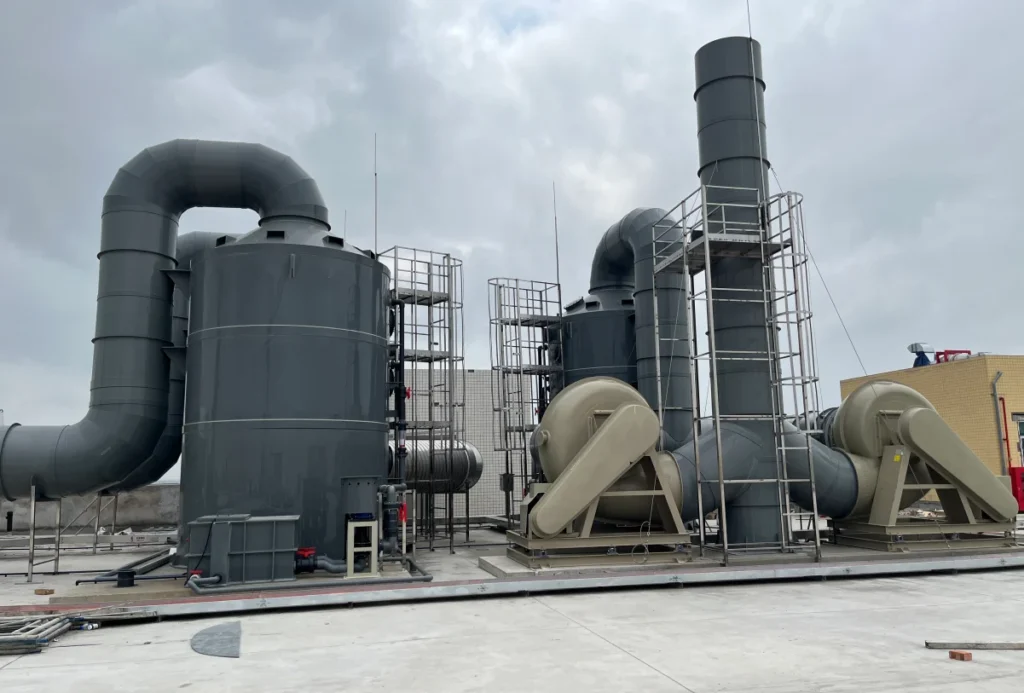
Most chemicals sit in a tank and wait. Sodium hypochlorite does not. From the moment it is made, the solution is decomposing — into chlorate and chloride by the main route, and into oxygen and chloride by a slower one — and the rate at which it does that is set by temperature, light, concentration and the metals it touches. A poly bleach tank is therefore not a container chosen for a fixed substance. It is a vessel built around a reaction, and every one of its features either slows that reaction or gets out of its way.
That single fact reorganises the whole specification. The vent is no longer a formality; it is the only thing standing between a slow gas evolution and a split tank. The colour of the wall is a product decision, not an aesthetic one. The material question is answered partly by the polymer and partly by what the polymer is bolted to. This page works through those in order, and it says plainly where a polyethylene tank, not a polypropylene one, is the right answer.
Key takeaways
- Bleach decomposes while it is stored. The main route makes chlorate and chloride; the slower route makes oxygen and chloride, and transition metals speed that second route up.
- The vent is sized by the fill rate first and the off-gas second. A bleach tank fails at a blocked vent far more often than at a wall.
- Decomposition rises by a factor of 3 to 4 for every 10 °C, not by a factor of 2. A tank in a warm room can lose strength fifteen times faster than one in a cool room.
- Light does the same damage through the wall, which is why bleach tanks are black or opaque rather than translucent.
- At ambient temperature, crosslinked polyethylene is the industry default for bleach and polypropylene is not. PP wins where the duty runs hotter or the vessel has to be welded to a shape.
- Metal is the quiet accelerator: a brass fitting or a stainless nipple is enough to turn a stable bath into one that gasses.
- Brine is the other chloride duty in the same plant, and it has the opposite trap: a brine stronger than the eutectic freezes sooner, not later.
What a Bleach Tank Actually Holds
The first correction is to stop treating bleach as a substance with fixed properties. What is in the tank is a mixture of hypochlorite, chloride, chlorate, caustic soda and water, and its composition is drifting from the day it is filled.
A solution that is reacting, not a chemical that sits
Sodium hypochlorite is made by reacting chlorine with sodium hydroxide, and a slight excess of caustic soda is left in the product because that excess is what keeps it stable. The solution that arrives in the tank is therefore alkaline on purpose, typically in the pH band the Chlorine Institute gives as the most stable, between 11 and 11.9.
That is a design constraint on the tank, not just on the chemical. The tank has to hold a caustic solution as well as an oxidiser, so a material that is fine with hypochlorite but not with hot caustic is not fine at all. It also means the pH is part of the storage condition: below about 10.8 the decomposition rate starts to climb, and in the acidic range it climbs steeply.
Nothing about this is visible from outside. A tank of bleach looks the same on day one and day sixty; the difference is in the titration, and by then the operator has usually compensated by dosing more.
The excess caustic also explains a failure mode that looks like a tank problem. If the tank or the pipework neutralises that alkalinity — because of an acidic residue from a previous duty, or a cleaning chemical left behind, or a wash-water line that drips into the tank — the pH falls and the decomposition rate rises sharply. A bleach tank that is shared with another duty needs to be cleaned to the point where the caustic balance is not disturbed.
Two pathways: chlorate first, oxygen second
The Chlorine Institute describes two decomposition routes. The dominant one produces chlorate and chloride: three hypochlorite ions give one chlorate ion and two chloride ions. The second, much slower route produces oxygen and chloride: two hypochlorite ions give one molecule of oxygen and two chloride ions.
The split matters because the two products have different consequences. Chlorate is a quality problem — it accumulates in the stored solution and it goes into whatever the bleach is dosed into, which is a regulated concern in drinking water. Oxygen is a pressure problem — it is a gas leaving a liquid in a vessel that was never designed to hold pressure.
Both routes are accelerated by the same things. Temperature raises both. Light raises both. Certain dissolved metals raise the oxygen route far more than the chlorate route, which is why a tank that has picked up iron or copper contamination can start gassing while an identical tank next to it does not.
The chlorate route deserves its own note because it is the quiet one. Chlorate is a dissolved salt, so it stays in the solution and travels with it. Nothing settles out, nothing smells different, and the tank level does not change. What changes is the ratio of chlorate to hypochlorite, and that ratio only becomes visible when the bleach is analysed or when the process it feeds starts showing the effect.
That is why bleach storage is a rotation problem as much as a vessel problem. The tank cannot stop the reaction, so the only control the plant has is how long the solution sits in it. A tank sized for a month of consumption is behaving very differently from the same tank sized for six months.
Why this is a tank problem and not only a chemistry problem
The chemistry says the solution will degrade whatever the tank is made of. The tank’s job is to control the four variables the chemistry responds to: temperature, light, contamination and pressure. None of those is fixed by choosing a polymer; all four are fixed by how the vessel is built and where it sits.
That is why two tanks of the same material can have completely different service lives. One is black, shaded, on a cool north wall, with plastic-wetted fittings and a vent somebody checks. The other is translucent, against a west-facing wall, with a stainless nipple and a vent nobody has looked at since commissioning. The polymer is identical; the outcome is not.
The Tank’s First Duty Is to Let the Gas Out
A sealed bleach tank is a pressure vessel that was never rated as one. The vent is the feature that prevents that, and it has to be sized for the thing that moves the most air, which is not the decomposition.
The vent is sized by the fill rate first
When product is pumped into a tank, the liquid displaces an equal volume of air. That displacement is fast and it is predictable: it is the fill rate, and it is usually an order of magnitude larger than anything the chemistry produces.
A 1,000-litre tank filled in twenty minutes displaces 1,000 litres of air in twenty minutes, which is 3 m³ per hour. A 5,000-litre tank on the same schedule displaces 15 m³ per hour. If the vent cannot pass that, the tank pressurises during filling, and the pressure finds the weakest point — usually a fitting, a manway gasket or a weld at the top course.
That is the first number to put on the drawing, and it is derived from the fill schedule, not from the chemistry. A vent sized for the off-gas alone will be too small on the day the tank is filled quickly.
The vent type matters as much as its size. A pressure-and-vacuum vent that opens only at a cracking pressure is the wrong default for bleach, because it holds a small positive pressure in the headspace between operations and because its moving parts are exactly where salt crust forms. An open vent with a loose cap, or a large-bore pipe with a removable screen, has no mechanism to seize.
Where the tank is indoors and the room is ventilated, an open vent is also the safer choice for a second reason: it lets the headspace communicate with the room instead of storing whatever comes off the surface. The room ventilation then deals with the small chlorine-bearing vapour that a bleach surface produces, rather than the tank holding it until a manway is opened.
Oxygen is the second, slower source
The oxygen route is slow, and it is worth quantifying what it could produce at its ceiling. A 12.5 % solution carries about 150 grams of sodium hypochlorite per litre, which is roughly two moles. If all of it decomposed by the oxygen route, each litre would release one mole of oxygen, about 22.6 litres at standard conditions.
That is a total, not a rate. A 1,000-litre tank could in principle release 22.6 m³ of oxygen over its contents’ whole life, spread across weeks or months, and only a fraction of the decomposition actually takes the oxygen route at all. As a continuous flow it is small.
But small is not zero, and the number that matters is what happens when the vent is blocked. A tank with a clear vent tolerates a slow gas evolution easily. A tank with a crusted vent accumulates it, and the pressure then arrives at the moment of filling, when the fill rate is also pushing.
| Tank volume | Air displaced at 20 min fill | Oxygen ceiling, whole contents |
|---|---|---|
| 500 L | 1.5 m³/h | 11.3 m³ |
| 1,000 L | 3.0 m³/h | 22.6 m³ |
| 5,000 L | 15 m³/h | 113 m³ |
Note on the figures — the middle column is tank volume divided by a twenty-minute fill, which is an assumption for the example rather than a site value. The right column assumes a 12.5 % solution at about 1.2 kg/L, complete decomposition by the oxygen route, and 22.414 L/mol at standard conditions. It is an upper bound over the contents’ lifetime, not a flow rate.
Headspace is the other variable, and it is set by the fill level rather than by the tank. A tank held nearly full has little headspace, so a small oxygen evolution raises the pressure faster; a tank held half full has a large buffer. Neither is a substitute for a working vent, but the fill level is a free adjustment that a plant can make while the vent is being repaired.
What headspace does not do is protect the liquid. A fuller tank leaves less air in contact with the surface, which limits how much carbon dioxide from the room can reach the solution and neutralise the excess caustic. So the two effects pull in opposite directions: a high level limits chemical contamination, a low level limits the pressure rise. In practice the vent settles the pressure question, and the level is set by how much draw-down the line needs.
Why bleach tanks fail at the vent, not at the wall
A polyethylene or polypropylene wall that is correctly sized for the hydrostatic head does not fail from the liquid. It fails from the inside out at a fitting, or it fails at the top when the headspace pressurises. Both of those are vent and connection problems, and both are avoidable.
The pattern is consistent enough to be a rule: the tank that splits is almost never the tank with a corroded wall. It is the tank with a vent full of salt crust, a screen that has scaled over, or a fill line that discharges straight at the vent connection so that splash dries inside it.
Two design moves address it before it happens. Keep the vent connection away from the fill path, so splash cannot reach it. And make the vent inspectable — a screwed or flanged connection that can be opened, not a welded stub with a screen pushed over it.
The connection itself is worth specifying as carefully as the vent. A vent boss welded into a thin top plate is a stress concentration, and it is the place a tank splits when the headspace pressurises. A reinforcing pad, or a boss set into a thicker section, costs little at the fabrication stage and removes the failure point. The same applies to the fill connection, which sees the same pressure transient from the other side.
Crust, screen and the inspection nobody does
Bleach leaves salt behind wherever a droplet dries. Around a vent, that means a crust that grows slowly and is invisible from the floor. A screen, added to keep insects out, is the worst version of the problem because it gives the crust a matrix to fill.
If a screen is required, it should be a coarse one that can be removed and rinsed, and the vent should be reachable without a ladder from the wrong side of the tank. The practical answer is a vent that is a short, large-bore, open pipe with a loose cap or a coarse removable screen, positioned where a person walking past can see it.
The inspection itself needs to be on a schedule, because there is no alarm for a blocked vent until the tank tells you. Quarterly is a reasonable interval for a duty that runs continuously, and it should be a written line on the maintenance sheet rather than an intention.
Temperature Is a Product Decision
The strongest lever on bleach quality is not the polymer and not the vent. It is the temperature of the liquid, and the effect is much larger than most specifications assume.
The published rate constants
The Chlorine Institute publishes measured rate constants for hypochlorite decomposition across temperature and concentration. The pattern is consistent: at every concentration, the rate roughly triples for each ten degrees.
The manual also corrects a common assumption. The rule of thumb that the rate doubles for every 10 °C is not what the measurements show. For solutions between 5 % and 16 % by weight, the measured factor is between 3 and 4. The difference between a doubling and a tripling is not academic; it is the difference between a tank that lasts a season and one that does not.
The concentration term matters as well. Decomposition is second order in hypochlorite, so a weaker solution is disproportionately more stable: the manual notes that halving the concentration reduces the rate by roughly a factor of five, not four, because the ionic strength falls too. That is why a 5 % solution keeps far longer than a 12.5 % one at the same temperature.
That creates a trade the tank sits in the middle of. High-strength bleach is cheaper to transport because each truckload carries more available chlorine, so suppliers ship 12.5 % and plants buy it. But the same strength is the one that stores worst. A plant that dilutes on receipt, or that buys a weaker solution because its consumption is slow, is trading transport cost against storage life, and the tank is where that trade is paid.
| Temperature | 4.74 wt% | 7.93 wt% | 10.82 wt% | 13.46 wt% | 15.89 wt% |
|---|---|---|---|---|---|
| 15 °C | 0.30 | 0.53 | 0.80 | 1.15 | 1.65 |
| 25 °C | 1.58 | 2.19 | 3.22 | 4.68 | 6.33 |
| 35 °C | 5.45 | 8.43 | 12.2 | 17.0 | 23.1 |
| 45 °C | 19.3 | 30.2 | 43.9 | 58.7 | 80.7 |
| 55 °C | 65.5 | 98.2 | 138 | 189 | 250 |
Note on the figures — reproduced from Table 3-1 of the Chlorine Institute’s Sodium Hypochlorite Manual, Pamphlet 96, Edition 3. The values are rate constants for decomposition; the manual does not give them a unit in the table, so they are comparable across rows and columns but are not a percentage per day.
What 10 °C does to a month of storage
Normalising the table to the 15 °C row makes the practical consequence visible. For the 13.46 % column, a tank held at 25 °C decomposes about 4.1 times faster than one at 15 °C. At 35 °C it is 14.8 times. At 45 °C it is 51 times, and at 55 °C it is 164 times.
Those ratios are what a plant room actually buys. A bleach store that sits at 15 °C is doing the chemistry a favour. The same store at 35 °C — a realistic temperature for an unshaded plant room in a warm climate — is destroying available chlorine nearly fifteen times faster, and the operator sees it as a chemical bill rather than as a tank problem.
This is the argument for treating the tank’s location as part of its specification. A tank on a cool north wall, shaded and ventilated, behaves like a different vessel from the same tank against a west-facing wall that bakes all afternoon. Neither choice costs anything at the drawing stage.
Sunlight is the same problem arriving through the wall
Ultraviolet light decomposes hypochlorite directly, with oxygen and chlorate as the main products. The Chlorine Institute notes that walls which do not transmit UV — metal, coated plastics, FRP — and opaque containers prevent or minimise that route.
For a polymer tank, the practical answer is a black or dark pigmented wall. Carbon black is the usual pigment, and it blocks the light without absorbing much heat. A translucent natural-colour tank is the wrong choice for bleach even though it is the cheapest, because it lets the sun do the work that the vent and the wall are supposed to prevent.
There is a second-order benefit. Painting or pigging the tank also keeps the liquid cooler, which feeds back into the temperature argument above. The two effects compound: the same wall change reduces the UV route and slows the thermal route at the same time.
Insulation is the other tank-level control, and it is often misunderstood. Insulation slows heat transfer in both directions, so it keeps a cool tank cool and a warm tank warm. For a bleach store that is shaded and ventilated, insulation helps. For one that has absorbed heat during the day, insulation holds that heat in overnight and can make the average temperature worse.
The reliable combination is shade first, ventilation second, insulation third. A tank in a ventilated shade does not need insulation to stay near ambient; a tank in the sun needs shade before it needs anything else. The order matters because each step costs less than the one after it.
The Material Question, Answered Honestly
The material question for bleach is not “which polymer resists hypochlorite”, because several do. It is “which polymer resists it while doing the rest of the job”.
Why PE and XLPE are the industry default for bleach
At ambient temperature, the standard vessel for sodium hypochlorite is crosslinked polyethylene. That is not a marketing claim; it is what the market shows. The suppliers who dominate the bleach-tank search results build rotational-moulded XLPE or HDLPE vessels, and the reason is a combination of oxidation resistance and cost.
Polyolefins are attacked by oxidisers through their carbon backbone, and a linear polyethylene chain is more resistant to that attack than a polypropylene chain with its regularly spaced tertiary carbons. Crosslinking adds further resistance. Add the fact that rotational moulding is cheap at the sizes a water plant needs, and the default is explained.
PE also has a hard ceiling that has to be respected. The polyethylene tank standard covers continuous service below 66 °C for Type I and below 60 °C for Type II, and its scope starts at 1,900 litres. A bleach store at ambient is comfortably inside that; a warm duty is not.
That scope floor is the reason small bleach vessels look different. A 200-litre day tank is not a rotational-moulded storage tank in the standard’s sense; it is a moulded or fabricated container, and at that size the choices are usually a moulded poly drum or a welded PP or PVC vessel. The material logic does not change, but the construction route and the standard behind it do.
Where polypropylene is the right answer
Polypropylene earns its place on three grounds, and none of them is “better bleach resistance”.
The first is temperature. PP homopolymer softens around 152 °C and its melting range is 160–165 °C, so a warm bleach duty that is outside the polyethylene band is still inside the polypropylene one. Where the solution is stored or dosed hot, that headroom is the deciding factor.
The second is fabrication. PP is welded from sheet, so a rectangular tank, a tank with an unusual footprint, a tank with a welded nozzle in a specific place, or a tank that is part of a fabricated line is a PP tank. Rotational moulding gives you a shape; welding gives you a drawing.
The third is that the tank may not be a bleach tank at all. In a plant that also stores acid, caustic or process water, standardising on one weldable polymer has value, and the polypropylene tank guide covers that wider trade-off.
The temperature headroom is not a licence to store hot bleach in polypropylene without checking. Heat raises the decomposition rate and it also raises the rate at which the oxidiser attacks the polymer, so the two effects work together on the same wall. A warm duty inside the polyethylene band is a reason to move to PP; a hot, concentrated duty is a reason to move past both polyolefins and look at PVDF or a lined FRP vessel.
The wider PP-versus-PE comparison is a different argument when the duty is not an oxidiser. For water, the two materials are separated by temperature ceiling and by fabrication route rather than by chemical resistance, and that comparison is set out in the polypropylene water tank article. Bleach adds a third variable — the solution attacks the polymer while it sits — and that is why the answer here is not the answer there.
Metals, gaskets and the fittings that ruin a good tank
The Chlorine Institute’s handling guidance is blunt: as a general rule, do not let metals except titanium and tantalum contact sodium hypochlorite. That rule is about the product, but it lands on the tank as a hardware specification.
The fittings that get fitted by default are the problem. A brass bulkhead, a stainless nipple, a mild-steel bolt through a flange — each is a small piece of metal in contact with the solution, and each contributes ions that accelerate the oxygen pathway. A tank can be perfectly specified in its wall and still gas because of one fitting chosen from what was on the shelf.
The answer is a plastic-wetted path: PP, PVC or PVDF wetted parts, with metal kept outside the liquid. Where a metal component is unavoidable, titanium is the exception the manual allows. The poly tank fittings page covers the three ways a connection passes through a wall.
Concentration, pH and what the tank cannot control
Two of the variables that most affect bleach stability are outside the tank’s control, and it is worth saying so. The concentration is set by the supplier, and the pH is set by the excess caustic in the delivered product. A tank cannot fix either.
What the tank can do is avoid making them worse. Dilution at the point of use is a decision the plant makes, and the second-order kinetics say a diluted solution is far more stable. Contamination is a decision too: a tank that is cleaned and flushed keeps its solution cleaner than one that accumulates residue at the bottom.
Where the stored solution is for potable water, the resin also has to meet the food-contact specification for olefin polymers, and the finished vessel may need health-effects certification. Those are separate from chemical resistance, and they are covered with the storage side in the chemical storage tank article.
| Material | Where it is the default | Its limit |
|---|---|---|
| XLPE / HDLPE | Bleach at ambient, rotational-moulded sizes from 1,900 L | Continuous service below 66 °C; shape fixed by the mould |
| PP-H | Warm bleach, custom shapes, welded nozzles, line-integrated vessels | Softer than PE above its service band; oxidiser attack rises with temperature |
| PVC-U | Hypochlorite at moderate temperature where PVC is already the plant standard | Lower temperature ceiling than PP |
| PVDF | Hot or concentrated oxidiser duties beyond the polyolefins | Cost, and a different fabrication route |
| FRP, vinyl ester | Large vessels and outdoor installations | Resin grade and liner integrity decide the life |
Note on the figures — this table is a map of where each material is normally used, not a compatibility rating. Compatibility has to be checked against the resin supplier’s data for the concentration and temperature actually in use.
Brine Is the Other Chloride Duty
Salt brine appears in the same plants as bleach for two different reasons, and the tank consequences are not the same.
Saturated brine is a different animal
In de-icing and dust control, brine is a sodium chloride solution spread on roads and stockpiles. In a chlor-alkali or hypochlorite plant, brine is the feedstock that gets electrolysed. Both are concentrated chloride solutions, both are stored in polymer tanks, and both are harder on metal than on plastic.
The difference from bleach is that brine does not decompose. Nothing is reacting in the tank, so there is no gas to vent and no strength to lose. What brine does instead is crystallise, and that changes what the tank has to be good at.
The other difference is density. A saturated brine is heavy, and the tank, the stand and the floor all have to be sized for the real specific gravity rather than for water. That is a structural question, not a chemical one, and it is the same question the chemical storage tank guide sets out for other dense solutions.
The practical effect is that a brine tank is not interchangeable with a water tank of the same nominal size. The shell has to carry more hydrostatic load at the same level, the stand has to carry more mass, and any slab or mezzanine under it was probably designed for water. A tank moved from a water duty to a brine duty is a change of load case, not a change of label.
Stronger brine freezes sooner
This is the trap in brine storage, and it runs opposite to intuition. The freezing point of a salt solution falls as concentration rises — but only up to a point. The Federal Highway Administration puts the sodium chloride eutectic at 23 % NaCl by weight, freezing at about −21 °C, and notes that beyond that composition the freezing point rises again.
Below the eutectic temperature there is no liquid left at all, only a mixture of ice and solid salt. So a brine that is deliberately made stronger than the eutectic does not protect against cold; it freezes at a higher temperature and drops salt out of solution while doing it.
For a tank, that means a saturated brine held outdoors through a cold snap can arrive at spring with a layer of salt on the bottom and a weaker liquid above it. The tank has not failed; the contents have separated. The design response is a bottom outlet that can be flushed, and a fill level that leaves room for the salt.
What a brine tank needs that a bleach tank does not
Three things change when the duty moves from bleach to brine. The vent becomes a simple breather rather than a gas path, because nothing is evolving. The material can be chosen almost entirely on the chloride and the temperature, because there is no oxidiser to resist.
A brine tank still needs that breather, and for the same reason a bleach tank does: filling displaces air at the fill rate. The difference is that the breather has one job rather than two, so it can be smaller and it does not have to cope with a gas that keeps arriving between fills. Brine also crusts the vent with salt, so the inspection routine carries over even though the chemistry does not.
The third is the bottom. Brine tanks accumulate undissolved salt, grit and scale, and the outlet has to be arranged so that the accumulation can be removed rather than drawn into the pump. That usually means a cone or a sloped floor, or a bottom outlet set in a sump, and it is the same geometry question the polypropylene tank sizing section covers for other settling duties.
The salt layer also affects the level instrument. A float or a pressure-based level sensor measures the liquid column, and a bed of salt on the bottom is not liquid, so the reading drifts as the bed grows. A tank that is periodically flushed and whose level is checked against a dip tape will show the problem before the reading does.
Containment, Double Wall and the Leak You Cannot See
Bleach is not the most hazardous chemical in a plant, but it is one of the most commonly double-contained, and the reasons are practical rather than dramatic.
Why bleach tanks are often double-walled
Two reasons. The first is that a bleach leak is a corrosion event as well as an environmental one: the solution attacks the concrete, the steel and the drains it reaches, so the cost of a small leak is larger than the volume suggests. The second is that bleach is frequently stored in places where a spill would reach a drain or a watercourse, and containment is the cheapest way to make that impossible.
The search results for bleach tanks reflect this. A large share of the vessels offered are double-wall, and the double-wall form is presented as the normal answer rather than an upgrade. For a plant that stores more than a few hundred litres, that is a reasonable default.
The annulus itself is a design subject, and the two philosophies behind it — sealed and evacuated versus open and pressure-equalised — are set out in the double wall tank article. What matters here is that the inner shell has to be the bleach-compatible one, because that is the shell the solution touches.
The annulus and the 10 % rule
Where the stored solution is a hazardous waste, containment becomes a regulatory requirement. The RCRA container standard requires a containment system able to hold 10 % of the volume of the containers or the volume of the largest container, whichever is greater.
That rule governs hazardous waste container storage areas, not every bleach tank, and it is worth being precise about the boundary. A bleach store that is not a hazardous waste accumulation area is not governed by it. But the figure is a useful benchmark even where it does not apply, because it is the number regulators and insurers reach for.
The arithmetic is worth doing rather than assuming. For a single 1,000-litre tank, 10 % is 100 litres and the largest container is 1,000 litres, so the greater figure is 1,000 litres — the whole tank. That is why a double-wall vessel for a single tank has to have an annulus that can take the entire contents, not a token sump.
What a bund does that a double wall does not
A double wall contains the tank. A bund contains the room. They answer different questions, and a plant may need one, the other or both.
A bund catches what escapes from a fitting, a hose or a pump that is not inside the tank, which a double wall cannot. A double wall contains the tank’s own failure without using floor space, which a bund cannot. Where the tank sits above a drain or a basement, the bund is usually the more important of the two.
The volume a bund has to hold is its own calculation, and it is normally expressed against the largest vessel rather than against the total stored. Three figures are commonly confused here — the 110 % bund, the RCRA 10 % rule and the spill-plan standard — and they do not transfer between duties without checking which one applies. The acid storage tank article sets out where each of them comes from.
Specifying a Bleach Tank
The specification reduces to seven inputs, and the first three decide more than the other four combined.
The seven inputs
The first is the solution: concentration, and whether it is bleach, brine or both. The second is the temperature it will actually reach in service, not the temperature on the label. The third is where the tank will stand — indoors or out, shaded or sunlit, and what the room does in summer.
The fourth is the volume and the fill schedule, which together set the vent. The fifth is the containment requirement: bund, double wall, or neither. The sixth is the connection list: fill, draw-off, vent, level, drain, and what has to pass through the wall. The seventh is the standard the vessel has to be built to.
The first three carry more weight than the rest because they set the rate of everything else. Concentration and temperature together pick the row and column of the decomposition table. Location decides both the light load and the ambient temperature the tank settles at. Get those three wrong and no amount of vent or containment design recovers the product.
The last four are the ones that turn a correct material choice into a working vessel. A tank with the right polymer and the wrong vent is a tank that splits. A tank with the right polymer and a stainless fitting is a tank that gases. A tank with the right polymer and no containment is a tank that will eventually put bleach where it should not be.
What we build, and what we do not claim
We fabricate welded PP-H vessels from 5 mm to 30 mm sheet, in rectangular and cylindrical forms, to the welded thermoplastic tank standards. Where the duty is bleach at ambient and nothing else, we will say so and point you to a moulded polyethylene vessel, because that is usually the cheaper and correct answer for a plain cylinder.
Where the duty needs a welded shape, a warm service, a double wall, or a vessel that is part of a fabricated line, the PP tank is the right one and that is what we build. The PP chemical storage tanks page lists the configurations, and the acid storage tank article covers the case where the same plant also stores acid.
What we do not claim is a shelf life. The storage life of bleach is set by temperature and handling far more than by the vessel, and any figure quoted without those two would be a guess dressed as a specification.
The questions we ask before quoting
Four questions come before the drawing. What is the concentration and what is the delivered temperature? Where will the tank stand, and what is the summer room temperature? How fast is it filled, and from what? And is there anything else in the tank — caustic, acid, brine — that the material has to survive?
Those four answers decide the vent, the colour, the containment and the polymer. Everything else on the drawing follows from them, and a quotation that arrives without them is a quotation for a shape rather than for a duty.
Frequently Asked Questions
Can I store bleach in a polypropylene tank?
Yes, at ambient temperature, and polypropylene is a sound choice where the vessel has to be welded to a custom shape. At ambient the industry default is crosslinked polyethylene, which is cheaper in a plain cylinder. The material has to be checked against the supplier’s compatibility data for the concentration and temperature in use.
Why does my bleach tank bulge?
Because the vent is blocked or undersized and the tank is holding pressure. Bleach evolves oxygen as it decomposes, and filling displaces air far faster. A crusted vent, a scaled screen or a fill line aimed at the vent connection will all do it.
How much faster does warm bleach decompose?
About three to four times faster for every 10 °C, according to the Chlorine Institute’s measurements for solutions between 5 % and 16 % by weight. That is steeper than the doubling that is often quoted, and over a 40 °C range it is the difference between a factor of about 50 and a factor of about 16.
Does the tank colour matter?
Yes. Ultraviolet light decomposes hypochlorite into oxygen and chlorate, so a black or opaque wall blocks a decomposition route that a translucent wall leaves open. A dark wall also keeps the liquid cooler, which slows the thermal route as well.
Can I use stainless fittings in a bleach tank?
Not as a default. The Chlorine Institute’s guidance is to keep metals other than titanium and tantalum out of contact with sodium hypochlorite. Dissolved transition metals accelerate the oxygen pathway, so a small stainless or brass fitting can make a well-specified tank start gassing.
What is the difference between a bleach tank and a brine tank?
Bleach is an oxidiser that decomposes in storage, so its tank is designed around venting, temperature and light. Brine is a stable chloride solution that crystallises, so its tank is designed around density, a flushable bottom and the fact that a brine stronger than the eutectic freezes at a higher temperature.
Sources
- The Chlorine Institute. Sodium Hypochlorite Manual, Pamphlet 96, Edition 3, April 2006. Sections 2.7, 3.2, 3.3, 3.5, 3.8, 3.9 and 6.1; Table 3-1. Copy hosted by the Pennsylvania Department of Environmental Protection. files.dep.state.pa.us
- U.S. Code of Federal Regulations. 29 CFR 1910.1000, Air Contaminants, Table Z-1, entry for chlorine (CAS 7782-50-5). ecfr.gov
- Federal Highway Administration. Manual of Practice for an Effective Anti-Icing Program, FHWA-RD-95-202, June 1996, Appendix B. fhwa.dot.gov
- ASTM International. ASTM D1998-21: Standard Specification for Polyethylene Upright Storage Tanks, clauses 1.1–1.3. store.astm.org/d1998-21.html
- British Standards Institution. BS EN 12573-1:2000, Welded static non-pressurized thermoplastic tanks — General principles, with parts −2 (vertical cylindrical), −3 (single skin rectangular) and −4 (flanged joints). knowledge.bsigroup.com
- INEOS Olefins & Polymers. Typical Engineering Properties of Polypropylene. Density, DSC melting range and Vicat softening temperature. ineos.com
- U.S. Code of Federal Regulations. 21 CFR 177.1520, Olefin polymers. ecfr.gov
- U.S. Code of Federal Regulations. 40 CFR 264.175, Containment, paragraph (b)(3). ecfr.gov