Ask a plant manager whether “charcoal” and “activated carbon” are the same material and you will get a different answer every time — because daily language uses the two words interchangeably, while an industrial specification treats them very differently. This guide settles the activated carbon vs charcoal question on the evidence a buyer actually needs: how each material is made, the numbers that prove which one you are holding, and what the answer means for an adsorption system at your site.
Key Takeaways
- Charcoal and activated carbon share the same carbon origin, but activation is the entire difference. Charcoal is the product of pyrolysis alone; activated carbon is then processed at 800–1,000 °C with steam or chemicals to open millions of micropores, lifting surface area from a fraction of a percent of the way toward a typical 500–1,500 m2/g. An adsorption bed needs the activated form; plain charcoal has no place in it. Everything else in the activated carbon vs charcoal discussion follows from that single production step.
- “Activated charcoal” and “activated carbon” are the same material in different dialects. The consumer and medical market says activated charcoal; the industrial spec sheet says activated carbon. The word that changes everything is “activated” — charcoal without it is a fuel, not an adsorbent.
- The number a buyer should ask for is iodine number, not words. Industrial activated carbon is specified at 900–1,100 mg/g iodine, ≤ 5% moisture, ≥ 95% hardness, in the mesh and form the vessel needs. If a quote cannot produce these figures, it is not specifying activated carbon.
- Charcoal filters in consumer products and industrial adsorption systems are different worlds. A charcoal deodorizer bag in a closet is marketing friendly and mostly a curiosity; an industrial activated carbon adsorber running at a controlled face velocity removes H₂S, VOCs and odors at the stack. Buying the industrial system is a specification exercise, not a shopping exercise.
What Are Charcoal and Activated Carbon?
In any comparison of activated carbon vs charcoal, it helps to start where the two are identical. Both are produced by heating carbon-rich biomass — wood, coconut shell, coal or peat — in a low-oxygen environment, a process called pyrolysis. In that process the volatile compounds in the feedstock are driven off, leaving a lightweight, carbon-rich, naturally porous solid. That solid is charcoal.
Activated carbon takes the next step. After pyrolysis, the material is activated: treated with steam or chemicals at high temperature (typically 800–1,000 °C) to strip away the disorganized material left inside the pores and open up a vast internal pore network. The result is a material with a surface area typically in the range of 500–1,500 m2/g — grams of it carry the internal surface area of a football field — and it is this pore structure, not any chemical difference, that lets activated carbon adsorb molecules.
So the simplest way to put activated carbon vs charcoal is: charcoal is carbon that has been carbonized; activated carbon is carbon that has been carbonized and then activated. The activation step is the entire difference, and it is what determines whether a material can be used for odor, VOC and gas adsorption or is only good for making heat.
Can Charcoal Turn Into Activated Carbon?
Yes — that is literally the production chain. Charcoal is the intermediate product, and activation upgrades it into activated carbon. That is also why the two are constantly confused: the feedstock is the same, the supply chain is the same, and the only distinction is what was done after pyrolysis.
The Key Differences
| Parameter | Charcoal | Activated Carbon |
|---|---|---|
| Production | Pyrolysis only | Pyrolysis + activation (steam or chemical at 800–1,000 °C) |
| Pore structure | Small, partially blocked pores | Millions of opened micropores |
| Surface area | A fraction of activated carbon | Typically 500–1,500 m2/g |
| Adsorption capacity | Minimal | Industrial grades: 900–1,100 mg/g iodine |
| Typical uses | Heating, cooking, screening coarser impurities | Odor control, VOC and H₂S removal, gas and water treatment |
The table shows why the activated carbon vs charcoal comparison is a real one and not a marketing distinction. Both are forms of the element carbon, but the material you can put in an adsorption bed is the one with the opened pores.
Activated Charcoal vs Activated Carbon: Are They the Same Material?
Yes — in the sense that matters to a buying decision, “activated charcoal” and “activated carbon” are the same material carrying two names. “Activated charcoal” is the common spelling in consumer and medical contexts and in UK English; “activated carbon” is the term used in industrial specifications, engineering documents and most English-language technical literature. A filter media manufacturer quoting “activated carbon” and a consumer product labeled “activated charcoal” are both describing carbon that has been activated.
What is not the same is charcoal and activated charcoal. Consumers meeting the word “charcoal filter” in a product description naturally assume they are getting the same thing as an industrial carbon bed. They are not: a charcoal-based kitchen filter or a charcoal deodorizer pouch catches coarse material and a little odor by simple contact, but it carries nowhere near the internal surface area or the engineering of an activated carbon adsorber. When the term is ambiguous, the number resolves it — see the specification section below.
Which One Does an Adsorption System Need?
Once the activated carbon vs charcoal question is settled, the answer for an adsorption system is unambiguous: it needs activated carbon. That is not a preference; it is the physics. Adsorption works by trapping molecules in pores, and charcoal simply does not have an adequate pore network for the gas volumes an industrial exhaust stream presents.
Where buyers get into trouble is a quote that says “charcoal filter” or “carbon filter” without saying “activated”. In an industrial specification, an unqualified “charcoal” term is a red flag: it may mean an unactivated product, or it may be loose language for real activated carbon. The fix is to demand the specification — iodine number, mesh, hardness, moisture, bulk density — so the material is defined by numbers rather than by nouns.
For streams that need more than physical adsorption — hydrogen sulfide, mercaptans, ammonia, amines — even standard activated carbon is not enough. These require chemically impregnated carbon so the gas reacts on the surface instead of just settling into a pore. That is why a complete activated carbon vs charcoal decision is really a two-level decision: (1) confirmation that the bed is genuine activated carbon, and (2) matching the grade to the compound list.
How to Verify You Are Buying Real Activated Carbon
The activated carbon vs charcoal distinction is easy to state and surprisingly hard to confirm from a product listing. Three checks settle it:
- Ask for the iodine number. Genuine industrial gas-treatment carbon is specified in the 900–1,100 mg/g range. A supplier who cannot quote an iodine figure is not specifying activated carbon.
- Ask for hardness and moisture. Hardness at or above 95% keeps the bed from crumbling into fines; moisture above 5% is capacity already spent on water rather than on your contaminant.
- Ask which stream it is for. Media packaged for aquarium or drinking-water use is genuine activated carbon, but in a grade and form chosen for liquid contact — not for an industrial exhaust bed.
Once these three answers are on the table, the activated carbon vs charcoal question stops being a matter of vocabulary and becomes a specification you can hold a supplier to.
Activated Carbon Forms and What They Do
Once you have confirmed the material, the next distinction is form. The same activated carbon is manufactured in several physical forms, and the form must match the vessel:
- Granular activated carbon — irregular grains in mesh sizes such as 4×8, 4×10 and 6×12; the standard fill for bulk-loaded adsorption towers where low pressure drop matters.
- Pelletised / extruded carbon — uniform cylinders pressed from powdered carbon; used where beds must hold shape and resist carry-over.
- Powdered activated carbon — fine powder dosed directly into liquids; used in water and process dosing rather than in dry gas beds.
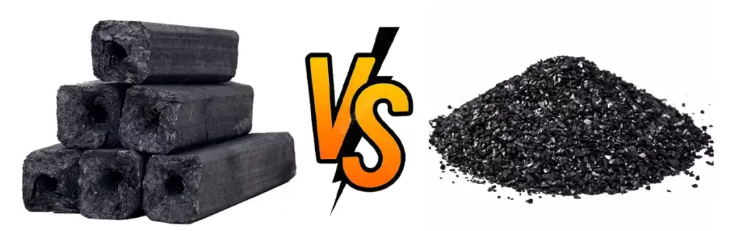
- Moulded carbon blocks — pressed 100×100×100 mm blocks that drop directly into drawer-tray adsorption boxes, eliminating voids and guaranteeing uniform bed thickness.
For tower and box systems, the granular and moulded forms dominate. We supply media in exactly these forms for the vessels we build — see our activated carbon media product page for grades and factory-direct supply terms.
From “Which Material” to “Which Grade”: the Buying Decision
Answering activated carbon vs charcoal settles the material, not the purchase. The practical buying questions are about the grade that goes into your specific duty:
- Iodine number — the measure of adsorption capacity; industrial gas-treatment grades run 900–1,100 mg/g.
- Hardness — at least 95%, so the grains survive handling and do not crumble into fines.
- Moisture — no more than 5%, so capacity is not wasted on water.
- Bulk density — 450–520 g/L sets the bed weight your vessel and support must carry.
- Form and size — granules, pellets or moulded blocks in the mesh your tray geometry expects.
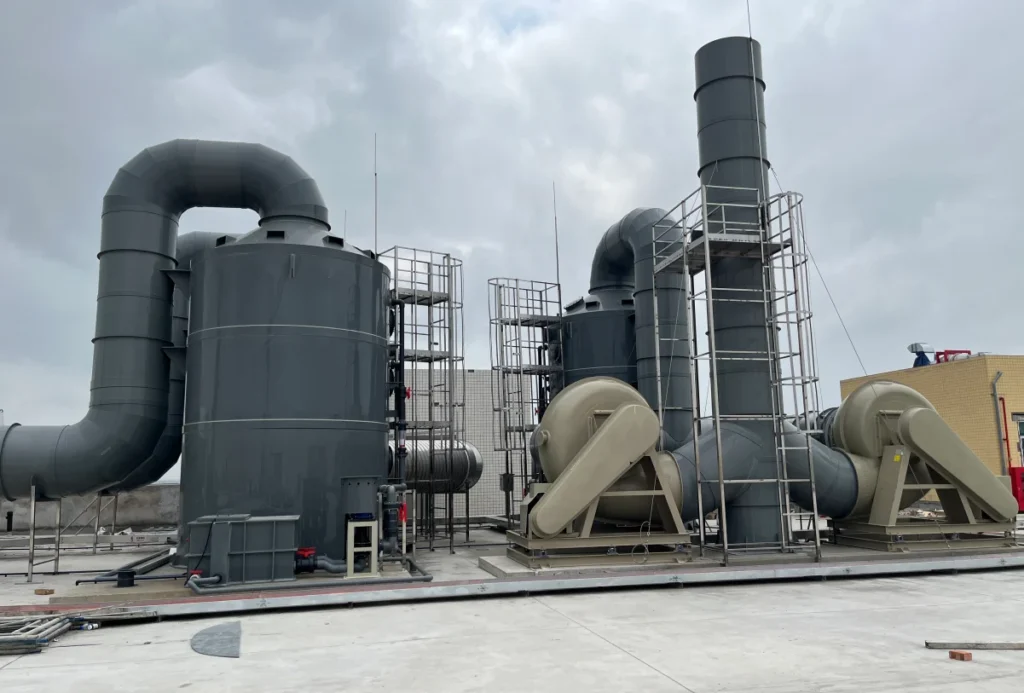
If you are specifying an adsorption system for odor or VOC duty, the material decision and the system decision are one exercise. Our activated carbon odor control systems pair a specified carbon bed with a PP or FRP vessel engineered for low pressure drop, and our activated carbon adsorption box guide walks through how the bed performs inside the tower.
When to Replace the Carbon — and What a Re-Fill Really Costs
Once a bed is genuinely activated carbon, the operating question changes from “which material” to “when does it stop working”. Activated carbon does not fail visibly; it saturates silently, and the first evidence is usually a rising outlet concentration or a returning odor — the point engineers call breakthrough.
Replace on Breakthrough, Not on the Calendar
Bed life is set by throughput, inlet concentration, humidity and media quality, not by a fixed interval. Under standard operating conditions our media is specified for up to 9 months of service, against a 12-month housing warranty and a 6-month media warranty. The trigger for replacement is measurement, not the calendar: an outlet VOC or H₂S reading, or a rising bed differential pressure. Fitting sampling ports and testing the bed directly removes the guesswork that turns an undersized media budget into an emergency compliance failure.
What a Re-Fill Actually Costs
The line item on a re-fill is not the carbon alone. Four costs sit inside every media change-out:
- Media cost — the fill itself, priced by grade, form and quantity at factory-direct rates.
- Disposal or regeneration — spent carbon is either regenerated, losing a percentage of capacity on each cycle, or disposed of; when the bed has adsorbed hazardous compounds, the disposal route is regulated.
- Labour and downtime — in a drawer-tray box a change-out is a same-day job with no tools; in a bulk-filled tower it is a heavier operation.
- Consumables — gaskets and trays inspected at each change-out, so a re-fill visits and verifies the housing too.
Because we manufacture both the media and the housing that holds it, a re-fill is ordered against the original specification: the same iodine number, the same mesh, the same block dimensions for the same tray geometry. That is what keeps the second fill performing like the first — and it is the practical difference between buying carbon and buying a specified bed.
Where the Confusion Comes From: Biochar, Charcoal and Carbon Black
The activated carbon vs charcoal question is tangled further by three neighbouring materials that carry similar names and get mixed up at the point of sale.
Biochar
Biochar is charcoal made for a different purpose: carbon sequestration and soil amendment. It is produced by pyrolysis of organic matter and is not activated, so it carries none of the micropore capacity of activated carbon. When a product page offers “biochar filters,” the intended application is not industrial adsorption.
Carbon black
Carbon black is an industrially manufactured, soot-like particle used as a pigment and reinforcement in rubber, plastics and inks. It is not a porous adsorbent at all, and it shares only the word “carbon” with the materials in this article.
Why the Names Collide
“Charcoal” is a word that sells; “carbon” is the word that specifies. Consumer brands lean on “charcoal” for deodorizer bags, grill fuel and skincare, while engineering documents use “activated carbon” for adsorption duty. So the activated carbon vs charcoal comparison found in the wild is usually really two separate questions: whether the material was actually activated, and which dialect the label happens to be using.
Frequently Asked Questions
Q: Is activated carbon the same as activated charcoal?
A: Yes. They are the same material; “activated charcoal” is the common consumer and UK term, and “activated carbon” is the industrial and technical term. A practical activated carbon vs charcoal test on any document is whether the word “activated” appears — that single word is the whole difference.
Q: What is the real difference between charcoal and activated carbon?
A: Activation. Both are made by pyrolysis, but activated carbon is then treated with steam or chemicals at high temperature to open millions of micropores, lifting surface area to typically 500–1,500 m2/g and giving it the adsorption capacity a treatment bed needs. In the charcoal and activated carbon comparison, every practical difference flows from that step.
Q: Can I use regular charcoal in an odor control system?
A: No. The pore structure of ordinary charcoal cannot handle the gas volumes of an industrial exhaust stream. Industrial systems run on genuine activated carbon with a specified iodine number, hardness and grade.
Q: Why does “carbon filter” sometimes mean water treatment?
A: Activated carbon serves both air and water. The material is the same, but the grade and form differ: coarse granular carbon for low pressure drop in gas beds, finer carbon for liquid contact. Always confirm the application when you see the term “carbon filter” without a duty.
Q: How long does an activated carbon bed last?
A: Until it breaks through — the point where outlet concentration rises as the pores saturate. Operating life depends on concentration, humidity and media quality; monitoring is by measurement, not by the calendar.
Conclusion
Charcoal and activated carbon share a feedstock and a name, but activation is the entire difference. When you are choosing between activated carbon vs charcoal for a treatment bed, the answer is structurally simple: the only candidate is genuine, specified activated carbon — in the form, mesh and iodine range your vessel demands. The language confusion around “activated charcoal” and “charcoal” disappears the moment the material is defined by numbers instead of by nouns.
Sources
- Wikipedia — Activated carbon (activated carbon is a form of carbon processed to have small, low-volume pores that increase the surface area available for adsorption; also called activated charcoal; typical surface area in excess of 1,000 m2/g).
- U.S. Environmental Protection Agency (EPA) — Monitoring by Control Technique: Activated Carbon Adsorber (adsorber outlet VOC concentration and regeneration parameters are the primary performance indicators; activated carbon adsorbers are a recognized control technique for VOC and odor emissions).