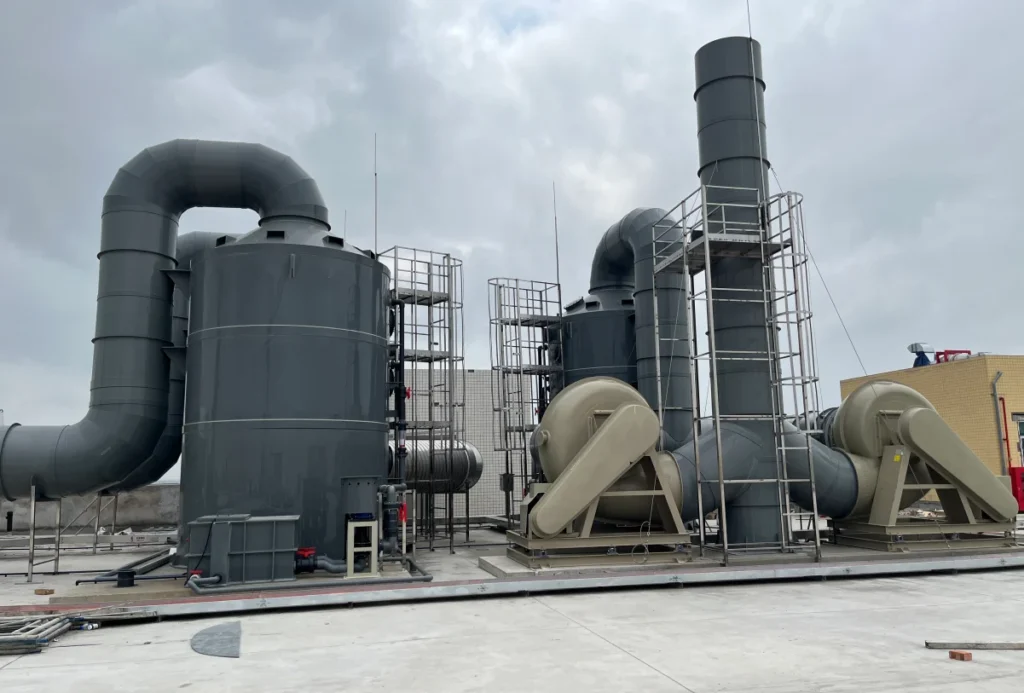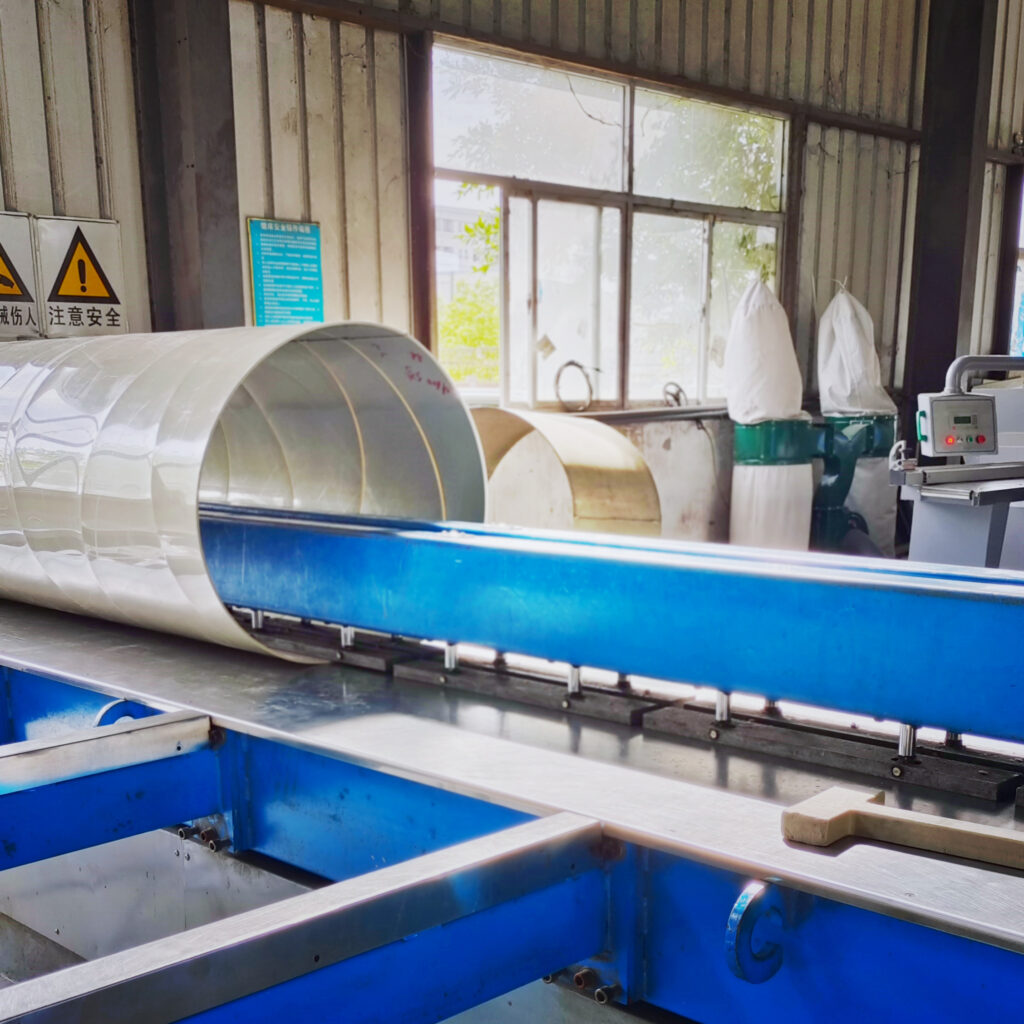
Every PP duct welding project survives or fails at its welds. A length of polypropylene duct is not a single extrusion like pressure pipe; above 400 mm, a round, square or rectangular PP duct is a sheet that has been welded into a tube, then welded again to the next section and to every fitting in the run. Sections up to 400 mm are a single seamless piece with no longitudinal weld, so on small duct the welding begins at the joints between sections. The material is strong, but the system is only as strong as the joints, and a duct weld is judged by a handful of numbers: the melt temperature of the polymer, the temperature actually reaching the joint, and the fraction of parent-material strength the weld has to carry.
Key Takeaways
- Above 400 mm, PP duct is a welded assembly, not a single extruded pipe. A large round duct is polypropylene sheet heat-welded into a tube, and the field joints are the same craft; sections up to 400 mm are a single seamless piece with no longitudinal weld. The quality of the welds, not the polymer, sets the system’s pressure-tightness and stiffness.
- Polypropylene cannot be solvent-welded — this is the single most common misconception in pp duct welding. PVC and many other thermoplastics can be joined with solvent cement; PP has no active solvent. The only reliable, code-accepted ways to join PP duct are heat welding (hot gas, extrusion, or butt/socket fusion) or mechanical flanges.
- Temperature is the craft. PP’s crystalline melting point is about 165 °C, but a hot-air welding gun runs at 300–325 °C because the air temperature is not the joint temperature. The polymer at the joint must reach roughly 200–260 °C: too cold gives a cold weld that peels open, too hot degrades the polymer into brittle, charred material.
- A good PP duct weld carries 80–95% of the parent-sheet strength. The weld is the creep-critical zone of the system, and under long-term load it is the joint that relaxes first. Welder skill, rod grade and heat control matter more than the polymer specification.
- A sound weld is proven, not assumed. Visual inspection catches cold welds and overheating, a destructive bend test proves fusion on a sample, and the system is then leak-tested under light positive pressure. Welders and shops should be qualified to the DVS 2207 family of welding standards.
Why PP Duct Is Welded
The reasons pp duct welding is the default joint method start with a material property. Polypropylene has a very low surface energy, which is why adhesives and tapes do not grip it for long and why it is difficult to paint or laminate. The same property rules out a common shortcut: there is no solvent cement for polypropylene the way there is for PVC. The options for joining PP duct are therefore heat welding or a mechanical connection, and heat welding produces the only joint that is chemically the same as the parent material. For an introduction to what a PP duct is — how sheet becomes round, square and rectangular sections, and how the material is specified — start with our polypropylene duct guide, and for the naming and basic anatomy see what is a PP duct.
A welded PP joint is homogeneous. The two pieces are melted together at the interface and the polymer chains intermingle; the joint is a continuous mass of the same material rather than two surfaces held by an adhesive layer. That is why a properly made PP weld can outlast the sheet around it, and why the entire duct industry assembles polypropylene ductwork by welding rather than by gluing.
Where Welds Appear in a PP Duct System
Welds are present in every duct system in two distinct roles:
- The fabrication seam. Above 400 mm, a round or rectangular duct is formed by welding sheet into a section along its length. The longitudinal seam and any reinforcing or gusset welds exist before the duct leaves the shop.
- The field joint. Duct sections, elbows, tees, reducers, transitions and flange faces are welded together on site. These field welds are made by the same hot gas and extrusion techniques, under less controlled conditions than in the shop.
The Two Weld Worlds
PP duct welding splits into two methods that are often confused, and choosing the right one for the job is the difference between a seam that lasts and one that peels.
Hot Gas (Rod) Welding — the Manual Method
Hot gas welding is the hand method: a hot-air gun heats the joint and the operator feeds a polypropylene welding rod into the molten puddle, building the joint pass by pass. It is the standard for field joints, repairs, corners and small fabrication work because it can reach any orientation and adapts to complex geometry.
Extrusion Welding — the Machine Method
Extrusion welding feeds a rod through a hot barrel while the machine simultaneously heats the joint, laying down a wider, more uniform weld bead than a hand weld. It is faster, more consistent and better suited to long straight seams and thick sheet, which is why shop fabrication of the longitudinal seam tends to use extrusion welding while field joints are more often hand welded.
Hot Gas (Rod) Welding, Properly Done
Hand welding is where most pp duct welding happens — in the field and in small fabrication — and it looks simple while being genuinely hard to do well. The operator controls three variables at once — heat, downward pressure and travel speed — and every one of them shows up in the finished weld.
Consumables and Setup
A hot gas hand weld needs a heat gun with a speed tip (the attachment that preheats rod and parent material together), polypropylene welding rod, and a way to clean and degrease the joint. The rod must be the same material family as the duct: homopolymer PP rod for PP duct, never a mixed or recycled rod of unknown grade.
Surface Preparation
The joint faces must be clean, dry and free of grease. Wipe with a solvent that evaporates fully, allow it to dry completely, and keep moisture away — water in the joint turns to steam at welding temperature and produces voids. Roughening helps with adhesives; for heat welding it is not required, since the weld is a melt mix rather than a surface bond, but the surfaces must be mechanically true so the gap is small and even.
The Passes
A hand weld is built in passes. A typical single-V edge joint takes a root pass that wets the gap, then one or two cover passes, the last of which caps the bead. On polypropylene a completed weld usually needs three to four passes to reach full strength. The rod is fed into the leading edge of the molten puddle at a shallow angle, and the bead is built up slightly proud of the parent surface so any finish grinding does not thin the joint below the sheet thickness.
Extrusion Welding, Properly Done
Extrusion welding brings four things a hand weld does not: a controlled rod feed rate, a consistent bead cross-section, higher deposition, and a machine-stable temperature profile. For pp duct welding of long straight seams and production fabrication, extrusion welding is the method that keeps a ten-metre seam as consistent as a one-metre one.
When Extrusion Wins
- Longitudinal seams on round or rectangular duct produced from sheet
- Thick sheet (typically 6–12 mm wall) where a hand deposit would take many passes
- Repetitive, straight joints where the same weld geometry repeats section after section
Hot Gas vs Extrusion — Comparison
| Parameter | Hot gas (rod) welding | Extrusion welding |
|---|---|---|
| Feed | Hand-fed rod | Machine-fed, preheated rod through a barrel |
| Bead width | Narrow, set by operator | Wider, uniform cross-section |
| Deposition rate | Lower | Higher |
| Consistency | Operator dependent | Machine repeatable |
| Best use | Field joints, corners, repairs | Long straight seams, thick sheet, fabrication |
Butt Fusion and Socket Fusion — the Pipe-Grade Joints
Polypropylene pipe is joined by fusion methods rather than rod welding: butt fusion, where two square-cut faces are melted against a heating plate and pressed together, or socket fusion, where an element heats pipe-end and socket until the two melt together. Duct systems generally do not use butt fusion on site, because duct sections are thin walled and the joint must resist a running leak in both directions. Yet the fusion family matters to someone welding duct for one reason: it is the same heat-based logic, and it is the method the PP pressure-pipe standards such as ASTM F2389 are built around. The contrast with PVC — which joins by solvent rather than heat — is covered in our PP duct vs PVC duct comparison.
For duct, the practical rules are simpler. Round duct sections are joined by rod welding a butt or lap seam, or by flanged connections; fusion is reserved for piping service. What must never be done is to attempt a solvent-weld joint on PP duct — the material will not soften in any common solvent, the joint will look solid, and it will separate under the first thermal cycle.
The Temperature Story: Melting Points, Gun Settings, and the 165 °C Line
Every pp duct welding operation is a controlled temperature event. Understanding the numbers is what separates a weld that fuses from one that fakes.
What 165 °C Melting Actually Means
PP is a semicrystalline polymer; its crystalline regions melt at approximately 165 °C, and the material becomes soft and workable well below that. The welding process does not simply reach 165 °C once and stop — temperature must climb through the softening range until the melt is fluid enough to intermingle, but must not stay high enough to degrade the polymer structure.
Gun Temperature vs Joint Temperature
The air leaving a hot-air welding gun is far hotter than the polymer melt. A typical setting is 300–325 °C at the nozzle; some equipment is quoted at 300 °C, and equipment such as King Plastic’s guidance specifies about 572°F (300 °C). The polymer at the joint, however, must be heated to roughly 200–260 °C, because the hot air loses temperature across the gap between nozzle and surface, and because overheating the polymer is worse than under-heating it. The 305–315 °C gun setting versus the 230–260 °C material temperature is a calibration difference, not a contradiction — the two numbers measure different things.
What Overheating and Under-Heating Look Like
- Under-heated (cold weld): the rod and parent never fully fuse; a “fish-eye” or translucent interface remains, and the weld peels open under modest force.
- Overheated: the polymer oxidizes and degrades; the weld discolors (yellow-brown), smells acrid, and becomes brittle. Charred or discoloured PP has lost most of its ductility.
- Right temperature: rod and parent flow together, the bead is uniform, and a cooled weld cannot be separated without tearing parent material.
Weld Strength and the Weld Factor
Designers rarely load a duct weld to its short-term limit; the concern is long-term integrity under creep. Polypropylene creeps under sustained load, and the weld is the creep-critical zone because it is the thinnest, most worked region of the system. How this load path compares with metal or FRP duct — where the joint is a flange or an adhesive bond rather than a homogeneous weld — is covered in our PP duct vs galvanized duct and PP duct vs FRP duct comparisons.
How Strong Is a Good Weld?
A correctly made PP weld retains roughly 80–95% of the parent-sheet tensile strength. On standard PP, consistent welds are expected in the upper part of that range; flame-retardant grades are more sensitive, and overheated flame-retardant welds can lose 30–50% of joint strength because the flame-retardant additives degrade before the polymer does. The engineering assumption is never 100% — a design that depends on full parent strength at every weld is a design that has not accounted for welding.
What the Duct Actually Asks of the Weld
A duct is a low-pressure, thin-walled vessel. The gas-side pressure is usually a few hundred pascals and the hoop stress is modest, so the weld is not carrying a burst load. What it must carry is:
- Leak-tightness — a pinhole bleed turns a well-designed system into a fugitive-emission problem
- Stiffness under vacuum or fan start-up — a bowed or un-welded seam collapses first
- Thermal cycling — PP moves about 0.15 mm per metre per 10 °C, and the weld must absorb that movement without cracking. The full sizing loop that decides duct diameter, wall and static pressure from the airflow — the context in which the welds then have to perform — is covered in our PP duct design and sizing guide.
Welding the Longitudinal Seam
That seam is also the boundary between welding and fabrication as subjects, because a longitudinal seam exists only on a duct that was fabricated from sheet in the first place — a moulded section has no seam to weld. Which sections arrive seamless and which are welded from sheet, and what the shop has to control to make the seam sound, is set out in our guide to PP duct fabrication.
When PP sheet becomes a duct section, the longitudinal seam is the longest single pp duct welding operation on the part. On wall thicknesses up to about 4–5 mm, a single-V butt preparation with a 60–70° bevel works; on thicker wall, the joint is prepared as a double-V or with a backing strip so full penetration is achieved without overloading the root. The seam is welded in a controlled sequence, alternating directions or welding from the centre outward, to keep distortion and shrink from winding the duct into a banana. Round and rectangular PP duct in the size range used for industrial exhaust — from about 110 mm up to 500 mm and beyond — is delivered this way; the standard size ladder and wall-thickness table are covered in our PP duct size and thickness guide.
The same preparation logic applies to rectangular duct corners and to gussets, where a poor weld fails by peeling at the corner rather than by cracking through the sheet. Where a run combines welded sections and fittings, the fitting-side joint is governed by the same craft — see our PP duct fittings guide for how elbows, tees, reducers and transitions are integrated.
Welding the Field Joint
A field joint carries more consequence on a laboratory exhaust duct than on a process run, because the duct passes through occupied space and the joint is the most likely leak path: a joint that weeps delivers the stream into the room rather than to the discharge point, which is the failure the whole system exists to prevent. How a laboratory exhaust duct is laid out, welded and verified is set out in our guide to laboratory exhaust duct; the hazardous-exhaust code layer behind it is in our guide to chemical fume exhaust duct.
Field pp duct welding is where most duct systems get into trouble, because it happens on a ladder or a lift rather than a bench. The same rules apply, and a few extra ones:
- Support both sides before welding. The weld must not be dragged by the unsupported weight of a swinging duct section.
- Dry the joint. Moisture condenses on cold duct; welding over damp PP produces steam voids.
- Weld in the orientation you can see. A blind overhead weld is the fastest way to a cold weld; rotate or access the joint properly.
- Never stack welds to fix a gap. A gap wider than the rod should be bridged with a backing strip or a patch, not filled with weld passes.
For the surrounding work — support spacing, hanger loads, expansion compensation and final leak testing of the installed system — the installation guide covers the steps that follow the welds: see our PP duct installation guide. Where shop-welded sections are needed instead of site welding, our industrial polypropylene duct customization and square polypropylene duct customization are fabricated with the shop welds documented, across the full industrial ductwork range.
Defects, Inspection, and Proving a Weld Is Good
Because a good result in pp duct welding is invisible in isolation, fabrication shops and contractors rely on a short inspection ladder: visual, then mechanical sample, then system test.
The Defect Family
- Cold weld (fish-eye): translucent interface, incomplete fusion, peels under load — the most common defect
- Dry rod: rod laid into a puddle that has already solidified; bead pulls away from parent
- Overheat / char: discolouration, brittleness, degraded polymer
- Undercut: the bead narrower than the sheet, thinning the joint
- Void: trapped moisture or gas, usually from welding over damp or dirty surfaces
The Inspection Ladder
- Visual: bead uniform, fused to both edges, no discolouration, no undercut. A skilled eye catches the overwhelming majority of production defects.
- Mechanical sample: a sacrificial coupon or a bend test on a shop weld — the weld must fail in the parent material or tear, never peel along the interface.
- System test: the installed run is leak-tested under light positive pressure (soap-bubble or pressure-decay) before it is enclosed or insulated.
Shops that weld PP duct commercially should qualify welders and procedures against the DVS 2207 standard family for welding thermoplastics, and should keep welder records the way a steel fabricator keeps weld maps. That paperwork is what a buyer can actually verify when a duct specification demands welded quality.
Flame-Retardant PP: Different Welding Numbers
Flame-retardant PP welds at a lower gun temperature than standard PP, typically 240–280 °C at the nozzle versus 280–320 °C for standard homopolymer, because the flame-retardant additives are thermally sensitive and degrade before the base polymer. The penalties for overheating are specific and measurable: the additives burn off, the surface chars, and a weld that should carry 80–95% of parent strength can lose 30–50%. Welding a flame-retardant duct with standard-PP settings is a real defect, not a cosmetic one. For the flame-retardant specification, fire ratings and the 25/50 rule — which applies at the assembly level, not the material — see our flame retardant PP duct guide.
Frequently Asked Questions
Q: Can PP duct be solvent-welded instead of heat-welded?
A: No. Polypropylene has no practical solvent welding route, unlike PVC. Attempting a solvent joint on PP produces a joint that looks bonded and separates under thermal cycling. Heat welding or mechanical flanges are the only accepted methods.
Q: What temperature is used for PP duct welding?
A: The polymer joint must reach roughly 200–260 °C, which means the hot-air welding gun runs hotter, typically 300–325 °C at the nozzle. Flame-retardant grades weld cooler, around 240–280 °C at the nozzle. The gun reading and the joint temperature are different numbers.
Q: How strong is a weld in PP duct?
A: A correctly made weld carries about 80–95% of the parent-sheet strength. On flame-retardant grades, an overheated weld can drop to 50% or less because the flame-retardant additives degrade first.
Q: Is extrusion welding better than hand welding for PP duct?
A: For long straight seams and thick sheet, extrusion welding is more consistent and faster. For field joints, corners and repairs, hot gas hand welding is the practical method. Most duct systems use both.
Q: How can I verify a duct weld after it is made?
A: Visually (uniform bead, no discolouration or undercut), with a mechanical sample or bend test that must tear parent material rather than peel along the weld, and finally with a leak test of the installed run. Qualified shops should have welder and procedure records per DVS 2207.
Conclusion
PP duct is a welded product, and pp duct welding is the part of its construction that decides a run’s long-term integrity. The material gives the duct its corrosion resistance; the welds give it pressure-tightness, stiffness under start-up loading, and the ability to survive thermal cycling. Joining polypropylene duct is a heat craft governed by three numbers — the 165 °C melt line, the 200–260 °C joint temperature, and the 80–95% weld factor — and it is proven, before the system is trusted, by visual inspection, a destructive sample, and a leak test. A buyer who verifies welder qualification and inspects the welds gets a duct system; one who assumes them gets a gamble.
Sources
- Wikipedia — Plastic welding (hot gas welding, extrusion welding, butt fusion and socket fusion are established thermoplastic joining methods; PP is welded by these methods).
- Wikipedia — Polypropylene (semicrystalline polymer; melting point of isotactic PP around 160–166 °C; low surface energy makes adhesive bonding difficult).
- DVS — German Welding Society — DVS 2207 series: “Welding of thermoplastics” (procedure and welder qualification rules for hot gas, extrusion and heated-tool welding of PP; referenced here as the qualification framework for duct fabrication and field welding).