Key Takeaways
1. A PP duct is a rigid ventilation duct extruded or fabricated from polypropylene, used to move corrosive or warm exhaust air where the plastic wall itself is the corrosion barrier.
2. “PP” stands for polypropylene, a partly crystalline thermoplastic with a density near 0.91 g/cm3 and a continuous service ceiling commonly quoted at 90-100 °C, depending on grade and load.
3. The wall is homogeneous — no lining, no coating — and the run is joined by thermal fusion welding, so a scratch exposes the same plastic rather than a corrodible substrate.
4. Factory wall thickness rises with diameter: 3 mm at φ110, 3.3 mm at φ200, 4.2 mm at φ315, 4.5 mm at φ400 and 5.5 mm at φ500, supplied in 3 m lengths.
5. Thermal expansion runs about ten times that of steel, so long runs need expansion joints and a mix of fixed and sliding supports.
6. A PP duct is the wrong choice for strong oxidizers, sustained service above its temperature ceiling, heavy mechanical loads, or a fire classification the grade does not carry.
7. In a scrubbed exhaust train the duct is rarely the largest pressure consumer — the scrubber and the fittings usually are — which changes how much a larger duct really saves.
What Is a PP Duct — and Why the Answer Changes the Spec
Ask a room of engineers what is a PP duct and most will answer “a plastic duct for corrosive fumes.” That answer is correct and almost useless, because it says nothing about the material grade, the joint type, the wall thickness the diameter requires, or which limit will end the duct’s service life. This guide answers what is a PP duct in engineering terms: the material, the construction, the real dimensions, the temperature and chemical boundaries, and the way the duct behaves inside a working exhaust system.
The question matters because polypropylene duct is not a drop-in substitute for galvanized steel. It is weaker, it expands far more, it costs more per metre, and it cannot be welded with the equipment a sheet-metal shop already owns. What it does is survive media that destroy metal and soften PVC, and it does so without a lining that can delaminate. Once you understand why those two facts sit together, the selection decisions stop being a matter of taste.
This article stays close to numbers. Where a range is quoted, the reason for the range is given. Where a figure comes from a specific grade or a specific factory line, that is stated. The goal is that a reader can take one number or one question out of each section and use it in a real project conversation — with a supplier, a fabricator, or an internal reviewer.
What Is a PP Duct? The Definition, Tightened
PP means polypropylene, a partly crystalline thermoplastic
“PP” is the abbreviation for polypropylene, the two letters that lead the name of the product. Polypropylene is a thermoplastic polymer built by polymerising propylene into long chains, and it is one of the highest-volume plastics in the world. Thermoplastic means the material softens when heated and hardens again on cooling, and that the cycle can be repeated. That single property is why the duct can be extruded from melted polymer and why its joints can be re-melted and fused rather than bolted.
Two structural facts about the material explain almost everything the finished duct does. First, polypropylene is partly crystalline: in industrial grades the crystalline fraction typically runs 30-60% of the volume, so the wall is a mixture of ordered regions that supply stiffness, hardness and solvent resistance, and amorphous regions that supply toughness. Second, the polymer is non-polar, which is the molecular reason for its chemical inertness — polar, water-based media find little in the structure to attack.
A duct, not a pipe — and why the distinction changes the spec
A duct is a pressure-ventilation component that carries air at close to atmospheric pressure. A pipe carries a pressurised fluid. That is the whole difference between a PP duct and a PP pipe, and it is not semantic: a duct is sized by cross-section, wall thickness and the airflow it must move, while a pipe is sized by a pressure rating and a wall-thickness series calculated for internal pressure. A part drawn to pipe rules and used in ventilation service will be heavier and more expensive than the duty requires, and its fitting geometry will fight the airflow.
The practical consequence is that a ventilation project should buy duct, and a chemical-transfer project should buy pipe, even when both are made from the same polypropylene. Mixing the two on one purchase order is a common source of over-specification on exhaust runs and under-specification on transfer lines.
What a PP duct is not
A PP duct is not a metal duct with a plastic coating or an internal lining. The entire wall is polypropylene, so there is no thin surface film whose failure would expose a corrodible substrate, and no boundary between two materials that could separate under thermal cycling. It is not a flexible or foil duct, which is a different, light-duty product family used in comfort ventilation. It is not fiberglass-reinforced plastic: there is no reinforcing layer and no resin matrix, and its stiffness comes from wall thickness rather than from reinforcement.
Each of those exclusions removes a specific failure mode. Coated metal fails when the coating is breached; lined duct fails when the liner blisters; FRP fails at the resin, not at the glass. A homogeneous polypropylene wall trades those failure modes for a different set of limits — temperature, load and expansion — which the rest of this article quantifies.
For the wider treatment of the material, the pillar guide on polypropylene duct covers grades, forms and system design in more depth than a single definitional page can.
What a PP Duct Is Made Of
An extruded, homogeneous wall
Round PP duct begins as polymer pellets that are melted and forced through a die to form a continuous tube, which is then cut to length. Square and rectangular duct is fabricated differently: flat PP sheet is cut to size, folded or formed, and welded along the seams into a box section. Both routes end at the same place — a wall of uniform material with no layer structure.
Homogeneity is the basis of the corrosion performance. Because the protective wall is the full plastic thickness, a scratch or a minor abrasion merely thins the same material by a fraction of a millimetre. On a coated metal duct the same scratch exposes bare steel and starts a corrosion cell that grows under the coating. The two behave completely differently after damage, and that difference is designed in, not added on.
Construction is the part of what is a PP duct that buyers most often skip, and it is the part that decides how the duct fails when something does go wrong.
PP-H, PP-B and PP-R — which grade actually goes into ducting
Polypropylene is a family, not a single material. The three grades most often quoted are PP-H (homopolymer), PP-B (block copolymer) and PP-R (random copolymer), and they differ in crystallinity and therefore in stiffness, impact behaviour, temperature response and chemical profile.
| Grade | Character | Typical duct use |
|---|---|---|
| PP-H | Homopolymer, highest crystallinity, stiffest, widest chemical range | Most corrosive fume and chemical exhaust ducting |
| PP-B | Block copolymer, better low-temperature impact, slightly lower stiffness | Cold or impact-prone installations, sheet duct |
| PP-R | Random copolymer, tougher, lower stiffness, common in pressure pipe | Rare in ventilation ducts, frequent in PP pipe |
Duct service most often lands on PP-H, which is why the continuous-service figures quoted in this article are PP-H figures. The habit worth building is asking which grade a quotation names. A price that looks unusually low is often a copolymer or a reprocessed grade substituted for the homopolymer the drawing specified.
Welded joints, not fastened seams
Individual sections are joined by thermal fusion welding. Depending on the wall thickness and the shop’s equipment, that means hot-gas welding with a filler rod to DVS 2207-3, or extrusion welding to DVS 2207-4, and butt or socket fusion on extruded pipe sections. The mating surfaces are heated until the polypropylene softens, pressed together, and fuse into one continuous material as they cool.
Because both parts are the same polymer, a sound weld is a continuation of the wall rather than a seam between dissimilar materials. That matters in corrosive service for a specific reason: a welded run has no gasket, no mechanical fastener and no crevice where liquid can pool. Metal duct is assembled with fasteners, gaskets and sealants, and each of those is a potential leak path in a wet airstream. A welded homogeneous run eliminates that whole class of joint — which is why long corrosive exhaust mains can be assembled without the joints becoming the weak points of the system.
Custom runs, transitions and non-standard sections are fabricated in the same way, and the customisation route for a one-off geometry is the same welding process applied to a drawing. The custom PP duct fabrication service is the practical entry point when a standard diameter or fitting does not fit the layout.
What Is a PP Duct’s Real Wall Thickness and Weight?
Most PP duct pages quote a “typical” size table and then ask you to confirm everything with the supplier. That is honest but unhelpful when you are trying to estimate a support load or price a run. The table below is different: it is the production series this factory builds, with the outside diameter, the corresponding inside diameter, the wall thickness used at that diameter, the standard length, and the mass per metre.
The production diameter series and its wall thickness
| Outside dia. | Inside dia. | Wall | Standard length | Mass per metre |
|---|---|---|---|---|
| φ110 mm | 104.0 mm | 3.0 mm | 3 m | ≈ 0.92 kg/m |
| φ160 mm | 154.0 mm | 3.0 mm | 3 m | ≈ 1.35 kg/m |
| φ200 mm | 193.4 mm | 3.3 mm | 3 m | ≈ 1.86 kg/m |
| φ315 mm | 306.6 mm | 4.2 mm | 3 m | ≈ 3.73 kg/m |
| φ355 mm | 346.6 mm | 4.2 mm | 3 m | ≈ 4.21 kg/m |
| φ400 mm | 391.0 mm | 4.5 mm | 3 m | ≈ 5.09 kg/m |
| φ500 mm | 489.0 mm | 5.5 mm | 3 m | ≈ 7.78 kg/m |
Two notes on reading it. Below φ110 the sections are supplied in 4 m lengths rather than 3 m. And the mass column is calculated, not weighed: it takes the annular cross-section at the stated diameter and wall, and applies a polypropylene density of 0.91 g/cm3. Real sections weigh a little more because of weld beads, flanges and fittings, so treat it as a lower bound for support design.
Why the wall steps up with diameter
The wall thickness is not chosen for pressure. Ventilation duct runs at close to atmospheric pressure, so the controlling load is usually bending between supports, plus the duct’s own weight. Because polypropylene’s stiffness is a small fraction of steel’s, a larger duct cannot span as far before it sags, and the way a designer buys that stiffness back is wall thickness rather than a stronger material. That is why the series steps from 3 mm at φ110 to 5.5 mm at φ500 rather than staying constant.
The practical follow-on is that hanger spacing for PP duct is set by the wall thickness and the diameter in the table, not by a rule of thumb carried over from sheet-metal practice. A span that is comfortable for a 4.2 mm φ315 run will not be comfortable for a 3 mm φ110 run, even though the smaller duct weighs far less.
A weight comparison that is usually overstated
Polypropylene is often described as around eight times lighter than steel, and that is true of the raw material: 0.91 g/cm3 against roughly 7.85 g/cm3. It is misleading for a finished duct, because a steel duct uses a far thinner wall for the same duty. A 0.6 mm galvanised spiral duct at φ315 works out near 4.7 kg per metre, against 3.7 kg per metre for the 4.2 mm polypropylene section in the table above.
So PP duct is lighter per finished metre, and noticeably easier to handle on a ladder, but the advantage is tens of percent rather than multiples. Support and lifting plans should be built from the actual mass per metre, not from a material-density ratio.
How to read a supplier’s size table
Three questions turn a size table into something useful. First, are the diameters outside or inside? A 3 mm wall on a φ200 section costs 6 mm of bore, which is roughly 6% of the area and therefore of the airflow. Second, is the wall thickness at the diameter you actually need, or a single figure repeated down the column? Third, is the standard length fixed, since a short length means more welded joints and more of the installation cost lands on site welds.
The diameters in the table above are stocked as standard products, and a run that needs an intermediate size — a φ250 or a φ280 — moves into the custom range rather than being forced onto the next stocked diameter. Standard sections for the common sizes are listed under PP duct products, including the φ315 mm section, while box-section work is quoted through the square duct customisation route.
Temperature, Pressure and Chemical Limits
The limits that end a PP duct’s service life are temperature, load and chemistry, and they interact rather than acting one at a time. Each is treated in turn below, but they share one conclusion: what is a PP duct rated for is a question that can only be answered with the medium, the continuous temperature and the span taken together.
The melting point is not a working temperature
Three temperature numbers get quoted for polypropylene and they are not interchangeable. The melting point of the high-crystallinity grades used in ducting sits around 160-170 °C. The glass transition, below which the amorphous regions become glassy and the material turns brittle, is somewhere in the region of −10 to −20 °C depending on grade. Neither is a design figure for a duct.
The number that governs service is the continuous service temperature, and for PP-H duct grades it is commonly quoted at 90-100 °C. The upper end belongs to a homopolymer grade under light load; the lower end belongs to a loaded, long-span, warm installation. Some suppliers in the North American market publish 100 °C for their duct grades, others cap nearer 90 °C, and both can be correct for the grade and configuration they are describing. A quotation should name the grade and the load assumption behind its temperature figure.
Creep is why the temperature figure depends on load
Every thermoplastic creeps: under a sustained load the polymer chains slowly rearrange and the part deforms over time, and the rate rises sharply with temperature. The crystalline regions of polypropylene act as a brake on that movement, which is why a more crystalline grade holds its shape better, but the general rule stands — the hotter the duct, the faster a given load deforms it.
That is the mechanism behind the phrase “depends on grade and load” that appears next to every PP temperature rating. A horizontal duct carrying only its own weight can run hotter than the same duct under a long unsupported span, a heavy fitting, or sustained mechanical loading. The correct project question is not “what is the maximum temperature” but “what temperature, under what span and load, for what service life.” The failures this prevents are the familiar ones: sagging between hangers and long-term ovality at elevated temperature.
Thermal expansion — the number that sizes the expansion joints
Thermal expansion of polypropylene runs roughly ten to fifteen times that of carbon steel. Published coefficients for extruded PP cluster around 0.10-0.15 mm per metre per kelvin, and taking 0.12 as a working figure is reasonable for layout. Steel sits near 0.012 mm per metre per kelvin.
Run the arithmetic on a real installation. A 20 m straight horizontal run that swings 30 K between a cold shutdown and a warm process grows by 20 × 30 × 0.12 = 72 mm. The same run in steel would grow by about 7 mm. Seventy-two millimetres is not a detail — it is roughly the width of a hand, and a run anchored rigidly at both ends will either buckle sideways, distort a branch, or load the welds until something gives.
The standard answer is an expansion joint or bellows at intervals, combined with a support scheme that fixes the duct at chosen points and lets it slide elsewhere. The fixed-point, guide-hanger arrangement used on plastic piping systems transfers directly. Support spacing, expansion-joint positions and the location of branches all belong on the layout drawing, because retrofitting an expansion joint into a welded run means cutting it on site.
Chemical resistance, and exactly where it stops
Polypropylene’s broad chemical resistance follows from the non-polar, partly crystalline structure described earlier: polar, water-based media have little to attack. That covers a large part of what industrial exhaust actually carries — acid mists, alkaline vapours, salt-laden air, most aqueous process fumes.
| Medium | Typical PP behaviour |
|---|---|
| Aqueous acids, alkalis and salt solutions | Generally resistant across a wide concentration range |
| Most organic solvents | Variable — aromatic and chlorinated solvents can swell the polymer; confirm per medium |
| Strong oxidizers — fuming sulfuric, concentrated nitric, chromic acid | Not suitable; oxidizing attack breaks the polymer backbone |
| Perchloric acid fume | Own rules — dedicated, washable system; confirm separately |
Two things make the boundary more subtle than a table suggests. Concentration and temperature act together, so a medium that is harmless dilute and cold can attack the same duct concentrated and warm. And resistance is not a single property that switches on and off; it degrades with time under a combination of chemical, thermal and mechanical load. The safe sequence is to identify every component of the stream, take the concentration and the continuous temperature, and check that specific combination against the grade’s data before ordering rather than after.
Flammability: standard grade versus flame-retardant grade
Standard polypropylene is a hydrocarbon and is therefore combustible. It does not need a flame to sustain itself indefinitely, but it ignites, it burns, and it drips. Plastics are classified for this under UL 94, which grades materials from HB through V-2, V-1 and V-0, with V-0 the rating most commonly specified in duct and equipment tenders and based on vertical burn behaviour with self-extinguishing within seconds.
Flame-retardant polypropylene is a modified grade with additives that change the burn behaviour and move it up that scale. So the answer to “is PP duct fire rated” is that it depends entirely on whether the specified grade is standard or flame retardant, and on the classification the project requires. For a project with a fire-performance requirement, the design step is to name the classification — HB, V-2, V-1 or V-0 — and then buy a grade documented to meet it, rather than assuming that “PP duct” and “flame-retardant PP duct” are the same product.
What Is a PP Duct’s Job in a Working Exhaust System?
A PP duct is one component of a chain, and its size is set by the chain rather than by the duct itself. Understanding the chain order is what turns a definition into a design, so this section walks from the capture point to the discharge.
The exhaust train, in order
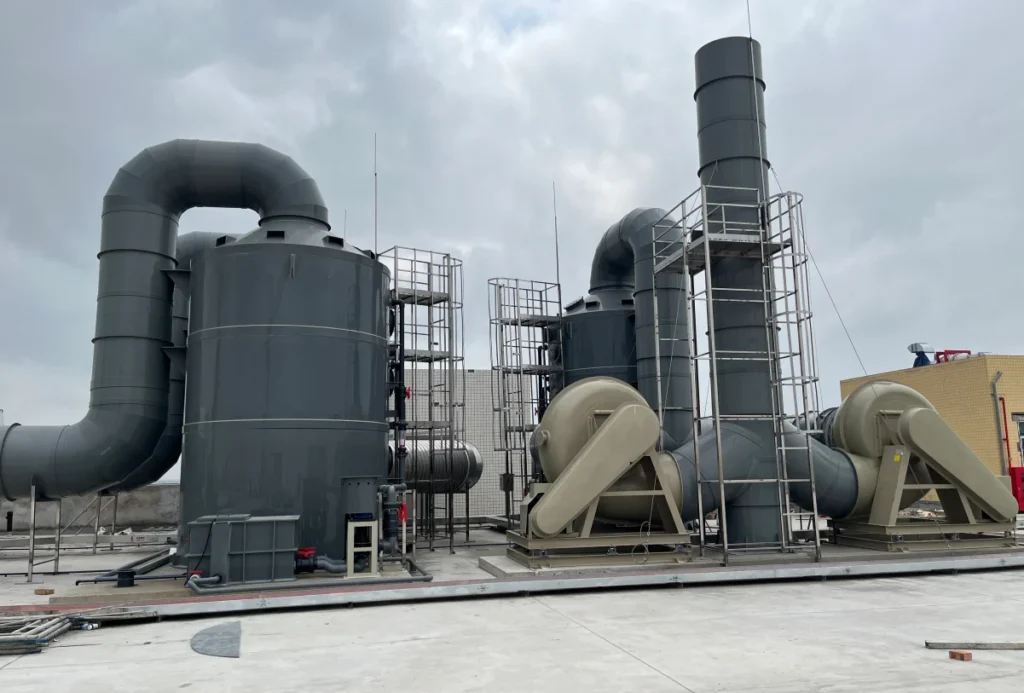
A typical corrosive-fume system runs: capture hood or enclosure, duct, control damper, treatment device such as a wet scrubber, fan, and finally a discharge stack. Air is pulled through the train by the fan at the end, so the entire duct run upstream of the fan is under negative pressure. That single fact drives two design habits.
First, a leak in a negative-pressure duct pulls air in rather than pushing fumes out, which is a safety advantage and the reason the fan is placed last whenever the process allows it. Second, the duct must be stiff enough not to collapse under the negative pressure it sees, which for most systems is a modest requirement but becomes real on a long, high-resistance run with a large fan.
The treatment device sits in the middle of the train, and its pressure drop is usually the largest single item in the system. A packed-bed wet scrubber commonly consumes several hundred to well over a thousand pascals, which is more than the entire duct run. That is the point made in the takeaways: resizing the duct upward to save fan energy has less effect than the numbers suggest, because the duct was never the dominant resistance. The engineering guides on how a wet scrubber works and on matching a blower to real duct resistance cover the two components that usually decide the fan duty.
Velocity first, diameter second
Duct diameter is derived, not chosen. The design sequence is to fix a target transport velocity, calculate the cross-sectional area needed for the airflow, and then round the resulting diameter to a stocked size. Target velocities for corrosive fume work commonly sit in these bands:
| Service | Typical target velocity | Reason |
|---|---|---|
| Laboratory and general chemical fume | 8-10 m/s | Keeps the stream moving without excessive noise and pressure loss |
| Plating and pickling mist | 10-12 m/s | Carries entrained droplets without letting them settle |
| Light dust or condensable vapour | 15-18 m/s | Above the settling velocity of the particles carried |
| Clean air, noise-sensitive | 6-8 m/s | Accepts a larger duct to cut both noise and pressure loss |
Take a worked case. A branch carrying 2,000 m3/h at a target 10 m/s needs an area of 0.0556 m2, which corresponds to a diameter of 266 mm. In a fine size series that would be specified directly. In the stocked series used here, φ200 gives an inside diameter of 193.4 mm, an area of 0.0294 m2 and a velocity of about 18.9 m/s — far above target — while φ315 gives 306.6 mm inside, 0.0738 m2 and about 7.5 m/s, somewhat below it.
So the coarse series forces a decision: accept a velocity below target on φ315, or move to a custom φ250 or φ280 and sit closer to 10 m/s. That trade is the practical reason custom diameters exist, and it is why the sizing decision and the procurement decision are the same decision. Transition pieces and reducers between two of those sizes are standard fittings, catalogued with the rest of the PP duct fittings range, and a square-to-round change is handled by a transition piece.
The pressure budget, and why velocity is expensive
Velocity pressure rises with the square of velocity: at 10 m/s in ambient air it is roughly 60 Pa, and at 20 m/s it is roughly 240 Pa. Because fan power tracks the product of flow and pressure, doubling the velocity in a fixed duct quadruples the velocity pressure component and therefore the running cost of the fan. That is the quantitative argument for not undersizing a duct to save material.
Friction loss along the run adds to it. Polypropylene is smoother than galvanised steel — published roughness figures for PP sit near 0.007 mm against roughly 0.15 mm for galvanised sheet — so friction factors are lower, though the advantage is modest once fittings and bends are counted. For a 30 m horizontal run at φ315 and 7.5 m/s, friction alone works out near 70 Pa at a friction factor of 0.02; a single 90° elbow at that velocity adds a comparable amount, and a partially closed damper can add more than the entire straight run.
The practical conclusion is that the pressure budget should be drafted component by component — hood, duct, bends, damper, scrubber, stack — before a fan is selected. The fittings and the treatment device dominate, the straight duct rarely does, and the item most often underestimated is the damper left part-closed for balancing.
Where the damper and the blower belong
The damping element controls branch flow so that the system can be balanced once, rather than repeatedly. Placing it on the branch rather than the main keeps adjustments local and keeps the main free of extra pressure loss. A PP butterfly damper in a welded duct is a mechanical component inserted into a plastic run, so the flange detail and the actuator mounting are worth settling at the drawing stage. Dampers built for this service are listed under PP duct dampers, and the airflow-control theory sits in the guide on plastic duct dampers.
The fan belongs at the end of the train wherever the process permits, for the negative-pressure reason given above. Because the fan is the component that sees the corrosive stream last, its own construction matters as much as the duct’s: a PP or FRP wheel and casing is normally specified, and the material decision between the two plastics is set out in the comparison of PP and FRP blowers.
Support and expansion layout for long runs
Long horizontal runs need the expansion allowance described earlier, and the support scheme to match it. In practice that means identifying a fixed point or two, letting the rest of the run slide axially in guide hangers, and placing expansion joints where the geometry has room to absorb movement. Branches off a moving run need their own flexibility, or the movement will transfer into a branch that was welded rigid.
The other habit worth carrying over from plastic piping practice is to check the run for cold-start brittleness. Polypropylene is tough at process temperature and progressively less so as it approaches zero, so a run that is installed outdoors and started in winter is a different impact case from the same run started warm. Support spacing, expansion allowance and impact protection at low level are the three layout items that most often get deferred to site, and all three are cheaper to draw than to fix.
PP Duct Against the Other Duct Materials
Against FRP the decisive question is not the resin datasheet but the fibre, because the glass carries the load and one common acid attacks it directly. The wall thicknesses, support loads and joint counts for that pair are set out in our article on PP duct vs FRP duct.
Against galvanized steel the deciding variable is whether the exhaust condenses on the duct wall, because condensation sets the rate at which the zinc coating is consumed and therefore the service interval. That comparison, with the coating expressed as a thickness and as a replacement interval rather than as a mill thickness, is set out in our article on PP duct vs galvanized duct.
The comparison that decides most specifications in practice is polypropylene against PVC, because the two overlap on most chemicals and separate on temperature. PP duct vs PVC duct is treated in full in its own guide.
The real choice in a corrosive exhaust project is rarely “plastic duct or metal duct” in the abstract. It is which material, in this medium, at this temperature, under this load. The table condenses the families most often compared, and the sections after it give the one distinguishing fact for each.
| Material | Density | Continuous service | The deciding fact |
|---|---|---|---|
| Polypropylene (PP-H) | ≈ 0.91 g/cm3 | ≈ 90-100 °C | Homogeneous welded wall, broad chemical range, low weight |
| Galvanised steel | ≈ 7.85 g/cm3 | Not temperature-limited | Strong and cheap, but the coating is the only corrosion barrier and it fails at cuts and fasteners |
| PVC / CPVC | ≈ 1.4 g/cm3 | ≈ 60 °C / ≈ 93 °C | Cheap and common, but the temperature ceiling decides against it on warm exhaust |
| FRP (resin + glass) | ≈ 1.5-1.9 g/cm3 | Resin-dependent | Strongest of the plastics family and able to span further, at more weight and more cost |
| PVDF | ≈ 1.78 g/cm3 | ≈ 140 °C | Where the chemistry or temperature exceeds PP, at a large cost premium |
| Stainless steel | ≈ 7.9 g/cm3 | High | Excellent in many media, but pits and stress-cracks in chloride service |
Against galvanised steel
Galvanised steel is the default for comfort ventilation for good reasons: it is strong, cheap, fast to fabricate and universally understood. Its weakness is that the zinc coating protects the steel only while it is intact. At flanges, fasteners, seams and bends the coating is cut or worn, the steel underneath is exposed, and in an acid or salt-laden airstream corrosion runs inward from the inside face — often invisibly until the wall thins or the duct leaks. In clean air, steel wins on strength and cost. In corrosive service the strength is irrelevant if the wall corrodes, and the chemically inert plastic wall decides the outcome.
Against PVC
PVC overlaps PP heavily in laboratory and fume service and is usually the cheaper material. The separating fact is temperature. Standard PVC’s continuous service limit is commonly quoted near 60 °C, and that figure is both a structural limit and a corrosion-performance limit, because both fall away together above it. CPVC extends the ceiling to roughly 93 °C. Polypropylene sits above standard PVC at 90-100 °C. PVC is also heavier, at about 1.4 g/cm3 against 0.91, so a same-volume wall weighs roughly half again as much. On a cool exhaust PVC may be the economical answer; on a warm one the extra temperature headroom of PP is what decides.
Against FRP
FRP is the other major corrosion-resistant duct family and the two overlap in application. FRP is a composite — a resin matrix carrying glass reinforcement — and its temperature and chemical limits are set by the resin rather than by the glass, which is why vinyl ester and other resin systems change what the same-looking product can carry. FRP is stronger and stiffer, spans further and takes heavier mechanical loads; PP is lighter and is joined by welding into a continuous homogeneous run. The choice usually turns on structure and layout rather than on chemistry, since both will handle a very wide range of media.
Against PVDF and stainless steel
PVDF is the step above PP on both temperature and chemical resistance, with a service range near 140 °C and compatibility with media that attack polypropylene. It costs substantially more, so it is normally reserved for the specific stream that defeated everything else. Stainless steel is the opposite case: an excellent material in many duties that performs badly in chloride service, where it pits and can stress-corrosion crack. A material that is “corrosion resistant” in general is not automatically the right one for the stream in front of you, and chloride is the usual reason a stainless specification is withdrawn.
When a PP Duct Is the Wrong Choice
The boundaries matter as much as the strengths, and a supplier who will not state them is not giving you a specification. Four conditions rule polypropylene out or push the decision elsewhere.
Strong oxidizers. Fuming sulfuric acid, concentrated nitric acid and chromic acid attack the polymer backbone itself, and no increase in wall thickness postpones that indefinitely. Where the stream carries a strong oxidizer, the duct moves to another material or to a confirmed high-performance grade rather than to a thicker PP wall.
Sustained service above the grade ceiling. The relevant ceiling is the load-dependent continuous service temperature, not the melting point. A stream that runs near or above 90-100 °C continuously, under a long span or with heavy mechanical duty, is outside the envelope of a standard PP-H duct. Occasional excursions are a different question from continuous operation and should be described as such when the system is specified.
Heavy mechanical loads and long unsupported spans. Polypropylene’s low stiffness is the price of its chemical resistance. Where the duct must carry significant external load, span a long distance between supports, or survive mechanical abuse, a reinforced composite or a metal structure is the sounder answer. Designing a PP run with steel-like spans is the most common way to end up with a sagging duct.
A fire classification the grade does not carry. If the project specifies a UL 94 class, a cleanroom material standard, or a building-code requirement, the duct must be a grade documented against that classification. A standard PP duct cannot be substituted for a flame-retardant one, and the substitution is not visible once the system is installed.
There is also a fifth, softer boundary worth naming: uncertainty. Where the medium or the temperature is genuinely unknown, the correct move is to confirm with the manufacturer and, for borderline cases, to test a sample rather than to interpolate from a table. A duct chosen on an assumption is a liability with a service life.
Where PP Duct Is Standard Practice
Polypropylene duct appears wherever a warm or aggressive stream would shorten the life of metal or exceed the temperature ceiling of PVC. Five industries account for most of it.
Pickling, plating and electroplating lines
Pickling and plating lines produce acid mist and warm vapour continuously, often with hydrochloric or sulfuric acid carry-over and a temperature well above ambient. This is the classic PP duct duty: the medium is aggressive, the temperature is moderate, and the run is long and branched. The same lines are usually fitted with a wet scrubber downstream, which is why the duct and the treatment device are normally specified as one system rather than two purchases.
Laboratory fume exhaust
Laboratory fume hoods exhaust a mixture that changes weekly, which makes broad chemical resistance more valuable than a narrow optimum. Polypropylene is a standard material for the duct behind a fume hood for that reason. Perchloric acid service is the notable exception and needs its own dedicated, washable arrangement rather than sharing the general exhaust.
Semiconductor and electronics wet stations
Wet benches and wet stations handle mixed acids and hydrofluoric chemistries in a cleanroom environment, which adds two requirements beyond chemical resistance: low particle shedding and a documented flammability classification for cleanroom materials. Both push the specification toward a controlled grade rather than a generic duct, and the material decision is usually reviewed against the cleanroom’s own material list.
Water treatment and odour control
Sewage and industrial water treatment exhaust carries hydrogen sulfide and, in chlorinated plants, chlorine — both of which attack metals quickly. Polypropylene duct between the covered process and the odour-control stage is common, and the treatment end of that run is covered by the wet scrubber range and by the guide to how activated carbon adsorption works where odour removal rather than absorption is the requirement.
Food, pharmaceutical and cleanroom production
Food and pharmaceutical exhaust frequently combines process vapour with washdown chemicals, so the duct sees intermittent caustic and acid exposure at warm temperatures. Polypropylene’s non-toxic, non-chalking surface and its suitability for washdown make it a natural fit, and food-contact or equipment-material certifications are commonly requested alongside the chemical data. The PP duct family used across these duties, together with round, square and custom sections, is listed under the industrial ductwork range.
Standards and Documentation to Ask For
A PP duct quotation is only as good as the documents behind it. These are the ones worth requesting, and what each of them answers about what is a PP duct in your specific service.
| Document or standard | What it establishes |
|---|---|
| Material datasheet naming the grade (PP-H, PP-B, PP-R) | Which polymer you are buying, and therefore which temperature and chemical figures apply |
| ASTM D4101 | The materials specification for polypropylene moulding and extrusion compounds |
| DVS 2207-3 and DVS 2207-4 | The welding procedures behind hot-gas and extrusion welds, and the basis for a weld procedure specification |
| UL 94 classification | The flammability class of the specific grade — HB, V-2, V-1 or V-0 |
| Chemical resistance data for the actual medium | Compatibility at the real concentration and continuous temperature, not a generic list |
| Dimensional drawing with wall thickness by diameter | Whether the sizes quoted are outside or inside diameters, and where the wall actually sits |
| NSF/ANSI 14 or NSF/ANSI 51 | Plastic piping system components, and food equipment materials, where either applies |
Two of these are frequently confused. ASTM D1784 is the classification for PVC and CPVC compounds, not for polypropylene, so a quotation that cites D1784 for a PP duct is quoting the wrong standard — the PP equivalent is ASTM D4101. And the UL 94 class belongs to the grade, not to the product family, so it should appear on the material datasheet rather than being asserted in a brochure. For cleanroom and semiconductor work a cleanroom material classification is often added to the list, and its requirements come from the facility rather than from the duct supplier.
Requesting these documents before order also settles a commercial question early: whether the quoted price is for the grade the drawing named. A datasheet that does not state a grade is not a datasheet.
How to Specify a PP Duct — Working Checklist
Once the specification is written, the numbers that decide whether it performs are chosen on site: support spacing at the operating temperature, the expansion the run must absorb, and where the fixed points sit. Those are worked through in our guide to PP duct installation.
The definition and the numbers come together in a sequence. Running it in order prevents the two most expensive mistakes: a duct chosen before the medium is known, and friction and expansion discovered at installation.
1. Name the medium. List every component of the stream with its concentration. Check the list against the chemical boundary, and treat strong oxidizers as a stop condition rather than a warning. Record perchloric acid service separately, because it needs its own arrangement.
2. Fix the continuous temperature. Take the sustained operating peak, not the occasional excursion, and add margin. Compare it with the grade ceiling and note the load that applies at that temperature, because the ceiling itself moves with load.
3. Set the target velocity. Choose the band that fits the service from the velocity table, and note why — droplet carry-over, settling velocity, or noise. The velocity band is the single input that decides the diameter.
4. Calculate the diameter, then round it. Area equals flow divided by velocity; diameter follows from the area. Then round to a stocked size and check what the rounding did to the actual velocity, because a coarse size series can move it a long way in either direction.
5. Confirm the wall thickness at that diameter. Read it from the supplier’s dimensional table rather than from a single figure, and pull the mass per metre at the same time for the support design.
6. State the grade and the fire classification. Name the grade explicitly and, where a fire or cleanroom requirement exists, name the classification the duct must meet. Ask for the datasheet that documents it.
7. Build the pressure budget. Add hood, straight duct, bends, damper, treatment device and stack. The treatment device will usually dominate; the partially closed balancing damper will usually be the underestimated item.
8. Lay out supports and expansion. Mark fixed points, sliding supports and expansion-joint positions on the drawing, and check that branches have room to move with the run rather than against it.
9. Confirm with the supplier. Take the medium, the temperature, the rounded diameter, the wall and the grade to the manufacturer for a written confirmation. This is the step where a definitional article ends and a quotation begins, and it is the step that converts a design into a deliverable.
Frequently Asked Questions
What does PP stand for in a PP duct?
PP stands for polypropylene, a thermoplastic polymer made by polymerising propylene. In ductwork the two letters name the material the entire wall is made from, not a coating or a lining. Related abbreviations that appear on datasheets are PP-H for the homopolymer grade most common in ducting, PP-B for block copolymer and PP-R for random copolymer, and the grade letters matter more than the family name because the temperature and chemical figures change with them.
What Is a PP Duct Made Of?
A PP duct is made from polypropylene and nothing else structurally. Round duct is extruded from melted polymer into tube sections; square and rectangular duct is formed from flat PP sheet and welded at the seams. Sections are joined by hot-gas or extrusion welding so the run becomes one continuous material. There is no reinforcing layer, no internal lining and no coating, which is why a scratch simply thins the same plastic rather than exposing a corrodible substrate underneath.
Is a PP duct the same as a PVC duct?
No. Both are thermoplastics used for corrosive exhaust, and they look similar in service, but PVC’s continuous service limit is commonly quoted near 60 °C while polypropylene sits at 90-100 °C. PVC is also heavier at about 1.4 g/cm3 against 0.91. The practical consequence is that a warm exhaust stream separates them quickly, and a cool one often lets the cheaper PVC win. Chemical resistance differs by medium as well, so compatibility should be checked for the specific stream either way.
What Is a PP Duct’s Temperature Limit?
The continuous service limit for common PP-H duct grades is quoted at 90-100 °C, and it depends on grade, load and span rather than being a single fixed number. It is not the melting point, which is around 160-170 °C, and designing to the melting point is the classic error. A duct softens and sags long before it melts, and a hotter duct under a longer span will deform faster because of creep.
What Is a PP Duct Used For?
A PP duct is used to move corrosive or warm exhaust air: acid mist from pickling and plating lines, laboratory fume hood exhaust, wet-station exhaust in electronics production, hydrogen sulfide and chlorine fumes in water treatment, and process vapour in food and pharmaceutical plants. In each case the medium would shorten the life of galvanised steel or exceed the temperature ceiling of PVC, while remaining within polypropylene’s chemical and thermal envelope.
Is a PP duct rigid or flexible?
Rigid. Industrial PP duct is supplied as rigid extruded tube or fabricated box section, welded into a fixed run and supported on hangers. It is not the thin flexible foil duct sold for comfort ventilation, which is a different product with a different pressure and temperature capability. The rigid construction is what allows fusion-welded joints and a homogeneous wall, and it is the reason the run needs expansion joints rather than simply flexing.
Can a PP duct be used outdoors?
Yes, with two additions. Polypropylene is not degraded by water or by ordinary ultraviolet exposure over a normal service life, so outdoor runs are common, particularly as discharge stacks. The two additions are expansion, because an outdoor run sees a wider temperature swing across the year than an indoor one, and low-temperature impact, because polypropylene becomes progressively more brittle as it approaches zero and a cold start is a genuine impact case.
How long does a PP duct last?
Service life is set by the service conditions rather than by the material alone, and it is dominated by temperature and chemical exposure. Inside its envelope, a welded PP duct in moderate corrosive service is a long-life component, and the reason it lasts is that there is no coating or lining to fail and no fasteners to corrode. Push it past the chemical boundary, run it above the grade ceiling, or subject it to sustained mechanical load, and life falls sharply. A written confirmation of the medium and temperature at the design stage is what makes a service life claim meaningful.
Getting a PP Duct Made to Your Drawing
The practical output of everything above is a short specification: the medium with its concentration, the continuous temperature, a target velocity, a rounded diameter with its wall thickness, a named grade, and a fire or cleanroom classification where one applies. That is enough to quote against, and it is more than most enquiries contain.
If you are still working out what is a PP duct for your particular stream, the fastest route is to send the medium and the temperature and let the geometry follow. If the duty is already settled, custom diameters, box sections and transitions are fabricated to drawing in the same welded construction described here, in the same grades, at any size between the stocked series and beyond it.
Whether the next step is a standard diameter, a custom section, or a full exhaust train with the scrubber and the fan included, the enquiry starts the same way: describe the stream, the temperature and the airflow. Send the process details and the quotation comes back with the diameter, the wall, the grade and the mass per metre already filled in.