


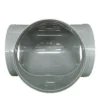


Equal Tee — Three-Way PP and PVC Duct Junction
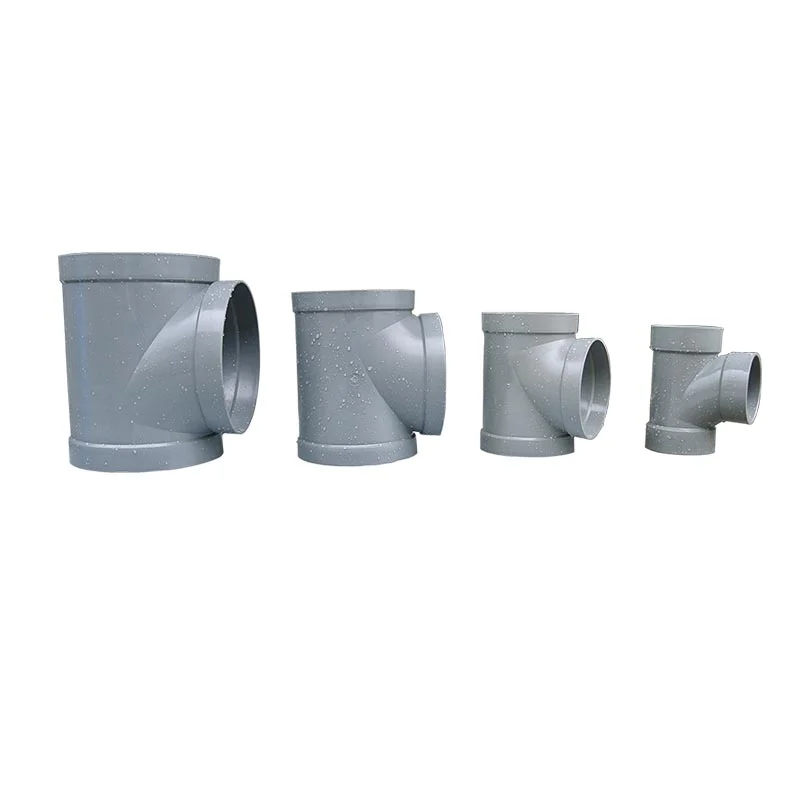
An equal tee splits one exhaust duct into two — or combines two into one — with all three ports sharing the same diameter. It is the most common junction fitting in industrial ventilation, and the one most often taken for granted. Until it fails, and the maintenance team discovers that the original tee was a custom fabrication that no current supplier stocks in that exact configuration.
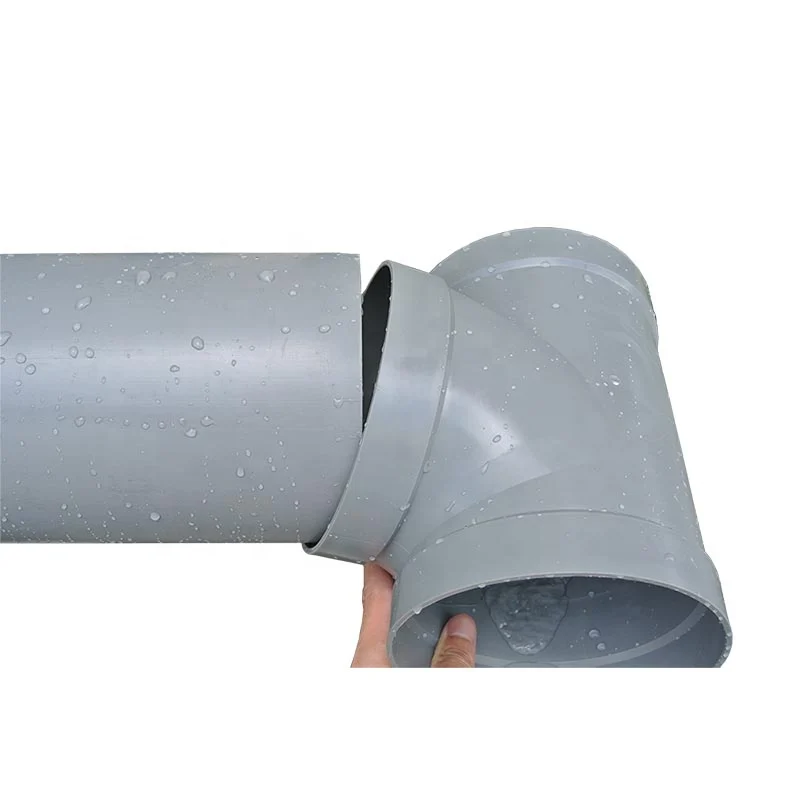
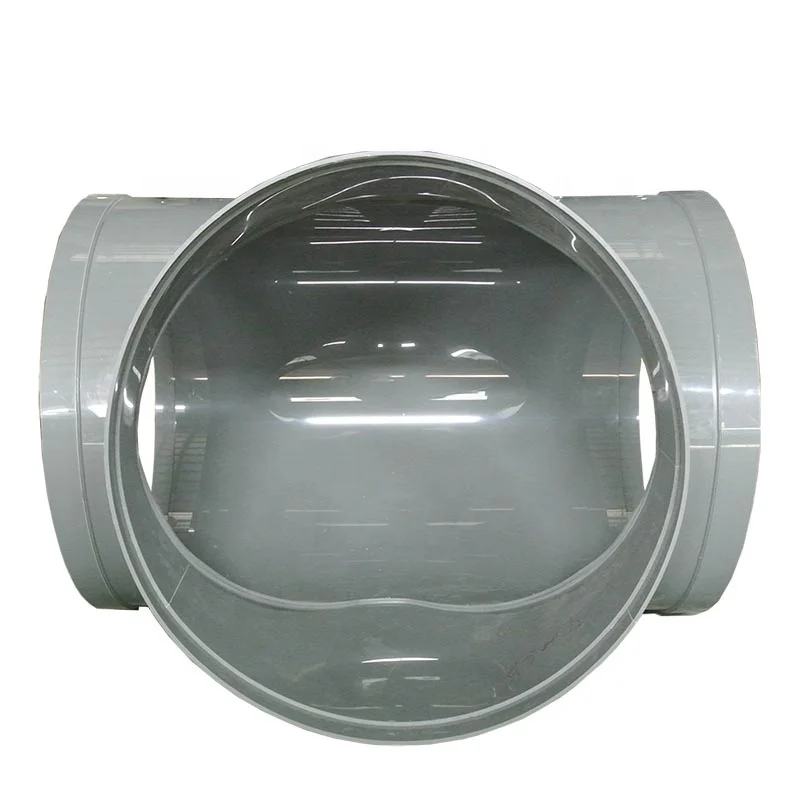
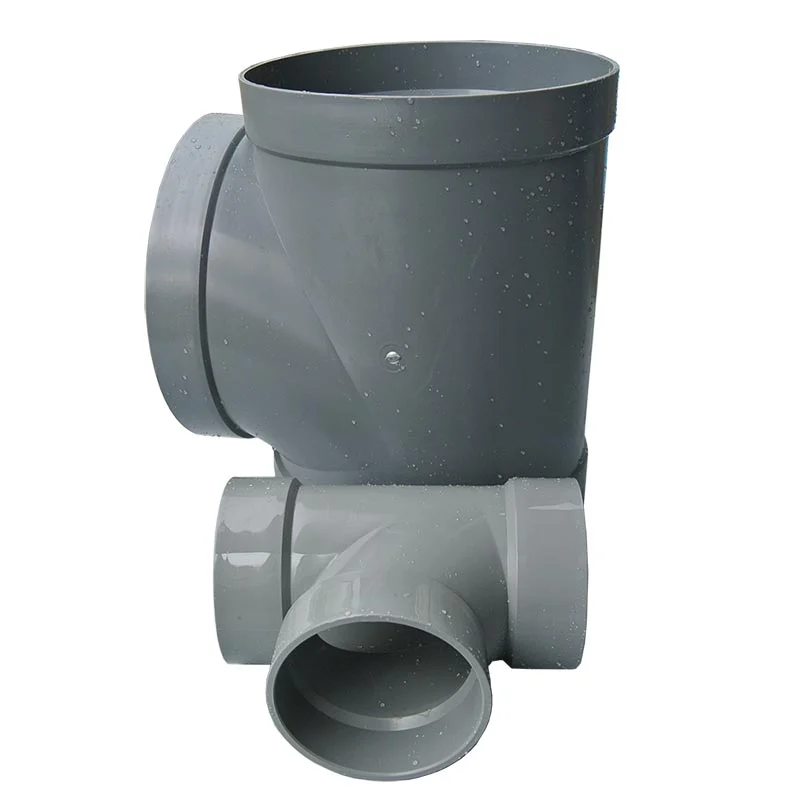
Xicheng manufactures equal tees in polypropylene and PVC. For standard diameters, injection molding produces a single-piece tee with smooth internal bore transitions at both branch intersections — the critical area where turbulence, particulate accumulation, and localized corrosion concentrate in a fabricated fitting. For diameters beyond molding capacity, hand-welded fabrication by PP specialists delivers the same dimensional accuracy with full-penetration joints inspected under ISO 9001.
The Junction Point: Where Flow Dynamics Determine Fitting Lifespan
An equal tee is not aerodynamically neutral. Every tee introduces turbulence at the branch intersection where airflow divides or combines. In a fabricated tee with internal weld beads at the junction, that turbulence interacts with surface irregularities to create localized high-velocity zones that accelerate both particulate erosion and chemical attack.
An injection-molded equal tee eliminates internal discontinuities at the junction. The bore transitions smoothly from the main run into each branch — no weld bead, no surface step, no crevice where corrosive mist condenses and concentrates. For exhaust streams carrying particulate, this smooth internal geometry also reduces the accumulation that occurs at internal projections in fabricated fittings.
The design of the branch intersection also affects pressure drop. A sharp 90-degree branch takeoff — the simplest geometry to fabricate — creates higher turbulence and pressure loss than a radiused transition. Injection-molded tees incorporate a radius at the branch root that hand fabrication can approximate but rarely match in consistency across production batches.
Injection-Molded or Hand-Welded: Matching Process to Application
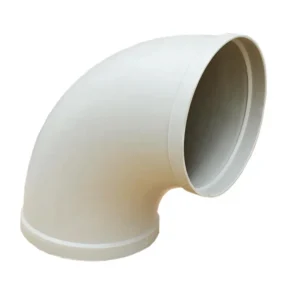
For equal tees in standard diameters, injection molding delivers a fitting with no internal joints at the most hydraulically stressed point in the component. The branch intersection, where turbulence peaks, is as smooth and chemically homogeneous as the straight sections of the main run. For diameters under 500mm, injection-molded duct elbows demonstrate the same single-piece construction applied to a different fitting geometry.
For equal tees in diameters beyond molding capacity, or with non-standard flange configurations, hand-welded fabrication is the practical route. The weld quality standard does not change: full-penetration hot-gas welding with matched-material PP rod, executed by specialists averaging eight years of polypropylene-specific fabrication experience.
The application determines the acceptable risk profile. An equal tee serving a low-consequence branch line with clean chemical vapor at moderate temperature can be reliably produced by either method. An equal tee at the main header junction of a production-critical exhaust system, where failure would require a full line shutdown to access, deserves the manufacturing method with the lowest failure probability.
Technical Specifications
| Parameter | Specification |
|---|---|
| Material | Virgin-grade PP (Polypropylene), PVC |
| Type | Equal tee — all three ports share the same diameter |
| Injection-Molded | Single-piece, smooth internal bore transitions |
| Hand-Welded | Full-penetration, matched-material PP rod |
| Density (PP) | 0.90 to 0.91 g/cm3 |
| Operating Temperature (PP) | -10-degrees-Celsius to 90-degrees-Celsius |
| Operating Temperature (PVC) | 0-degrees-Celsius to 60-degrees-Celsius |
| Connection | Socket weld, butt weld, flanged |
| Certifications | ISO 9001, ISO 14001; SGS tested |
| Custom | Non-standard diameters, flange patterns, branch configurations |
Where Equal Tees Branch and Combine
An electronics manufacturing facility in East Asia operates a multi-line etching exhaust system where each production line’s extraction duct joins a common header through an equal tee. The original fabricated tees accumulated particulate at internal weld beads at the branch intersection, requiring quarterly inspection and periodic cleaning. Replacement with injection-molded PP equal tees eliminated the accumulation sites.
A chemical processing plant in the Middle East uses 400mm equal tees to split a main exhaust header into two parallel scrubber inlet ducts. The flow-splitting application requires matched pressure drop through both branches — a condition that depends on identical internal geometry in both tees. Injection-molded tees, produced from the same steel tooling, provide the dimensional consistency that hand fabrication cannot guarantee across two separate fittings.
A pharmaceutical facility uses equal tees in a laboratory fume hood exhaust network where multiple hood drops join a common riser at each floor level. The smooth internal bore of injection-molded PP tees minimizes the particulate accumulation that would otherwise require access-panel cleaning in a completed ceiling plenum.
Global Compliance and Industrial Trust: Why Customers Choose Xicheng
Every equal tee in an industrial exhaust system is a potential maintenance access point — or a potential failure point. Which one it becomes depends on the manufacturing quality of the fitting and the material’s compatibility with the exhaust chemistry.
Xicheng Environmental operates over 40 production bases and offices across China, with 2 dedicated manufacturing facilities in Vietnam. We maintain inventory of standard injection-molded tees and fabricate custom configurations to order. Every fitting is produced under audited certifications: ISO 9001 for quality management, ISO 14001 for environmental management, and SGS tested for the raw materials that become your duct fittings.
Our engineering team reviews every custom tee order against the application context: exhaust composition, operating temperature, flow rate, and whether the tee splits or combines flow — a distinction that affects the internal flow dynamics at the junction.
One-Stop Engineering Support: From Spec to Shipment
You need an equal tee that matches your duct diameter and flange standard. You need it to arrive on the date you scheduled for installation. You need it to fit.
Here is how Xicheng handles every order:
- Specification Confirmation. Send us the duct diameter, flange standard, and exhaust gas composition. We confirm material compatibility and recommend injection-molded or hand-welded construction.
- Certified Manufacturing. Production under ISO 9001 and ISO 14001. Hand-welded tees receive individual weld inspection at the branch intersection — the highest-stress point in the fitting.
- Complete Documentation. SGS test reports, certificate of origin, packing list, commercial invoice. Container loading photographs before departure. Tracking information the day your shipment leaves.
- Engineering Access. Direct contact with our engineers by phone, email, or WhatsApp. No gatekeepers. No forwarded messages.
Frequently Asked Questions
Q: What is the difference between an equal tee and a reducing tee?
A: An equal tee has all three ports at the same diameter — the main run and the branch are identical. A reducing tee has a branch port smaller than the main run diameter. Use an equal tee when splitting or combining flow between ducts of the same size. Use a reducing tee when the branch line carries less airflow than the main header.
Q: Why choose injection-molded over hand-welded for an equal tee?
A: The branch intersection of an equal tee is the most hydraulically stressed point in the fitting. An injection-molded tee has no internal weld bead at this junction — the transition from main run to branch is a single, smooth surface. This eliminates the particulate accumulation and localized corrosion sites that internal weld beads create. For diameters under 500mm, injection-molded construction provides the lowest failure risk.
Q: Can you produce equal tees with flanged connections?
A: Yes. Tees can be supplied with flanged, socket-weld, or butt-weld connections in any combination. Flanges are available in ANSI, DIN, JIS, or custom bolt patterns.
Q: What is the lead time for equal tees?
A: Standard injection-molded equal tees ship within 5 to 7 working days. Hand-welded tees in standard diameters ship within 7 to 10 working days. Custom diameters or flange configurations require 12 to 18 working days.
Send us your duct diameter, flange standard, and exhaust gas composition. Our engineering team will confirm material compatibility — and you will have a quotation within 48 hours.
Contact Xicheng Environmental Today.
- 🎯 Address: No.34 Zhenxing Road (Shengtaian Heavy Industrial Park B), Loucun, Guangming New Dist, Shenzhen, Guangdong, China
- ☎️ Phone/WhatsApp: +86 18028775826
- 🗺️ Email: xichengepltd@gmail.com
Reviews
There are no reviews yet.