Key Takeaways
1. FRP blowers move corrosive, humid, or chemically loaded air without the rust, pitting, and galvanic corrosion that cut metal fans short.
2. Every part that touches the air stream should be fiberglass — housing, wheel, inlet cone — so the fan, not a coating, does the corrosion protection.
3. Centrifugal FRP blowers handle long duct runs and scrubber duty; axial fiberglass fans move large volumes at low pressure. Match the type to the pressure you actually need.
4. A strong RFQ gives eight numbers — flow, static pressure, temperature, humidity, chemical concentration, spark class, drive, and voltage. Get them right before you ask for a quote.
5. Fibreglass reinforced plastic keeps its chemistry even when scratched, so service life in acid or salt service routinely exceeds stainless steel at a fraction of the purchase price.
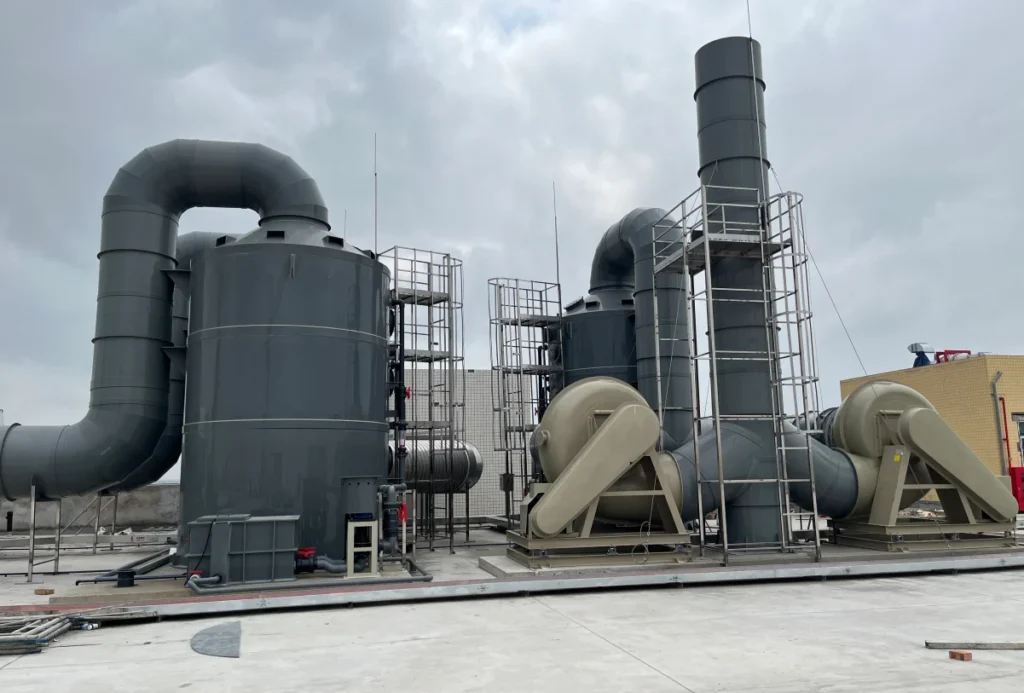
FRP blowers are industrial air-moving systems built from fiberglass reinforced plastic instead of steel, stainless steel, or coated carbon steel. A fiberglass fan shrugs off chemicals that quickly eat a metal fan: hydrochloric acid mist from a plating line, hydrogen sulfide in a wastewater plant, chlorine off-gas, caustic fumes from a chemical reactor. Because the whole wetted section — housing, wheel, inlet cone, outlet — is molded in composite, an FRP blower offers corrosion resistance in every square centimeter of the air path, not just on a painted surface.
Engineers reach for frp blowers when either the air or the surrounding atmosphere will attack metal. Concrete signs: corrosion that appears on galvanized ductwork, rust streaks on a carbon steel fan housing after six months, pitting on a metal impeller, or unplanned fan replacements that keep landing in the maintenance budget. In the field the decision is rarely “should we buy FRP?” so much as “which FRP blower, and which resin system, fits this gas stream?” That is the question this guide answers, from material basics to the eight points a good RFQ should carry.
This guide covers what FRP is, why corrosion resistant fiberglass outperforms metal in aggressive service, the main types of fiberglass fans and blowers, how to read a fan curve when selecting one, the industries that use them, and what to verify when sourcing from a Chinese manufacturer. If you are evaluating pricing from India or regional fabricators, the same selection logic applies — the difference that matters is wet-side engineering, certification, and how the supplier proves performance on paper.
What Is an FRP Blower?
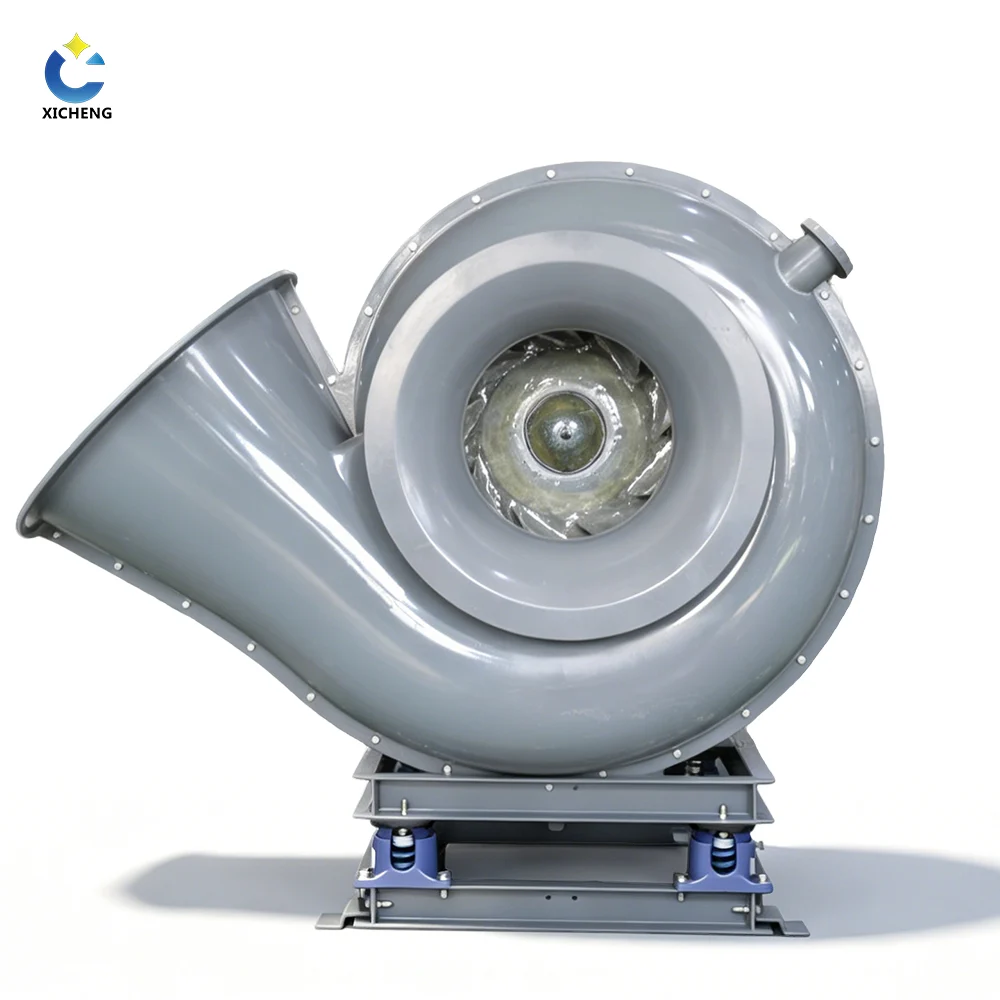
An FRP blower is a fan whose structural parts are built from fiberglass reinforced plastic, a composite of glass fibres and thermoset resin. The resin family decides how the fan behaves in chemistry and heat. Polyester resins are economical and suit mild fume duty. Vinyl ester resins, made from epoxy novolac chemistry, resist acids, bases, and solvents much longer and tolerate slightly higher temperature peaks. Epoxy systems appear less often in fans, mainly in specialist roles. For a fiberglass fan in acid or salt service, vinyl ester is the default recommendation and the reason most suppliers quote “vinyl ester FRP” rather than a generic grade.
Lay-up matters as much as the resin. A production FRP fan is built in layers: a corrosion-resistant surface called the veil, a resin-rich chemical barrier, reinforced glass mat and woven roving for strength, and an exterior binder coat. The process is labor-driven and hand-routed, which is why frp air blowers are made by fabricators who control wet lay-up, not by sheet metal shops. Quality signals on the shop floor are consistent thickness control, proper cure, and resin that does not leave exposed glass in the airstream.
Because the material is molded, an FRP blower housing and impeller arrive as clean composite shapes with no welded seams — one more reason corrosion starts later than it does in a fabricated metal fan. The trade-off is weight and rigidity: fiberglass is about a third the weight-density of steel but less stiff, so FRP blowers carry heavier-duty bearing supports and a more careful balance spec than an equivalent carbon steel fan.
Why FRP Wins Where Metal Fails
Metal fans fail in corrosive air for mechanical reasons, not just cosmetic ones. Uniform corrosion thins the housing until it leaks. Pitting attacks stainless steel at inclusions and dents, and in chlorides it can tunnel through a 316L wheel in months. Stress corrosion cracking snaps shafts and blade attachments. Galvanic couples between dissimilar metals — a steel shaft in an aluminum hub, for example — accelerate failure right at the joints. Each mode ends the same way: unscheduled downtime, contaminated process air, and a replacement bill that resets the maintenance budget.
A non-metallic, non-sparking construction
An FRP fan removes the metal from the air path entirely. Housing, wheel, and inlet are composite; metallic hardware that must remain — shafts, fasteners, motor — is isolated behind the housing rather than washed by the gas stream. That design has a safety payoff as well as a longevity one. FRP blowers are non-sparking in the airstream and can be produced with conductive veil systems and grounded construction to control static build-up in volatile atmospheres, an option worth flagging whenever the exhaust carries solvents or flammable concentrations.
Service life is the headline number. Fiberglass is chemically inert to the media that corrode steel, so performance holds for years in acid fume, salt spray, humidity, and H2S service. Buyers often compare an FRP blower against a stainless blower on paper, but the composite wins twice: it resists a broader range of chemicals — including the chloride levels that pit stainless — and it costs a fraction of the 304/316 build.
FRP vs metal at a glance
| Attribute | FRP blower | 304/316 stainless | Coated carbon steel |
|---|---|---|---|
| Chemical resistance | Excellent, whole-body | Good, but pitting in Cl⁻ | Depends on coating integrity |
| Corrosion after a scratch | Chemistry unchanged | Local attack begins | Coating breached → rust |
| Non-sparking airstream | Yes | Yes | Yes |
| Weight | Light | Heavy | Heavy |
| Temperature limit | ~120 °C (250 °F) | Very high | High |
| Relative purchase cost | Low-moderate | 2–4× FRP | Lowest |
| Typical service life in acid fume | Longest | Long but at a premium | Short unless recoated |
The table assumes clean engineering on both sides. In wet, chloride-rich, or constantly humid streams — where coatings eventually fail and stainless pits — FRP is the material that keeps a fan running between scheduled overhauls rather than between emergency call-outs.
Types of FRP Blowers
FRP fans and blowers come in two aerodynamic families — centrifugal and axial — and in several mounting configurations. The family is dictated by the pressure the system needs, not by preference.
Centrifugal FRP blowers
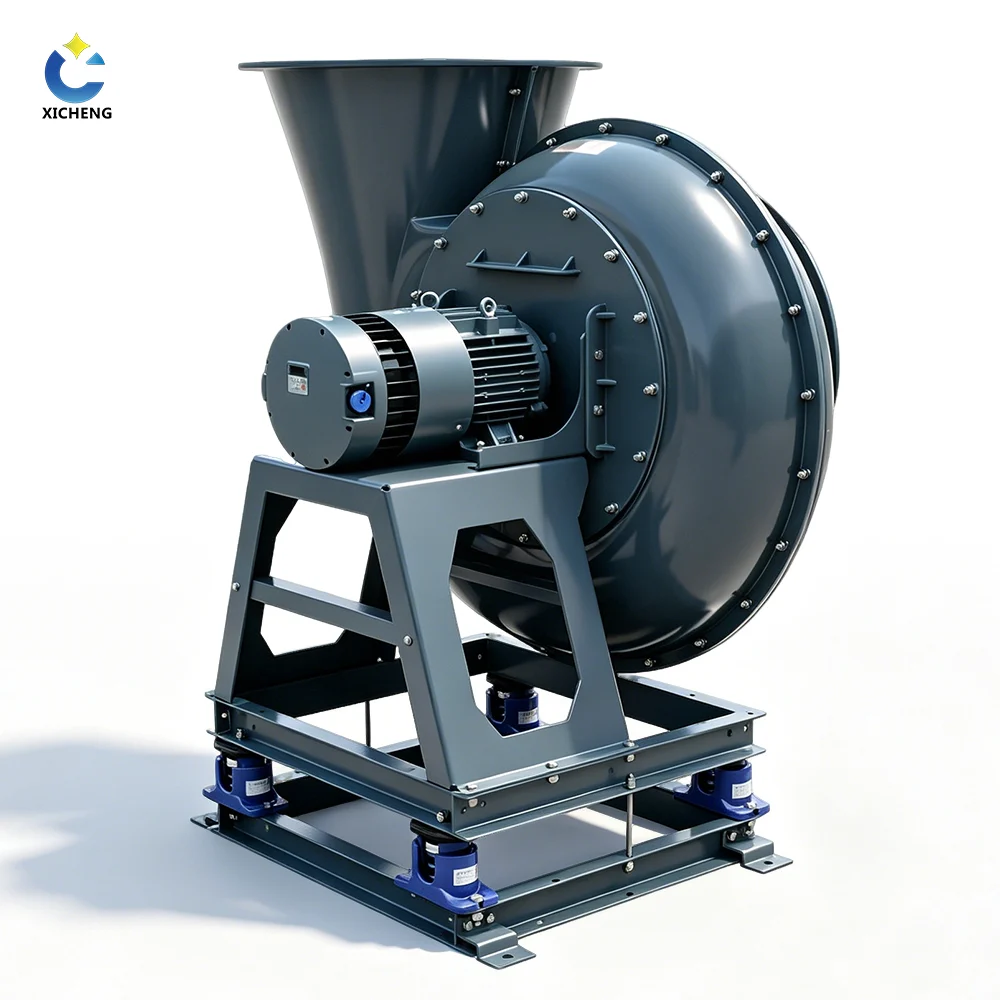
A centrifugal fan draws air in through the inlet cone, spins it outward through a curved impeller, and discharges it at right angles to the intake at elevated pressure. This is the workhorse of industrial exhaust because it overcomes the resistance of long duct runs, dampers, elbows, and scrubber packing. Backward-inclined wheels run at higher speed, draw less power at high flow, and are the efficient first choice for general fume duty. Radial-blade FRP impellers are heavier and slower but hold pressure stability and resist material build-up, which makes them the standard for pressure blowers and particulate-laden streams. When a buyer asks for “frp centrifugal blower,” one of these two wheel designs is usually what they need.
FRP pressure blowers
When a process needs high static pressure at a modest flow rate — tall stacks, scrubber media columns, pneumatic assist, or a restricted pickup — a dedicated FRP pressure blower with a radial wheel delivers stable, pulsation-free output. Pressure ratings run from low-single-digit inches of water column into the high-pressure range where a standard backward-inclined fan would stall.
Axial FRP fans
Axial fans push air parallel to the shaft. They deliver very high flow at very low pressure and suit wall ventilation, cooling, and short-path exhaust. They cannot overcome dense packing or long runs, so the choice between axial and centrifugal is really a choice between moving lots of air cheaply and pushing air through resistance.
Mounting families
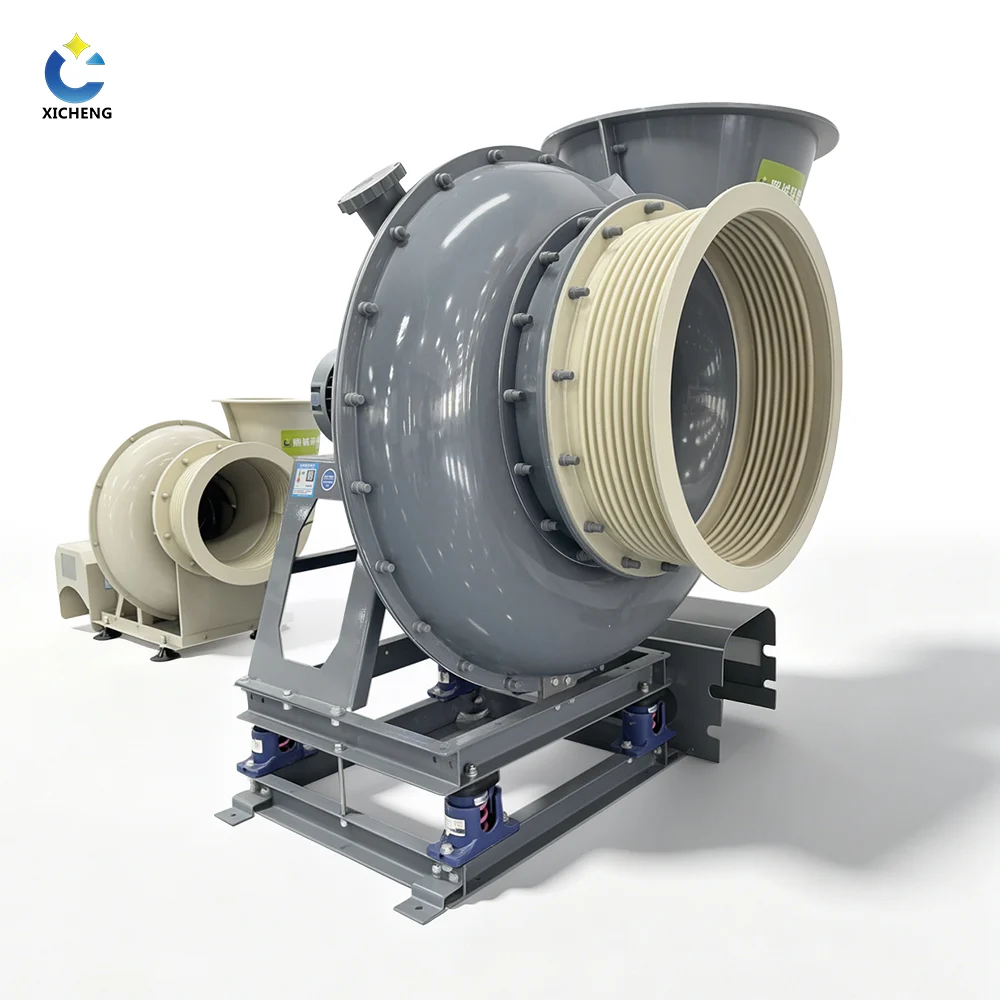
The same wheel serves different building layouts. Inline centrifugal units mount directly in ductwork for confined spaces. Wall and roof exhausters hug the building envelope, upblast versions throw the discharge away from workers and roof membranes, and tube-axial fans fill open plenums. All share the same wetted-side FRP construction.
| FRP type | Typical airflow | Typical static pressure | Best for |
|---|---|---|---|
| Backward-inclined centrifugal | Up to ~120,000 CFM | 1–30 in w.g. | Long duct runs, scrubbers, general fume |
| Radial-blade / pressure blower | Low–moderate | High, up to 30+ in w.g. | Tall stacks, dense packing, corrosive gases at pressure |
| Axial (tube, panel, wall) | Very high | 0.5–4.5 in w.g. | Large volumes, low resistance, envelope exhaust |
| Inline centrifugal | Moderate–high | 1–12 in w.g. | Confined runs inside ductwork |
FRP Blower Performance & Specs
Designing with the fan curve
Every FRP blower ships with a performance curve — flow against static pressure at a given speed. The point where that curve crosses the system resistance curve is the operating point, and it must sit inside the stable region of the fan. Buying on nameplate CFM alone ignores the ductwork between the fan and the process: a long run, dampers, filters, or a wet scrubber can double the pressure the fan must produce, and a fan selected without that number moves less air than the tag suggests. A reputable supplier selects on volume plus required static pressure and validates the point on the actual curve.
Wheel choice shows in the curve shape. A backward-inclined FRP wheel produces a curve that rises to a stable peak and then decays, with a non-overloading horsepower characteristic — airflow can climb without the motor loading itself up. Radial-blade pressure blowers hold a flatter curve across a wider flow band and tolerate heavier dust or build-up, at the cost of lower efficiency. When the system resistance guess is risky, the flatter curve is the safer bet; when efficiency dominates the decision, the backward-inclined curve wins. A supplier that prints the curve next to your duty point is also showing confidence that it can be met.
RPM and drive options
Direct-drive FRP blowers run the wheel on the motor shaft; belt-driven units use adjustable pulleys so the operating point can be tuned after installation without re-motoring. Belt drive carries a small efficiency penalty and adds belt maintenance, but the field-adjustable speed is often worth it when duct dynamics are uncertain. For rotating equipment this drive choice also affects bearing and balancing spec, and it is one of the points a good supplier walks through during selection rather than after the sale. Where energy cost dominates the running bill, a permanent-magnet drive fan delivers the same duty on markedly less power.
Temperature and chemical limits
FRP has a temperature ceiling shared across the family: roughly 120 °C (250 °F) for standard vinyl ester. Hotter streams push engineers toward polypropylene for mild duty or metal alloys for high temperature. Within the safe band, the resin and veil class decide chemical compatibility — vinyl ester resists the acid/base attack that defeats polyester, and the surface veil is the layer that keeps fibres from wicking gases into the wall. Fire-retardant resin systems and conductive veils are available for systems where code or explosion risk demands them.
Where FRP Blowers Work Best
Fiberglass exhaust fans are the default moving element wherever the air takes on chemistry. The industries with the longest FRP track record share one trait: corrosive, humid, or chemically loaded air that punishes metal over a two- or three-year horizon. Understanding the pattern matters more than memorizing a list — if a plant has aggressive gas streams, an FRP blower is usually on the specification.
Chemical and acid fume exhaust
Chemical plants, plating shops, anodizing lines, and acid pickling operations run acids and oxidizers into ventilation ducts daily. HCl mist from degreasing, chromic acid from anodizing, mixed acid fume from pickling — each attacks carbon steel immediately and stainless in chloride service — which is why these lines historically specify an FRP exhaust fan for the fume hood and duct connection.
Scrubber and waste-gas systems
A gas scrubber depends on fan pressure to pull or push dirty gas through packing, and the fan lives inside the same corrosive envelope as the tower. FRP blowers are the standard prime movers for wet scrubbers in this configuration: the fan creates negative pressure at the scrubber inlet and moves cleaned gas to the stack. The physics of that loop — system resistance, static pressure, and where the fan sits relative to the media — is covered in detail in our guide to gas scrubbing, in the overview of VOC control systems, and in the dedicated look at chemical waste gas treatment, and solvent or odour loads are handled by a carbon adsorption box fed by the same fan.
Lab and cleanroom ventilation
Laboratory fume-hood exhaust and cleanroom acid waste ventilation move small volumes at low-to-moderate pressure but with constant chemical exposure and a zero-tolerance safety envelope. FRP is favored here both for corrosion resistance and for the non-sparking, low-leak construction that supports lab air-change requirements.
Supporting industries drawn from the same logic include wastewater treatment and odor-control plants, pulp and paper, fertilizer, pharmaceutical fume duty, semiconductor tool exhaust, and indoor pool ventilation. If your process resembles any of these, and the airstream can attack metal, the material decision has already answered itself.
On the regulatory side, ventilation of acid, solvent, and fume sources traces to the occupational local-exhaust rules in OSHA 29 CFR 1910.94, and corrosion-resistant FRP blowers are the conventional compliance choice for such systems because the duct and fan keep working inside the corrosive envelope for the plant’s life.
How to Choose: 8 Parameters Before You Send an RFQ
A useful frp blower quotation starts with eight numbers. Sending “one exhaust fan for acid fumes” produces a brochure, not a fan; carrying the full set produces a selection an engineer can check against a curve. The eight-point checklist below is what competent suppliers ask for before they quote.
The 8-number RFQ checklist
| # | Parameter | What it decides |
|---|---|---|
| 1 | Required airflow (CFM / m³/h) | Fan size and family |
| 2 | Required static pressure (in w.g. / Pa) | Wheel type, speed, motor power |
| 3 | Gas temperature | Resin system; boundary beyond ~120 °C |
| 4 | Humidity / condensation | Resin and drain provisions |
| 5 | Chemical composition & concentration | Resin class, veil, hardware material |
| 6 | Spark class / explosion risk | Conductive veil, grounding, motor class |
| 7 | Drive: direct or belt | Speed tuning and maintenance |
| 8 | Voltage / phase / Hz | Motor and starter package |
Two lazy answers defeat the list. “Just give me 20,000 CFM” without a static pressure number leaves the supplier guessing at the wheel and the drive. And “chemicals — you know, the usual ones” cannot be engineered; a concentration difference of a few hundred ppm can shift the recommended resin from polyester to vinyl ester.
Resin, veil and grounding options
With the eight numbers in hand, the supplier configures the build. Polyester suits mild duty at the lowest cost; vinyl ester is the default for acids, bases, and aggressive humidity. A Nexus or C-glass veil forms the chemical barrier that keeps fibres out of the gas stream. Conductive veils plus shaft grounding buy static dissipation where solvents or dust are present. Fire-retardant resin systems are available where local code or process risk requires a lower flame-spread surface. Each option moves the price, so specify it deliberately instead of accepting whatever the quote body says.
Buying FRP Blowers from China
China is a major source of fiberglass fan supply for exporters in Southeast Asia, the Middle East, Africa, and Latin America. The economics are real: composite fabrication is labor-intensive, and Chinese FRP shops quote substantially below U.S. or European catalog houses while delivering the same vinyl ester construction. What separates a good Chinese FRP blower supply relationship from a risky one is not the price on the proforma — it is engineering verification and wet-side discipline.
Why a China exporter works for FRP
Because the material is hand-laid, a Chinese manufacturer with controlled lay-up, cured resin, and balancing rigor can reproduce the same wheel geometry and performance that a Western brand sells at a premium. Buyers who source direct should expect: a selection sheet with a performance curve matching their RFQ numbers, the resin and veil grade stated by name, a weight balance report on the wheel, a test-run record on the blower, and export packaging for the motor and accessories. These are normal exports of a well-run shop, not concessions.
What to verify before import
Verify performance in writing before you commit: the supplier should stand behind their curve and offer a test run at the specified duty point. Confirm certifications that matter in your market — CE for European-facing projects, ATEX or the local equivalent where atmospheres are hazardous, and any structural standard referenced in your specification. Agree on the motor brand, voltage, and phase before the quote is final, because motor rework after arrival is the most common reason an imported FRP blower stalls at commissioning. Finally, pin down MOQ, lead time, and incoterm: composite fans ship as volumetric cargo, so freight is a real line item in the landed cost.
How a supplier proves the fan meets its curve
Performance claims on a datasheet are free; proof is a shop record. A disciplined fibreglass shop documents the impeller balance grade, runs the assembled blower at the design duty, and records motor amps, airflow, and static pressure achieved on the test rig. That documented run is the difference between buying a fabricated part and buying an engineered FRP blower. Ask for it the same week you ask for the price — a factory that already tests will send the record without negotiation, and a factory that does not will show up when asked.
Rough guides on the supply side: most industrial FRP blower builds land between four and ten weeks for a new tooling-free size, and small-to-medium fans tolerate container shipment without special crate design. A manufacturer that answers the eight RFQ numbers with a curve instead of a price-only reply is the one worth the conversation.
FRP Blower FAQ
How long do FRP blowers last compared with stainless steel?
FRP blowers routinely outlive stainless blowers in aggressive chemical exposure. Stainless handles many acids well but pits and stress-cracks in chlorides; the composite matrix of an FRP blower resists a broader chemical band with minimal degradation, and it fights on even after a surface scratch. Actual life depends on gas chemistry, temperature, and maintenance, but in acid or salt fume service a ten-year-plus run on FRP is common. If you are comparing on total cost of ownership, include both the purchase premium and the replacement interval.
Are FRP blowers explosion-proof?
No fiberglass fan is automatically explosion-proof. FRP blowers are non-sparking in the airstream, and a conductive veil system with grounded construction can control static build-up — the option to specify when the exhaust carries solvents. True explosion-proof rating comes from the motor and electrical package, which must be specified to the hazard class of the location. Tell the supplier the zone and gas group; do not assume the fan body alone buys the rating.
What is the maximum temperature for an FRP blower?
Standard vinyl ester FRP blowers run to roughly 120 °C (250 °F). Beyond that ceiling the options are polypropylene for mild chemistry or metal alloys for hot duty — an FRP blower is not the right tool above its resin class. Within the safe band, the resin and veil selection, not the fan model, governs what chemical duty the blower can hold at that temperature.
What is the difference between FRP and PP blowers?
FRP blowers are fiberglass reinforced plastic — composite, cured, and rigid — and suit larger sizes, higher pressure, and wider chemical duty. PP (polypropylene) blowers are welded thermoplastic, lighter and cheaper for small corrosive fume jobs, but they sag near ~80 °C and are harder to stiffen for big wheels. Lines that process hot acid or solvents typically settle on FRP; laboratories and smaller fume benches often choose PP blowers for economy. We cover both materials and their trade-offs in the FRP-vs-PP selection article.
Do I need a centrifugal or an axial FRP blower?
Centrifugal FRP blowers generate pressure and push air through ductwork, dampers, and scrubber packing; axial fiberglass fans move very large volumes at low pressure. Choose centrifugal when the duct run is long or the system has real resistance — the majority of industrial exhaust cases — and axial when you are ventilating a space that asks for air volume rather than pressure. Your static pressure number from the RFQ checklist answers the question faster than a size guess.
Can FRP blowers be customized, and what is the lead time?
Yes — composite construction is naturally customizable. Motor duty, drive, housing orientation (inlet angle and discharge position), flange pattern, resin class, veil, and balancing grade can all be specified on an FRP blower build. Typical lead time for a new size is four to ten weeks depending on the wheel and the shop load. Supply your eight RFQ numbers and a reasonable target date; a manufacturer that replies with a performance curve and a build sheet is in a position to deliver on both.
Selecting an FRP blower is a material and mechanical decision once the chemistry is known. The wet-side builds — vinyl ester, veil, non-sparking construction, pressure capacity — determine whether the fan runs for years or fails in a season. For a corrosive-air project, a fiberglass fan selected on real numbers is one of the most reliable pieces of rotating equipment a plant can install.
If you are evaluating a specification or an existing quote, start with the eight RFQ numbers above and ask the supplier for a curve, a build sheet, and a test record. Xicheng manufactures FRP blowers and PP blowers for fume, scrubber, and process exhaust duty, and our corrosion-resistant fan range is built around the same wetted-side engineering described here. Review the FRP blowers product page or the PP blower range inside the PP-FRP blower category, or contact our engineers with your eight numbers to get a selection matched to your gas stream.