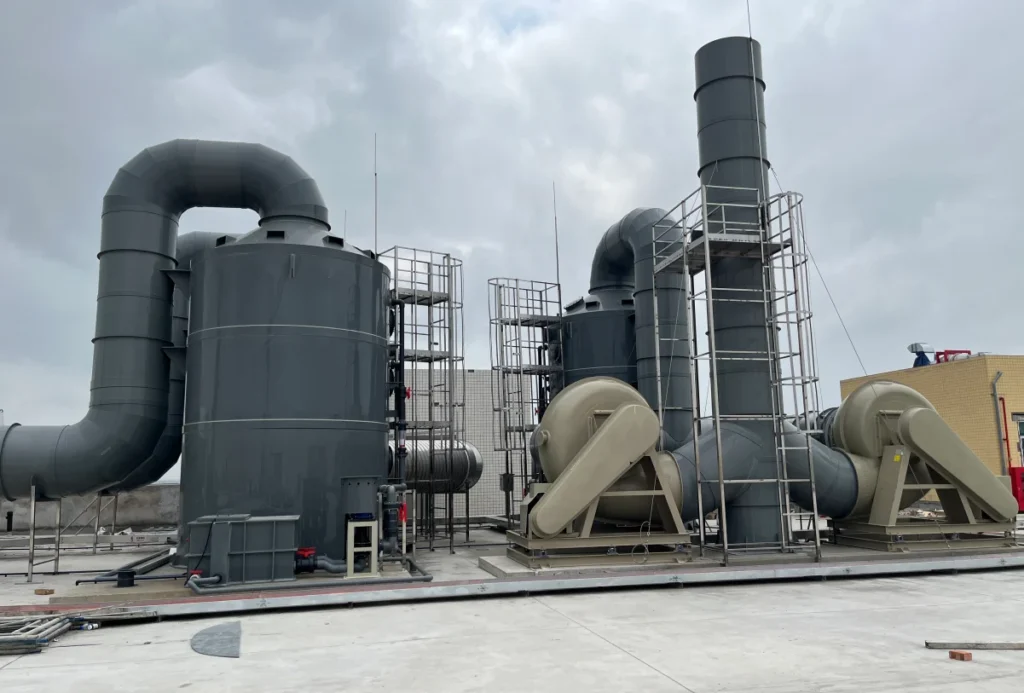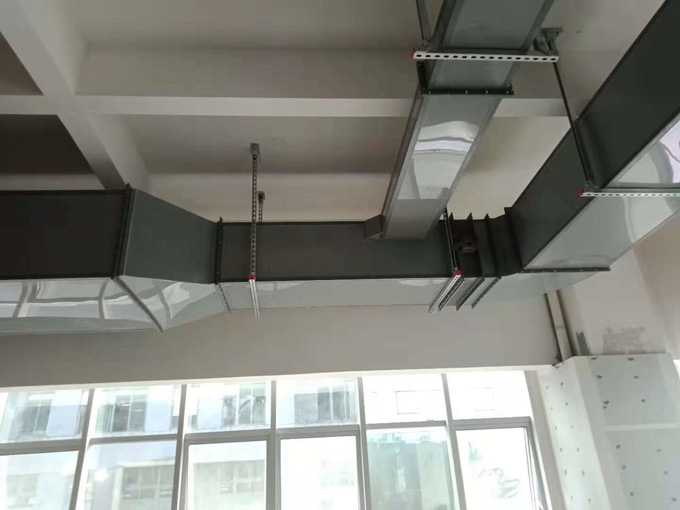
PP duct fabrication is not a side detail of a ventilation project; it is a production decision that defines the product. Polypropylene duct is made by two routes: diameters up to 400 mm are moulded as a single seamless piece, and diameters above 400 mm are fabricated — sheet cut, rolled or folded, and welded along the seam. The difference is visible in one place: a moulded section has no longitudinal weld, a fabricated section has one. This guide covers both routes, with the fabrication detail that applies once a run moves above the 400 mm cutover.
Key Takeaways
- PP duct is made by two routes, not one. Up to 400 mm in diameter, a section is moulded as a single seamless piece with no longitudinal weld; above 400 mm it is fabricated from sheet and welded. The seamless moulded range is a real quality advantage — no weld means no seam to leak or crack.
- Square and rectangular duct are made from V-grooved sheet, not from welded corners. A router cuts a controlled groove along the fold line so the sheet bends into a clean 90° corner, and the corner lip is then welded. Round duct above the moulded range is rolled and welded along its seam.
- The groove, the seam and the flange are the three quality checkpoints in fabrication. A groove cut too deep cracks the outer skin; a seam weld that is cold or undercut leaks; a flange that is not square pulls the whole run out of line.
- A shop adds value through tolerances and documentation. A fabricator with real PP welding skill holds section straightness and end-squareness, welds to the DVS 2207 family, and leak-tests before crating. A price-only quote usually means none of the three.
- Send a drawing or an airflow figure, not a wish. A maker sizes the section, wall and flange from your airflow and route. The drawing you approve is the contract — measure the as-built system against it before it leaves the shop.
How PP Duct Is Made: Moulded Up to 400, Fabricated Above
The first question to ask about any PP duct supplier is which of the two manufacturing routes they can actually run. At Xicheng both are in-house. Below 400 mm the section is a single moulded piece: no sheet, no seam, no welding — the duct is formed whole, so the only joints in a small run are the flange joints between sections. Above 400 mm the diameter is too large to mould economically, and the section is fabricated from PP sheet using the cutting, grooving, rolling, welding and flanging sequence described below.
Seamless Moulded Duct (Up to 400 mm)
For ducts up to 400 mm in diameter, a one-piece moulded section is stronger in the one place a fabricated section is weakest: the longitudinal seam does not exist. There is no seam to leak, no weld to crack under thermal cycling, and no reduction in wall at a hand-made joint. This is why seamless construction is specified wherever leak-tightness and long service life are the first priorities — laboratory exhaust, semiconductor process exhaust and clean air handling.
Fabricated Duct (Above 400 mm)
Above 400 mm the moulded route stops being economical, and sections are fabricated from sheet: the sheet is cut to a developed layout, grooved or rolled into shape, welded along the longitudinal seam, fitted with flanges, and shop-tested. Everything in the rest of this guide applies to this route. The seam here is load-bearing — it is the longest weld on the part, and it is where fabrication quality is judged.
Why Fabrication Decides the Duct
Fabrication also inherits decisions made upstream, and two of them change the shop’s work directly: the grade the duct is made from, and whether the service requires a flame-retardant one. A fabricator working to a stated grade rather than to a generic “polypropylene” is working to a different material than one who is not, and the sheet a flame-retardant duct is cut from has a different welding window. What the grades are is set out in our guide to what a PP duct is, how the choice sits against PVC in our guide to PP duct vs PVC duct, and what the flame-retardant requirement adds in our guide to flame retardant PP duct.
Above the moulded range, a polypropylene duct system is an assembly of fabricated sections, which is the real subject of pp duct fabrication: converting sheet into pressure-tight, dimensionally true ductwork. There is no such thing as an off-the-shelf fabricated PP duct the way there is for steel spiral duct — every section begins as sheet and is converted into a duct by a sequence of shop operations. The moulded range carries the same truth in reverse: choosing a seam-free product where the diameter allows it is a design decision, not a default.
The Input: PP Sheet and Grades
Fabrication above 400 mm starts with the material, and not every PP sheet is duct-grade. In pp duct fabrication the sheet is the feedstock, and its properties carry straight through to the finished part. Duct fabrication uses homopolymer polypropylene sheet (PP-H) in solid or twin-wall form, supplied in thicknesses that match the duct size: typically 6 mm and above as the diameter climbs. How that sheet is itself produced is covered in our how polypropylene sheet is made guide, and the grade-and-limits discussion is in our polypropylene duct guide.
Three sheet properties matter most to a fabricator:
- Thickness uniformity. A specification is written for a nominal wall; a sheet that varies drives weld gaps, flange seal problems and weight that does not match the calculation.
- Weldability. The sheet must weld with its own rod to a joint that holds 80–95% of parent strength. Low-quality or heavily recycled sheet welds poorly and bubbles at the seam.
- Flatness and stress state. Residual stress in the sheet shows up when it is rolled or folded — a springy sheet fights the shape and pulls the weld.
From Drawing to Cut
Every fabricated section begins as a cutting layout derived from a drawing — the geometry step where pp duct fabrication locks in fit. For round duct the flat layout is a rectangle whose width is the circumference plus a seam allowance, and whose length is the section length. For square and rectangular duct the development is a flat grid of faces separated by the fold lines.
This is where fabrication accuracy is decided. If the developed width is short, the section is undersized and the welder is forced to close a gap; if the end faces are not square on the drawing, nothing corrects it later. A competent shop checks the fabrication drawing against the route and the flange faces before any sheet is cut, because errors at this stage are the most expensive kind.
| Operation | What it produces | The failure it silently introduces |
|---|---|---|
| Development & cutting layout | The flat shapes and fold lines that become the section | Undersized or un-square parts that no later step corrects |
| Cutting & grooving | Face sheet plus the V-grooves that make corners | Groove too deep cracks the outer skin; too shallow forces the fold |
| Folding / rolling | The open or tubular pre-form | Unrestrained PP relaxes and opens the seam at the corner |
| Seam welding | The pressure-tight, continuous joint | Cold welds, fish-eyes and undersized beads that leak under test |
| Flanging & stiffening | Connections and reinforcement | Out-of-square flanges that pull every downstream joint out of line |
| Shop test | Proof the section holds the design airtightness | No test record means an untested weld shipped to site |
Cutting and Grooving
PP sheet is cut with a panel saw, a shear or a CNC router, and router work is how square duct earns its clean corners — one of the sharper skills in pp duct fabrication. For a square or rectangular section, the fabricator routes a V-groove along each fold line on the inside face. The groove is cut to a controlled depth near the sheet thickness, leaving a thin outer skin. When the two faces of the groove close, the skin acts as the hinge, the outer corner keeps its radius, and the inside corner becomes a sharp, easily welded lip.
Groove depth and geometry are a quality checkpoint because they are invisible in the finished duct. A groove too deep cracks the outer skin — a hairline crack that later propagates under thermal cycling. A groove too shallow forces the fold and stresses the corner. Both are cheap at cutting time and expensive later, which is why good fabrication looks for corner quality, not just flat-sheet quality.
Making Square and Rectangular Duct
Once the sheet is grooved, the section is folded on a brake or bending table — the step in pp duct fabrication where squareness is actually won or lost. The fold brings the groove faces together; the inside corner lip is then welded closed, and the longitudinal corner welds complete the box. The rectangle is held true while it cools, because PP relaxes after folding and a part that is not restrained leaves the corner open at the seam.
For larger rectangular duct, fabrication adds gussets or corner stiffeners to keep the face from oil-canning under fan start-up and thermal movement. The geometry of the section follows the size rules in our PP duct size and thickness guide.
Making Round Duct
Above 400 mm, round duct is formed by rolling the developed sheet into a cylinder — the forming operation that sets the quality of pp duct fabrication for large circular runs. The two long edges overlap by a seam allowance, and the overlap is welded along the full length with an extrusion weld — the seam is the longest single weld on the part and the one that governs leak-tightness. After welding, both ends are trimmed square to the axis so that the flanges and the adjacent section mate true.
The points where fabricated round duct and flanges interface are covered in our PP duct fittings and PP duct design and sizing guides; the seam weld itself — temperature, rod and passes — is the craft documented in our PP duct welding guide.
Welding the Seam
Welding is where sheet becomes a duct, and the process quality decides everything downstream — which is why the welding section of pp duct fabrication gets the most attention in a shop. The longitudinal seam and the corner joints must be continuous, fused, and free of cold spots and voids. The numbers that govern a good weld — the 165 °C melt line, the 300–325 °C gun setting, the 200–260 °C joint temperature, and the 80–95% weld factor — are covered in full in our PP duct welding guide. In fabrication, the same rules apply with two shop-specific additions: the seam is long enough that consistent travel speed matters, and the weld is made before flanging so the operator has access to the joint.
Flanging, Reinforcing and Specialty Construction
After the section is welded, it is fitted with the connections and stiffening that make it a usable part — the finishing stage of pp duct fabrication. A duct flange is a ring of PP sheet welded around the end, drilled for bolts; its straightness and squareness determine whether site joints mate without strain. Reinforcing rings or tie bars are added on large diameter or high negative-pressure runs to stop the section collapsing under fan-induced static pressure.
Beyond solid-wall construction, twin-wall PP duct is fabricated in two concentric skins with an air gap, giving better condensation control and stiffness for the same structural weight — the same family of construction but a different fabrication sequence, and a higher skill bar at the end closures.
Shop QC: Tolerances, Weld Inspection and Leak Testing
Shop QC matters more on a laboratory exhaust duct than on most process work, because the duct is the containment path for a stream that would otherwise be released into an occupied room, and the tolerances that decide a fit in a ceiling void are the same ones that decide whether a joint seals. What a laboratory exhaust duct has to satisfy, and what the code requires of it, is set out in our guides to laboratory exhaust duct and chemical fume exhaust duct.
A smart buyer treats the QC gate in pp duct fabrication as part of the price. A fabricated PP duct should arrive with the following checks completed, and a buyer is entitled to ask for the records:
- Dimensional check against the approved drawing: internal dimensions, wall thickness, section length, flange bolt pattern.
- End squareness — a flange that is welded out of square drives every downstream joint out of alignment.
- Weld inspection — visual check for cold welds, fish-eyes and voids on every seam, plus a destructive sample or bend test on production welds.
- Leak test — the section is pressure-tested against the design airtightness class before crating, not after the whole run is installed.
From the Factory to the Site
Fabricated sections are crated and shipped as individual pieces — round and rectangular sections, elbows, tees, reducers, transitions and flange faces — and joined on site. That division of labour is why the drawing is a contract: the pieces must fit each other and the drop-in points specified in advance. How those pieces are lifted, supported and joined on site is covered in our PP duct installation guide, and the comparison of a PP system against metal or fibre-reinforced duct is in our galvanized and FRP comparison guides.
What to Send a Custom PP Duct Maker
Custom ductwork — moulded below 400 mm, fabricated above — starts with the right handoff. A maker does not need a finished drawing to start, but does need one of the following, and the more specific the better:
- The airflow and route. Airflow (m³/h or cfm), gas temperature, the contaminants, and the physical route with lengths and bend positions. From this a maker sizes diameter, wall, fittings, and chooses the moulded or fabricated route.
- A 2D or 3D drawing. If you have a layout, send it; the maker fits flanges, transitions and support points to your geometry.
- Your specification boundaries. Airtightness class, pressure, temperature, chemical duty, any code requirement. These decide wall, twin-wall choice and flange rating.
For factory-documented sections from the plant that both moulds its seamless range and welds its own sheet, our industrial polypropylene duct customization and square polypropylene duct customization pages show the level of documentation a duct section should carry, across the full industrial ductwork range.
Frequently Asked Questions
Q: Is all PP duct welded from sheet?
A: No. Up to 400 mm in diameter, one-piece moulded duct is made without any longitudinal seam; above 400 mm, sections are fabricated by rolling or folding sheet and welding the seam. The moulded range is seamless by design.
Q: Why does my supplier not mention that the small sizes are seamless?
A: Because most suppliers only fabricate. A maker that runs both routes — moulded to 400 mm and fabricated above — can give you a seam-free section wherever the diameter allows, which is a genuine leak-tightness advantage.
Q: How is square PP duct made?
A: Sheet is routed with a V-groove along each fold line, folded to 90°, and the corner lips are welded — one of the classic operations in pp duct fabrication. Round duct above the moulded range is rolled and welded along its longitudinal seam.
Q: What wall thickness does a fabricated PP duct need?
A: It follows the diameter, rising as the section grows, with a minimum dictated by rigidity rather than by pressure. The exact ladder is in our PP duct size and thickness guide.
Q: Why does my quote not include a drawing or leak test?
A: It should. A maker that quotes a price without a drawing commitment cannot hold dimensions, and one that skips the leak test is shipping untested welds. Ask for both in writing.
Conclusion
PP duct is made two ways, and the right choice starts with the diameter. Up to 400 mm, a one-piece moulded section gives you a duct with no longitudinal seam and no weld to leak or crack — an advantage that matters wherever airtightness and service life come first. Above 400 mm, pp duct fabrication is where duct systems are won or lost: the sheet must be duct-grade, the foldlines grooved without cracking the skin, the folds held square, the longitudinal and corner seams welded to the same standard a welder must prove, and the flanges fitted true enough that site joints mate without strain. A buyer who checks the drawing, the welds and the shop leak test gets a system that behaves like the specification. For the seam and joint craft that turns sheet into a duct, our dedicated guide covers it in depth: PP duct welding.
Sources
- Wikipedia — Polypropylene (semicrystalline thermoplastic available as sheet; joined by welding; properties, grades and sheet processing background for fabricated ductwork).
- Wikipedia — Plastic welding (hot gas and extrusion welding are the established methods for joining thermoplastic sheet, the basis of the fabricated-duct seam).