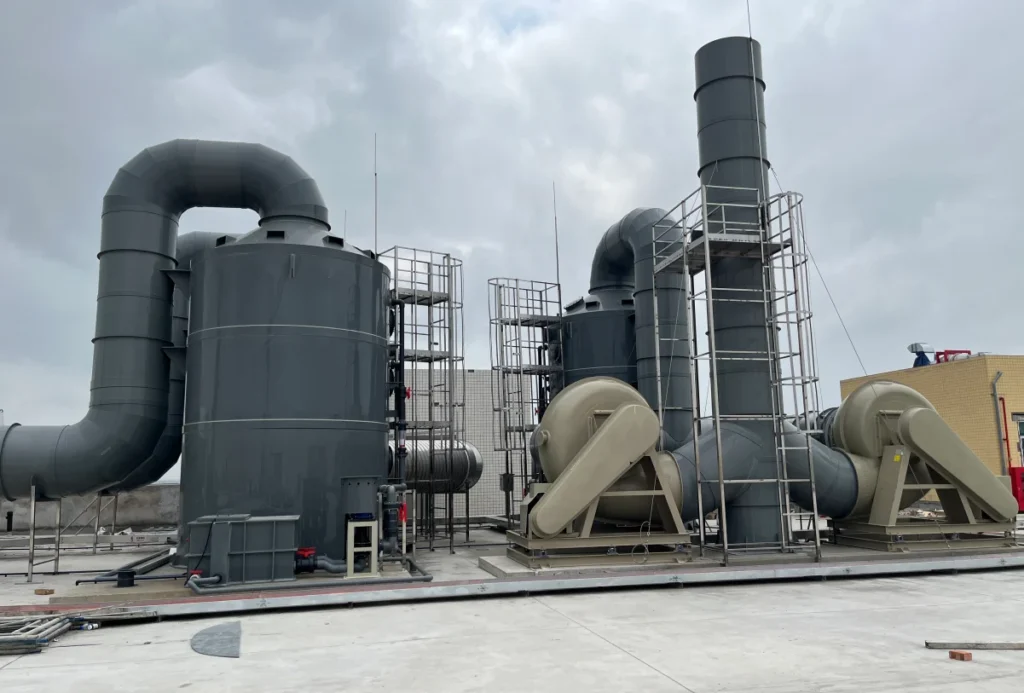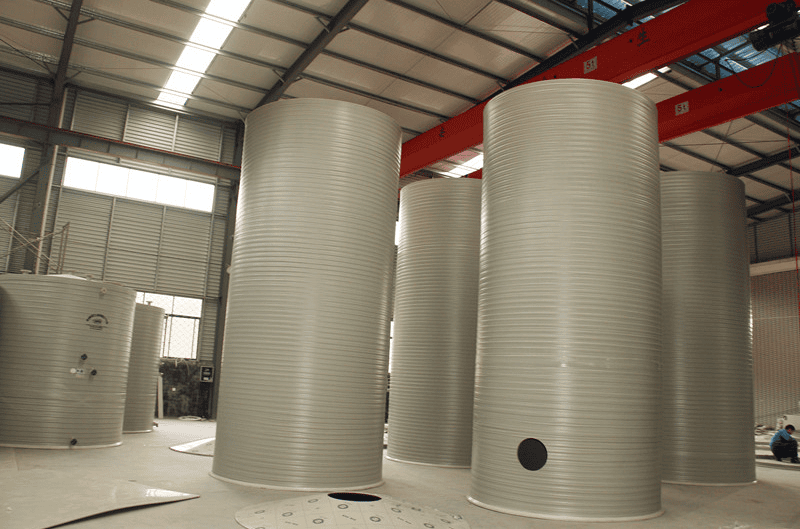
A vertical poly tank is a cylinder standing on one end, flat-bottomed, open to atmosphere and built from thermoplastic sheet or a moulded shell. The definition takes one line. What takes longer is realising that the word “vertical” decides almost nothing by itself. The same nominal capacity can be sold as a 2.2 m diameter vessel nearly 5 m tall, or as a 3.4 m diameter vessel barely over 2 m tall. Both are vertical. Both are called the same thing. One of them will not fit under the beam you have.
The orientation decision is usually framed as a choice between vertical and horizontal, and it is worth seeing what that choice physically is. Take a 4,000 US gallon cylinder, which is 15.14 m³. Stand it up at 2 m diameter and it rises 4.82 m and occupies 3.14 m² of floor. Lay the identical cylinder on its side and it needs 2 m of height and 9.64 m² of floor. Same shell, same mass, same volume. The installation differs by a factor of 3.07 on the floor and 2.41 on the height. The same exchange rate applies whatever the contents, and for an acid storage tank the material decision has to be settled before the orientation can be.
So the three questions this page answers are not about capacity. They are about the exchange rate. First, how headroom and floor area fix the diameter-to-height ratio of the tank you can fit, and what a taller tank costs in wall. Second, why hoop tension in a vertical wall falls linearly with depth, which is why the base weld governs and the top of the shell does not. Third, why a flat bottom is free to stand on and expensive to drain, and where the rest of the bottom-type spectrum sits.
Key Takeaways
- Vertical and horizontal are not two tanks. They are one cylinder in two orientations, so at a fixed diameter the footprint ratio and the height ratio are exact reciprocals. A 4,000 US gallon vessel at 2 m diameter occupies 3.14 m² standing and 9.64 m² lying down — a factor of 3.07 on the floor and 2.41 on the height.
- Doubling the height at constant volume halves the footprint, but the hoop force at the base and the total shell area both rise to 1.41 times their original values, because both scale with the square root of height. Floor is bought with plate.
- The wall does not have to be uniform. Hoop force falls linearly with depth as T = ρg(H − z)R, so the base seam between shell and floor is the governing point and the top of a tall vessel can be thinner. The allowable stress that goes on the other side of that comparison comes from the standard, not from a catalogue.
- A horizontal tank carries a load a vertical one never sees. Sitting on two saddles turns the shell into a beam, and longitudinal bending acts in the same wall as hoop tension. Adding a stiffening ring and widening the saddle contact angle is what pays for the orientation.
- Flat is not the absence of a bottom detail. The outlet cannot sit flush with the floor, so the permanent heel is the footprint multiplied by the outlet centre height: at 2.591 m diameter, a 100 mm outlet traps 527 litres on every cycle.
- Slenderness is the one trade with no upside. At constant volume, halving the diameter doubles the height and cuts the overturning margin to roughly one quarter, because the resisting moment shrinks while the wind lever arm grows. Empty-tank wind is the case that governs, not the full one.
What a Vertical Poly Tank Is, and Where the Name Comes From
Three phrases describe the same object, and seeing them together explains why the specifications disagree about it. The search term is vertical poly tank. The catalogue term is upright water tank. The engineering drawing says vertical storage tank. None of them is wrong, and none of them is precise, because the word carrying the meaning in all three cases is the one that is never varied.
Vertical Poly Tank, Upright Water Tank, Vertical Storage Tank: Three Names, One Object
ASTM D1998-21, the United States specification for moulded polyethylene storage tanks, settles the vocabulary in its first sentence. It covers “flat-bottom, upright, cylindrical tanks molded in one-piece seamless construction by rotational molding”, made for above-ground vertical installation and “capable of containing aggressive chemicals at atmospheric pressure”, with capacities from 1,900 L (500 gal) up. Upright is doing the work that vertical does in the search term, and cylindrical and flat-bottom are quietly assumed alongside it.
On the European side the same object has its own calculation standard. EN 12573 is a family of parts for welded static non-pressurised thermoplastic tanks, and part 2 is titled “Calculation of vertical cylindrical tanks”. Its published scope descriptors name vertical, cylindrical shape, welded joints, structural design and mathematical calculations, and list polypropylene among the polymers it covers. A vertical plastic tank is not a variant of some more general object in either system. It is a category with its own arithmetic.
What the three names share is more useful than what separates them: a vertical axis, a flat base that carries the full weight of the contents, a closed cylindrical shell, and a vent. That is the entire specification. Everything else — the diameter, the height, the plate thickness, the bottom detail — is a number chosen against a site, and it is where two vertical poly tanks of the same nominal capacity stop being interchangeable.
Vertical Is a Ratio, Not a Shape
The characteristic that actually distinguishes one vertical poly tank from another is the ratio of height to diameter, and the range sold under the name is wider than most buyers assume. A 100 US gallon moulded tank commonly stands about 1.6 m tall on a 0.58 m diameter, which is an H/D near 2.7. A wide shallow tank of the same family can sit below 0.6. Both arrive described as vertical tanks, and the two behave nothing alike under wind, under seismic load, or under a mixer.
Slenderness changes what the tank is for. Above H/D of roughly 2, the vessel is essentially a column: it is efficient in floor area, awkward to clean, and sensitive to any sideways force. Below H/D of 1, it is a squat drum: stable, easy to reach into, and hungry for floor. The capacity you need sits somewhere on that line, and so does the room you have. Setting the ratio is the first real decision, and it is made before any plate is selected.
This is also why two suppliers can quote the same number of gallons and produce tanks that are not interchangeable. The gallon figure fixes a volume. It does not fix a footprint, a height, or a wall.
Why the Cross-Section Is Round and Not Rectangular
A cylinder carries liquid pressure as membrane tension. The internal pressure pushes outward, the wall resists by pulling against itself around the circumference, and that hoop force closes on its own around a complete circle. There is no span to bend, no support to add, and no reaction to hand to a frame. The shell carries the load and returns it to itself.
A flat wall cannot do that. The same pressure arrives perpendicular to a plate that has to span between supports, so it is carried in bending, and bending stress grows with the square of the unsupported span. Shortening a span by half cuts the stress to a quarter; doubling it quadruples the stress. That exponent is why rectangular tanks are built around ribs, posts and base frames rather than around plate thickness. The full arithmetic for that shape belongs to what bending does to a flat wall, and this page does not repeat it.
What matters here is the consequence for orientation. Because a round shell needs no internal structure, a vertical round tank can be large and nearly empty inside. That is what makes it practical for storage, and what limits it for anything that needs a flat working surface.
What This Article Does Not Cover: Pressure Vessels
Atmospheric is the word that keeps this page honest. A vertical poly tank is vented, so the pressure on the wall is the liquid column and nothing else. The moment a tank is closed and pressurised, the governing load stops being the contents and becomes the gas above them, and the design rules change with it. ASTM D1998-21 handles this the way a good standard should: it states its limits and then states what to do outside them.
The confusion is common enough to be worth naming. One of the pages ranking for cylindrical tanks opens by defining a cylindrical pressure vessel, quotes a maximum allowable pressure around 10,000 psi, and then continues straight into atmospheric storage tanks without marking the change. Those two numbers belong to different worlds. A pressure vessel at that order of magnitude is a heavy-wall steel fabrication under a design code of its own. A poly storage tank at atmospheric pressure sees a few tens of kilopascals at the base and is built from sheet a few millimetres thick. Reading one as the other is how a tank gets specified at ten times its necessary weight, or at a fraction of it.
For the material question — which polymer survives which chemical, at which concentration and temperature — the entry point is the polypropylene tank selection guide. For the chemical comparison itself, the polymer-by-polymer view sits in chemical storage tank materials.
Headroom and Floor Area Decide the Orientation, Not the Volume
The first number a buyer arrives with is capacity, and it is the last number that constrains anything. A volume can be built into an infinite family of cylinders, and the site picks one out of that family by fixing two dimensions: how much floor you can give up, and how much height you can occupy. Those two together determine the diameter, and the diameter determines everything downstream. Whether the catalogue files the item under tank vertical or under vertical tank does not change a single term in that chain.
Measure Three Things Before You Open a Catalogue
The clear height is the first measurement, and it is the one most often taken wrong. It is not the distance from floor to ceiling. It is the distance from the tank base to the lowest overhead obstruction, minus the room needed above the tank for its top head, its nozzles, its level instrument and the head and shoulders of whoever will inspect the inside. A 4 m ceiling can easily leave 3 m of usable tank.
The available floor is the second, and it should be measured as a shape rather than an area. A round tank in a corner wastes the corner; a round tank against a wall wastes a crescent. Two square metres of floor can be plenty in open space and useless in a 1.2 m passage. The third measurement is access: the largest single dimension of the finished tank has to get through the door, the gate or the stairwell it passes on the way in, which becomes the binding constraint on wide tanks more often than anyone expects.
Same Volume, Three Diameters: What Changes on the Floor
Take a nominal 5,000 US gallon duty, which is 18.93 m³, and pour it into three cylinders of different diameter. Nothing else changes — same volume, same liquid, same height of nothing in particular — and the site consequences diverge immediately.
| Diameter | Height required | H/D | Floor area at base | Relative floor |
|---|---|---|---|---|
| 2.2 m | 4.98 m | 2.26 | 3.80 m² | 1.00× |
| 2.8 m | 3.07 m | 1.10 | 6.16 m² | 1.62× |
| 3.4 m | 2.08 m | 0.61 | 9.08 m² | 2.39× |
Table 1 — The same 18.93 m³ as three plain cylinders. Heights are geometric: the wall is assumed to be of zero thickness and the ends flat, so a real vessel is taller than the figure shown and holds less than the figure implies.
The columns are reciprocals of each other, and that is a property rather than a coincidence. Floor area times height is the volume, and the volume is fixed, so any increase in area comes out of the height and any increase in height comes out of the area. Going from 2.2 m to 3.4 m diameter multiplies the floor by 2.39 and divides the height by the same 2.39. The exchange rate between floor and headroom is exactly one to one.
That is the whole of the first decision. It is not a matter of taste, and it does not depend on what is in the tank. It depends on which of the two dimensions your building is short of.
The Height You Forgot: Freeboard, Top Nozzle and Ladder
The geometric height in Table 1 is the liquid column. A vessel has to hold more than the liquid: a top head or flat cover above the high-level point, a freeboard allowance so the liquid surface does not touch the fitting, a base ring or plinth to spread the load, and above all of that the clearance to operate whatever is on the lid. The working height is routinely half a metre to a metre more than the tank height, and on a small vessel that is a large fraction of the total.
Top access is the part people forget until installation day. A vertical tank is serviced from above, because the top opening is the only opening large enough to enter, and reaching it requires either a ladder fixed to the shell or a platform beside it. Both need space, and both need the lid to open without fouling anything. The detail of how an opening behaves structurally is the subject of how an open top tank handles its rim; here the point is simply that the rim has a working envelope around it, and the envelope is part of the height budget.
What Adding Height at Constant Volume Actually Costs
Making a tank taller at the same volume is not free, and the cost is not where intuition puts it. If the volume is fixed, the radius falls as the square root of the height. Everything that depends on radius then moves at a predictable rate, and three of those quantities move together.
Double the height at constant volume and the floor area halves, because the volume is split over twice the height. The hoop force at the base rises to 1.41 times its original value, because the pressure at the base doubles while the radius has fallen to 0.71 of its original, and 2 × 0.71 is 1.41. The total area of shell you have to buy and weld also rises to 1.41 times, because the circumference shrinks by 0.71 while the height doubles. Quadruple the height and both of those become 2.00, while the floor falls to a quarter.
So a slender tank buys floor and pays for it twice: in a thicker wall at the base and in more shell overall. That is the honest trade, and it is the reason very tall tanks stop being economical before they stop being possible. It is also the reason the choice in Table 1 is a real design decision rather than a preference.
When the Room Pushes You to a Horizontal Tank
If the ceiling is the constraint and the capacity is not negotiable, the answer is to rotate the cylinder. A horizontal tank converts height into length, which is why it appears under low roofs, along walls and beneath structures that cannot be moved. The structural price is covered later, because rotation is not a neutral transformation of the shell.
It is worth being clear about what has and has not changed. The volume is the same. The mass is the same. The shell area is the same. What changed is which dimension the site has to supply, and therefore which load case governs. A horizontal tank is not a different product. It is the same product asked to behave as a beam.
When the Room Pushes You to a Low Profile Tank
There is a third option between the two, and it is the one the catalogue calls low profile. A low-profile tank is still vertical, still flat-bottomed and still serviced from the top. It simply has an H/D below about one, so it spreads its volume sideways instead of upward. It keeps the vertical poly tank’s structural advantage — the hoop force still closes around a circle — while giving up the vertical tank’s main benefit, which is a small footprint.
That trade is worth recognising because it is often the right one in a plant room with a low soffit, and because it is frequently mislabelled. Low profile is a posture, not a bottom type, and it is treated as a posture in its own section below rather than as the fourth member of a list of floors.
Hoop Tension: Why a Vertical Wall Can Get Thinner as It Rises
A vertical poly tank has one structural member, the shell around it, and the load on that shell changes with height in a way that no other tank type enjoys. The pressure at any point is the weight of the liquid column above it, so the pressure at the top of a full tank is zero and the pressure at the base is the whole column. Everything else in the wall follows from that single line of arithmetic.
The Formula: T = ρg(H − z)R
Let H be the design liquid level measured from the base, z the height of the point being considered above the base, R the radius, ρ the liquid density and g the gravitational acceleration. The hydrostatic pressure at that point is p = ρg(H − z). For a thin cylindrical membrane, the circumferential force per unit height of wall is T = pR, so:
T = ρg(H − z)R
The units are force per unit length of wall — newtons per metre — because the quantity is a membrane force, not a stress. To turn it into a stress you divide by the plate thickness: σ = T/t. Nothing in the formula contains a material property, which is the first useful thing about it. The force the wall has to carry is set by the liquid, the geometry and gravity. The material only decides how much thickness is needed to carry it.
Reading the Formula as a Fabrication Instruction
The expression is linear in z, and that linearity is an instruction rather than a curiosity. At half the liquid depth the force is half. At three quarters of the depth it is a quarter. A wall built to a single thickness is therefore overbuilt at every point above the base, and the waste grows with the square of the tank’s height.
Fabricated thermoplastic tanks respond to this by stepping the plate. A typical arrangement is a thicker course at the bottom where the force peaks, a mid course, and a lighter top course, with each joint placed where the next plate size can carry the load. A 30 mm bottom course tapering to 12 mm at the top of a tall vessel is a normal shape of answer, not an exotic one. Welded construction makes that easy: each course is cut and welded to the one below it, and the change in thickness happens at a horizontal weld line.
Stepping only works if every course is cut, formed and welded to the same datum, which is the subject of the fabrication sequence behind the plate step.
Moulded tanks cannot do this in the same way. A rotational mould produces one wall of one thickness, with thicker sections only where the tool allows material to pool. That is one of the reasons the moulded catalogue stops where it does, and one of the reasons a tall vessel above a certain size is a welded fabrication by definition.
What the Numbers Look Like at 3 Metres
Take a tank 3 m of liquid deep and 2 m in diameter, holding water at 1,000 kg/m³. The table gives the pressure, the hoop force and the resulting stress in three plate thicknesses, at four heights. The stress column is the membrane force divided by the plate thickness, with no weld factor and no safety factor applied.
| Height above base, z | Pressure p | Hoop force T | σ at t = 6 mm | σ at t = 10 mm | σ at t = 15 mm |
|---|---|---|---|---|---|
| 0 m (base) | 29.4 kPa | 29.4 kN/m | 4.91 MPa | 2.94 MPa | 1.96 MPa |
| 1.0 m | 19.6 kPa | 19.6 kN/m | 3.27 MPa | 1.96 MPa | 1.31 MPa |
| 2.0 m | 9.8 kPa | 9.8 kN/m | 1.64 MPa | 0.98 MPa | 0.65 MPa |
| 3.0 m (surface) | 0 kPa | 0 kN/m | 0 | 0 | 0 |
Table 2 — Water at ρ = 1,000 kg/m³ and g = 9.81 m/s², R = 1 m, H = 3 m. Stress is T/t with no weld efficiency factor and no safety factor.
What the table deliberately does not contain is an allowable stress. That number is not a constant and it should not be pulled from a blog. It depends on the polymer, on the service temperature, on the design life and on the weld detail, and it is what EN 12573-2 exists to define. The honest use of Table 2 is to read the stress at the base, look up the design stress your standard gives for your material at your temperature and life, and compare them. Anyone quoting a fixed allowable figure for polypropylene without those three inputs is guessing.
What the table does show, without any allowable at all, is the shape of the answer. The base carries four times the force of the half-height point, and it carries infinite times the force at the surface. A 15 mm plate at the base is working three times as hard as the same plate a metre up. That ratio is fixed by physics and is the same in every material.
The Bottom Weld Is the Design Point, Not the Middle of the Wall
Every maximum in Table 2 arrives at the same place: the horizontal seam where the shell meets the floor. That seam carries the peak hoop force, and in a flat-bottom tank it also carries the reaction from the floor plate, which is pushed down by the liquid and held by the shell around its perimeter. The two loads meet at a right angle in a joint that is welded from one side and inaccessible from the other.
That is why the corner detail is the first thing to ask about in a specification, ahead of plate thickness. A 12 mm wall with a properly filleted and fully fused base seam is worth more than a 20 mm wall with a partially penetrated corner. It is also why hydrostatic testing is done at the base and why the test level matters: the seam sees its maximum on the day the tank is filled to the design head, not on the day it is commissioned at half capacity.
A tank that passes its wall calculation and fails at the base is not a tank that was under-designed. It is a tank where the calculation stopped one joint too early.
Temperature Moves the Allowable Stress
Thermoplastic design stress is a function of temperature and time, and both move in the same direction: warmer, or longer, and the safe stress falls. A wall that is adequate on a cold commissioning day at ambient is not automatically adequate at 60 °C in year ten of continuous service, even though the hoop force from the liquid has not changed at all.
The United States specification handles this explicitly. ASTM D1998-21 limits itself to atmospheric vessels with “continuous service temperatures below 66 °C (150 °F) for Type I tanks and below 60 °C (140 °F) for Type II tanks”, and then, in the following clause, directs anyone needing “higher temperature service” to other relevant sources of standards. That is a standard refusing to extrapolate, and it is the right model to copy.
Two conclusions follow. First, the number that matters in a specification is the service temperature, not the ambient temperature, and for a heated duty it is the hottest the contents ever get. Second, when the duty sits at or beyond the limit of the specification that would otherwise apply, the answer is a different design basis rather than a thicker wall of the same one. The temperature question is where the material choice and the structural calculation meet, and the polymer comparison behind it belongs to chemical storage tank materials.
A Horizontal Tank Carries a Second Load: Bending Between Saddles
Rotating a vertical tank onto its side keeps the volume, the mass and the shell area, and adds a load case that did not exist before. A vertical shell carries pressure and passes it around a closed ring. A horizontal shell is held up at two points along its length, so between those points it is doing what a beam does: it sags under its own weight and the weight of what is inside it. In a horizontal tank water also sits in a trough, and the depth at any given cross-section is the same all the way along the length, which is the detail that makes the hoop calculation easy and the bending calculation unavoidable.
The Saddle Span Turns a Shell Into a Beam
A horizontal cylinder normally rests on two saddles, one near each end, and the spacing of those saddles is a design variable in its own right. Close them together and the tank overhangs at both ends; spread them wide and the span between them grows. The shell sees a distributed load of its own mass plus contents, and over that span it develops a bending moment that is largest near mid-length.
The section that resists that moment is the shell itself. For a thin cylinder the second moment of area about a diameter is approximately πR³t, so the section modulus is πR²t, and the longitudinal bending stress is simply M divided by that. The consequence is uncomfortable: doubling the radius of a horizontal tank multiplies its section modulus by four, but it also multiplies the load by four and the span, if the volume is fixed, by a quarter. The balance between span and section is what the saddle positions are for.
Longitudinal vs Hoop: Two Stresses Acting at Once
In a vertical poly tank there is effectively one stress to check in the shell: hoop tension, falling with height. In a horizontal tank there are two, and they peak in different places. Hoop tension still follows the pressure, which is set by the liquid depth at that point and is therefore constant along the length at a given elevation. Longitudinal stress follows the bending moment, which peaks at mid-span and is zero at the supports.
For a closed shell there is also a longitudinal stress from the pressure itself, roughly half the hoop value, because the end caps push back against the contents and the shell has to carry that thrust along its axis. That component is not the same as the bending stress and does not peak in the same place, but it is present everywhere and has to be added where the two coincide.
A vertical poly tank never asks this question. Its end caps are top and bottom, its thrust closes vertically into the base, and the shell only ever sees hoop. That single-stress condition is a large part of why a vertical poly tank tolerates such simple fabrication.
Where the Vertical Advantage Disappears
The worst region in a horizontal tank is usually not mid-span at all. It is at the saddle, where the support reaction enters the shell and has to spread into it over a narrow contact area. Directly above the saddle the shell is compressed circumferentially; immediately beside it, the shell is pulled. That local stress concentration depends on how wide an angle of the shell the saddle actually touches, which is why saddle contact angles are specified rather than left to the fabricator.
Two mitigations are standard. The first is a wide contact angle, commonly around 120° of arc, so the reaction is spread rather than concentrated. The second is a stiffening ring or a wear plate at each saddle, which distributes the reaction over a longer band of shell. Neither exists on a vertical poly tank, because a vertical poly tank has no discrete support reaction to spread.
This is the part of the comparison that most orientation guides skip. They describe horizontal tanks as stable and easy to transport, which is true, and stop there. The structural cost of being a beam is what a fabricator prices, and it is why two horizontal tanks of the same volume can differ substantially in shell thickness and in fitted steelwork.
The 4,000 Gallon Horizontal Water Tank Arithmetic
Return to the 4,000 US gallon duty, 15.14 m³, at a 2 m diameter. A search for a 4000 gallon horizontal water tank is a search for this exact cylinder, and the arithmetic that answers it takes one line. Laid horizontally, the length required is 4.82 m, and the footprint is 2 m by 4.82 m, which is 9.64 m². The height is 2 m plus whatever the saddles add, typically a few hundred millimetres.
Stood vertically at the same diameter, the height required is the same 4.82 m and the footprint collapses to 3.14 m². The water alone weighs 15.14 tonnes in either case, split between two saddles when horizontal and concentrated on one base ring when vertical. Whether the vessel should be polypropylene at all is a separate question, answered by the duty temperature and set out in polypropylene water tank.
The symmetry is worth noticing: when the diameter is held constant, the length of the horizontal tank and the height of the vertical one are the same number. They are the same cylinder, and the choice is which of its two dimensions your room will accept. That is the entire content of the orientation decision before structure is considered, and it is the reason that search is in effect a request for permission to go long and low.
Why Horizontal Tanks Suit Long, Low Footprints
Three conditions favour the horizontal storage tank over any vertical option. The first is a long wall or a narrow service corridor, where a cylinder laid along the wall uses space a vertical tank cannot. The second is a low headroom plus a large capacity, the combination that a vertical tank cannot satisfy at any diameter. The third is a requirement for a low centre of gravity, which matters on a transportable unit and matters again in a seismic design, because the same mass at a lower height produces a smaller overturning moment.
The conditions that argue against it are equally specific. Horizontal storage tanks are awkward to mix, because the liquid depth above the agitator changes with the fill level. Cleaning and inspection are easier from a manway at a comfortable height, but the interior is harder to reach at the ends. And the saddle structure has to be right, because a horizontal tank that is under-supported at the saddle does not fail gracefully.
For a low, long room that still needs a cleanable interior and top access, the answer is often neither of the above but a squat vertical vessel, which keeps the vertical poly tank’s single-stress shell and simply accepts a larger footprint.
Bottom Types: Flat, Low Profile, Elliptical, and the Edge of the Spectrum
Posture and bottom type are two different axes, and the market sells them as one. A flat bottom tank and a low profile tank are not alternatives to each other, because one describes what the base looks like and the other describes how tall the vessel is relative to its width. Sorting them out removes most of the confusion in the category, and it also explains why two tanks that look similar in a catalogue photograph behave so differently once they are full.
Flat Bottom Tank: The Floor Is the Foundation
A flat bottom tank stands directly on a prepared surface. The base is a flat circular plate welded to the shell, and the whole weight of the contents passes through that plate into whatever is underneath it. There is no frame, no leg set, no skirt and no steel support, which is the most important structural fact about the type: the foundation and the tank base are the same connection.
That single fact explains why flat bottoms dominate the large-capacity end of the market. A 15-tonne vessel needs a load path, and a flat plate spreading that load over three or four square metres is the simplest one available. It also explains the installation requirement, which is uncompromising in an unglamorous way: the surface has to be continuous, level and capable of carrying the full mass without settling differentially. Sand, gravel and a concrete slab all qualify when properly prepared. A patch of uneven ground does not, and a flat-bottom tank placed on one will distort at the base and load the corner seam in a way the design never considered.
The phrase flat bottom water tank describes the ordinary case, and the ordinary case is most of the volume sold. A flat tank in a plant room, a row of flat tanks along a wall, a flat bottom utility tank used for wash-down water or non-potable service: these are all the same construction carrying different contents. The specification that governs the construction is the one quoted earlier, whose scope is written for “flat-bottom, upright, cylindrical tanks” and nothing else.
Occasionally the same request arrives written as a water tank in flat form, which only makes sense if the answer is already half known: a vessel with a flat base standing on a flat floor. That phrasing is worth recognising, because it usually accompanies the assumption that flat means featureless, and flat does not mean featureless. It means the base is a plate rather than a cone or a dished head, and the consequences of that choice are concentrated at one fitting.
What “Flat” Costs You at the Outlet
The outlet has to sit somewhere, and it cannot sit at the elevation of zero. A nozzle welded flush with the floor plate would have its bore half blocked by the plate itself, so the outlet centre is lifted a short distance — typically 50 to 150 mm — above the base. Everything below that elevation is liquid the tank cannot drain, and its volume is simply the footprint multiplied by that height.
| Outlet centre above base | Permanent heel at D = 2.591 m |
|---|---|
| 50 mm | 264 L |
| 100 mm | 527 L |
| 150 mm | 791 L |
Table 3 — Heel volume = base area × outlet centre height, with the base taken as a flat disc of 2.591 m diameter (5.27 m²). The shell thickness is ignored, which overstates the volume by less than one percent.
The arithmetic is easy to check and hard to argue with. A 5.27 m² floor with the outlet 100 mm up traps 527 litres, every time, forever. On a 5,000 gallon tank that is under three percent of the contents, which sounds negligible until the liquid is a product rather than water, or until the tank has to be emptied before a changeover, or until the residue has to be disposed of as hazardous waste on every cycle.
Three remedies exist and each has a price. A recessed sump pressed or welded into the floor plate lowers the outlet a little and adds a fabrication step. A floor sloped toward the outlet drains better but reduces the usable volume and complicates the base preparation. A cone bottom removes the problem entirely and replaces it with a support structure, which is the subject of the last heading in this section. The choice is a real design decision, and the number in Table 3 is the figure that decision is made against.
Low Profile Tank: A Posture, Not a Bottom
A low profile tank is a vertical poly tank with a height-to-diameter ratio below about one. It is still upright, still flat-bottomed in most cases and still serviced from the top, so nothing about its structure is new. What changes is the exchange rate: it gives up floor area in return for headroom and stability.
Two applications make that trade willingly. The first is a plant room with a low soffit and plenty of floor, where a conventional vertical poly tank simply will not stand up. The second is any duty where the liquid surface needs to be large relative to the depth — settling, skimming, or a vessel that doubles as a buffer with a long residence time. A low profile water tank in that setting is doing work that a tall narrow vessel cannot do at all, because the surface area is the point.
The stability benefit is real and worth quantifying in direction if not in numbers. The overturning moment from wind or seismic load scales with the height at which the force is applied, while the resisting moment scales with the base radius. Cutting the height and widening the base attacks both terms at once, which is why a low profile water storage tank is often the answer on an exposed site even when headroom is not the constraint.
One caution belongs with the word itself. The search results for low profile tanks are heavily mixed with pickup-bed tanks and trailer-mounted water carriers, which share the shape and none of the requirements. Everything in this section assumes a fixed installation on a prepared base, anchored or not as the site demands. A tank that is designed to be driven between sites is a different product with a different structural brief.
Elliptical Tank: Usually a Trailer Tank, Not a Storage Tank
The word elliptical deserves a paragraph of boundary rather than a section of its own. In industrial practice an elliptical tank most often means a vessel with an elliptical cross-section rather than a circular one, and the reason to build one is almost always transport: an ellipse fits a road vehicle’s width limit while carrying more volume than a circular section of the same height. The other common use is a leg-mounted tank with an elliptical base for stability.
Neither is a stationary atmospheric storage tank in the sense this article uses. An elliptical section also loses the property that makes a cylinder cheap, because the hoop membrane force is no longer uniform around the perimeter; the flatter sides carry more than the tighter curves. That is a solvable problem, and it is solved by analysis that a round tank never needs.
The point of the distinction is practical. A buyer who arrives looking for an elliptical tank is usually solving a transport or a fit problem, and a vertical poly tank will not solve it. A buyer who wants a round vessel standing on a flat base has arrived at the right family, and should stop using the elliptical term before it sends them into a catalogue of trailer tanks.
Where the Cone Bottom Belongs
The cone bottom is the other end of this spectrum, and it exists to answer exactly the problem Table 3 quantifies. Replace the flat plate with a downward cone and the outlet moves to the apex, so the heel shrinks toward the volume of the cone tip itself. For a duty that must drain completely — a batch process, a sludge, a slurry, anything that cannot tolerate a residue — that is worth buying.
What it costs is everything the flat bottom avoided. A cone cannot stand on the ground, so the vessel needs legs or a support ring, and that steelwork has to carry the full weight. The outlet now sits below the shell, which adds to the total height. And a tall vessel on legs is a less stable structure than the same vessel on a base plate, so the anchoring and the seismic question become larger rather than smaller.
The geometry of the cone — its angle, its volume, and how much of the heel it actually removes — belongs to the dedicated treatment of cone bottom tank geometry and is not repeated here. What belongs here is the boundary: T5 covers flat bottomed vertical tanks, and the moment a duty needs a cone, the design conversation has moved to another page.
Reading a Tank Table: Capacity, Level and Weight
A product table is written to sell, and every column in it is true, but the three numbers a buyer needs are rarely the three numbers that are printed. Capacity, level and weight are the ones that drive the civil work, the instrument selection and the operating procedure, and each of them is derived rather than stated.
Gallons, Litres and Tonnes
The conversion that matters is not the one on the datasheet. One US gallon is 231 cubic inches, which is 3.785 412 litres, and the difference between a US gallon and an imperial gallon is large enough to cause a genuine error: the imperial gallon is 4.546 litres, about twenty percent larger. A tank specified in the wrong gallon is a tank twenty percent the wrong size, so the unit has to be established before the first number is used.
Once it is, the arithmetic is short. A 5,000 US gallon vertical water tank holds 18,927 litres, and a litre of water is a kilogram, so the contents weigh 18.93 tonnes. That is the number the slab is designed for, and it is almost never the number printed on the catalogue page. The empty tank might weigh 300 kg; the filled one weighs sixty times that. A floor that carries the tank carries the water, and the water is the load.
Litres per 100 Millimetres: Why One Inch Is Not One Inch
A level instrument measures height, and height converts to volume through the cross-sectional area. That area depends on the diameter and on nothing else, so the same rise in level means wildly different quantities in different tanks. The table makes the spread visible.
| Tank | Diameter | Volume per 100 mm | Volume per inch |
|---|---|---|---|
| 100 US gal vertical | 0.584 m | 26.8 L | 1.80 US gal |
| 5,000 US gal vertical | 2.591 m | 527 L | 35.4 US gal |
| 5,000 US gal vertical | 3.581 m | 1,007 L | 67.6 US gal |
Table 4 — Plain cylindrical section, no correction for wall thickness or for any dished head. Diameters are the internal diameters that produce the stated per-unit volumes.
An inch of level is 1.80 US gallons in the small tank and 35.4 gallons in the large one at 102 inch diameter. That is a factor of 19.7 between two vessels that both answer to the name vertical water tank. A sight glass marked in inches is therefore a perfect instrument on one and a seriously imprecise one on the other, and the required resolution follows from the table rather than from preference.
The reverse reading is the useful one at specification time. If a dosing or batching duty needs to resolve 50 litres, the tank has to be wide or narrow enough for 50 litres to be a measurable height. That is the connection between a tank table and the metering equipment downstream of it, and it is why the specification of PP dosing tanks starts with the level geometry rather than with the pump.
A 100 Gallon Vertical Water Tank and a 5,000 Gallon Vertical Water Tank
The two ends of the size range are worth putting side by side, because they share a name and nothing else. The phrase 5000 gallon vertical water tank specifies a volume and nothing more, and vertical water tanks of that volume are built at two and a half metres across and more. A 100 gallon vertical water tank, by contrast, is a small moulded vessel roughly half a metre across and one and a half metres tall, with a height-to-diameter ratio near 2.5 to 3. It is slender, light when empty and sensitive to anything sideways. That is why the moulded units of this size commonly carry moulded tie-down slots or a base flange with bolt holes, and why a fence or a wall is a better neighbour for one than an open yard.
A 5,000 gallon vertical water tank is a different engineering problem in every respect. It holds 18.93 tonnes, its base is a structural element rather than an accessory, and its height-to-diameter ratio can be anywhere from 2.3 down to 0.6 depending on the diameter chosen. The small tank’s governing question is whether it will tip. The large tank’s governing question is whether the slab will settle and whether the base seam will hold.
Nothing about the phrase distinguishes the two, which is why capacity alone is a poor brief. A supplier who quotes on gallons alone is quoting on the one number that does not constrain anything.
Nominal, Gross and Working Volume
Three volumes sit behind every capacity figure, and the gaps between them are not rounding. The geometric volume is the cylinder that the outer dimensions enclose. The nominal volume is what the manufacturer prints, and it already accounts for the fact that the vessel has a head, a wall and corners that the arithmetic cylinder does not. The working volume is what can actually be filled and operated, which stops below the overflow or high-level point and starts above the outlet.
The gaps are made of wall thickness, head shape and freeboard, and none of the three is zero. That is why a tank cannot be sized by multiplying an outside diameter by an outside height and calling the result the capacity, and why a nominal figure cannot be inverted to recover the dimensions. The nominal number is the only one that has been through the manufacturer’s own correction, which is precisely why it should be used as printed and not recalculated.
For the vertical PP storage tanks in a typical range, the practical consequence is that a nominal 5,000 gallon vessel is a little taller than the 3.07 m that Table 1 predicts for a 2.8 m diameter, and holds a little less than the mathematics says. The direction of the difference is always the same: real tanks are taller and hold less than the ideal cylinder of the same nominal diameter.
Choosing Between Vertical, Horizontal, Flat and Low Profile
The four terms in this heading are not four products. They are three postures and one bottom type sharing a shop shelf, and the difference between them decides which of the vertical storage tanks, horizontal vessels or squat drums a given room can actually accept. The decision is made in a fixed order: the site fixes the posture, the process fixes the bottom, and the maintenance regime fixes the access. Doing it in any other order produces a specification that has to be reissued.
The Decision Table
The table below compresses the preceding six sections into conditions and answers. It is not a substitute for the arithmetic, but it is the order in which the arithmetic should be applied.
| Condition on site or duty | Answer |
|---|---|
| Headroom ample, floor scarce | Vertical, at a high H/D |
| Headroom limited, floor ample | Horizontal along a wall, or low profile vertical |
| Low centre of gravity required, or seismic-sensitive site | Horizontal |
| Top opening needed for access, mixer or instrument | Vertical |
| Duty must drain completely | Cone bottom — outside this article |
| Secondary containment required | Double wall — outside this article |
| Room is rectangular and the tank lines a wall | Rectangular — outside this article |
Table 5 — Conditions are listed in the order they should be evaluated. The first row that the site satisfies usually decides the posture; the remaining rows refine it.
Two of the rows deserve a warning. The horizontal answer is the right one for headroom and for centre of gravity, but it brings the saddle bending from the earlier section, so a horizontal tank is never the cheap answer — it is the answer that fits. And the low profile answer is the right one for headroom without giving up top access, but it consumes the most floor of any vertical option, which is why it is the wrong answer in any room where floor is the scarce dimension.
Wind and Overturning: The One Thing That Gets Worse as You Go Up
Every trade described so far has been a swap of one resource for another, with the total cost roughly constant. There is one that is not a swap, and it is the reason slenderness has a limit that is not economic.
Consider an empty tank, which is the governing case for overturning because the resisting weight is at its minimum while the wind area is unchanged. The resisting moment is the weight times half the diameter. The overturning moment is the wind pressure times the projected area times the height at which that area acts, which is roughly half the shell height for a uniform pressure distribution. The margin is the ratio of the two.
Hold the volume constant and let the height double. The diameter falls by a factor of the square root of two, so the resisting moment falls to 0.71 of its original value. The projected area rises by the square root of two and the lever arm doubles, so the overturning moment rises by a factor of about 2.83. Divide one by the other and the margin falls to one quarter. Triple the height and it falls to one ninth. Under a uniform pressure acting at mid-height the relationship is exactly the square of the height ratio, and real wind profiles and gust factors bend that number a little without changing its shape.
That is the answer to why very tall vertical tanks stop being used before they stop being buildable. It is also why the wind pressure used for the check is the one from the building code that governs the site, and not a figure from a tank catalogue. A vendor does not know the site’s exposure category, its terrain, or its design wind speed, and a tank supplier who quotes a wind rating without asking those questions is quoting a number that does not apply.
Access, Cleaning and the Top Opening
A vertical tank is maintained from above. The top opening is the only aperture large enough to enter, which makes it the hatch, the vent, the instrument mounting point and the route for a mixer shaft at the same time. That concentration is convenient in a plant room with a ladder and inconvenient everywhere else, because reaching the top of a 4.8 m vessel requires either fixed access or a mobile platform, and both need clear space that the site must reserve at the design stage rather than the maintenance stage.
A horizontal tank moves that access to a comfortable height. The manway sits on the side of the shell at whatever elevation the saddle height allows, which for a 2 m tank is roughly shoulder level. Cleaning is easier from there, inspection is easier, and no ladder is needed. What is lost is the ability to drop a mixer straight down through the top, and what is gained is a maintenance task that does not require working at height.
Both arrangements have an envelope around their opening, and the envelope is part of the layout. A vertical poly tank’s top opening needs room above it for the lid to swing and for a person to stand. A horizontal tank’s manway needs room beside it for the same. The one that fits your room is decided before the tank is ordered, not after.
Installation: Base, Anchoring and the Weight on the Slab
The base detail is the difference between a tank that lasts and a tank that leaks at the corner. A flat bottom tank needs a continuous, level, drained surface with enough bearing capacity for the full contents, and the bearing capacity requirement is large: 18.93 tonnes on 3.14 m² is about 60 kPa, which is well within a domestic slab but is not within a patch of compacted gravel that has not been designed for anything.
Anchoring is a separate question from bearing. A tank that is bolted down resists uplift and sliding but transmits wind and seismic load into the slab, which then has to resist it. A tank that is not bolted down relies on its own weight, which is considerable when full and negligible when empty. Most failures in this category happen to empty tanks in high wind, not to full ones, which is why the anchoring decision cannot be made on the basis of normal operating weight.
Preparation details matter more than they look. A base that is level within a few millimetres keeps the shell from being distorted, and a distorted shell concentrates load at the corner seam. A drained base prevents water sitting under the floor plate for years. Neither is expensive at the time of construction and both are expensive to correct afterwards.
When Another Tank Type Is the Right Answer
Four exits from this page are worth stating plainly, because a buyer who needs one of them and arrives here will otherwise spend time on a specification that cannot work.
The first is a duty that must drain completely, which needs a cone bottom rather than any of the flat variants discussed here. The second is a duty that needs containment of a leak as well as containment of the contents, which is a double wall containment problem and not a posture problem at all. The third is a rectangular room that has to be filled wall to wall, where a cylinder wastes the corners no matter how it is turned. The fourth is a capacity or a chemical beyond what a standard vertical PP storage tanks range covers, in either direction.
Each of those is a real requirement and each belongs to a different page. Recognising which one applies early is worth more than optimising the tank that fits none of them.
Frequently Asked Questions
Six questions arrive often enough to be worth answering directly. Each answer is the short form of something established above, and each points back to the section that carries the arithmetic.
What is the difference between a vertical poly tank and a horizontal one?
They are the same cylinder in two orientations. A vertical poly tank stands on its base and carries liquid pressure as hoop tension in a shell that closes on itself. A horizontal tank lies on saddles and, in addition to the same hoop tension, carries longitudinal bending between its supports. Vertical gives the smaller footprint and the simpler structure; horizontal gives the lower height and the lower centre of gravity, at the cost of saddle steelwork and a second stress case.
How do I work out the footprint of a 5,000 gallon vertical water tank?
Convert to cubic metres — 5,000 US gallons is 18.93 m³ — then divide by the height you can accommodate. The result is the required cross-section, and the diameter follows from it. At 3.07 m of liquid depth the diameter is 2.8 m and the footprint is 6.16 m². At 2.08 m of depth it is 3.4 m across and 9.08 m². Table 1 has the three-diameter version of the same calculation.
How thick should the wall of a vertical poly tank be?
Thick enough that the hoop stress at the base stays within the design stress your material and standard allow at your service temperature and design life. The stress itself is computable: T = ρg(H − z)R at the base, divided by the plate thickness. What cannot be quoted from a web page is the allowable value, because it depends on three inputs the page does not know. Above the base the required thickness falls in proportion to the remaining depth, which is why fabricated tanks are built in stepped courses.
Is a flat bottom tank weaker than a cone bottom tank?
Not weaker, differently loaded. A flat bottom carries the contents straight into the foundation, which is efficient in structure and permanent at the outlet, where the heel from Table 3 cannot be drained. A cone bottom moves the outlet to the apex and eliminates the heel, and pays for it with a support structure, extra height and a less stable footing. The choice is about emptying the tank, not about its strength.
Can a vertical poly tank be installed outdoors?
Yes, with two provisions. It has to be anchored or shielded against wind, because an empty tank is the governing case and its own weight is not a reliable restraint. And it needs protection from ultraviolet exposure appropriate to the polymer and the climate, which is a material question rather than a structural one. The overturning margin falls steeply with height, so a tall tank in an exposed position is the case that needs the closest look at the anchor design.
Which tank orientation is better in an earthquake zone?
Horizontal, in general, because the mass sits lower and the overturning moment is smaller for the same volume. The exception is a site with more floor than headroom, where a low profile vertical poly tank achieves a similar effect by widening the base. In either case the seismic forces themselves come from the building code that governs the site, and the tank specification has to be checked against those forces rather than against a generic rating.
Send Us Your Room Dimensions, Not Just the Volume
A volume on its own cannot be turned into a tank. What can is three numbers and a sentence: the clear height under the lowest obstruction, the floor area you are willing to give up, and the widest thing that has to pass through the door on the way in. With those, the diameter follows from the arithmetic in Table 1, the posture follows from the room, and the bottom type follows from how completely the tank has to empty.
If you have a duty with a chemical, a temperature and a discharge requirement, send those too. The material question is answered by the polymer comparison rather than by the tank geometry, and the two are decided together.
Send us your room dimensions and we will come back with a diameter, a height and the base detail, rather than a gallon figure that has to be renegotiated later.
XICHENG EP manufactures welded and moulded thermoplastic storage, dosing and process tanks in polypropylene, HDPE and PVC, and supplies them with fabrication drawings, base details and installation guidance. Tanks are built to order against the duty, the site and the standard that governs it.
Methodology — All geometry in this article is computed from first principles: cylinder volume V = (π/4)D²H, hydrostatic pressure p = ρg(H − z), membrane hoop force T = pR and hoop stress σ = T/t. Water is taken at ρ = 1,000 kg/m³ and g = 9.81 m/s². No allowable stress is quoted, because that value is a function of polymer, service temperature, design life and weld detail, and is defined by the applicable standard rather than by this article.
Methodology — The wall-thickness stresses in Table 2 are membrane stresses with no weld efficiency factor and no safety factor. They are the load side of the comparison only. The resistance side must be taken from the standard that governs the vessel, at the service conditions of the specific duty.
Sources
- BSI. BS EN 12573-2:2000 — Welded static non-pressurized thermoplastic tanks — Calculation of vertical cylindrical tanks. BSI Knowledge, published 15 November 2000. knowledge.bsigroup.com (accessed 31 October 2026).
- BSI. BS EN 12573-1:2000 — Welded static non-pressurized thermoplastic tanks — General principles. BSI Knowledge, published 15 November 2000. knowledge.bsigroup.com (accessed 31 October 2026).
- ASTM International. ASTM D1998-21 — Standard Specification for Polyethylene Upright Storage Tanks, §1.1–1.3. astm.org (accessed 31 October 2026).
- The Engineering ToolBox. Water Density, Specific Weight and Thermal Expansion Coefficients. engineeringtoolbox.com (accessed 31 October 2026).
- The Engineering ToolBox. Volume Units Converter. engineeringtoolbox.com (accessed 31 October 2026).