Key Takeaways: Buying FRP Blowers From a Manufacturer
- The supplier landscape for FRP blowers is split three ways: premium US and European brands, strong India-based manufacturers, and China FRP blower manufacturers who export worldwide. Each group sells the same machine category at very different price points, lead times, and minimum order sizes, so the shortlist should be chosen against the project, not against the homepage.
- Most manufacturers publish the machine, not the trade terms. Where the catalog says impeller type and CFM, the real purchase questions — MOQ, lead time, balancing grade, motor voltage, crating and export documents — are answered by a manufacturer who sells direct and is used to cross-border buyers.
- Certification separates a fabricator from an engineered FRP blower manufacturer. ISO 9001 for the factory system, impeller balancing in ISO 1940 tolerance and published test data per air-movement standards are the audit checkpoints before any pricing is compared.
- Direct-from-China buying works because the build is specified, not imported. FRP and PP blowers are made to order against a data sheet — gas chemistry, CFM, static pressure, motor voltage — so shipping a container is only the last mile of a process that starts with correct sizing, not the other way around.
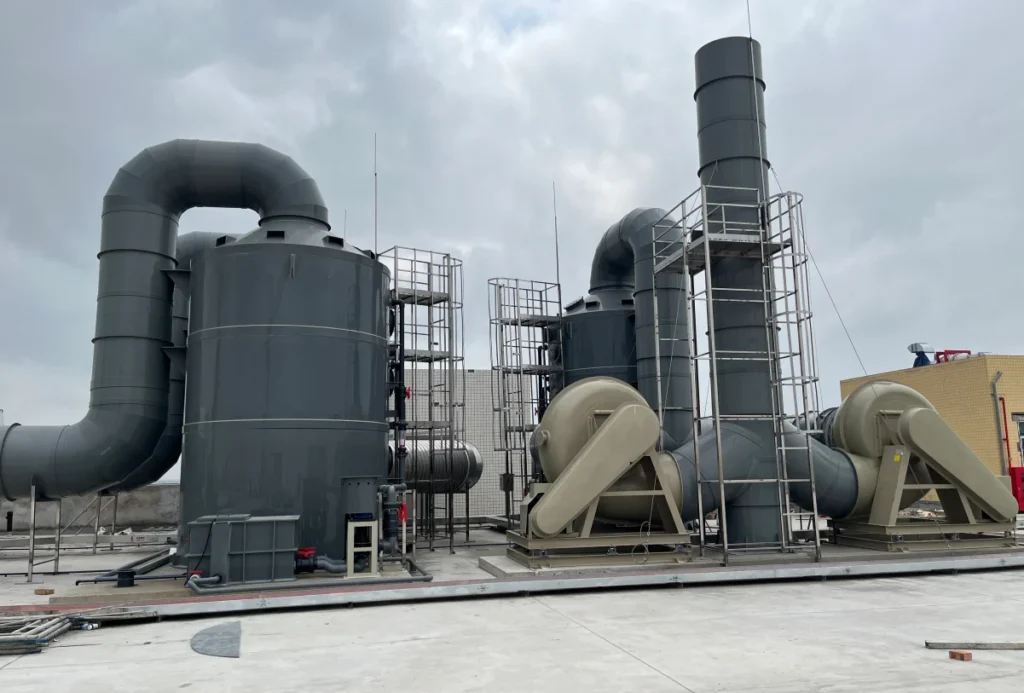
This page is written from the factory side. Xicheng EP is a China FRP blowers manufacturer that builds polypropylene and fiberglass reinforced plastic (FRP) centrifugal blowers for corrosive exhaust, fume extraction and gas-treatment service, and ships them direct to buyers in India, the Middle East and Southeast Asia. If you are here because you are comparing frp blowers manufacturer quotes — an India fabricator, a US brand, and a China factory — this page explains how those three compare, what a direct-from-China order actually involves (MOQ, lead time, motor voltage, crating, documents), and the five-sheet data set you need in front of you before you ask anyone to quote. The goal is a machine that arrives sized correctly, balanced correctly, and priced at a manufacturer’s level rather than a trader’s markup.
The Supplier Landscape: Who Sells FRP Blowers in 2026
A search for frp blowers manufacturer returns three distinct groups, and knowing which one you are talking to is half the negotiation. The groups compete on the same machine — a centrifugal blower with a corrosion-resistant polymer casing and wheel — but their price structure, delivery and commercial terms are engineered on completely different assumptions. Understanding the split lets you match the group to your project before you compare individual quotes.
US and European Brands — Premium Price, Long Lead Times
The American and European FRP fan houses are the engineering reference for the category. Their catalogs define what a proper fiberglass reinforced plastic fan looks like: premium flame-retardant vinyl ester resin systems (Ashland Derakane and Hetron grades are the ones quoted by name), an inner corrosion-resistant “C-veil” liner, stainless hardware, backward-inclined impellers with no metal in the airstream, spark-resistant construction with graphite impregnation for flammable service, and certified curve data from independent laboratories.
This is precisely the construction standard the general glass-reinforced plastic reference describes for corrosion duty. What the same brands are not — and this is the structural flaw in using them as a default — is responsive to a cross-border buyer with a 415 V 50 Hz motor question, a 4-to-6-week build window, or a single-unit prototype order. US and European quotes carry domestic engineering labor, metal-safety certification overhead and multi-week or multi-month factory schedules, and the price lands 2 to 4 times a comparable Asian build before freight. They are the right answer when a project demands a nameplate with an AMCA-certified curve and a Western engineering stamp — and the wrong default for a mid-size fume-exhaust or scrubber project that needs a working machine on a working lead time.
India FRP Blower Manufacturers — Strong Domestically, Thin on Export Terms
The India-based group is far the most common result for the frp blowers manufacturer and frp blowers supplier phrases, with good reason: there is a deep, long-standing fiberglass industry in Gujarat, Mumbai, Pune and Bengaluru, built around chemical plants, plating shops, effluent treatment and scrubber trains that all need corrosion-resistant fans. India builders genuinely know PP+FRP construction, offer capacities from about 150 CMH well past 100,000 CMH, and quote motor voltage, casing material and impeller type natively for their own market. The honest gap is on the export side: most of these shops are regional fabricators whose order book, commercial terms, balance-grade documentation and crating practice are built for domestic delivery, and whose pages rarely publish MOQ, lead time, or test data. For an Indian buyer domestic proximity is a real advantage — spare wheels in days, local rupees — but for a buyer outside India, comparing an India fabricator and a China manufacturer on export terms is the point of this page: what matters is the trade package, not the passport sticker.
China FRP Blower Manufacturers and Exporters — the Direct Option
The China group is the manufacturer-direct lane that the SERP under-serves: China FRP blower and PP blower factories rarely rank for the generic phrases even though they build the largest share of the world’s polymer fan volume. A China manufacturer — the kind that is also a fiberglass centrifugal blower manufacturer landing in frp blowers suppliers results via B2B marketplaces — sells the same centrifugal machine family with the trade terms that cross-border projects need: IEC motors wound for 415 V 50 Hz, balance to ISO 1940, plywood crates with the impeller restrained, commercial documentation, and workable MOQs from single evaluation units up to container quantities. The difference between the best and worst of this group is not the material list — everyone uses the same resin names — but the test discipline, the impeller-balancing rig, and whether the factory will size the machine against your system curve instead of quoting a catalog page. That is the distinction this page is built to help you verify.
| US / European brand | India manufacturer | China exporter (direct) | |
|---|---|---|---|
| Typical FRP blower range | 6–72” wheel, certified curves | 150–100,000+ CMH | 1,000–100,000+ CMH, made to order |
| Price level (same duty) | 2–4× Asian build | Moderate, export-adjusted | Manufacturer-direct, lowest per CFM |
| Lead time | 8–20+ weeks | 4–10 weeks | 3–7 weeks typical |
| MOQ | 1 (at full price) | 1–5 units | 1 piece prototype to full container |
| Certification visible | ISO 9001, AMCA / independent test | ISO 9001, CE often cited | ISO 9001, ISO 1940 balance, CE on request |
| Export trade package | Built for domestic + EU/US | Thin on export terms | IEC 415/380 V 50 Hz, crating, docs standard |
| Best fit | Auditable certified projects | India-domestic customers | India / Middle East / SEA buyers sourcing direct |
None of the rows is “better” in the abstract — the table exists so the comparison is made on the decision the buyer actually faces. For a corrosive-fume or scrubber project outside the US and EU, the practical question is usually China manufacturer versus India manufacturer on export terms, and the deciding variables sit inside that trade package. The wheel and casing choice behind all three columns is the same selection logic covered on this site’s forward versus backward curved fan comparison and the general centrifugal fan reference.
What We Build: FRP and PP Blowers From the Factory Floor
Xicheng EP is a frp blowers manufacturer and PP blower manufacturer working from the material up: the factory laminates FRP casings, welds polypropylene bodies, balances impellers, and test-runs every machine before crating. Because the polymer blowers on this page are made to order against a data sheet rather than drawn from shelf stock, the practical build decision is the material decision — FRP, PP, or the PP-and-FRP composite that most corrosion service actually wants — and the two product families below cover the split.
FRP Blowers — Fiberglass Casing for Corrosive and Hot Gas Streams
The FRP line is the fiberglass reinforced plastic centrifugal blower: a laminated casing and impeller built with glass reinforcement in a corrosion-resistant resin matrix. For gas streams that are hot, strongly acidic, or carry abrasive or solvent load, the FRP machine is the structural standard — the composite wall carries the strength that a softer thermoplastic loses at temperature, and it shrugs off halogenated, oxidising and mixed-acid attack that would shorten a painted metal or polyester build.
Construction follows the accepted laminate recipe: a corrosion barrier liner on the wetted face (the “C-veil” or Nexus veil layer that shields the glass from chemical wicking), a structural laminate behind it, flame-retardant vinyl ester resin for the standard chemical build (bisphenol A epoxy vinyl ester for the hot or harsh cases, epoxy novolac vinyl ester — the “super” ester — for the worst ones), and stainless or non-metallic hardware so the fasteners do not become the corrosion point. Where the stream is flammable, graphite is added through the laminate and the impeller bonded into a spark-resistant construction with proper grounding — the machine family this site details in the corrosion resistant blower guide. Impellers follow service, not fashion: backward-inclined or backward-curved blades for the standard low-turbulence, power-limiting chemical duty, forward-curved where the CFM-per-watt and space matter more than pressure, radial-tip where the stream carries droplets or solids, reviewed on this site’s centrifugal fan explainer.
PP Blowers — Polypropylene Wetted Parts for Alkaline and Humid Streams
The PP line is the polypropylene welded blower, and in practice most of the machines this factory ships are built PP wetted parts with an external FRP or reinforced shell, which is why the pp frp blower supplier phrase and the frp blowers manufacturer phrase point at the same bracket. Polypropylene carries the wetted service — dilute sulphuric, hydrochloric and nitric acid fumes, dilute caustics, plating and anodising vapours, and the humid mist from wet scrubbers — welded into a leak-tight casing with continuous service to roughly 80–90 °C. PP is lighter than the glass laminate, welds fast, and is the least-cost answer for the bulk of fume-extraction exhaust; the composite version adds the shell that keeps a hot, flexing thermoplastic body from creeping under an external duct load. The hub of this material logic is this site’s FRP versus PP blower comparison, which assigns each material by temperature, chemistry and mechanical duty rather than preference.
Configurations — Direct Drive, Belt Drive, VFD-Ready
Every FRP and PP blower in the range is quoted in the configuration the application needs, and the configuration is part of the data sheet, not an afterthought. Direct-drive build puts the impeller on the motor shaft through a seal, keeps the footprint small, and is the right answer where the motor can live close to the machine and speed control is handled on the drive side. Belt-drive build parks the motor outboard of the casement with sheaves and belts, isolating it from the gas path entirely — the standard arrangement where the stream is corrosive or potentially flammable and the motor must be a safe distance from the wheel — and lets the duty point be set by sheave ratio rather than by buying a new motor. VFD-ready means the motor and wheel are selected so a variable-frequency drive can ride a rising system curve — the carbon-bed and loaded-scrubber case that this site’s gas-treatment exhaust fan guide explains in full — and the drive itself is supplied where the project specifies it.
| Representative duty | Machine | Capacity | Static pressure | Typical motor |
|---|---|---|---|---|
| Plating / anodising fume exhaust | PP centrifugal, backward-inclined wheel | 3,000–15,000 m³/h | 1,000–2,500 Pa | 1.5–7.5 kW, 415 V 50 Hz, TEFC |
| Chemical-plant acid scrubber discharge | FRP centrifugal, vinyl ester + C-veil | 10,000–60,000 m³/h | 2,000–4,500 Pa | 7.5–30 kW, belt or direct |
| Laboratory / semiconductor exhaust | PP or PP+FRP, direct drive | 1,000–10,000 m³/h | 800–2,000 Pa | 0.75–5.5 kW, VFD-ready |
| Effluent / sewage odour and aeration | FRP or PP corrosion-resistant | 5,000–100,000 m³/h | 1,200–4,000 Pa | 3–45 kW, VFD-ready |
| Wet scrubber / gas-treatment train | PP or FRP, belt drive, spark-resistant option | 5,000–80,000 m³/h | 2,500–6,000 Pa | 5.5–37 kW, isolated motor |
The table is illustrative, not load-bearing: every row is a data-sheet starting point, and the actual wheel, speed and motor are chosen against the system curve the project supplies. That is the difference between buying from a catalog and buying from a frp blowers manufacturer who sizes to the point of operation. The two product lines behind the table are the FRP blowers product range and the polypropylene blowers product range.
Certification, Testing and Quality at a China Manufacturer
The material list on a quote is easy to copy; the test discipline behind it is what separates one frp blowers manufacturer from another. This section is the audit checklist that a buyer can run against any candidate — us, or a competitor — in a single round of questions, and it is the section most manufacturer homepages never write down. When a quote cannot answer these three checkpoints with documents, the price is not the risk; the missing data is.
ISO 9001 as a Factory System, Not a Sticker
First, the quality system. ISO 9001 says the factory runs documented, controlled processes — production records, material traceability, calibration of the instruments that matter, and a corrective-action loop — and a serious manufacturer treats it as the operating procedure rather than a wall plaque. On a made-to-order fiberglass blower the traceability matters concretely: the resin batch used for a casing, the impeller balance report, and the run-test sheet should be attachable to the serial number of the machine in the crate. The general reference for the management-system idea lives in the ISO 9000 family material, but the practical request is a copy of the certificate and a sample of a real production record, not the brochure that mentions it.
Impeller Balancing to ISO 1940 and a Run Test Before Crating
Second, the vibration story, which is where FRP blowers fail in the field. Imbalanced polymer impellers — especially vinyl ester wheels that absorb moisture or resin-rich webs that cast heavy — are the source of most premature bearing failures on corrosive service, and the fix is boring and verifiable: the impeller is balanced to an ISO 1940 quality grade (G6.3 for the standard build, G2.5 for high-speed wheels), recorded on a balancing report, and the assembled machine runs at operating speed against a vibration meter before it is crated. The rotor balancing reference explains the grades and the measurement; the request to a supplier is the balance report for the actual impeller in the shipment and the run-test sheet showing rms velocity at the fan bearings. A supplier that produces a current balance report for a single order is doing what its certificate advertises; one that says “standard industry practice” without the paper is not.
Resin, Veil and Fire-Retardant Options by Stream Chemistry
Third, the laminate specification, written down. Every corrosion-resistant FRP blower in this factory’s catalog is quoted with the resin family named — isophthalic polyester for general acid service, flame-retardant vinyl ester for the standard chemical build, bisphenol-A vinyl ester for hotter streams and stronger oxidisers, and epoxy novolac vinyl ester (the “super” ester) for the aggressive halogenated and mixed-acid cases — plus the corrosion barrier arrangement: a minimum 300-micron resin-rich “C-veil” inner layer on the wetted face, and Nexus organic veil where the stream’s chemistry attacks glass specifically. The same discipline that this site’s chemical resistant exhaust fans guide applies to application, the quote applies to laminate: if the supplier cannot write down the resin and veil on the data sheet, the machine cannot be bid, because those two lines decide how many years the casing survives.
MOQ, Lead Time and Export to India, the Middle East and Southeast Asia
The trade terms are where direct-from-manufacturer buying either works or falls apart, so they get their own section and their own straight answers. These are not secret numbers we quote privately; they are the operating terms of a China FRP blower factory that ships to buyers, not to traders, and they are published here so a comparison is possible before the first call.
Workable MOQs, From One Evaluation Unit to Container Quantities
Minimum order quantity follows the purpose of the order. A project replacing one failed exhaust fan, or validating a supplier with a single machine, is a legitimate order for one piece at a list price with the same balance and run-test discipline as a batch — manufacturers built on made-to-order work never learned to refuse single units because the single unit is how cross-border trust starts. At the other end, a plant standardising a line, or a distributor building stock, orders by the container, and the per-unit price, engine mounting, spare parts and documentation are quoted as one package. The practical middle — two to ten units for one site — is the sweet spot where tooling, shared fan curves and common impeller diameters make batch pricing kick in. No MOQ is a barrier on this range; the honest question is which pricing band the order’s size puts it in.
Lead Times: Standard, Custom, and the Fabrication Walk
Lead time divides into two honest numbers. A blower built on a proven impeller pattern — the standard FRP or PP sizes in the product range — is fabricated, balanced and tested in roughly 2 to 4 weeks from a confirmed data sheet, because the laminate, curing, balancing and motor sourcing are a sequence we run every week. A genuinely custom build — an unusual impeller diameter, a special material laminate, a frame size we have not jigged — adds design and pattern time, and the honest number goes to 4 to 7 weeks. The “fabrication walk” covers curing: FRP composite structures are laid up, cured, post-cured where the resin chemistry requires it, and only then machined, balanced and painted, and a factory that rushes that schedule sells you a blower that de-laminates in its second year. Planned correctly, the total from confirmed data to a crated machine stays inside 7 weeks for most builds, and freight time is quoted separately below.
Export Specs: Voltage, Crating, and the Documents in the Bis
Export service is the China manufacturer’s home turf, and it is all specified at order time:
- Motor voltage. The standard cross-border build is proportionate to the destination market: 415 V 3-phase 50 Hz for India, 380–415 V 50 Hz across the Middle East and Southeast Asia, with 60 Hz motors only when the site actually runs 60 Hz. Motors are IEC-frame TEFC with IP55 and class F insulation as the standard, and the voltage-hertz line is written on the data sheet, not assumed.
- Hazardous service. Where the gas stream is flammable, the motor and drive specification follow the ATEX or Indian/regional classification called for in the project enclosure, and the spark-resistant wheel and casing option — graphite-loaded laminate plus grounding — is quoted at the same time.
- Crating. FRP and PP blowers ship in plywood or steel-framed crates with the impeller restrained, the shaft packed against transit movement, and the flange faces protected; a wheel that vibrates loose in a container reaches the site cracked, so the crate plan is part of the build, not the freight.
- Documents. The export set — commercial invoice, packing list, bill of lading, and a certificate of origin on request — is standard, and pre-shipment inspection is offered rather than resisted, because a photographed crated machine with serial number and balance report buys more trust than any claim in an email.
Freight planning is, honestly, the buyer-friendly part of buying direct: sea freight from China to Nhava Sheva or Mundra runs roughly 3 to 4 weeks, to Jebel Ali or Dammam roughly 2 to 4 weeks, and to Southeast Asian ports roughly 1 to 3 weeks, so a 3-week build plus one freight leg is a realistic total of 5 to 7 weeks door-to-mill. The quote answers to pin down from any frp blowers manufacturer are the three of this section — price band by MOQ, build time split standard-versus-custom, and the freight leg — taken together with the contact form rather than spread across three email threads.
How to Evaluate Any FRP Blowers Manufacturer: The RFQ Checklist
This section is the work item of the page. Whether the shortlist is Xicheng or a competitor, the way to buy with your eyes open is to send every candidate the same RFQ data set and compare the answers on paper. A real frp blowers manufacturer answers all of it; a fabricator with a gallery page answers the parts it can and goes quiet on the rest, and that silence is the signal. Gather the five numbers below and no supplier has any reason to guess.
The Performance Data to Send, in Five Numbers
Take the request to a form, not a description:
- The required flow — in m³/h or CFM — at the fan inlet, not at the hood.
- The static pressure the fan must clear — the sum of duct, hood, terminal, filter or scrubber element losses at that flow, worst-case.
- The gas chemistry — what the stream actually contains, at what concentration and temperature, and whether it is saturated or has carryover droplets.
- The altitude and ambient at the installation site to correct density.
- Motor and control preference — voltage/hertz, direct or belt or VFD, enclosure level, and hazardous-area classification if the gas is flammable.
With those five lines filled, the sizing discipline behind the machine is the same one this site builds the whole high pressure blower selection guide on: pick the operating point, not the category. Any supplier told the flow and worst-case pressure and chemistry can quote a machine; the difference is whether the quote includes the wheel and casing reasoning that justifies the size.
The Material and Wheel Lines to See Written Down
On the returned quote, check three lines before the price. First, the material line: casing and impeller laminate named by resin (vinyl ester, bisphenol, epoxy novolac), the corrosion-barrier veil, and the wetted hardware spec — if the quote says only “FRP,” it is a recipe without ingredients. Second, the impeller line: wheel type (backward-inclined for the standard chemical duty), diameter, tip-speed ceiling, and the ISO 1940 balance grade attached to a balancing report. Third, the build line: direct or belt drive, shaft and bearing spec, drain and inspection access on the casing, and the hardest question — whether the factory will supply the fan curve against your operating point and certify it under an independent air-movement program such as AMCA. A frp blowers manufacturer who does made-to-order work publishes curves per build; one who sells only shelf sizes hands you a table instead.
Commercial Terms Worth Pinning Down Before Any Order
Finally, put the trade terms in writing on the same data sheet: the MOQ band the price assumes (one, five, or container), the quoted lead time split into build time and freight leg, the incoterm (FOB and CIF or DAP are the workable defaults for this trade, with the freight leg quoted so there is one number to compare), the payment terms, and the warranty language — what is covered and for how long, and how a spare impeller or replacement part is priced and shipped within it. Buyers who add this third section to the RFQ shorten their own negotiation by weeks, because the commercial sheet is where the honest factories are comfortable and the traders start chiselling.
FRP or PP, and the Rest of the Selection Chain
How to Choose FRP vs PP for Your Gas Stream
Given the same five-line data set, the material decision falls into a ladder. If the stream is dilute mineral acid or caustic fume, humid from a scrubber, around or below 80–90 °C, and mechanically light — the ordinary fume-extraction case — a polypropylene build is the least-cost honest answer, welds leak-tight, and handles the wet wall without drama. If the stream is hotter than the PP ceiling, stronger in acid or oxidising chemistry, abrasive, or carries the mechanical load of a bigger wheel and higher static pressure, the FRP build takes over: the composite wall carries the strength the thermoplastic loses at temperature, and its resin family is chosen against the specific chemistry. Where the stream is literally both — humid dilute acid on a big machine — the composite, PP wetted parts with an FRP shell, splits the difference, which is why PP+FRP construction is the default on this factory’s scrubber and fume lines rather than an option.
The full reasoning ladder is the FRP versus PP blower comparison, and the temperature side of the same question is covered there.
Beyond the material, the rest of the selection chain for a corrosion-service FRP or PP blower lives in the articles this site has built around the same machine family, and a buyer sizing one of these will hit most of them:
- Start with the wheel and principle — what a centrifugal fan is and forward versus backward curved wheels.
- Match the material to the stream — the sitewide FRP blowers guide, the polypropylene blowers guide, and the corrosion resistant blower guide.
- Where the gas is chemically aggressive in the exhaust train, the chemical resistant exhaust fans guide and the gas-treatment exhaust fan guide carry the sizing side.
- Pressure, speed and drive are the third axis — the high pressure blower guide, the direct drive blower guide and the following article on evaluating any frp blowers manufacturer on centrifugal fan drives.
Those links exist so that a buyer who lands on the purchase page can walk the whole selection chain from wheel to drive without leaving the site; the purchase decision here is the last click, not the first education.
FRP Blowers Manufacturer FAQ
What is the minimum order quantity for FRP blowers from a China manufacturer?
There is no content MOQ on the standard range: a single evaluation unit is a legitimate order at list price with the same balancing and run-test discipline as a batch, and batch or full-container pricing applies from roughly two to ten units up to whole-container quantities. The quote always states which MOQ band its price assumes.
How long does production take, and how long is shipping to India, the Middle East or Southeast Asia?
Standard builds are fabricated, balanced and tested in roughly 2 to 4 weeks; custom builds with a new impeller diameter or special laminate run 4 to 7 weeks. Sea freight from China to Nhava Sheva or Mundra is about 3 to 4 weeks, to Jebel Ali or Dammam about 2 to 4 weeks, and to Southeast Asian ports about 1 to 3 weeks, so a realistic total is 5 to 7 weeks door-to-mill.
Can you supply the blowers for 415 V, 50 Hz motors?
Yes. 415 V 3-phase 50 Hz is the standard winding for the Indian market, and 380-415 V 50 Hz is standard across the Middle East and Southeast Asia, all on IEC-frame TEFC motors with IP55 and class F insulation. The voltage and hertz line is written on the data sheet, and 60 Hz windings are quoted only where the site actually runs 60 Hz.
How are FRP blowers packed for export?
In plywood or steel-framed crates with the impeller restrained, the shaft packed against transit movement and the flanges protected. The crate plan is part of the build, so a wheel cannot vibrate loose in a container. A pre-shipment inspection with a photographed, serial-numbered crated machine is offered rather than resisted.
Can FRP and PP blowers be customised for a specific gas stream?
Yes. The build is made to order against the data sheet: flow, worst-case static pressure, gas chemistry, temperature and motor voltage. The material, resin family, veil, impeller wheel type and drive follow that data sheet, so a machine for hot strong-acid scrubber discharge and one for dilute plating fume are different builds, not re-badged shelves.
How do I know the impeller is balanced before it ships?
The impeller is balanced to an ISO 1940 quality grade (G6.3 standard, G2.5 for high-speed wheels) and the assembled machine runs at operating speed against a vibration meter before crating. That is issued as a balance report and a run-test sheet with the serial number, and the buyer should ask to see both — from any frp blowers manufacturer, not just us.
Get FRP Blower Pricing Direct From the Factory
This page reduces to one exchange: the five-line RFQ set — flow in m³/h or CFM, worst-case static pressure, gas chemistry and temperature, site altitude, and motor voltage — sent to a manufacturer who sizes to the operating point and answers MOQ, lead time and freight in the same quote. That is the whole difference between buying from a frp blowers manufacturer and buying from a catalog broker, and it applies whether the order is one evaluation machine or a container. The PP and FRP blower range on this site is built exactly that way, and sending the five numbers gets back a matched machine — material by chemistry, wheel by the point of operation, drive by the stream, motor wound for the site — priced at the factory and quoted with the trade terms in writing.