Key Takeaways: High Pressure FRP Blowers
- High pressure frp blowers are corrosion-resistant centrifugal fans that hold high static pressure, typically 5,000 to 15,000 Pa in a single stage. The FRP housing and impeller handle acids, solvents, and halogens that would eat steel quickly.
- High static pressure changes the build. High pressure FRP blowers need 8 to 12 mm laminate housings — against 5 to 6 mm for a standard FRP centrifugal — plus a radial impeller with a backplate to stop pressure flexing the casing.
- Polypropylene is the second half of the answer, at a lower pressure band. PP high static pressure blowers, like the Plastec STORM line, use forward-curved wheels and stop well short of high pressure frp blowers of the radial class; PP is capped at about 180 to 190°F continuous.
- Resin and temperature decide the FRP ceiling. Standard vinyl-ester FRP runs to about 176°F continuous; special resins reach about 226°F, and the laminate, not the fan shape, sets the boundary.
- Keep the motor out of the airstream and match the drive to the pressure. Arrangements 8 and 10 put belt drives and bearings outside the corrosive flow, which is why high-pressure polymer duty so often runs belt-driven rather than close-coupled. Those facts compress high pressure frp blower datasheets into one readable page.
What Is a High Pressure FRP Blower?
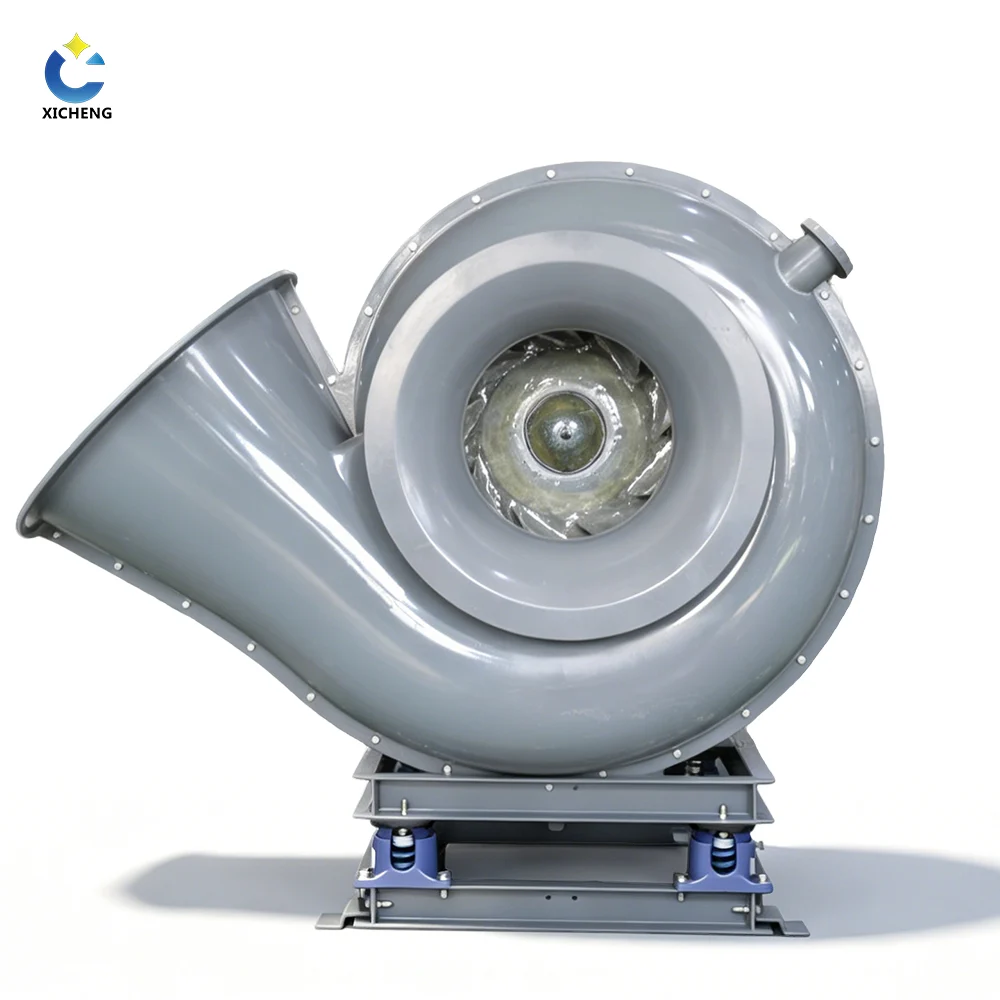
A high pressure frp blower is a corrosion-resistant centrifugal fan built from fiberglass-reinforced plastic and designed to deliver static pressure that a standard FRP centrifugal fan cannot. Air Emissions, which builds scrubbers and their blowers, defines the class in numbers: a high pressure FRP blower generates static pressure above 5,000 Pa and reaches roughly 15,000 Pa in a single stage — typically two to three times the pressure of a standard FRP centrifugal fan. The housing and impeller are fabricated from glass-reinforced plastic so the machine survives acids, solvents, halogens, and wet gases that attack painted steel within a season.
The phrase sits inside a wider family: a high pressure centrifugal fan can be built in steel, aluminum, FRP, or polypropylene. The material is what this article owns. Steel and aluminum carry the top of the pressure range at high temperature but lose the chemistry fight; FRP handles the corrosive side of high pressure; polypropylene handles moderate pressure with an even lower material cost. The centrifugal fan primer on this site explains the common geometry, and the high pressure blower selection guide sets the method this article builds on.
The Dual-Material Answer to High Static Pressure
Two polymer families dominate high-pressure corrosion duty. Fiberglass-reinforced plastic brings the structural strength to hold a heavy static pressure with a radial or backward-curved wheel, and it tolerates a broader chemical range and higher temperature than common thermoplastics. Polypropylene brings the lowest material cost and free-form welding, but its practical service is capped at about 180 to 190°F continuous and its typical high-pressure wheels are forward-curved, which constrains the pressure band well below the FRP class. The right choice depends on the pressure the system truly needs and the temperature of the gas at the fan.
Read high pressure frp blower datasheets with both eyes on two numbers: the static-pressure band the curve actually holds and the resin grade the housing is built from. A machine that quotes the pressure without the resin is quoting half the specification, because the resin is what survives the stream that pushed you toward fiberglass in the first place. When the two numbers line up with your duty, the build — thick laminate, sealed shaft, motor outside the flow — is what the later chapters of this guide walk through.
Everything below walks that comparison in the same order as the method: the pressure requirement first, then the wheel family, then the material, then the construction that keeps the fan alive in the corrosive airstream.
One caution before the numbers. “High pressure” and “corrosion resistant” are both marketing words that appear on products that cannot produce either. A thin FRP fan with a forward-curved wheel can be sold as “high pressure” and will not deliver the curve a scrubber demands, and a coated metal fan can be sold as “corrosion resistant” and will still blister inside a warm acid stream. The numbers in this guide are the filter: pressure per stage, laminate thickness, resin grade, and continuous temperature. Demand them from the supplier before comparing anything else, and the difference between a real high pressure frp blower and a marketing page becomes obvious in one screen.
The Method Handoff: Same Curve, Material Now Decides
The high pressure blower chapter of this cluster establishes the selection method: measure the real duct resistance, plot the operating point on the fan curve, leave stall margin, then pick the wheel family. Nothing changes when the housing is fiberglass or polypropylene. High pressure frp blowers are still chosen against the system curve, never against a free-air CFM number on a datasheet. What changes is the material decision that follows the pressure figure.
Recap: Operating Point, Then Material
Read the pressure the system needs and the flow at that pressure, mark them on the curve, and confirm the operating point sits away from the stall region. Then translate that pressure to a wheel family: forward-curved for the low band, backward-inclined and radial for the upper bands. The types of centrifugal fans guide maps those families, and the pressure number you honestly measure decides which family is even in the conversation.
Where Steel and Aluminum Step Aside
With the pressure and wheel settled, the material question is about the gas, not the curve. Warm clean air runs fine on coated steel. But when the stream carries acid mist, solvent vapor, halogens, or a wet combination of them, steel and aluminum exhaust their useful life before the warranty does. At that point the economics flip: a polymer blower costs more up front than painted steel but outlasts it by years in corrosive service, and the fan-systems guidance on energy.gov still applies because the efficiency and curve work are identical once the material is right for the duty.
In practical terms this is why high pressure frp blowers are quoted after the chemistry is confirmed, not before. The resin that shrugs off the stream matters as much as the wheel that holds the pressure, and a supplier who prices the machine before knowing the worst component is pricing a guess. Send the full chemistry, not just the pressure, and the quote comes back with the resin and the laminate to match.
FRP High-Pressure Capability: Numbers First
The reason to specify high pressure frp blowers is the combination of pressure and chemistry that metal cannot carry. Grasp the numbers before the materials, because every construction choice hangs off them.
Static Pressure Band: 5,000–15,000 Pa and Beyond
The class definition is concrete: a single-stage high pressure FRP blower holds roughly 5,000 to 15,000 Pa, or about 20 to 60 inches of water column, which is two to three times what a standard FRP centrifugal fan delivers. Radial and backward-curved wheels carry this band; forward-curved wheels do not. Texas engineering vendor Texel Seikow quotes the top of its FRP backward-curved range at 18.0 inches of water column across large frames to 130,000 cfm, which matches the same family judgment. These frp pressure blowers are the machines that push a chemical scrubber, a tall stack, or a long corrosive duct without stalling. When the air is corrosive and the curve calls for this band, high pressure frp blowers are the standard answer — nothing in the polymer catalog below it holds the pressure, and nothing in metal survives the stream.
Construction That Contains the Pressure: 8–12 mm Laminate
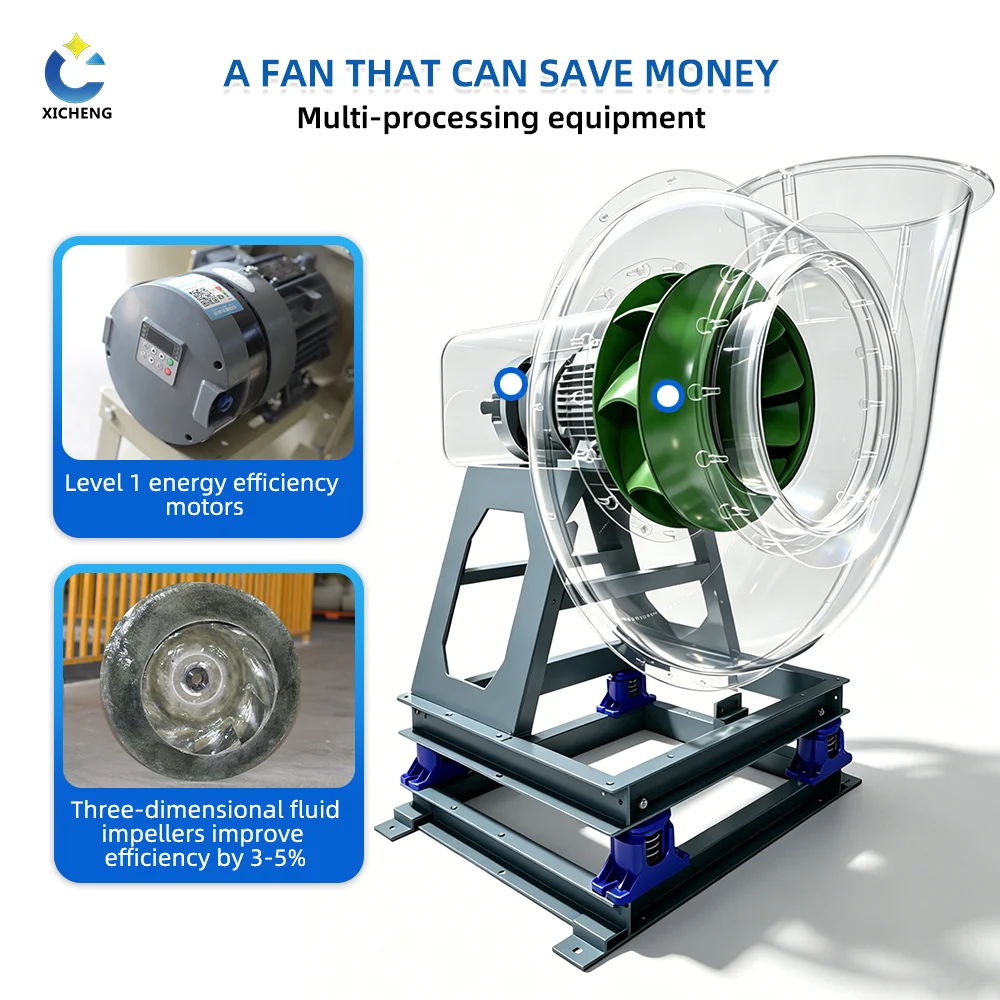
High internal pressure flexes a housing, and flexing cracks a corrosion liner. That is why the laminate is the sensor of the class. High pressure FRP blowers carry an 8 to 12 mm housing laminate, while a standard FRP centrifugal runs 5 to 6 mm, and the thicker wall is what keeps the casing from deflecting at the operating pressure. The impeller follows the same logic: a radial wheel with a full backplate keeps the blades and hub stable under the differential, which is the construction Air Emissions names for its pressure blower range.
Ask a supplier to break the wall down when you compare quotes. A corrosion-resistant FRP housing is rarely a single laminate: it layers a resin-rich corrosion barrier on the gas side, a structural build-up behind it, and often an external veil, and the total thickness is what the pressure rating rests on. Two machines can both be called “FRP” and differ in the barrier resin and the structural resin, which changes the chemistry they can carry as much as the pressure they can hold. The 8 to 12 mm figure is a floor for the high-pressure class, and the laminate make-up half of the paragraph is worth printing on the datasheet before you sign.
Resin and Temperature Limits
Fiberglass is not one material; glass-reinforced plastic is a resin-plus-glass system, and the resin sets the chemistry and temperature ceiling. Standard vinyl-ester FRP runs continuously to about 176°F; special resins lift the practical ceiling to roughly 226°F, and higher-temperature laminates exist for specific duties. Wikipedia’s glass-reinforced plastic entry walks the resin families, and the centrifugal fan entry frames the wheel physics. Above the resin ceiling, or where the stream is too reactive for polyester or vinyl ester, hand the duty back to lined steel or a metal alloy — the polymer line is not universal.
Our FRP blowers and the frp blowers pillar page carry the material and manufacturing detail, and the pressure band in this section is what the high-pressure range of that line is built to hold.
The PP High-Pressure Band: Lower Pressure, Higher Temperature Ceiling
Polypropylene is not the poor cousin of FRP in high-pressure duty; it is the budget half of the same answer, and it serves a real band of the market that FRP reaches from above. The evidence that the band exists comes straight from the catalogues. Plastec sells a “STORM” line of high static pressure polypropylene blowers — the STORM-12 is a direct-drive, forward-curved polypropylene blower marketed for high static pressure fume and scrubber extraction. Indus Fan lists a polypropylene high-pressure centrifugal model, PP6-30, in the same product family as its FRP high-pressure F9-19. The machines exist; the question is where their ceiling sits.
Forward-Curved Wheels Set the PP Ceiling
The Plastec STORM design tells the story by choosing a forward-curved wheel. Forward-curved polypropylene wheels are cheap to mold and give high flow for a small wheel, but their efficiency drops steeply past roughly 1.5 inches of water column, which caps the practical pressure band far below the FRP radial class that high pressure frp blowers occupy. So when a supplier talks about high pressure polypropylene fans, read it as “moderate pressure, corrosion budget, fume-hood scale,” not as radial-class pressure. The round-number check is simple: if your system needs 5,000 Pa or more, the forward-curved PP wheel is already off the curve. Before you reach for high pressure frp blowers on a job that only needs moderate pressure, price the high pressure PP machine first — the FRP build carries a cost premium of 40 to 80 percent above the standard class for pressure the hood may not need.
The 180–190°F Ceiling
Temperature is the second constraint. A standard polypropylene blower alloy serves continuously to about 180 to 190°F, matching the 80 to 100°C deformation zone polymer suppliers quote. A high static pressure polypropylene blower in a warm fume stream must be selected with that ceiling verified at the fan inlet, not at the source. Above the ceiling, or where the pressure band reaches into the class that high pressure frp blowers own, the wheel and housing hand off to fiberglass, which is exactly the trade this cluster’s PP blowers page and the polypropylene blowers guide cover from the material side.
The build philosophy also differs. A PP high-pressure blower is usually welded sheet — panels cut from extrusion, heat-fused at the seams, with the wheel either molded or fabricated from welded blades. FRP is laid up in a mold around the same wheel geometry, which is why FRP handles complex curved housings more easily than PP fabrication does. Neither approach is wrong; they are differently tooled answers to the same corrosion problem, and the shop floor that welds PP well is not necessarily the one that laminates FRP cleanly. Ask which process your supplier actually runs in-house before the price conversation starts.

FRP vs PP at High Pressure: The Decision Table
One table settles most material questions for high pressure frp blower projects, because the two polymers do not really compete across the same band — they serve adjacent bands and the stream’s worst chemical member pushes the choice. High pressure frp blowers own the top of the band; the high pressure PP machine owns the budget half. Nine times out of ten the failure is over-ordering, so read the left and right columns against your real pressure figure before you buy either.
| Factor | FRP high-pressure blower | PP high-pressure blower |
|---|---|---|
| Practical static-pressure band | 5,000–15,000 Pa (20–60 in. W.G.), radial / backward-curved | Moderate; forward-curved ceiling near 1.5 in. W.G. |
| Continuous temperature ceiling | About 176°F standard vinyl ester; to about 226°F special resin | About 180–190°F |
| Wheel family | Radial with backplate, backward-curved | Forward-curved typical; BI on larger frames |
| Chemical range | Broad: acids, solvents, halogens (resin-dependent) | Very good for acids and caustics; solvent-sensitive |
| Housing build | 8–12 mm laminate for pressure containment | Welded sheet, light shell |
| Relative cost | Medium-high (40–80% above standard FRP centrifugal) | Lowest of the corrosion-resistant class |
| Best duty | Deep-bed scrubbers, tall stacks, corrosive pneumatic conveying | Fume hoods, modest scrubber circulation, low-temp corrosion budget |
Follow the Worst-Case Member
The stream’s worst component, and its peak temperature, decide the material more than the average does. A gas that is 90% clean air and 10% hot solvent vapor is corrosive and hot enough to rule out PP and standard resins. Specify against the worst case, verify the ceiling at the fan inlet, and keep the operating point inside the band this table draws. The cluster’s FRP-versus-PP comparison and the PP/FRP blower category carry the same decision across the whole product range.
Construction for High-Pressure Polymer Duty
High pressure frp blowers stay alive in corrosive service because the build matches the pressure and the chemistry at the same time. Four construction details separate a machine that runs for a decade from one that fails within a season.
Thick Housing, Radial Backplate, Shaft Seals
Pressure containment comes first: the 8 to 12 mm laminate described above, so the casing does not flex and crack its corrosion liner. The impeller rides on a radial design with a full backplate so the wheel holds its shape under the differential, and the shaft entry carries a seal suited to the stream — packed gland, mechanical seal, or a gas seal where leakage cannot be tolerated. These are the seals a pressure-blower supplier certifies, because a pressure blower that weeps corrosive vapor at the shaft is a leak nobody wants inside the plant.
Keep the Motor Out of the Airstream
Process gas that is corrosive, warm, or vapor-laden must not touch the motor or its windings. Belt-drive arrangements place the motor outside the duct entirely: Arrangement 8 puts the impeller on one side of the bearings with the belt on the extended base, and Arrangement 10 carries the belt drive between bearings on the housing. Both put clean plant air on the motor while the polymer wheel does the work, and both allow speed adjustment without a VFD. Arrangement 1 direct drive is economical for clean, dry high-pressure air but rarely right for the corrosive streams this article is about. frp pressure blowers specified for chemical service are therefore belt-driven in the majority of real installations — and when the pressure and the chemistry are both real, spec high pressure frp blowers with Arrangement 8 so the motor and bearings live out their rated life.
Spark Safety in Non-Metallic High-Pressure Duty
Fiberglass and polypropylene cannot strike an impact spark the way dropping a steel tool on a metal wheel can, which makes a polymer high-pressure fan a natural fit for flammable-vapor atmospheres where the blower itself must not be an ignition source. The non-metallic wheel is only half the answer: the motor still needs the right hazardous-location certification, and the AMCA test standards your datasheet cites should match the duty. The corrosion-resistant blowers chapter and the polypropylene fan blades and impellers parts guide carry the spark and material detail deeper.
Two smaller details round out the build. The shaft that passes through the housing should be a corrosion-resistant alloy — carbon steel with a protective sleeve, or stainless — because the shaft is the one component a polymer housing cannot protect. And the housing should drain: any condensate that collects inside a high-pressure polymer case is the very acid the machine exists to move, so a properly placed drain keeps it from pooling against a seam. Small items, but they separate high pressure frp blowers that survive their first winter from one that does not.
Applications: Where High-Pressure Polymer Blowers Earn Their Keep
The two material classes buy their place in four recurring jobs, and the pressure figure from the system decides which machine shows up.
Deep-Bed Scrubbers and Stack Discharge
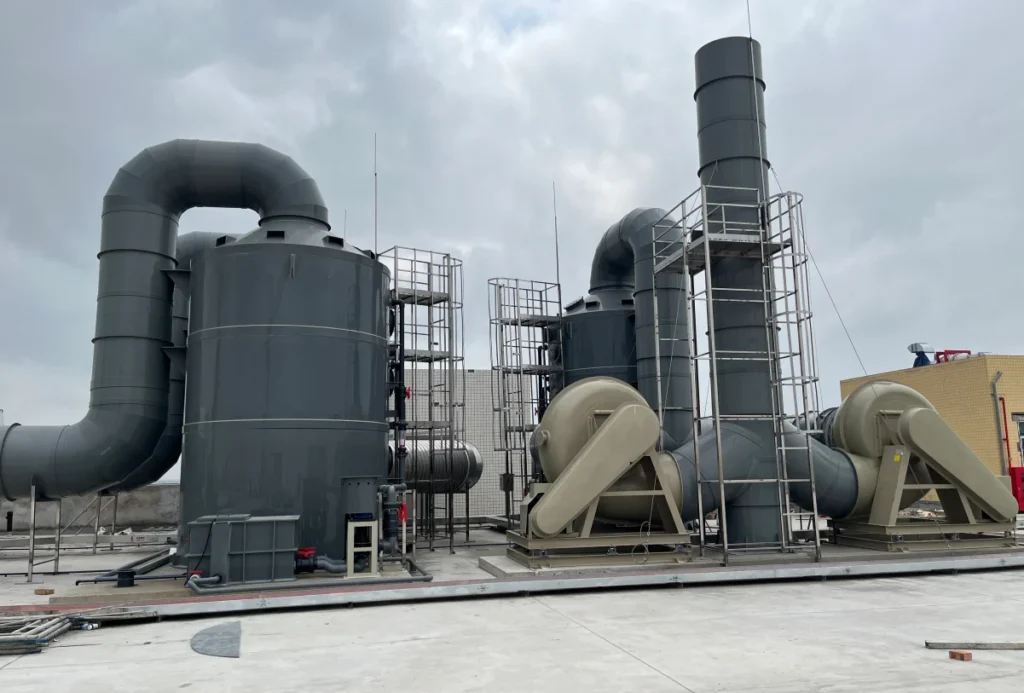
A deep-bed chemical scrubber with more than about 1.5 meters of packing owes its fan a serious static pressure: packing alone can drop 4.0 inches of water column per meter, so a deep bed lands at 8 to 15 inches W.G. That is the FRP radial class, and the industrial wet scrubber line on this site is specified with exactly that margin. High pressure frp blowers on this duty are sized for the worst loaded-filter condition, not the clean run, because the fan must hold the curve as the bed loads and the packing saturates. Stack discharge and high-resistance filtration sit in the same band: long duct, final filter bank, and the stack itself all add to the curve, and a high pressure centrifugal fan rated for chemical service carries them without drifting into stall.
Corrosive Powder Conveying and Fume Hoods
Pneumatic conveying of corrosive powders — salt-laden dust, reactive metal fines — pushes low volume against high pressure through a pipe, the classic radial-machine duty, now built in FRP so the line survives. Fume hoods sit at the other end: their static pressure is modest, so a high pressure polypropylene fan with a forward-curved wheel serves the hood, the duct, and the nozzle drop, capped by the 180 to 190°F line. The chemical-resistant exhaust fans guide carries the hood, duct, and stack logic that turns these jobs into a complete system.
The Application Table
| Application | Static-pressure band | Material class |
|---|---|---|
| Deep-bed chemical scrubber | 8–15 in. W.G. | FRP radial |
| Stack discharge / high-resistance filtration | High | FRP radial / backward-curved |
| Corrosive powder pneumatic conveying | Very high | FRP radial |
| Fume hood extraction | Moderate | PP forward-curved |
| Modest scrubber circulation | Moderate | PP forward-curved |
| Warm solvent fume, low temperature | Moderate | PP (verify inlet temperature) |
| Hot acid fume, high resistance | High | FRP special resin / lined metal |
Walk the table from the pressure figure your system honestly presents. If the number is below the PP forward-curved ceiling and the temperature is under 190°F, the PP machine is the economical answer. If the pressure climbs past that ceiling, or the chemistry bites standard resins, high pressure frp blowers are the ones that stay on the curve.
Frequently Asked Questions About High Pressure FRP Blowers
What static pressure can high pressure FRP blowers reach?
A single-stage high pressure FRP blower reaches roughly 5,000 to 15,000 Pa, about 20 to 60 inches of water column, with a radial or backward-curved wheel. Large FRP backward-curved frames are quoted to about 18 inches W.C. The wheel family and the housing laminate decide where your machine lands inside that band.
Can polypropylene handle high pressure?
Polypropylene handles moderate pressure, not the radial class. Typical high pressure polypropylene fans use forward-curved wheels, whose practical ceiling sits near 1.5 inches W.C. before efficiency collapses. Polypropylene high pressure blowers exist because the moderate band plus corrosion resistance plus low cost is a real job, not because PP replaces FRP at high static pressure.
How thick must an FRP high-pressure housing be?
Roughly 8 to 12 mm of laminate, against 5 to 6 mm for a standard FRP centrifugal. The thicker wall is what prevents the casing from deflecting under high internal pressure and cracking the corrosion liner. Ask the supplier for the laminate thickness breakdown before you compare prices.
Do high-pressure polymer blowers need a special drive?
For corrosive service, yes: keep the motor out of the airstream. Arrangement 8 and Arrangement 10 belt drives place the bearings and belt outside the duct, so the motor breathes clean air while the polymer wheel does the work. Direct drive is for clean, dry high-pressure air.
Are high pressure FRP blowers explosion-safe?
The fiberglass or polypropylene wheel cannot strike an impact spark the way a metal wheel can, which removes one ignition source in flammable-vapor atmospheres. The motor must still carry the appropriate hazardous-location certification, and resin grades need checking for the specific chemistry. Non-metallic is a safety advantage, not a certificate by itself.
High pressure FRP blower vs stainless steel for chemical duty?
Stainless steel wins where temperature or abrasive solids push past the resin line; FRP wins on broad acid and halogen chemistry, lower weight, lower cost, and no weld-line corrosion in most solvents. Estimate ten-year cost of ownership — purchase, lining repair, downtime — because the initial price of the polymer machine is frequently higher than painted steel but its service life in corrosive air is far longer.
Get a High Pressure FRP Blower Recommendation for Your Duty
Every decision in this guide collapses to three facts: the static pressure the system truly presents, the worst component and peak temperature of the gas at the fan inlet, and the flow you need against both. Send those three facts to the Xicheng team and the reply comes back as a concrete specification for your high pressure frp blowers or your PP high pressure fan: the wheel family, the housing laminate, the resin grade, the drive arrangement, and the price.
Send the duty details and get a matched high pressure FRP blower recommendation — an engineering answer for your scrubber circuit, your fume hood, your stack, or your corrosive conveying line, not a catalogue page.