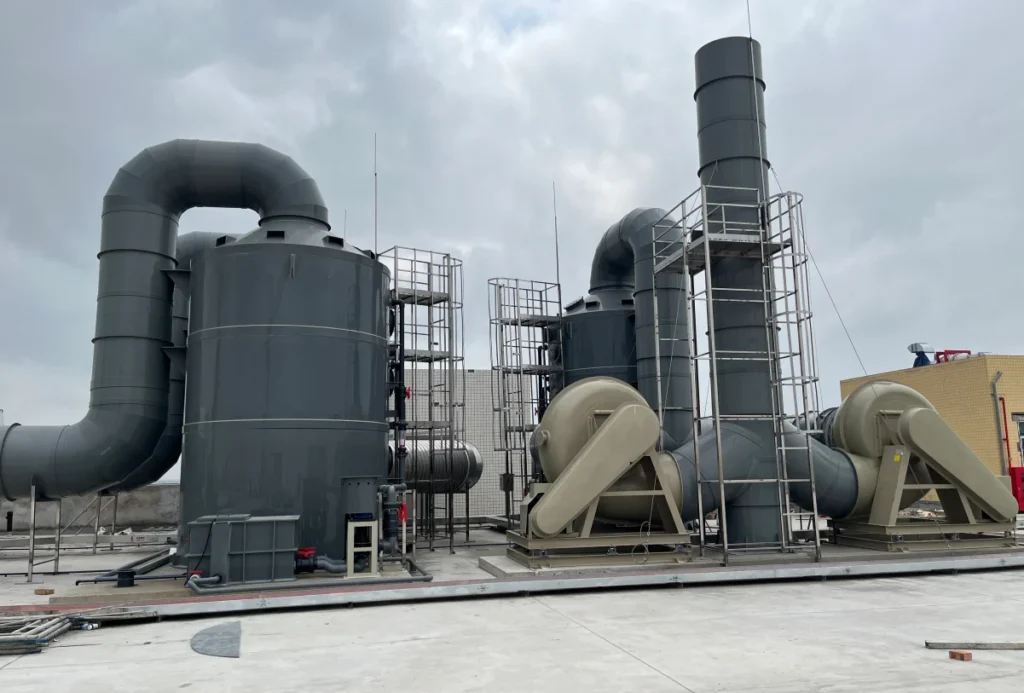
Key Takeaways: Two Stage FRP Blowers
- Two stage frp blowers nearly double the pressure a single composite wheel can hold. The machine carries two radial impellers in series inside one housing, each stage adding roughly 6,000 to 10,000 Pa, so the pair reaches about 30,000 Pa before polymer construction hands off to lined steel.
- The single-stage FRP ceiling sits near 15,000 Pa, set by a 45 m/s impeller tip-speed limit. Past that speed, vinyl-ester laminate delaminates at the blade-to-backplate joint, so staging — not a larger wheel — is how corrosive high pressure climbs.
- Let the pressure ladder pick the stage count. Below 5,000 Pa a standard backward-curved FRP fan suffices; 5,000 to 15,000 Pa is single-stage radial territory; 15,000 to 30,000 Pa is where two stage frp blowers earn their keep; past 30,000 Pa the shell becomes steel with a polymer liner.
- Staging pays an efficiency tax and a cost tax. Radial high-pressure wheels run at about 60 to 70 percent static efficiency against 75 to 85 percent for backward-curved, and the 8 to 12 mm housing, heavier shaft, and up-rated bearings bring bearing life down to roughly 2 to 4 years.
- Read the combined series curve, not the single-stage curve. Impellers staged in series double pressure at the same flow; machines run in parallel double flow at the same pressure — the operating point sits where the combined curve meets the system curve.
Do You Actually Need Two Stage FRP Blowers?
Two stage frp blowers are corrosion-resistant centrifugal machines that add a second radial impeller in series inside one housing, lifting the static pressure a polymer wheel can hold while the flow stays the same. Most corrosive high-pressure jobs never need them. A single-stage FRP radial machine already reaches roughly 5,000 to 15,000 Pa, which covers deep-bed scrubbers, tall stacks, and high-resistance filtration — the duties this cluster’s high pressure FRP blowers guide sizes in detail. Two stage frp blowers matter only when the honest system curve climbs past the single-stage ceiling and the chemistry still demands a polymer airstream.
Three duties justify staging rather than a bigger single wheel. First, a scrubber train whose packing, interstage duct, and stack together exceed about 15,000 Pa — a dense bed deeper than 1.5 meters already claims 8 to 15 inches of water column before the stack adds its share. Second, corrosive pneumatic conveying that pushes low volume against 20,000 Pa and up through a small-bore pipe. Third, a gas-boosting circuit in an acid or halogen line where re-routing or a pressure lift is called for. In each case the question is the same one this site’s high pressure blower selection method asks first: measure the real static pressure at the worst filter and bed condition, then let that number decide whether one wheel will do.
The Pressure Ladder: Let It Pick the Stage Count
Before any material or drive decision, measure the static pressure the system genuinely presents at the fan inlet, at the worst loaded-filter or saturated-bed condition. Then place that number on the four-rung ladder that decides whether two stage frp blowers belong in the specification at all. The comparisons below quote static pressure in Pa and inches of water column, with the class of machine each rung calls for.
| System static pressure at inlet | Machine class | Stage count |
|---|---|---|
| Below 5,000 Pa (about 20 in. W.G.) | Standard FRP backward-curved centrifugal fan | Single |
| 5,000–15,000 Pa (about 20–60 in. W.G.) | Single-stage FRP radial with backplate, 8–12 mm housing | Single |
| 15,000–30,000 Pa (about 60–120 in. W.G.) | Two radial impellers in series inside one composite housing | Two |
| Above 30,000 Pa | Lined steel or dual-laminate construction, polymer liner + steel shell | Two or more |
The ladder does one job only: it converts a measured number into a stage count before any brand conversation begins. Buyers who skip it order on momentum — a two-stage machine quoted for a system at 9,000 Pa, or worse, a single-stage machine ordered for a train that truly needs 18,000 Pa. Both mistakes are expensive, and both come from quoting against the clean run instead of the loaded condition. Put the worst-condition number on the table in the first email and the supplier’s first reply is the correct rung.
Two stage frp blowers are the third rung of that ladder, and the rung most buyers over-reach for. Nine times out of ten the correct answer for a corrosive exhaust train is the second rung — a single-stage radial machine in a 8 to 12 mm laminate housing, quoted against the worst-condition curve rather than the clean run. The two-stage machine earns its place only when the honest number climbs past 15,000 Pa and the stream still forbids metal. Above 30,000 Pa a multistage blower stops being a polymer product altogether: the shell must hold that pressure with a steel strongback, and the FRP liner exists only to carry the corrosion load, a construction the FRP blower range on this site specs whenever the chemistry and the pressure are both real.
Why a Single Composite Wheel Stops at 15,000 Pa
The single-stage ceiling is mechanical, not marketing. A vinyl-ester FRP rotor holds impeller tip speed to about 45 m/s; beyond that speed, centrifugal stress delaminates the joint where blade meets backplate. That fixed speed, not the motor, sets the pressure a single wheel can generate. A representative single-stage machine at 3,200 RPM with a 500 mm radial impeller in a 12 mm housing will quote about 12,000 Pa at 6,000 CFM on a 50 HP motor — and that is near the end of what one composite wheel can hold. The best way to understand how the wheel builds pressure and how the parts fail is the mechanism breakdown in this site’s how a centrifugal blower works guide.
Three failure modes show up when a single composite wheel is pushed for pressure, and each one points at staging rather than a larger wheel. The first is at the blade-to-backplate joint, where centrifugal stress delaminates the laminate once the 45 m/s tip-speed boundary is crossed. The second is casing flex: internal pressure bulges a housing built to standard thickness until the corrosion liner cracks and the aggressive gas reaches the structural fiber. The third is the discharge scroll, where the stagnation point creates localized pressure above the housing average and standard laminate erodes first. Each of these signs says the system needs pressure containment and staging, not a bigger single wheel — and each is answered in the construction section of this guide.
High pressure radial blade blowers solve the stress problem in the only way a single wheel can: straight blades projecting from the hub with a full backplate distributing centrifugal load across the laminate, in a housing thickened to 8 to 12 mm so the casing does not flex under internal pressure. The price of that geometry is efficiency — radial high-pressure wheels run about 60 to 70 percent static efficiency, against 75 to 85 percent for a backward-curved wheel of the same diameter, the trade this cluster’s forward-versus-backward curved fan comparison lays out in full. So when a system asks for more than the radial single wheel can deliver, the answer is not a larger wheel chasing a tip speed the laminate cannot take; it is two wheels in series, which is where glass-reinforced plastic and fan-system engineering guidance meet at the honest pressure number — and the subject of the next section, two stage frp blowers.
Two Stages in One Housing: How the Second Wheel Doubles Pressure
The two-stage composite blower shares one housing and one shaft with two radial impellers plumbed in series. Gas leaves the first stage’s scroll and is ducted straight into the second stage’s inlet, so each wheel re-energizes the airstream and adds its own pressure rise — roughly 6,000 to 10,000 Pa per stage in composite construction. That is the defining move of two stage frp blowers: the machine stacks pressure, it does not scale one wheel, because a single bigger wheel would push tip speed past the laminate boundary that section three described.
The series math is simple and worth carrying to any supplier conversation. Where each stage holds about 8,000 Pa, the pair delivers near 16,000 Pa before interstage losses; allow a few percent for the duct between stages and the assembled machine still clears 15,000 Pa. A multi stage centrifugal blower is the same family with two or more wheels, and two stage frp blowers are the practical polymer expression of that family — beyond two wheels the shell economics of composite construction stop making sense and suppliers move to lined steel. Ask for the combined series curve, not the single-stage curve, because every stage’s pressure rise must be read against the same system curve; the sum of the two single-stage curves is the honest product curve.
Put the series concept to work on a concrete train. A deep-bed scrubber handling chlorine dioxide runs its packing at about 6,500 Pa, the stack and duct add another 3,500 Pa, and a final high-resistance filter banks another 4,000 Pa — the honest curve lands near 14,000 Pa, still inside the single-stage ceiling. Add a longer stack for dispersion, or a second bed, and the figure clears 16,000 to 18,000 Pa, and the selection moves to two wheels: two radial stages each rated near 8,500 Pa, quoted as a combined curve against that total. The duties and duct lengths that build those totals are catalogued in the applications table of this guide; the numbers above are representative quotes, not a substitute for measuring your own worst condition. Ask the supplier for the stage-by-stage pressure allocation so the maintenance crew knows what each wheel carries and where to look when performance drifts.
Two stage frp blowers are quoted after the chemistry, like every machine this site sells. The impellers are radial with full backplates, the housing is the 8 to 12 mm laminate class, and the drive arrangement keeps the motor out of the airstream — the build details in the construction section of this guide. When an engineer orders a two-stage machine and later finds the assembled unit under-delivers, the usual cause is that the system curve moved, not the machine; the input limits of a staged blower are the same inputs a centrifugal fan needs, and the way those inputs convert to a curve is the subject of this site’s types of centrifugal fans reference.
Series vs Parallel Fan Curves in Corrosive Duty
Staging and its cousin, paralleling, do opposite things to the fan curve. Staging two impellers in series nearly doubles static pressure at the same flow — each stage’s pressure rise stacks on top of the last, so the combined curve is roughly the vertical sum of the two single-stage curves. Paralleling two machines nearly doubles flow at the same pressure — their flows add and the combined curve is roughly the horizontal sum. Getting these two directions straight is half of fan selection, which is why this site’s centrifugal fan primer and the centrifugal fan reference both start at the curve before anything else.
Corrosive duty rarely uses parallel in the same way clean-air plants do. Parallel exists for large volume or redundancy: two single-stage FRP machines feeding a high-flow scrubber circuit, each sized so the other can carry the duty during service. Series exists for pressure: a scrubber train with a deep bed plus a long stack whose total resistance crosses 15,000 Pa. The decision table should read the system curve first — if flow is the gap, run parallel or buy the bigger single wheel; if pressure is the gap, stage in series or move to a lined-steel multistage.
Every staged polymer fan you price should arrive with the combined series curve drawn against the system curve, with the operating point and the stall margin marked. Suppliers who hand you only a single-stage curve and a multiplier are asking you to trust a number they have not plotted. The same discipline applies to the pressure-measurement step: spec against the worst loaded-filter and saturated-bed condition, the method this cluster’s high pressure blower selection guide enforces before any curve discussion.
The Commercial Multistage World: Metal and Side-Channel
The multistage centrifugal blower outside the polymer world is a metal machine, and it is worth knowing what it is before pricing a polymer two-stage. Traditional designs use cast-iron or cast-aluminum impellers in a series of concentric housings, engineered for high pressure and vacuum on clean gases — the class a tested fan standard exists for. These machines reach pressures polymer staging only dreams of, precisely because the wheel is metal and spins far past the 45 m/s composite tip-speed limit, and that is also their weakness on a corrosive stream: bare metal at those tip speeds and temperatures needs coatings, fluoropolymer liners, or exotic alloys to survive the chemistry a fiberglass wheel shrugs off.
The other commercial multistage path is the side-channel, or regenerative, blower. Side-channel machines are multistage in a different geometry — slotted side channels re-accelerating the gas many times per revolution — and they run continuously at constant flow, in suction or compression, on IE3 motors, as the daily-duty workhorse of water treatment and gas boosting. Modern side-channel ranges claim thermal gains such as a roughly 15 percent cut in fluid temperature rise from impeller redesign. They are, in practical terms, the polypropylene blower sprinting in the low-flow high-pressure lane, and on a clean stream they typically beat a staged polymer fan on price.
Set the two families side by side with the chemistry in hand. The useful decision anchor between them is the chemistry column, not the pressure column. Where the gas is wet, acid, or halogen, every coating and liner seam is a future failure point, and the polymer two-stage is the lower-risk answer regardless of how much pressure a metal machine could hold. Where the gas is dry and the pressure is extreme, the metal machine is the only answer and the chemistry must be engineered at the wetted surfaces. Frame the comparison that way and the multistage selection stops being a brand contest.
If the stream is dry, modest, and the pressure is high, a coated multistage centrifugal blower is often the economical answer. If the stream is acid or halogen — the judgment this site’s FRP-versus-PP comparison formalizes — the polymer machine wins because there is no coating seam waiting to be attacked, and two stage frp blowers take the job with the same laminate and the same locked chemistry the single-stage machine uses. The split, in one line, is the one this guide keeps returning to: metal handles the pressure a polymer cannot, polymer handles the chemistry a metal lining cannot.
Building a Two-Stage Composite Blower for Pressure
The build that keeps a two-stage polymer machine alive in corrosive service is the same pressure-containment discipline single-stage high pressure FRP blowers follow, carried to double duty. The housing is the 8 to 12 mm laminate class, with the discharge scroll of each stage reinforced — 12 mm in the first portion of the scroll wrap, where the stagnation point creates localized pressure above the housing average. Pressure-containment sizing follows a hoop-stress method like the one ASME RTP-1 documents for reinforced plastic tanks, and the supplier you buy from should state the laminate thickness breakdown per stage before you compare prices.
Two wheels double the load, so the mechanical train is the second story. The shaft that drives both impellers is heavier by an order of 30 to 50 percent over a standard fan, the bearings are sized to 40 to 60 percent more load capacity, and bearing life in high-pressure service runs about 2 to 4 years against 5 to 8 years for standard centrifugal duty — a real maintenance line item to budget. Each impeller keeps the radial backplate that high pressure radial blade blowers use, so the wheels hold their shape under the differential. The shaft entry carries a pack, mechanical, or gas seal matched to the stream, and the housing drains: condensate inside a two-stage composite case is the very acid the machine exists to move.
Keep the motor out of the airstream. Arrangement 8 and Arrangement 10 belt drives place the bearings and belt outside the duct so the motor breathes clean plant air while the polymer wheels do the work, and they allow speed adjustment without a VFD. Two stage frp blowers specified for chemical service are therefore belt-driven in the majority of real installations. Aluminum- and steel-wheel machines, by contrast, sometimes close-couple — the wheel-material trade that decides. For a staged polymer fan the motor also needs the right hazardous-location certification when flammable vapor is present; the non-metallic wheels cannot strike an impact spark, which removes one ignition source, but the motor must still carry its certificate. The material, seal, and drive details that hold up on a stress frame are the same ones this cluster’s corrosion-resistant blowers chapter and polypropylene fan blades and impellers parts guide carry deeper.
Applications: Where the Stage Count Earns Its Keep
The applications table reads straight off the pressure ladder. Walk each row from the static-pressure band the system honestly presents at the fan inlet, then take the machine class and stage count that band demands. The chemical-resistant exhaust fan guide on this site carries the hood, duct, and stack logic that turns these jobs into a full system.
| Application | Static-pressure band at inlet | Stage count / material |
|---|---|---|
| Deep-bed chemical scrubber, packing above 1.5 m | 8–15 in. W.G. (about 2,000–3,700 Pa) | Single-stage FRP radial |
| Deep-bed scrubber plus tall stack resistance | Above 60 in. W.G. (above 15,000 Pa) | Two-stage FRP, wheels in series |
| Corrosive pneumatic conveying, high resistance | 20–120 in. W.G. | Two-stage FRP; lined steel past 120 in. W.G. |
| Tall stack discharge with high-resistance filter bank | High | Single- or two-stage FRP |
| Gas boosting in a corrosive circuit | Moderate to high | Two-stage FRP when above single-stage ceiling |
| Low-flow, high-pressure corrosive air | High | Metal side-channel or polymer two-stage |
| Hot aggressive fume past 30,000 Pa | Very high | Lined steel / dual-laminate |
Most scrubber and hood circuits live on the first two rows. A dense packing depth claims 4.0 inches of water column per meter, so a bed past 1.5 meters lands in the 8 to 15 inches band that a single-stage machine covers — but the moment the stack and the interstage duct push the honest total past 60 inches, two stage frp blowers are the polymer answer, and the industrial wet scrubber line on this site is specified with exactly that margin. Above roughly 120 inches of water column the polymer stage count runs out, and a multistage blower in lined steel — polymer liner carrying the corrosion, steel shell carrying the pressure — takes over. Read the table from the measured number, not from the sales sheet, and the stage count buys itself.
Frequently Asked Questions About Two Stage FRP Blowers
When do I need a two-stage FRP blower instead of a single-stage one?
When the honest static pressure at the fan inlet, measured at the worst loaded-filter and saturated-bed condition, crosses about 15,000 Pa and the stream still forbids metal. Below that figure a single-stage FRP radial machine in an 8 to 12 mm housing is the correct, cheaper answer; staging exists to lift pressure, not to add margin a single wheel already covers.
How much pressure can FRP staging reach?
Two stage frp blowers reach about 30,000 Pa before composite construction becomes impractical. Each stage contributes roughly 6,000 to 10,000 Pa, and the series stack is the sum of the two stage curves minus interstage duct losses. Past 30,000 Pa the shell hands off to lined steel, where the FRP liner provides corrosion resistance and the steel provides pressure containment.
Is a two-stage FRP blower expensive compared with a single-stage or a metal multistage?
Yes on both sides of the comparison. Two stage frp blowers carry the 40 to 80 percent premium of high-pressure composite construction over a standard FRP centrifugal, plus the second wheel, heavier shaft, and up-rated bearings, and bearing life drops to about 2 to 4 years in high-pressure service. A coated metal multistage serves the same pressure band at a lower price when the chemistry allows coatings — once the stream is acid or halogen, the polymer machine wins because there is no lining seam waiting to be attacked.
Can polypropylene handle staged pressure?
Polypropylene stays in the moderate band. Forward-curved PP wheels lose efficiency steeply past about 1.5 inches of water column, the practical ceiling this cluster’s high pressure FRP blowers guide draws, and its continuous ceiling sits near 180 to 190°F. PP serves fume hoods and modest scrubber circulation; staged pressure in polymer form is FRP’s job.
Do staged polymer blowers need a special drive arrangement?
For corrosive service, yes: keep the motor out of the airstream. Arrangement 8 and Arrangement 10 belt drives place the bearings, belt, and motor outside the duct so the drive breathes clean air while the polymer wheels do the work, and both allow speed adjustment without a VFD. Direct-drive staging is for clean, dry high-pressure air.
Why is a staged composite blower less efficient than a single-stage one?
Each radial high-pressure stage runs near 60 to 70 percent static efficiency against 75 to 85 percent for a backward-curved wheel, and two stages in series multiply that tax rather than add it, plus the interstage duct bleeds a few percent more. Efficiency is not the reason to buy a two-stage machine — pressure at a locked chemistry is, and the efficiency ledger belongs to the ten-year cost calculation.
Get a Two-Stage FRP Blower Matched to Your Curve
The whole decision collapses to the same facts this guide has been asking for: the static pressure the system truly presents at worst condition, the worst component and peak temperature of the gas at the fan inlet, and the flow you need against both. Send those three to the Xicheng team and the reply comes back as a staging decision for your two stage frp blowers or your lined-steel alternative: the wheel family, the stage count, the housing laminate per stage, the resin grade, the drive arrangement, and the price. The machines behind that reply — single-stage and staged — are catalogued in the FRP and PP blower range.
Send the duty details and get a matched two-stage FRP blower recommendation — an engineering answer for your scrubber train, your corrosive conveying line, or your stack discharge, drawn against your system curve rather than a catalogue page.