Key Takeaways: How to Choose a Centrifugal Blower Manufacturer
- The phrase “centrifugal blower manufacturer” is used by three very different suppliers: a genuine factory, an OEM assembler that buys wheels and casings in, and a trading house that sub-contracts the whole build. All three present themselves the same way online, so the first verification step is deciding which one you are actually talking to before price is even discussed.
- Certification is the fastest filter. ISO 9001 covers the factory quality system, an AMCA Certified Ratings Program seal covers published air, sound and efficiency data, and balance grade is held to ISO 1940. A centrifugal blower manufacturer who cannot name which of these applies to your order is a fabricator, not an engineered supplier.
- The material system decides whether the blower survives the gas stream. For corrosive, humid or fume-laden duty the specification that matters is the resin and liner in the casing and wheel — not the motor nameplate. FRP and PP are the two polymer families that carry that duty, and they are not interchangeable.
- Commercial terms are quoted per order, not catalogued. MOQ, lead time, motor voltage, crating and export documents are answered by whichever centrifugal fan manufacturers you shortlist. This page hands you the supplier qualification checklist and the RFQ data set that let you compare any of them on the same footing.
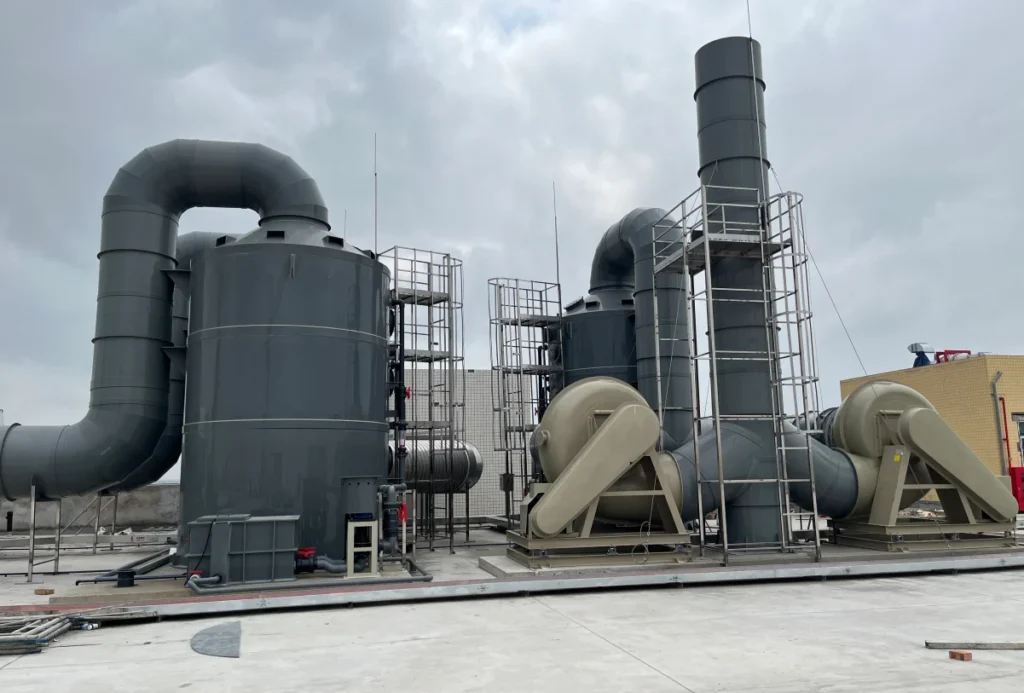
This page is written from the buying side of the desk, but by a factory. Xicheng EP builds FRP and polypropylene centrifugal blowers for corrosive exhaust, fume extraction and gas-treatment duty, and ships them direct to importers in India, the Middle East and Southeast Asia. If you arrived here because you are comparing quotes from more than one centrifugal blower manufacturer — a US brand, an India fabricator and a China factory — this guide sets out how those suppliers actually differ, which credentials you should demand before pricing, and the RFQ data set you need in hand before you ask anyone to quote. The goal is a machine that arrives sized to your system curve, balanced to a stated grade, and priced at a manufacturer’s level rather than three layers of trading margin.
The Centrifugal Blower Manufacturer Landscape: Who Actually Makes What
A search for centrifugal blower manufacturer returns a flat list of brand pages and directory entries, and on the surface they all look identical: a hero image of a scroll casing, a capacity range, and a quote button. In practice the suppliers behind those pages sit in three completely different businesses, and knowing which one you are dealing with is half the negotiation. The machine category is the same — a centrifugal blower with a corrosion-resistant casing and wheel — but the price structure, delivery and after-sales assumptions behind it are not.
Factory, OEM Assembler, or Trading House?
The first distinction is who owns the metal and the tooling. A true centrifugal blower manufacturer runs the fabrication, the welding, the balancing rig and the test bench under one roof. An OEM assembler owns the brand and the catalog but buys wheels, casings and sometimes complete units from contract factories, then assembles and labels them. A trading house owns neither: it takes your enquiry, forwards it to a factory it does not name, and adds margin on the way back. All three describe themselves as a “manufacturer” on their homepage.
The distinction matters because the failure modes differ. When an assembler or trader hits a spec problem — a wheel that must be re-balanced, a casing that needs a heavier liner, a motor that must be re-wound for 415 V 50 Hz — the change has to travel to a third party the buyer cannot see, and the lead time and accountability leak at every hop. A factory that builds in-house can answer on the spot and stand behind the fix. That is the practical meaning of manufacturer-direct, and it is the single most useful thing to establish early.
How the Regions Differ
The second distinction is geography, because the region a supplier sits in shapes its price base, its lead time and, most importantly, whether it is built to serve a cross-border buyer. The US and European fan houses are the engineering reference for the category: certified curve data, named resin systems, and metal-safety documentation. They are the right answer when a project demands an auditable AMCA-certified nameplate and a Western engineering stamp, and the wrong default for a mid-size fume-exhaust or scrubber project that needs a working machine on a working lead time, since their price lands two to four times a comparable Asian build before freight.
India-based manufacturers are the most common result for the generic phrases, and with good reason: there is a deep fiberglass and fan industry around Gujarat, Mumbai and Chennai serving chemical, plating and effluent plants. They know polymer construction well and quote natively in their own market. The honest gap is on the export side — most are regional fabricators whose order books, balance documentation and crating practice are tuned for domestic delivery. China factories are the direct lane the generic phrase under-serves: the largest share of the world’s polymer fan volume is built there, yet those factories rarely rank for the broad terms even when they ship worldwide.
| US / European brand | India manufacturer | China manufacturer (direct) | |
|---|---|---|---|
| Typical range | 6–72” wheel, certified curves | 150–100,000+ CMH | 1,000–100,000+ CMH, made to order |
| Price level (same duty) | 2–4× Asian build | Moderate, export-adjusted | Manufacturer-direct, lowest per CFM |
| Lead time | 8–20+ weeks | 4–10 weeks | 3–7 weeks typical |
| MOQ | 1 (at full price) | 1–5 units | 1-piece prototype to full container |
| Credentials visible | ISO 9001, AMCA / independent test | ISO 9001, CE often cited | ISO 9001, ISO 1940 balance, CE on request |
| Export trade package | Built for domestic + EU/US | Thin on export terms | IEC 415/380 V 50 Hz, crating, docs standard |
| Best fit | Auditable certified projects | India-domestic customers | India / Middle East / SEA buyers sourcing direct |
No row in that table is “better” in the abstract. It exists so the comparison is made on the decision you actually face. For a corrosive-fume or scrubber project outside the US and EU, the real choice is usually China factory versus India manufacturer on export terms, and the deciding variables sit inside the trade package rather than the catalog. The wheel and casing selection logic behind all three columns is the same one covered in the sitewide FRP blowers guide, and it is worth reading before any quote is requested.
What Our Centrifugal Blower Line Covers
Xicheng EP is a China-based centrifugal blower manufacturer working almost entirely in polymer construction, and everything we build is made to order against a data sheet rather than pulled from a warehouse. That is deliberate: the reason a polymer centrifugal blower exists at all is corrosive or humid service that would destroy a mild-steel unit in months, and corrosive duty is never one-size-fits-all. The line therefore splits first by material system, then by pressure and drive, then by how far the build has to be customized for the stream.
FRP and PP Corrosion-Resistant Centrifugal Blowers
The two material families we work in are FRP (fiberglass reinforced plastic, built up over a vinyl-ester or epoxy resin with a corrosion-resistant inner liner) and PP (polypropylene, a thermoplastic welded into a monolithic casing and wheel). FRP is the general-purpose workhorse: it takes larger casings, holds its shape at higher temperatures, and can be specified spark-resistant for flammable duty. PP is the lighter, tighter choice for strongly acidic or alkaline streams where its continuous welded surface and low weight win, and it is often the more economical answer below about 60 °C.
Which one is right is a stream-chemistry question, and we answer it per project rather than pushing one material. The full range is listed on the FRP blowers product page, and the thermoplastic side is set out on the PP blowers product page. Both families are built with the impeller as the corrosion-critical part: no metal in the airstream, and a balance grade quoted up front.
Pressure, Drive, and Duty Range
A centrifugal machine covers a wide band of static pressure depending on wheel and speed, and the drive choice is what makes that band accessible in service. Direct-drive units couple the motor shaft to the impeller and give the most efficient, lowest-maintenance arrangement for continuous duty; belt-driven units trade a little efficiency for the ability to trim speed and airflow on site, which matters when system resistance is uncertain. If the duty needs very high discharge pressure at moderate flow, a two-stage arrangement is the usual answer rather than forcing a single stage to its limit.
Because duty range drives the whole selection, we treat it the same way the direct drive centrifugal blower guide sets out on this site: match the drive to the duty first, then size the wheel, then confirm the motor. Getting that order right is what keeps a corrosive-duty blower from being over- or under-powered in the first year.
Custom Builds and OEM Supply
Most orders we ship are genuinely custom — a specific CFM and static pressure against a specific duct run, a casing orientation that fits an existing plant footprint, a motor wound for the buyer’s local voltage and frequency, and occasionally spark-resistant or explosion-proof execution for flammable service. Because the casing is fabricated rather than cast, that customization is a drawing change, not a new tool. We also supply OEM and private-label builds for system integrators who need blowers to their own drawings.
The full spread of polymer blower options, including the ways a build can be adapted, is grouped on the PP and FRP blowers category page. For a buyer comparing centrifugal fan suppliers, the useful question here is not whether a supplier can customize — everyone claims that — but whether they build in-house and can show you the drawing and the balance report for the unit you are buying.
How to Evaluate a Centrifugal Blower Manufacturer
This is the section most supplier pages skip. The engineering content on the category is everywhere — impeller types, working principles, performance curves — but almost nothing is written about how to tell a capable centrifugal blower manufacturer from a confident one. The four checks below are the ones that actually separate suppliers, and every one of them can be answered before you commit to a purchase order.
Certifications That Prove Performance (AMCA, ISO, CE)
Certificates are only useful when you know what each one covers. ISO 9001 is a factory quality-system certificate: it says the manufacturer runs documented processes, not that any particular blower performs as advertised. CE is a declaration of conformity for the product in the European market. The credential that speaks directly to performance is an AMCA Certified Ratings Program seal, which the Air Movement and Control Association lists per product type and issues against published air, sound and efficiency data. If a supplier quotes a pressure curve and a sound level, ask whether those numbers sit under an AMCA seal or are simply catalog figures.
The same discipline applies at the component level. Impeller balance should be quoted to a stated grade (ISO 1940 is the common reference), and the motor should carry its own certification for the voltage and frequency you need. A centrifugal blower manufacturer who can name the standard behind each claim is one who tests to it; a supplier who answers in adjectives is one who does not.
Test Reports, Dynamic Balancing, and Traceability
Ask each supplier on your shortlist whether they run a performance test on your specific unit and can send the report. In practice this separates two kinds of factory: those with a test bench that measure airflow and static pressure against the design point, and those who assemble to a drawing and ship on trust. Dynamic balancing is the other half — an unbalanced polymer wheel destroys bearings and shakes the casing, and a balancing report with the grade and the residual unbalance is normal documentation for a serious builder.
Traceability ties it together: the resin batch, the wheel drawing, the balance grade, the motor certificate and the test result should all point to one serial number. When a supplier cannot produce that chain, the risk is not theoretical. It shows up two years later when a replacement wheel has to match a machine nobody documented.
Materials, Coatings, and Corrosive Duty
Because the whole reason to buy a polymer centrifugal blower is aggressive service, the material system is where the real engineering sits. Ask what resin the casing uses and whether there is an inner corrosion-resistant liner; ask how the wheel is bonded and whether any metal sits in the gas path; ask whether the construction is spark-resistant if the stream can be flammable. These are the details that decide service life on a scrubber or fume-exhaust train.
This is also where the two polymer families diverge, and the choice should be argued per stream rather than assumed. The trade-offs are covered on the corrosion resistant blower guide, and the head-to-head comparison of the two plastics is set out in the FRP versus PP blower comparison. A manufacturer who pushes one material for every enquiry has not read your stream chemistry.
Supplier Qualification Checklist
The table below is the short pre-purchase audit. Every line can be answered by email before a purchase order exists, and a supplier who resists any of them is telling you something useful.
| Dimension | What to ask for | Red flag |
|---|---|---|
| Manufacturing status | In-house fabrication, welding and balancing; factory address and photos of the build line | Reluctant to name a factory; blurry “partner factory” answer |
| Quality system | ISO 9001 certificate with scope and validity | Logo without a certificate number |
| Performance data | AMCA CRP seal or a test report for the quoted curve | Catalog figures with no test basis |
| Balance grade | Impeller balance to a stated grade (ISO 1940) with report | No balance documentation offered |
| Material system | Named resin, inner liner, and bonding method for casing and wheel | Vague “fiberglass” with no liner detail |
| Motor | Voltage, frequency, efficiency class, and product certificate | Unspecified motor “to suit” |
| Traceability | Serial number linking drawing, resin batch, balance and test records | No serial-number record |
| Commercials | MOQ, lead time, packing, incoterm, and warranty in writing | Verbal-only terms |
Run the same eight lines against every centrifugal blower manufacturer you are considering, and the shortlist collapses fast. It also makes the eventual price comparison honest, because you are finally comparing like-for-like builds rather than a well-documented machine against a catalogue promise.
Centrifugal Fan Suppliers, Traders, and Ventilating Equipment Manufacturers
The word “supplier” is where a lot of buyers accidentally change what they are buying. A centrifugal fan suppliers page and a centrifugal fan manufacturers page can look identical, but the first may be a distributor quoting a factory it does not control, and the second is the factory itself. The same blur runs through the broader term ventilating equipment manufacturer, which spans everything from a fully integrated blower factory to a firm that buys in every component and sells a box with its logo on it. None of that is dishonest — traders and integrators have a legitimate role — but the buyer needs to know which model they are paying for.
Telling a Manufacturer From a Middleman
The tells are not subtle once you know to look. A manufacturer will name a factory location and offer to show the build line; a trader will keep the source vague. A manufacturer will answer a specification question with a technical answer — why this wheel, why this resin for your stream — while a trader relays the question and returns with a price. A manufacturer can commit to a balance grade and a test report; a trader can only pass on whatever the factory behind them will give. And when a defect or a change order appears, a manufacturer fixes it in-house, while a trader’s schedule depends entirely on someone the buyer never meets.
For high-pressure and heavy-duty duty, the difference bites hardest, because that is where the build tolerances are tightest. The pressure side of the category — where casing strength, wheel design and motor matching all have to be engineered together — is covered in the high pressure FRP blower guide, and it is exactly the duty a reseller is least able to stand behind, since a mis-specced high-pressure unit fails at the customer’s plant, not at the trader’s desk.
The practical rule is to ask, once, in writing, who fabricates the casing and balances the wheel, and to treat a non-answer as the answer. A genuine centrifugal fan manufacturer will name itself; a trader who is honest about being a trader is still a viable partner, provided the price reflects it and the buyer knows to push the technical questions one layer deeper.
Industrial Blower Manufacturers: Commercial Terms That Decide the Deal
Industrial blower manufacturers compete on more than the machine. Two suppliers can quote the same duty at similar prices and still produce very different orders, because the commercial terms wrapped around the unit — minimum order, tooling, lead time, capacity and export handling — decide whether the purchase actually works. For a cross-border buyer those terms are often the real differentiator, and they are the part most catalog pages leave blank.
MOQ, Samples, and Tooling
Minimum order quantity is the first gate. A US or European brand will sell a single unit but at full list price with a long schedule; an India fabricator typically sets a small MOQ of one to five units; a China factory selling direct will usually take a single prototype for evaluation and scale to container quantities from there. Because polymer blowers are fabricated rather than cast, there is normally no expensive new tooling to amortize — the casing is laid up or welded to a drawing, so a one-off is a drawing change, not a mould investment. That is why direct-from-China buying can start small without a penalty that would make a single evaluation unit uneconomic.
The practical advice is to ask each supplier for two numbers at once: the MOQ for your exact duty, and the price of a single evaluation unit. A supplier whose MOQ is rigidly high is either a volume house that is not a fit, or a trader protecting a margin that a small order would expose.
Lead Time, Capacity, and Export Terms
Lead time splits into two clocks: the build, and the shipping. Domestic brands and regional fabricators quote the build only and leave freight to you; a factory used to export quotes both, and handles crating, documentation and the incoterm. When comparing, force every supplier onto the same clock — build-plus-delivery to your site, not build alone — because a shorter factory schedule can still lose to a longer one that ships cleanly.
For gas-treatment and scrubber projects the export detail is not a formality: a blower that has to arrive at a plant, be lifted into position and coupled to a duct run needs the impeller restrained for transit and the casing crated to survive a container. That handling is standard practice for a factory that ships abroad regularly, and it is where domestic-only suppliers most often fall down. The application side of this duty — what the machine has to do once it is installed — is covered in the gas-treatment exhaust fan guide, and it is worth matching a supplier’s export track record against the criticality of that service before signing.
Finally, put the terms in writing: MOQ, lead time, packing standard, incoterm, payment schedule, and warranty period. A centrifugal blower manufacturer who will only give those verbally is one who expects to renegotiate them later. Written terms are not a sign of distrust; they are how a cross-border order survives the distance between the factory gate and your plant.
Centrifugal Fan Manufacturer RFQ Checklist
The fastest way to tell a serious centrifugal fan manufacturer from a price-quoter is to send a properly specified RFQ. A vague enquiry — “need a blower for exhaust” — will get you either a placeholder price or a request for the same information you should have sent in the first place. A complete RFQ gets you a real quote, a real lead time, and a machine that fits, because the supplier can size against your system instead of guessing.
The Data to Send
Seven fields cover the large majority of polymer centrifugal blower enquiries, and none of them is hard to assemble. Send them all and you will get comparable quotes back from every centrifugal blower manufacturer on your shortlist.
- Gas or air chemistry — what is being moved, at what concentration, and whether it is acidic, alkaline, humid or flammable. This is what drives the FRP-versus-PP choice and the liner specification.
- Temperature — the working gas temperature at the blower inlet. It sets the material limit and, above roughly 60 °C, usually pushes the selection toward FRP over PP.
- Airflow (CFM or CMH) — the volume required at the operating point.
- Static pressure — the system resistance the blower has to overcome, including ducts, dampers and any downstream equipment.
- Duty and environment — continuous or intermittent, indoor or outdoor, ambient conditions, and any altitude correction.
- Motor supply — voltage, phase and frequency at the installation site (for example 415 V / 50 Hz or 460 V / 60 Hz).
- Constraints — available footprint, casing orientation, noise limit, and whether spark-resistant or explosion-proof execution is required.
If you are unsure which wheel and drive the duty calls for, the plain-language primer on the types of centrifugal fans is a good place to anchor the selection before you write the RFQ.
Verify the Rating Before You Sign
The last item on the checklist is the one buyers most often skip: ask each supplier to state, in the quote, the standard or program under which the quoted performance is rated. If it is a certified figure, the manufacturer should be able to point to the certification on the AMCA certified ratings listings for centrifugal fans. If it is an in-house test figure, they should be able to send the report. Either answer is workable; a supplier who cannot place the number on any basis is the one to drop.
When the RFQ comes back with the performance basis, the balance grade, the material system and the export terms all stated, you are comparing manufacturers rather than brochures. Send the same seven fields to us and we will answer against your duty directly — the easiest way to do that is through the contact page, and we reply to a complete RFQ with a sized machine and written terms rather than a placeholder price.
Related Reading
This page sits at the buying end of the cluster; the engineering underneath it is covered across the guides below. Read them in the order that matches your decision.
- Sourcing from China specifically — the FRP blowers China manufacturer guide picks up where this page leaves off, covering the direct-import trade package in full.
- The material decision — start with the sitewide FRP blowers guide and the polypropylene blowers guide, then the head-to-head FRP versus PP comparison.
- The duty — where the gas is chemically aggressive in the exhaust train, the corrosion resistant blower guide and the chemical resistant exhaust fans guide carry the sizing side.
- Pressure, speed and drive — the high pressure blower guide, the high pressure FRP blower guide and the direct drive blower guide cover the third axis of specification.
- Where to start — if the fundamentals are still open, the what a centrifugal fan is primer and the types of centrifugal fans overview set the vocabulary.
Centrifugal Blower Manufacturer FAQ
How do I verify a centrifugal blower manufacturer before ordering?
Ask four things in writing: an ISO 9001 certificate with its scope, the standard behind any published performance figure (an AMCA Certified Ratings Program seal is the strongest), the impeller balance grade with a report, and a serial-number record that ties the drawing, resin batch, balance and test data together. A supplier who answers all four is a manufacturer worth quoting; one who deflects is telling you the answer.
What is the difference between a centrifugal blower manufacturer and a supplier?
A manufacturer fabricates the casing, welds the wheel and balances the impeller in-house and can stand behind the build. A supplier or trader resells a factory’s product, often without naming the factory, and cannot commit to balance grades, test reports or in-house fixes. Both models exist legitimately, but the buyer should know which one they are paying for and price accordingly.
Do centrifugal blower manufacturers sell small quantities?
It depends on the supplier type. US and European brands sell single units at full price on long schedules; India fabricators commonly set a small MOQ; China factories selling direct will usually take a single prototype evaluation unit and scale up. Because polymer casings are fabricated rather than cast, there is normally no tooling investment forcing a high minimum.
Which certifications should a centrifugal fan manufacturer hold?
ISO 9001 for the factory quality system is the baseline, and CE is common for European-market products. The performance-specific credential is an AMCA Certified Ratings Program seal covering air, sound or efficiency data. Impeller balance is separately held to a stated grade such as ISO 1940. Match the certificate to what it actually covers rather than counting logos.
What MOQ and lead time should I expect from a China centrifugal blower manufacturer?
For made-to-order polymer blowers, a single evaluation unit up to container quantities is normal, with lead times of roughly three to seven weeks for the build plus transit. A factory used to export will quote both clocks and include crating, documentation and an incoterm; a domestic-only fabricator typically quotes the build alone and leaves freight to the buyer.
Can a centrifugal blower manufacturer build to my own specification?
Yes, and for corrosion-duty blowers that is the norm. Expect to specify gas chemistry, temperature, airflow, static pressure, motor voltage and frequency, footprint and orientation, and any spark-resistant requirement. A factory that fabricates the casing can adapt a drawing change at low cost, so customization is routine rather than a special order.
Choosing a centrifugal blower manufacturer is a shortlist and an audit, not a price list. Establish which supplier model you are talking to, run the qualification checklist against each one, and insist the performance basis, balance grade, material system and commercial terms are stated in writing before you commit. Xicheng EP builds FRP and polypropylene centrifugal blowers to order for corrosive exhaust, fume extraction and gas-treatment duty, and answers a complete RFQ with a sized machine and written terms rather than a placeholder. Send your duty through the contact page and we will quote against your system curve.