Key Takeaways
1. A polypropylene duct is a thermoplastic exhaust duct built from welded PP sheet or extruded PP pipe, chosen because it resists acids, bases, and solvents that corrode galvanized steel and soften PVC.
2. Grade matters more than the word “polypropylene”. PP-H homopolymer carries the widest chemical and temperature range, while PP-B and PP-R copolymers trade a little stiffness for impact strength.
3. PP handles roughly 90-100 °C in continuous service but turns brittle near 0 °C, so expansion joints, support spacing, and impact protection belong in the design, not in the punch list.
4. Round, square, and rectangular sections are all fabricated from the same sheet and welded to DVS 2207-3 or DVS 2207-4, which is what makes a system gas-tight and repairable.
5. Thermal expansion of PP runs about ten times that of steel. A long run needs expansion joints and sliding supports or it will buckle at the anchors.
6. PP duct wins on lifecycle cost in fume exhaust, plating, pickling, laboratory, and semiconductor service, and loses to metal only where temperatures exceed its ceiling.
A polypropylene duct (PP duct) is an industrial exhaust duct made from polypropylene sheet or extruded PP pipe, joined by hot-gas or extrusion welding into a gas-tight system. It is the default material for moving corrosive fumes: acid mist off a plating line, hydrogen chloride vapour from a pickling tank, solvent-laden air from a laboratory bench. Polypropylene ignores chemicals that destroy galvanized steel in months and soften PVC at moderate heat.
The material is not new. Polypropylene is the second most widely used polymer in the world, and fabricators have welded it into tanks, scrubbers, and ductwork for more than fifty years. What changes from project to project is the grade, the wall thickness, the section shape, and the joining method. Get those four right and a polypropylene duct system runs for decades on almost no maintenance. Get them wrong and the same installation sags, cracks at a weld, or leaks at a flange within a season.
This guide covers the whole picture: what a polypropylene duct is, how PP-H, PP-B, and PP-R grades differ, chemical and temperature limits, round versus square sections, standard sizes and wall thickness, system design including thermal expansion and support spacing, fabrication and welding to DVS 2207, installation requirements, how PP compares with PVC, galvanized steel, and FRP, the industries that depend on it, and what drives cost when you order.
What Is a Polypropylene Duct?
A polypropylene duct is a duct fabricated from polypropylene, a semi-crystalline thermoplastic produced by polymerising propylene. In industrial ventilation the term covers round pipe sections extruded from PP, square or rectangular ducts built up from PP sheet, and the full family of welded fittings — elbows, tees, reducers, flanges — that connect them. The defining feature is that the air path is solid thermoplastic all the way through, not a coating applied to metal. A scratch on a PP duct exposes more PP; a scratch on a coated steel duct exposes bare steel.
Three properties put polypropylene at the front of the material list for corrosive exhaust:
- Chemical resistance. PP withstands most acids, bases, salts, and a broad range of solvents. Hydrochloric, sulphuric, and phosphoric acid at the concentrations typical of pickling, plating, and laboratory exhaust leave it unchanged.
- Low density. At roughly 0.91 g/cm³, PP weighs about one-eighth of steel for the same section. A three-metre length can be handled by one person, which cuts installation labour and the load on the supporting steel.
- Thermal and electrical insulation. PP does not conduct heat or electricity, so surface condensation forms less readily than on metal and the duct rarely needs separate electrical isolation.
How PP Ducts Differ from PVC, Metal, and FRP
PVC is the closest competitor and the material most often confused with PP. Both are thermoplastics welded the same way, but PP has the higher temperature ceiling and better resistance to solvents and caustics. PVC keeps an edge in cold, mild service and costs less per kilogram. Galvanized and stainless steel resist heat but corrode under acid attack — galvanised within months, stainless steel through stress-corrosion cracking in chloride service. FRP brings high strength and a temperature ceiling near 120 °C, but costs more and is harder to modify on site. Later sections compare each choice directly.
Where Polypropylene Ducting Is Used
You will find PP ductwork wherever the exhaust stream would eat metal: laboratory fume hoods, chemical and pharmaceutical plants, electroplating and pickling lines, semiconductor and PCB wet benches, wastewater odour control, and any process tied to a wet scrubber. It is equally common overhead in a fabrication shop where several hoods tie into one main trunk and the branch ducts have to be light enough to hang from a modest steel frame.
A full range of polypropylene duct systems spans round pipe from small diameters up to large-bore mains, square and rectangular duct, and the welded fittings that join them.
If you are still deciding whether polypropylene is the right material at all, our companion guide answers what a PP duct is in more depth, with factory wall-thickness data by diameter, temperature and chemical boundaries, and worked sizing examples.
Polypropylene Grades for Ductwork: PP-H, PP-B, and PP-R
“Polypropylene” is a family, not a single material. The German welding code that governs PP duct fabrication, DVS 2207-3, names three grades in its own weld-parameter table — PP-H, PP-B, and PP-R — and the grade you specify decides both the chemical envelope and how the duct behaves when it is welded, dropped, or heated.
Homopolymer (PP-H)
PP-H is made from propylene monomer alone. It has the highest stiffness, the best chemical resistance, and the highest continuous service temperature of the three grades, which is why it dominates industrial ductwork, tanks, and scrubber bodies. Its weakness is impact strength at low temperature: below roughly 0 °C a homopolymer becomes brittle, and a dropped fitting can crack. Material naming follows ASTM D4101, the classification system for polypropylene injection and extrusion materials, with ISO 1873 giving the equivalent international designations.
Copolymer (PP-B and PP-R)
PP-B is a block copolymer in which ethylene segments are introduced to improve impact strength. PP-R is a random copolymer with better long-term hydrostatic strength at moderate temperature. Both give up a little stiffness and chemical resistance compared with PP-H, and in exchange they survive knocks and cold-site handling far better. For outdoor or unheated installations, or for duct runs that will be walked on or repeatedly dismantled, a copolymer grade is often the lower-risk choice.
Which Grade to Specify for Chemical Exhaust
For a duct carrying acid fumes at elevated temperature, PP-H is the default. Where the duct will see mechanical abuse, low ambient temperatures, or frequent disassembly, move toward a copolymer or specify a heavier wall in PP-H. A supplier that offers only “polypropylene” without naming the grade has not given you enough to compare quotes. Ask for the grade, the melt flow index, and the sheet or pipe standard the material meets.
Flame-Retardant Modifications
Standard PP burns, so when a code or an insurer calls for a fire rating the material is modified with flame-retardant additives. Those grades are tested and classified under UL 94, and the rating governs which version of the material a specification will accept. Fire performance and chemical performance pull in slightly different directions, so decide early which one takes priority on your project. The next section deals with the ratings themselves.
Chemical Resistance and Temperature Limits
Two numbers decide whether polypropylene is the right duct material for a given stream: the chemical compatibility at the operating concentration and temperature, and the temperature the duct will actually see. Both are frequently reported in a way that misleads.
Chemical Resistance and pH Range
PP handles strong acids, alkalis, and salt solutions across a wide pH band. It shrugs off hydrochloric, sulphuric, and phosphoric acid, caustic soda, sodium hypochlorite at moderate temperature, and most alcohols. It is attacked by strong oxidising acids such as concentrated nitric, chromic, and fuming sulphuric acid, by halogens and wet chlorine gas, and by aromatic and chlorinated hydrocarbons — benzene, toluene, xylene, carbon tetrachloride — which cause swelling and loss of strength.
Resistance falls as temperature rises. A chemical that is harmless at 20 °C may attack the same duct at 80 °C, because the rise in molecular mobility lets the medium diffuse into the wall. Any compatibility decision therefore needs the concentration and the temperature, not just the chemical name.
Continuous vs Short-Term Temperature
Supplier data sheets quote PP limits anywhere from 80 °C to 100 °C, which confuses buyers comparing quotes. The difference is duty. PP-H is normally rated for continuous service in the 90-100 °C band and can tolerate brief excursions above it, while 80 °C figures usually describe a conservative continuous design value or a different grade. For ductwork, design on the continuous figure with margin and treat short-term peaks as exceptions, adjusting support spacing to suit. PVC by comparison is limited to roughly 60 °C continuous. Never accept a quote that rests on one temperature figure without saying which kind it is.
Cold matters too. Below about 0 °C polypropylene loses impact strength, and handling damage rather than chemical attack becomes the failure mode. Duct installed outdoors in a cold climate should be supported and braced against wind and thermal movement, and handled with the same care in winter as in summer.
UV Exposure and Outdoor Service
Unstabilised polypropylene degrades under ultraviolet light, chalking at the surface and embrittling over years of direct sun. Outdoor duct runs should use UV-stabilised sheet, usually carbon-black pigmented, or be shielded behind a cladding. Roof stacks and exhaust risers are the usual trouble spots because they take sun on all faces with no shade from the building.
Fire Behaviour
Standard PP is combustible. Two ratings appear in ductwork specifications: UL 94 for the burning behaviour of the plastic itself, where V-0 is the usual target, and the cleanroom material approvals issued by FM Approvals, where FM 4910 constrains both fire and smoke in semiconductor and pharmaceutical cleanrooms. In most buildings the fire question is answered at the system level — fire dampers and rated enclosures at zone boundaries — rather than by the duct material alone. Confirm what the authority having jurisdiction actually requires before paying for a special grade.
Round, Square, and Rectangular Polypropylene Duct
Polypropylene duct is made in three section shapes, and the choice is usually settled by the space you have, the fabrication method available, and the pressure the system must hold.
Round Duct
Round sections are extruded as pipe or rolled from sheet and welded along one seam. For a given cross-sectional area a round duct has the smallest perimeter, so it uses less material and produces the lowest friction loss per metre of any shape. It also resists internal pressure and vacuum better than a flat panel, which is why round PP duct is the default for long mains and for anything running at meaningful static pressure. Round is the natural choice wherever the routing allows it.
Square and Rectangular Duct
Square and rectangular duct is built from welded sheet panels. It earns its place where headroom is tight, where the duct has to fit against a wall or inside a ceiling void, and where several branches leave a common trunk and rectangular take-offs are easier to fit. The trade is stiffness: a flat panel needs reinforcement, usually in the form of welded stiffeners or a heavier wall, and pressure capability is lower than an equivalent round section. For large-bore low-pressure exhaust mains, though, rectangular construction is often the most practical answer on site.
A square polypropylene duct can be built to almost any plan dimension, which is what makes it useful for retrofit work where the duct has to thread through existing structure.
Transition Pieces
Most real systems mix the two shapes: rectangular plenum at the hood or scrubber, round main in the ceiling void, round branches to the stacks. The piece that joins them is the square-to-round transition, fabricated from sheet and welded to both the rectangular panel and the round pipe. Transition geometry controls a surprising amount of system loss. A long, gradual taper costs far less pressure than a short abrupt change, and the supplier should be asked to follow the good-practice angle rather than whatever fits the shortest space.
Polypropylene Duct Sizes, Diameters, and Wall Thickness
PP duct is not sold in a fixed catalogue of stock sizes the way galvanized spiral duct is. Most of it is fabricated to order, which means the “standard” sizes are really a set of preferred dimensions that keep tooling, fittings, and freight sensible.
Standard Diameters
Round PP duct is commonly produced from around 100 mm up to several hundred millimetres in diameter, with 200 mm, 250 mm, 315 mm, 355 mm, 400 mm, 450 mm and 500 mm covering most industrial exhaust work. The diameters follow the nominal outside-diameter series used across thermoplastic pipe, which keeps flanges, couplings, and gaskets interchangeable between suppliers. Branch ducts rarely exceed 200-250 mm because the hoods they serve do not need more; mains climb into the 400-500 mm band as several branches combine. A 400 mm PP duct or 500 mm duct typically forms the trunk of a multi-hood system feeding one scrubber or stack.
Wall Thickness and Pressure Class
Wall thickness is what converts a diameter into a pressure rating. For a given diameter, a heavier wall resists higher positive and negative pressure, spans further between supports, and takes more abuse during installation. Sheet thicknesses for PP duct generally run from about 3 mm on small branches to 8-10 mm or more on large low-pressure mains, while extruded pipe follows a standard wall-to-diameter ratio. Systems are usually described by a pressure class — so many inches or millimetres of water gauge, positive and negative — and the class should be stated on the drawing rather than left to the fabricator to infer.
Two details separate a well-specified duct from a vague one. The first is whether the stated pressure is positive, negative, or both; an exhaust system almost always runs under vacuum, and negative pressure is what collapses an under-thickness panel. The second is stiffening: a large rectangular duct may meet its class through welded stiffener rings rather than a heavier panel, and the quote should say which method is used.
How to Read a PP Duct Specification
A complete line item on a duct schedule carries the material grade, the section shape, the nominal diameter or the width and height, the wall thickness, the pressure class, the length, and the joining method at each end. Where any of those is missing, the fabricator is making a judgement call on your behalf. Two suppliers comparing the same drawing will price very differently if one assumes 3 mm sheet and the other 5 mm, so pinning the schedule down before the RFQ goes out is the cheapest way to get comparable bids.
System Design: Sizing, Thermal Expansion, and Supports
Polypropylene behaves differently from metal in three ways that catch out engineers who are used to sheet-steel ductwork. It moves much more when it heats, it carries far less weight for the same size, and it cannot be forced into position the way a steel spool can. Design for those three and the installation goes smoothly.
Airflow, Velocity, and Static Pressure
Sizing starts with the airflow each hood or process requires, then a target velocity in the duct. For corrosive fume exhaust the transport velocity has to be high enough to carry mist and entrained droplets without letting them settle and pool at low points, but low enough to keep pressure loss and noise under control. Duct diameter follows from airflow and velocity: the same volume through a smaller duct raises velocity, pressure loss, and fan power. That pressure loss belongs to the system, not the fan, and it accumulates across every metre of straight run, every elbow, and every transition. The fan is then selected on total volume plus the static pressure the whole system demands.
Thermal Expansion and Expansion Joints
This is the point where PP duct design departs from metal practice. The linear thermal expansion of polypropylene is roughly 0.15 mm per metre per degree Celsius, around ten times that of steel. A ten-metre run that swings 50 °C between a cold start and operating temperature grows about 75 mm. Restrain both ends of that run and the force goes into the anchors, the flanges, or the welds, and something gives.
The fix is standard practice in thermoplastics but often missing from a metal-minded drawing. Long runs get expansion joints at calculated intervals, and supports are set up so the pipe can slide axially rather than being clamped at every point. One anchor fixes the position of the run; the rest of the supports guide or slide. Getting this wrong does not usually fail on day one. It shows up months later as a cracked weld or a pulled flange at the end of the run.
Support Spacing and Hangers
Because PP is light, the support steel can be lighter than for metal duct — but because it is less stiff and softens as it warms, the horizontal spacing must be tighter than steel practice would suggest, and it must be based on the operating temperature, not the ambient one. Hangers should carry the duct on a wide saddle or a lined cradle rather than a bare metal strap, since a point load on warm PP will gradually deform the wall. Runs that cross a walkway or sit close to vibrating equipment benefit from a PP duct damper and flexible connections, which also help isolation between a fan and the duct it serves.
How Polypropylene Duct Is Fabricated
Almost nothing in a PP duct system comes off a shelf. Understanding how the parts are made explains why the lead time is what it is, why the weld quality matters so much, and what to look for when you audit a supplier.
Sheet and Pipe Inputs
Two input forms feed the shop. Extruded PP pipe arrives as straight lengths and becomes round duct, either used as-is or with a longitudinal seam welded where larger diameters need it. PP sheet, typically 3 mm to 10 mm thick, is cut, formed, and welded into square or rectangular ducts, transitions, hoods, plenums, and tank bodies. Both inputs carry the grade designation from the previous section, and both should come with traceable material certificates.
Thermoforming and Welded Construction
Curved and compound shapes — elbows, transitions, hood canopies — are usually made by heating a cut PP blank until it softens, then forming it over or into a mould. What comes off the mould is a shell, not a part. The shell is then trimmed, fitted, and welded to its neighbours. That is the structural reality of thermoplastic duct: the weld is the joint, and it is also the weakest point in an otherwise uniform wall. A shop that controls weld temperature, speed, and pressure produces joints that are as chemically resistant as the parent sheet. A shop that does not produces joints that fail first.
Welded vs Molded Fittings
Fittings come in two families. Fabricated fittings are built up from cut sheet and welded, which makes them economical in small quantities, in unusual geometries, and in large sizes. Molded fittings are produced from injection-moulded or thermoformed components and give smoother internal geometry, tighter dimensional tolerance, and a consistent bore through the bend. In a system where pressure loss and cleanliness matter, a moulded fitting is worth the extra cost at the elbow, tee, and reducer positions.
In practice a good system uses both. An injection-molded elbow at a critical change of direction keeps loss low, while a fabricated reducing tee handles the odd branch size the moulds do not cover. Ask the fabricator which parts will be moulded and which welded, and why.
Joining and Welding Methods
Every section of a PP duct system has to be joined to the next one, and the method you choose determines whether the system is gas-tight, how quickly it can be assembled on site, and whether it can be taken apart again for cleaning or modification. The welding side of this is governed by published technical codes rather than shop habit.
Hot-Gas Welding to DVS 2207-3
Hot-gas welding is the workhorse of thermoplastic duct fabrication. A heated gas stream, usually air, plasticises the base material and a filler rod of the same polymer, and the two are fused under pressure. The German technical code DVS 2207-3 covers both variants: string-bead welding, where the filler is fed through the welding nozzle, and welding with the torch separate from the filler rod, used in awkward positions and for the weld root. The same code names PP-H, PP-B, and PP-R in its weld-parameter table, which is a useful reminder that the grade and the welding procedure are tied together. DVS 2207-3 applies to material thicknesses of roughly 2-10 mm; beyond that, extrusion welding takes over.
Extrusion Welding to DVS 2207-4
In extrusion welding a hand-held extruder plasticises a continuous stream of PP and deposits it into the joint as a molten bead, which is then consolidated with a heated shoe. It is faster and produces deeper fusion than hot-gas welding, and DVS 2207-4 governs the process. Larger wall thicknesses, long seams on big panels, and any joint that has to carry structural load are the normal applications. The practical consequence for a buyer is that a fabricator running both processes can build a large-bore duct that would take an unreasonable number of hours with a hand torch.
Flanges, Couplings, and Bolted Joints
Not every joint should be permanent. Where a duct has to be dismantled — at a scrubber inlet, at a fan, at an inspection point, or where two shop-fabricated spools meet on site — the joint is a bolted flange or a mechanical coupling instead of a weld. Flanges are welded onto the duct ends and bolted together with a gasket between them; a duct coupling does the same job on round duct with a simpler joint. Field joints of this type let the system be assembled by site labour without a welding torch, and they keep the serviceable parts of the run accessible for the life of the plant.
Fabrication and installation in North America commonly follow the SMACNA thermoplastic duct construction manual, which sets out construction details and pressure classes for plastic duct in the same way its metal counterparts do for sheet steel.
Installation Requirements
How those requirements are met on site — support spacing by diameter, the movement a run has to absorb, fixed points and expansion joints, and the welding and leak-testing sequence — is set out in our guide to PP duct installation.
Polypropylene duct installs faster than welded steel duct, but it is not forgiving of the habits that steel ductwork encourages. Treating it like sheet metal is the most common way to damage a new system before it ever runs.
Handling and Site Conditions
PP duct is light, which makes it easy to carry — and easy to throw around. The material is notch-sensitive: a sharp knock against a steel edge, or dropping a spool onto a concrete floor in cold weather, can start a crack that grows under thermal cycling. Spools should be stored flat on timber, kept out of direct sun before installation where the material is not UV-stabilised, and lifted with fabric slings rather than chains. Work in the duct should be done with the openings covered so swarf and tools do not end up inside a run that is about to be closed.
Supporting and Anchoring
Supports do two jobs: carry the weight and let the duct move. Because PP expands far more than steel, a run is anchored at one point and allowed to slide everywhere else, with the expansion taken up at joints designed for it. Supports spaced at steel-duct intervals will sag as the duct warms, so spacing follows the operating temperature and the wall thickness rather than a rule of thumb borrowed from metal. Each support should present a broad, smooth bearing surface — a lined cradle or a wide saddle — and clamps should never be tightened hard enough to indent the wall, because a local dent becomes a stress riser once the system cycles.
Testing and Leak Checks
Before the system runs, the duct should be checked for leaks at the joints that matter most: field flanges, couplings, and any weld made on site. A simple pressure or vacuum test on an isolated section confirms that flanges are gasketed correctly and that site welds are sound. Visual inspection of shop welds should look for a uniform bead, complete fusion at the root, and no undercut or unfused edges. On a corrosive exhaust system a small leak is not just an efficiency loss; it is a place where acid vapour escapes into the building, which is a safety matter rather than a maintenance one.
Polypropylene Duct vs PVC, Galvanized Steel, and FRP
That comparison has a third material in it, and it is the pair where the ranking is least obvious: FRP wins on stiffness, loses on joints, and one acid reverses the order entirely. The by-diameter numbers are worked through in our article on PP duct vs FRP duct.
The comparison against galvanized steel does not turn on the sheet thickness, because the corrosion resistance is a zinc coating of roughly 19 µm that is consumed in service. What follows from that — the coating arithmetic, the acid dew point, and the duties where galvanized steel is genuinely the better material — is worked through in our article on PP duct vs galvanized duct.
Polypropylene and PVC are the two materials this choice usually comes down to, and they separate on temperature, chemistry and fire behaviour rather than on price alone. The full comparison is worked through in our guide to PP duct vs PVC duct.
Four materials cover most industrial exhaust ductwork. None is best at everything, and the right answer depends on the temperature, the chemistry, the budget, and how long the plant is expected to run.
| Property | Polypropylene (PP-H) | PVC | Galvanized steel | FRP |
|---|---|---|---|---|
| Continuous temperature | ~90-100 °C | ~60 °C | 400 °C+ | ~120 °C |
| Chemical resistance | Excellent across acids, bases, solvents | Good, weaker on solvents and caustics | Poor; coating decides life | Very good, resin-dependent |
| Weight | Very light (~0.91 g/cm³) | Very light | Heavy | Moderate |
| Joining | Welded to DVS 2207, flanged | Welded, solvent-cemented | Bolted, riveted, sealant | Hand lay-up, bonded |
| Field modification | Easy to cut and re-weld | Easy | Easy in light gauges | Difficult |
| Relative capital cost | Moderate | Low | Low to moderate | High |
The pattern is consistent. Galvanized steel is the cheapest way to move warm air and the most expensive way to move corrosive air, because the zinc coating is only a delay and corrosion starts at every cut edge, every fixing, and every scratch. PVC is cheaper than PP and welds the same way, but its roughly 60 °C ceiling rules it out of hot exhaust and its solvent resistance is weaker, so it suits cold, mild fume service rather than aggressive process exhaust.
FRP has the highest strength and a comfortable temperature ceiling, which makes it the right answer for very large ducts and for streams hotter than PP can take. It is also heavier on capital cost, harder to alter once fabricated, and slower to repair. Where a stream is within PP’s chemical and thermal envelope, PP duct usually delivers the lowest lifecycle cost of the four, because it does not corrode, does not need coatings, and can be repaired on site with a welder and a rod.
Temperature is the first cut. If the stream runs above about 100 °C, PP is out and the choice is between FRP and a metal alloy. If it runs below 60 °C and the chemistry is mild, PVC is the economical answer. Between those two, for aggressive chemistry at moderate temperature, polypropylene is the material the rest of this guide is about.
Applications Across Industries
The same material properties — chemical inertness, low weight, weldability — make PP duct useful in a wide spread of industries. What changes between them is the specific chemical load and the standards the installation has to satisfy.
Laboratory and Fume Hood Exhaust
Laboratory exhaust is PP duct’s home ground. A fume hood pulls a cocktail of solvents, acids, and reagents from the bench, and the concentration and combination change with every experiment the lab runs. PP handles that variability better than PVC because it is not attacked by the solvents that soften PVC, and better than metal because it will not corrode. Systems usually run at modest temperature and low pressure, so duct sizing is driven by hood face velocity and by the need to keep every branch balanced.
Chemical and Pharmaceutical Plants
In chemical production the duct is part of the process safety envelope. Reactor vents, reactor charging hoods, centrifuge exhausts, and drum-filling stations all need to contain vapours that are toxic, corrosive, or both, and the ductwork has to stay leak-tight for years without a shutdown to replace it. Pharmaceutical plants add cleanability to the requirement: smooth internal surfaces, no crevices where product can accumulate, and drainable routing.
Electroplating and Pickling Lines
Plating and pickling are the most aggressive common service for exhaust duct. Chrome, nickel, zinc, and copper plating tanks release acid mist; pickling lines release hydrogen chloride at temperature and often carry entrained droplets. A PP duct resists the acid attack that destroys galvanized steel in a single season, and the same material handles the caustic rinse stages on the same line without needing a different duct material for each zone.
Semiconductor and Electronics
Wafer fabs and PCB wet benches exhaust acids, bases, and solvents from tightly controlled process areas. Here the duct has to meet cleanroom fire and smoke approvals as well as chemical ones, and it usually runs in a plenum above a clean ceiling where access is difficult. Light weight matters more here than almost anywhere else, because the supporting structure above a cleanroom is rarely built for heavy steel duct.
Scrubber and Air Pollution Control Ductwork
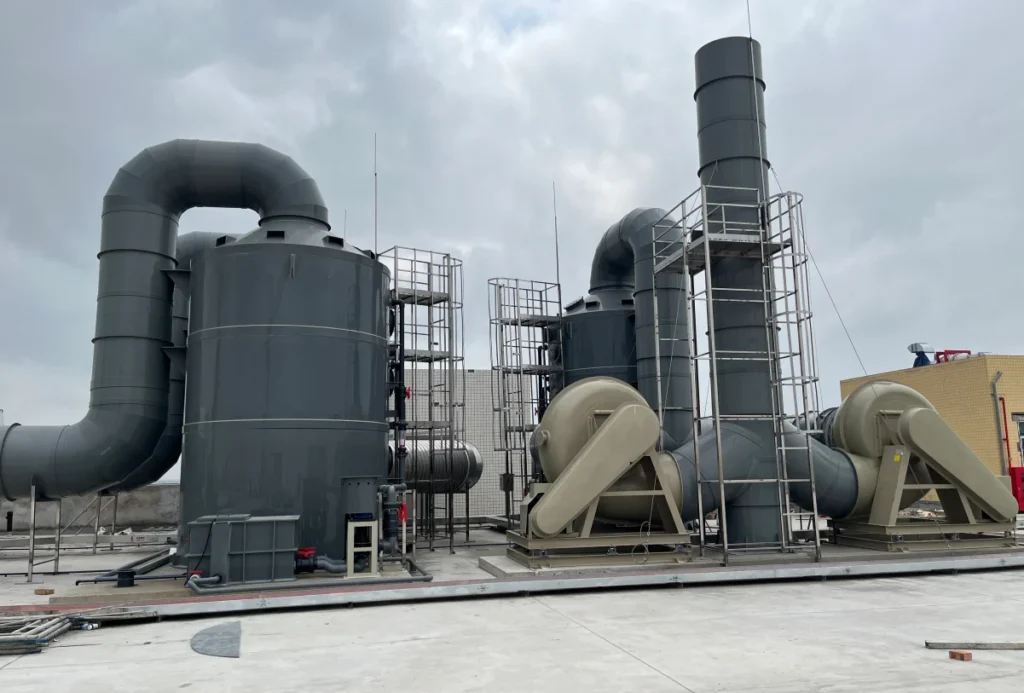
Any wet scrubber needs duct on both sides of it: dirty gas in from the process, clean gas out to the stack, and often a bypass. The duct downstream of a scrubber carries saturated air and entrained droplets, which is exactly the condition that corrodes metal. PP duct is the conventional choice for the wetted sections, and it pairs with the PP duct fittings that make the connections to the scrubber shell and the fan inlet.
Cost Factors and How to Order Custom PP Duct
Buyers usually start with a price per metre and discover the number does not hold. PP duct is a fabricated assembly, not a commodity, so cost is a sum of material, geometry, and joining labour rather than a rate card.
What Drives PP Duct Cost
The dominant cost is material weight. Because PP is sold by weight and the wall thickness rises with diameter and pressure class, a large-bore duct costs far more per metre than a small branch — not in proportion to diameter but closer to how the wall area grows. Grade adds a smaller increment: PP-H costs somewhat more than a copolymer, and flame-retardant or UV-stabilised sheet costs more again.
The second driver is complexity. A straight length is cheap. Every elbow, tee, reducer, and transition adds fabrication labour, and a fabricated fitting made from cut sheet takes far longer than a moulded one. Systems with many small branches leaving one main therefore cost more than their total duct length suggests, because the fitting count is high. The third driver is joining: site-welded joints cost more than bolted flanges once you account for the welding and inspection time.
PP Duct vs Galvanized Steel on Total Cost
On purchase price alone, galvanized steel duct almost always wins. On installed and lifetime cost the comparison usually flips. PP weighs a fraction of steel, so support steel, rigging, and the labour to install a given run are all smaller. PP does not corrode, so it does not need the repair, coating, or premature replacement that a steel duct in acid service requires — replacement that usually arrives at the worst time, mid-campaign, with the line down. On aggressive service, the correct comparison is PP against the steel duct plus several years of maintenance and at least one replacement.
How to Specify and Order Custom Duct
Almost all PP duct is made to order, so the quality of the enquiry decides the quality of the quote. The drawings should carry the material grade, the section shape and dimensions, the wall thickness, the pressure class, the length, and the joining method at each end, plus the airflow and the chemistry so the supplier can flag anything that sits outside the material’s envelope.
A supplier who asks about the gas stream before quoting is doing the work that prevents a failed installation. Our team fabricates custom polypropylene duct in round, square, and rectangular sections with matching fittings, and will review a duct schedule against the chemistry and temperature before pricing it. Send the drawings and the process conditions together and you will get a quote that reflects the system you actually need.
Frequently Asked Questions
What is a polypropylene duct made of?
A polypropylene duct is made from polypropylene, a thermoplastic produced by polymerising propylene. It is manufactured from extruded PP pipe for round sections and from PP sheet for square and rectangular sections, with the parts joined by hot-gas or extrusion welding. The most common grade for industrial ductwork is PP-H homopolymer, chosen for its chemical resistance and its temperature ceiling near 90-100 °C in continuous service.
Can polypropylene duct handle high temperatures?
PP-H is typically rated for continuous service between about 90 °C and 100 °C, with limited tolerance for brief excursions above that. That ceiling is well above PVC, which is limited to roughly 60 °C, but well below steel or FRP. If the exhaust stream runs consistently hotter than 100 °C, polypropylene is the wrong material and the specification should move to FRP or a metal alloy.
Is PP duct better than PVC duct?
For hot or chemically aggressive exhaust, yes. PP has a higher temperature ceiling and better resistance to solvents and caustics, so it survives streams that would soften or attack PVC. For cold, mild fume service PVC remains a reasonable and cheaper choice. The decision usually turns on two questions: does the stream exceed about 60 °C, and does it contain solvents or strong caustics? A yes to either points to PP.
How are polypropylene ducts joined?
Shop joints are welded, either by hot-gas welding under DVS 2207-3 for thinner material or by extrusion welding under DVS 2207-4 for heavier sections and long seams. Joints that need to come apart again — at a scrubber, a fan, or a field connection — use bolted flanges or mechanical couplings instead, so site assembly does not require a welding torch. A correctly welded joint is as chemically resistant as the sheet around it, which is why weld quality is the main thing to inspect.
Does polypropylene duct need special supports?
Yes, in two respects. Support spacing has to be tighter than for metal duct and must be based on the operating temperature, because PP softens as it warms and is less stiff than steel. Supports also have to allow the duct to move: the thermal expansion of PP is about ten times that of steel, so the run is anchored at one point and allowed to slide elsewhere, with expansion joints taking up the movement. Rigidly clamping a long PP run at every support is one of the most common installation mistakes.
How long does a PP duct system last?
In the correct chemical and temperature envelope, a properly welded polypropylene duct system routinely serves for decades with little more than visual inspection. Its failure modes are almost always outside that envelope: a stream that runs hotter than the design assumed, a support scheme that over-restrains the run, or mechanical damage during installation or later modification. Design the expansion and the supports correctly and the material itself is rarely the limiting factor.
Choosing a Polypropylene Duct Supplier
Polypropylene duct is a fabricated product, so the fabricator matters as much as the material. Two suppliers can quote the same drawing and deliver very different systems, and the difference will not be visible until the duct has been running for a year.
Four things separate a capable supplier from a broker. They will name the grade — PP-H, PP-B, or PP-R — and back it with material certificates rather than offering generic “polypropylene”. They will state which parts are moulded and which are fabricated, and why. They will weld to a published code, DVS 2207-3 or DVS 2207-4, with welders qualified to the corresponding examination. And they will ask about the gas stream and the temperature before they quote, because those two numbers decide whether the design is sound.
If you are specifying a corrosive exhaust system, send us the duct schedule together with the airflow, the chemistry, and the operating temperature. We fabricate polypropylene duct, fittings, and dampers in round, square, and rectangular sections, and we will tell you before the order if the stream sits outside what the material can safely handle — which is the cheapest conversation you can have on a project like this.
Contact our engineering team for a review of your duct requirements.