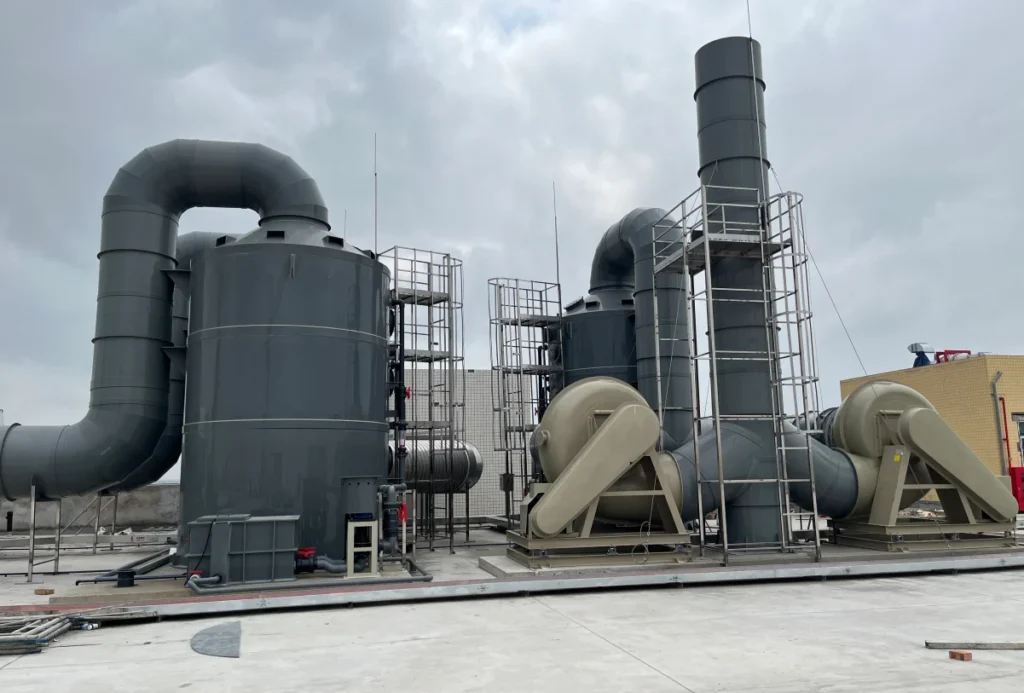
Key Takeaways: Fume Cupboard Polypropylene Fan
- A fume cupboard polypropylene fan is the negative-pressure engine of the cabinet. Its whole job is containment — holding the face velocity that keeps chemicals inside — not just moving air, so it is sized like a safety device rather than like a ventilation fan.
- Airflow starts from the sash. Face velocity of 80 to 120 fpm times the open sash area sets the CFM the fan must deliver, and the opening changes as the operator works, which is why airflow control belongs in the same conversation as the fan.
- Static pressure is the part nobody measures first. Hood slot, duct, elbows, and roof stack can add 1 to 4 in. wg of resistance before the fan curve is even drawn, and the honest system curve — not the cleanest one — is what the fan must clear.
- Polypropylene fits nearly every laboratory exhaust stream. Dilute acids, bases, and solvents under roughly 180 to 190°F sit inside PP’s material window, and the fan must be spark-resistant with the motor out of the airstream, exactly as the exhaust regulations for fume cupboard service demand.
- ATC systems cut the CFM when the sash closes, and the fan answers with a VFD. Variable air volume is where the energy leaves the system, and speed control on the fume cupboard polypropylene fan is how the building earns most of it back.
Fume Cupboards and the Fan Behind Them
A fume cupboard is the British-industrial name for what American labs call a fume hood — an enclosed workbench with a movable sash that traps hazardous fumes, vapors, and dusts and carries them away through ducting. The cabinet itself is only the front half of the safety system. Behind it, at the end of a duct run that is usually kept under negative pressure all the way to the roof, sits the exhaust fan that creates the airflow and holds it steady against every disturbance — a door opening, a person walking past, a hot plate stirring the air inside the enclosure. That machine is the subject of this guide.
The fume cupboard polypropylene fan is the workhorse of exactly this position in laboratory exhaust: a small-to-middle-sized centrifugal blower built from welded polypropylene, set at the far end of the duct, sized to move the cabinet’s airflow at the cabinet’s required face velocity and to push against the total friction of the pipe run. Polypropylene is the natural material because the streams a laboratory cupboard actually sees — dilute acids, caustics, common laboratory solvents — are cool, dilute, and corrosive to metal, all at once. The material chart for that family is laid out in this site’s polypropylene blower guide, and the wider exhaust system it fits into is described in the chemical resistant exhaust fan reference.
Containment is the operating word. A fume cupboard works when the airflow across its open sash is fast and even enough that nothing generated inside escapes around the operator — turbulence, spills, and cross-drafts are the failure modes. Every engineering choice in this article, from the wheel type to the drive, exists to protect that one number: the face velocity. Get the fume cupboard polypropylene fan wrong by undersizing it, and the cabinet behaves like a fan that quietly stopped — chemicals drift out exactly when the work looks normal.
What a Fume Cupboard Fan Actually Does
The exhaust train of a ducted fume cupboard is hood slot, duct, fan, and stack, and the four must be built from the same corrosion logic because the same dilute acid stream wets every surface along the way. The fan is deliberately the last element in that train: everything between the sash and the fan inlet runs under negative pressure, so a pinhole leak in a duct joint pulls room air in instead of pushing chemicals into the lab. That layout rule is one of the most quoted in laboratory design — the fume hood exhaust fan sits outside the building, and the duct stays negative all the way, which is why the chemical exhaust system guidance on this site treats the fan as the endpoint of a containment chain rather than as a standalone machine. The same system logic, with the chemistry of the foul gas doing the talking, is what the gas scrubber overview carries into the treatment end of the train.
Face Velocity and Containment
Containment is measured by face velocity — the speed of air drawn through the open sash, normally expressed in feet per minute. The widely quoted working band for a conventional chemical fume cupboard is 80 to 120 fpm average across the opening; higher endpoints within that band are reserved for the most hazardous materials, and the containment test behind it is the ANSI/ASHRAE 110 procedure, which challenges the cabinet with a measurable tracer gas and checks how little escapes. Average face velocity is the number a facility measures with an anemometer on a schedule, not a nameplate — a fume hood that has fallen out of its band is unsafe until it is fixed, and regulatory programs go as far as padlocking failed sashes closed.
Because the fan generates that face velocity, the fan is what the regulations reach for. The California code that many laboratory standards echo says plainly that the exhaust fan should be acid resistant and spark-resistant, that the fan motor should not be located within the duct work, and that drive belts should not be located within the duct work — a sentence this guide treats as a three-part specification, and one you can verify in the Stanford Laboratory Standard and Design Guidelines under the ventilation provisions that rest on OSHA 29 CFR 1910.1450, the laboratory standard that requires fume cupboards and protective equipment to be kept functioning properly. Every fan recommendation below answers one of those three clauses, and the case for the fume cupboard polypropylene fan is that it answers all three at once — PP is acid resistant by nature, the plastic wheel is spark-resistant by construction, and the remote-mounted motor never lives in the duct work.
Sizing Airflow: Face Velocity Times Opening
The airflow a fume cupboard fan must deliver is the product of one safety number and one geometry: average face velocity times the open sash area. A six-foot bench cupboard with the sash raised eighteen inches presents roughly nine square feet of opening; at a 100 fpm average that is about 900 CFM, and take the same cabinet to a 120 fpm band and you are ordering a machine near 1,100 CFM. The arithmetic is the same for every hood, which is why the fan is specified from the face velocity, not the other way around. The centrifugal fan primer on this site walks the underlying physics of how the wheel turns that flow of air into static pressure, and the types of centrifugal fans study names the wheels the cabinet duty actually uses.
| Bench cupboard width | Working opening (sash height × width) | CFM at 80 fpm | CFM at 100 fpm | CFM at 120 fpm |
|---|---|---|---|---|
| 4 ft (1.2 m) | 1.5 ft × 4 ft ≈ 6 ft² | 480 | 600 | 720 |
| 6 ft (1.8 m) | 1.5 ft × 6 ft ≈ 9 ft² | 720 | 900 | 1,080 |
| 8 ft (2.4 m) | 1.5 ft × 8 ft ≈ 12 ft² | 960 | 1,200 | 1,440 |
| Walk-in (floor-mounted) | Full door area, often 20–40 ft² | 1,600 | 2,400 | 3,600 |
Those flows land squarely in the territory of the small industrial PP centrifugal blowers this site’s range is built around — the fume cupboard polypropylene fan class that moves 400 to 2,400 CFM against 1 to 8 in. wg covers a single bench cupboard and most paired installations. Two cautions belong beside the arithmetic. First, the opening is the variable: as the operator raises the sash, the face area grows and the required flow climbs, so a fixed-speed machine must be sized for the tallest permissible sash, never for the comfortable working position. Second, face velocity is an average — room cross-currents at the hood face above roughly 20% of that average are the classical cause of containment failure, which is why the hood is placed away from doors and walkways as much as the fume cupboard polypropylene fan is sized to its airflow.
Static Pressure: The Part Nobody Measures First
Containment and airflow give you the CFM; the second half of the fan specification is the static pressure the system will honestly demand, and this is where laboratory fan selections usually go wrong. The fume cupboard polypropylene fan does not see the weather of the lab — it sees the sum of every pressure loss between the sash slot and the stack outlet: the hood’s internal slot and baffle drop, the accelerating losses at fittings, elbows and branch takeoffs along the run, the friction of straight duct, and the momentum of the roof discharge. A short single-cabinet run on the same floor can total well under one inch of water gauge; a cabinet manifolded up two floors to a roof fan with three elbows and a rain cap can total three or four inches. Both are common in the field, and they never came off the cabinet’s nameplate.
| System element | Typical pressure loss range | Notes |
|---|---|---|
| Fume cupboard slot and baffles | 0.15 – 0.5 in. wg | Set by the cabinet manufacturer; part of the hood, not the duct |
| Duct friction (PP or FRP) | 0.1 – 0.4 in. wg per 50 ft | Shrinks with diameter; long runs lift the total fast |
| Elbow (90°, smooth radius) | 0.05 – 0.15 in. wg each | Concentration of fittings in a tight plant room is a real budget |
| Branch takeoff / manifold mixing | 0.1 – 0.3 in. wg | Every joined hood adds its share |
| Roof stack and discharge | 0.1 – 0.4 in. wg | Taller stacks for odor dilution cost pressure, not just steel |
The discipline that protects the selection is the same one this site’s high pressure blower method makes its first rule: draw the honest system curve at the worst loaded condition, not the cleanest one. A duct with a sealing valve partially closed, a stack cap half-clogged, or three cupboards on one manifold with one at full sash — each of these shifts the operating point up the resistance curve and left along the fan curve, dropping flow exactly when the cabinet needs it most. Start from the centrifugal blower operating principle if the intersection logic is unfamiliar, then size the fume cupboard polypropylene fan to clear the worst point with the change in speed available on its drive rather than to meet the average.
Why Polypropylene for Fume Cupboard Exhaust
The laboratory streams a fume cupboard actually handles are the material question solved before the fume cupboard polypropylene fan is chosen. Dilute mineral acids, dilute caustics, and the common organic laboratory solvents — acetone, ethanol, toluene, the everyday bench toxics — sit inside polypropylene’s compatibility window at the temperatures a laboratory cupboard operates at, which is room temperature plus the marginal heat of the work conducted inside the sash. Polypropylene is a wetted-wall material first: it resists these streams by surface, welded into a containment vessel for the gas rather than held off by a coating, and its continuous-service ceiling of about 180 to 190°F left the laboratory far behind. The PP temperature ladder, and the resin that succeeds it when the stream outruns it, is laid out step by step in this site’s FRP versus PP comparison, and the wheel that carries the stream is covered by the polypropylene fan blade and impeller guide.
The second reason PP wins the fume cupboard slot is that it satisfies the regulations without a coating system. A polypropylene wheel striking nothing cannot raise a spark against its own housing, which is the practical meaning of the spark-resistant requirement in the laboratory ventilation codes; the fan housing and impeller are welded from the same material as the duct; and because the motor is a remote component, the fume cupboard polypropylene fan is supplied with the motor out of the airstream and, where the duty calls for it, an explosion-proof or flameproof motor classification. This is the configuration that makes polypropylene fans for fume cupboards a defensible engineering answer to the three-part test of the exhaust regulations rather than a series of workarounds. The polypropylene blower family guide anchors the whole material story, and the actual machines are the PP blower product line.
When PP Hands Off to FRP or Metal
Every polymer has a boundary, and the fume cupboard duty crosses it in three situations. Hot reactive chemistry — concentrated sulfuric digestions, fuming mixtures, perchloric acid work — outruns PP’s temperature and oxidation limits; perchloric cupboards in particular are built with water-wash duct systems in which the wetted materials shift to special resin or rigid PVC and the fan follows. Solvent-rich streams in unusual concentrations, or an exhaust train that serves both cupboards and a general process stack, can justify moving the fan to FRP for broader solvent compatibility; the corrosion resistant blower guidance carries that decision table, and the fiberglass builds live on the FRP blower product pages. And a dedicated fume hood reference from the general literature confirms the material reasoning from the hood side: polypropylene and fiber-reinforced plastic both appear among the approved hood liners, with steel reserved for nuclear or specialty duty. The practical rule is short: the fume cupboard polypropylene fan stays the default until the chemistry or the temperature proves otherwise.
Wheel Choice: The Fan Type Inside the Pipe
Within the polypropylene construction, the wheel decides where the machine lands on the pressure-versus-flow trade-off, and a fume cupboard exhaust system is a low-to-moderate static pressure duty — the honest budgets in the previous section top out near 4 in. wg. That makes the fume cupboard polypropylene fan almost always a centrifugal machine, and the centrifugal family splits into the same three wheels the rest of this cluster describes. Forward-curved blades move the cabinet’s large airflow at low pressure with a small, quiet wheel — the most common single-cupboard choice. Backward-curved or backward-inclined blades run more efficiently at the moderate pressures of a manifolded multi-cupboard run and resist overloading if a damper partially closes. Radial-blade wheels hold the efficient edge of the pressure range for the longest, chokiest stacks; they are louder and heavier, and rarely needed for bench cupboards. The forward versus backward curved fan comparison on this site quantifies the trade-offs wheel by wheel.
| Fan form | Pressure band | Where it fits a cupboard system |
|---|---|---|
| Forward-curved centrifugal | 0.5 – 4 in. wg | Single and paired bench cupboards; smallest wheel, quietest |
| Backward-inclined centrifugal | 1 – 8 in. wg | Manifolded rows, longer duct legs; efficiency holds at partial flow |
| Radial-blade centrifugal | 3 – 20+ in. wg | Chokey stacks, walk-in hoods with high slot losses |
| Tubeaxial / vaneaxial | 0 – 2.5 in. wg | Short roof-mounted legs; low pressure only, no containment margin |
| Inline mixed-flow | 1 – 6 in. wg | Straight-in-pipe mounting when the roof is impossible |
| Roof exhaust | By wheel internals | Factory-packaged curb-mounted units with integral stack |
Two practical points close the fan-type decision. First, the motor must stay out of the airstream regardless of wheel — the belt-driven or remote-motor arrangements that satisfy the laboratory code are available in both the FF and BF builds, and the drive choice between them is a trade worth its own decision matrix on the direct drive selection guide. Second, the fan supplier must publish a performance curve tested to a recognized standard; the AMCA fan performance standard is the reference this series measures its machines against, because a fume hood exhaust fan spec written on catalog CFM alone, without the curve that proves the intersection, is a guess wearing a specification. Any one of the centrifugal forms above — confirmed against the honest system curve — reliably carries the fume hood exhaust fan duty; the wheel chosen is simply where along that curve the fume cupboard polypropylene fan is allowed to live.
ATC, VAV, and the Drive That Answers Them
Airflow control is what turns a fume cupboard from a constant-load device into an energy-managed one, and it changes how the fan is specified. In a constant-air-volume system the cabinet draws the same CFM at every sash position — the fume cupboard polypropylene fan runs flat out whether the operator is working or not, and the laboratory wastes conditioned air continuously. An automatic airflow control package measures the sash position or the hood face velocity and trims the exhausted volume; the classic variant is a variable-air-volume system that holds the face velocity constant while the sash is open and drops the exhaust toward a safe minimum when the sash closes. The energy is real: laboratories run four to five times as energy-intensive as ordinary commercial buildings, and the most cited result of closing sashes to cut exhausted air at rest is a sustained reduction of roughly 30 percent in total fume hood exhaust load.
VFD Speed Control vs Fixed-Speed CAV
The fan must be able to move to those varying duty points, and that is a drive question, not a cabinet question. A fixed-speed machine sized for the tallest sash simply pulls its full airflow all the time — safe, simple, and the most expensive hour on the meter. When the control system calls for a lower exhausted volume, the matching fan answer is a variable frequency drive turning the fume cupboard polypropylene fan down along its curve; the fan laws the rest of this cluster leans on say flow follows speed, so a 20 percent reduction in exhausted air is a roughly 10 percent speed cut, and power falls with speed cubed, which is where the operating cost actually leaves the building. The economics of the VFD against a fixed-speed or belt-pulley alternative, with the reliability trade-offs spelled out in dollars, are the table built for this series on the direct drive centrifugal blower selection guide.
One caution keeps the control story honest. The ATC system is only as good as the monitoring behind it: air flow monitors that alarm on high or low flow and a documented maintenance program are what the laboratory standards and the fume hood exhaust fan manufacturers equally assume. The fan’s drive and the cabinet’s controller must speak the same airflow language, and the performance curve the fume cupboard polypropylene fan was selected on must be the curve the control system is allowed to travel along — size the machine so its middle speed band, not its maximum, is the normal working point, and there is headroom for the choked-stack worst case on the drive rather than on the margin of the motor.
After the Cupboard: Scrubbers, Carbon, and PP Duct
A ducted fume cupboard does not always stop at the stack. Where the emissions must be treated before discharge — a solvent-heavy research stream, a campus with odor limits, a plant room that exhausts into a restricted envelope — the fan pushes the gas onward through a treatment train built from the same materials as the cupboard. The rules of engagement were set in the fume cupboard sections above and they do not change when the duct stops being a chimney and becomes a reactor: the PP duct and pipework line and its square-duct variant carry the same acid stream in the same welded material, and the fan must deliver the added pressure drop of the train on top of the duct budget — a wet scrubber pack, a carbon bed, and a final HEPA box each add load the honest system curve has to carry.
The treatment the exhaust actually needs follows the chemistry. Acid and base fumes drop out of the gas stream in a wet scrubber, and the scrubber cluster on this site treats the system the way this one treats the cupboard — the chemical waste gas treatment guide and the VOC scrubber study cover the treatment end, with the industrial wet scrubber product line as the hardware. Solvent vapors that survive the scrubber stage, or streams that skip it entirely, hand off to carbon adsorption, which the activated carbon adsorption box reference, the OEM carbon box guide, and the carbon plus HEPA filter box cover in their own detail. For the fan engineer the message is the addition: each element downstream is resistance upstream, and the lab pp frp blowers chosen for the through-the-scrubber layout must be selected on the combined curve, not the cupboard curve.
Why Not a Ductless Cabinet
The obvious shortcut — a self-contained, filtered fume cupboard with the fan built into the hood and the air returned to the room — belongs in the comparison because it keeps appearing in procurement. The material reality is that a ductless cabinet’s activated-carbon filter adsorbs a known, limited chemistry, passes ammonia and carbon monoxide, and requires discipline about what is used inside it; most research institutions decline them for exactly that reason, carrying the gone-today gas through the filter and back into the breathing zone. The filtration family above exists on this site because the carbon stage is valuable — downstream of a real stack discharge, where a missed chemical goes outside instead of into the same room. Sizing the fume cupboard polypropylene fan into a ducted, treatable system is the answer that keeps the containment, the energy control, and the chemistry options open at the same time.
FAQ
What size fume cupboard polypropylene fan do I need?
Size from containment, not from the catalog. Take the average face velocity the cabinet requires — conventionally 80 to 120 fpm — multiply by the largest permitted open sash area in square feet, and that is the CFM duty. Add the honest static pressure of the duct run and the stack (typically 1 to 4 in. wg), draw the system curve, and select a machine whose fan curve clears the worst point. A single 6 ft bench cupboard at 100 fpm with a 9 ft² opening needs about 900 CFM; a pair of cupboards on one manifold roughly doubles the flow and adds a takeoff loss.
Can one fan serve two or three fume cupboards?
Yes, and it is a common retrofit. Each cupboard keeps its own hood slot and control, and the branch ducts join into a common riser that the fan serves. The fan must be sized for the worst simultaneous scenario — generally the sum of the cupboards at their design flows, with a manifold mixing loss added — and every join must be pressure-balanced so one cupboard’s closure does not steal airflow from another. VAV control on the fan makes a manifold practical because the total demand falls as individual sashes close.
What is the difference between a fume cupboard fan and a general exhaust fan?
Containment and reserve. A general exhaust fan moves room air against modest duct losses; a fume cupboard exhaust fan must hold a specified face velocity against a specified worst-case static pressure while the sash geometry changes, stay within an acid-resistant and spark-resistant specification, and keep its motor out of the duct. They share centrifugal aerodynamics, but the duties, curves, and acceptance criteria are specified differently.
Is a ductless (recirculating) fume hood the same as a ducted system?
No. A ductless cabinet filters the air — activated carbon adsorbs a known chemistry and bypasses gases such as ammonia and carbon monoxide — and returns it to the room. Containment is only as good as the filter’s match to the chemistry, which is why many research facilities generally do not permit ductless units for changing or unknown work. The ducted fume cupboard polypropylene fan route moves everything outside, where a missed chemical cannot come back into the breathing zone.
Does the fan need to be spark-proof and explosion-proof?
Two different requirements. The laboratory ventilation codes require the exhaust fan to be acid resistant and spark-resistant under normal corrosive service — a polypropylene wheel in a polypropylene housing gives that without extra coatings. Explosion-proof classification is an additional rating applied where flammable vapors can build up, calling for a flameproof or explosion-proof motor and sealed construction; the two are specified on different pages and both are worth asking for by name.
How often should the fume cupboard exhaust system be checked?
Daily, periodically, and annually. The daily check is a visual one — a strip of tissue held at the face confirming inward flow. The periodic check measures average face velocity with an anemometer across the grid, typically on the cycle the facility’s industrial hygiene program sets, and annually the system gets the full mechanical review: bearings, belts where they exist, damper travel, motor current, and re-verification against the design curve. A cupboard that has drifted out of its face-velocity band is taken out of service until it is corrected.
Get a Fume Cupboard Fan Sized to Your System
The selection discipline this article built is legible in four numbers: face velocity, open sash area, worst-case static pressure, and the chemistry and temperature of the stream between the sash and the stack. If you can supply those four, a fume cupboard polypropylene fan can be specified to the containment curve rather than to a catalog page — with the wheel confirmed for the pressure band, the material confirmed for the stream, the motor out of the airstream, and the drive carrying the VAV that pays the energy bill back. The whole PP and FRP blower range on this site is built from the same material logic, including the permanent magnet fan for the quiet lab setting, and sending the four numbers gets you a matched recommendation — a containment answer, not a price list.