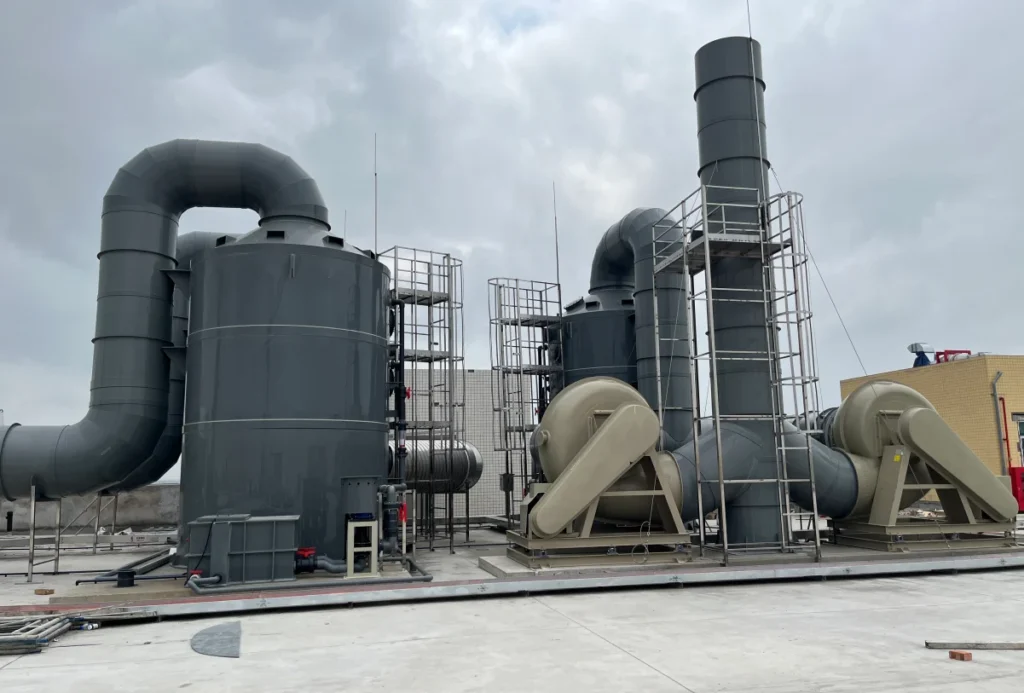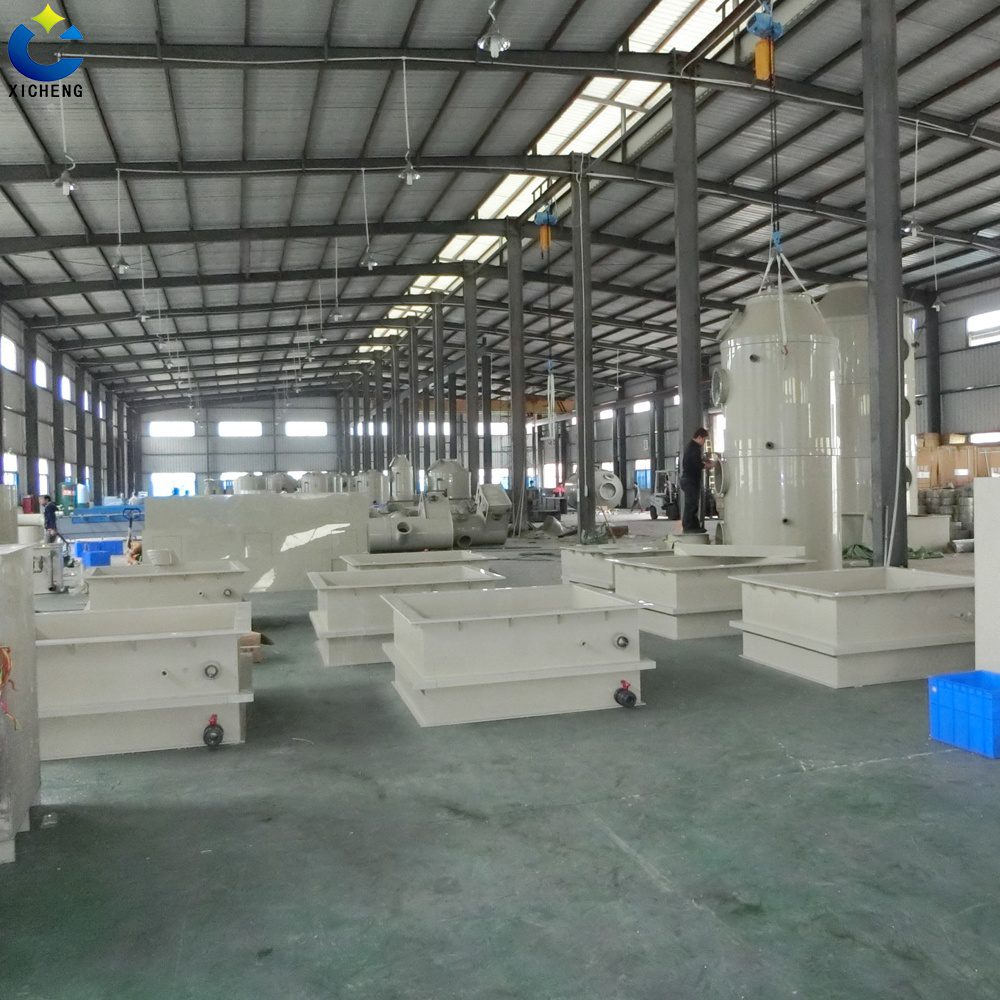
A polypropylene tank is a welded vessel fabricated from polypropylene sheet, and its case rests on one property above the rest: polypropylene holds acids, alkalis, salts and most aqueous chemicals at temperatures where the cheaper polyolefin, polyethylene, has already lost stiffness. It is also the material most often specified by mistake, because “poly” is not one substance. Polypropylene, polyethylene, polycarbonate, PVC and polyurethane all shorten to something that sounds like poly, and a buyer who asks for a “poly tank” may be asking for any one of them.
That sentence compresses a whole process: the board thickness, the seam schedule and the test that closes it. Each step is set out in how sheet becomes a welded tank.
This guide answers the questions that decide whether a polypropylene tank is the right vessel for a duty, and what to put on the drawing if it is. It compares PP with PE and HDPE on melting range, density and chemical resistance — the three comparisons where the published numbers are most often misquoted. It explains how a large PP tank is actually built, why that route rules out some sizes, and why the chemical-resistance table that a supplier hands you is a starting point rather than an answer. It sets out the loads that redesign a tank: hydrostatic head, specific gravity, temperature, wind and ultraviolet. And it closes with the eight inputs that decide a quotation, because a tank enquiry missing any one of them can only be priced by guesswork.
It stays at the level of specification. For the vessels themselves — standard and custom PP storage sizes, fittings and delivery — see our PP chemical storage tanks range. If you already know your duty and your dimensions, the shop drawing and quote are the next step.
The other half of the specification is the volume. How much a plant actually needs, and which of the six jobs the vessel is doing, is worked through in the industrial water storage tank guide — because a tank sized from a daily total is usually either oversized or irrelevant.
Key Takeaways
- “Poly” is not a material. Polypropylene, polyethylene, polycarbonate, PVC and polyurethane are five different plastics with five different chemical-resistance profiles. This page is about polypropylene only, and it says so every time a neighbouring material behaves differently.
- Polypropylene melts higher than high-density polyethylene and is lighter: the U.S. food-contact specification for olefin polymers puts polypropylene at a density of 0.880–0.913 g/cm³ and a melting range of 160–180 °C, while a major HDPE resin data sheet gives 0.930–0.965 g/cm³ and a melting point of 135 °C for the homopolymer. PP is the lighter, higher-melting material of the two.
- A large polypropylene tank is extrusion-welded from sheet, not moulded. Rotational moulding and blow moulding are the polyethylene routes, and they carry a size ceiling that sheet fabrication does not.
- Polypropylene has a boundary, and it is a hard one. Strong oxidizing acids, chlorinated solvents and aromatic hydrocarbons attack it. Nitric acid at 65% is rated unacceptable at both 20 °C and 60 °C; chloroform, carbon tetrachloride and methylene chloride the same.
- Wall thickness is a calculated result, not a preference. It follows from hydrostatic head, the specific gravity of the contents and the service temperature. Thicker than necessary is a cost problem; thinner than necessary is a failure mode.
- A quotable enquiry carries eight inputs. Missing one of them, price is a guess and lead time is a guess.
What a Polypropylene Tank Actually Is — and What “Poly” Leaves Out
Polypropylene is a polyolefin, and the U.S. regulation that governs it as a food-contact material defines it in one sentence: basic polymers manufactured by the catalytic polymerization of propylene. That definition matters commercially, because it excludes a long list of materials that share the abbreviation. A tank described as a “poly tank” in a tendering document may be polypropylene, polyethylene, polycarbonate, PVC, polyurethane or a polyester resin. Each of those behaves differently against the same chemical at the same temperature, and each is fabricated by a different process.
The Material in Plain Numbers: Melting Point, Density and Service Temperature
Three numbers do most of the work in a material comparison, and all three are available from a primary source rather than a supplier brochure. The U.S. food-contact specification for olefin polymers lists polypropylene at a density of 0.880–0.913 g/cm³ and a melting range of 160–180 °C. The same table lists polyethylene at a density of 0.85–1.00 g/cm³ and leaves the melting-point column blank, so it sets no melting window for polyethylene at all.
The melting range is a range, not a point, because degree of crystallinity varies with grade. The same regulation carries a second polypropylene entry, for the metallocene-catalysed route, with a melting range of 150–180 °C. Anyone quoting a single melting temperature for polypropylene is quoting one grade, not the material.
Service temperature is a different quantity from melting temperature, and the two are frequently confused in supplier literature. A polymer does not need to melt to fail in service; it needs only to soften enough that the wall deflects under load. For fabricated tanks we rate service from −10 °C to 95 °C, which sits well below the crystalline melting range and leaves the melting figure as a processing number rather than a service number. Below −10 °C, impact resistance falls away and a tank that is bumped while cold can crack.
Homopolymer (PP-H) and Copolymer (PP-C): Which One Goes Into a Chemical Tank
Polypropylene is supplied in two families. Homopolymer, usually written PP-H, is the stiffer and higher-melting of the two, and it is the default for fabricated chemical and water tanks. Copolymer, PP-C, contains ethylene blocks that improve impact resistance at low temperature at the cost of some stiffness and some chemical resistance. If a tank will stand outdoors in a cold climate and take mechanical knocks, copolymer is the safer sheet. If it will hold a warm chemical at a fixed temperature indoors, homopolymer is the better choice.
The distinction is invisible in the finished tank. Both are polypropylene, both are weldable, and both look the same. It appears on the sheet certificate and in the service temperature margin, which is where it should be checked.
“Poly” Is Not One Material: PP, PE, PC, PVC and Polyurethane
The five materials that hide behind poly split into two groups by fabrication route. Polypropylene and polyethylene are weldable thermoplastics that can be built up into large vessels from sheet or formed into smaller ones by moulding. Polycarbonate, PVC and polyurethane arrive in a tank enquiry mainly as linings, coatings and small moulded components.
The practical consequence is that a chemical-resistance chart for one of them tells you nothing about another. Polypropylene and polyethylene are chemically similar in the solvents they resist and the solvents they do not, but polypropylene holds its stiffness to a higher temperature. PVC resists some strongly oxidizing environments that polypropylene does not, but it is a less forgiving material to fabricate into a large welded vessel. A specification that says “poly” and nothing else has not specified a material.
Why a Large Polypropylene Tank Is Not Injection Moulded
Injection moulding appears in a great deal of published material about polypropylene tanks, and it is the wrong process for any vessel you would call a tank. Moulding requires a tool whose cost scales with size and whose clamping force scales with projected area. A mould for a two-metre diameter vessel is not a manufacturing decision, it is a capital project. Moulding serves small components — fittings, closures, brackets — and it serves them well.
Large polypropylene vessels are built from sheet, cut and welded. That is the point at which the material choice stops being academic, because sheet fabrication has its own rules about weld quality, stiffening and base support, and those rules are what the rest of this page is about.
Polypropylene vs Polyethylene and HDPE: The Choice That Decides Service Life
The comparison that matters most is not polypropylene against exotic materials. It is polypropylene against polyethylene, because the two are close enough in price that the decision is usually made on a datasheet rather than on a budget. They are both polyolefins, both weldable in sheet form, both resistant to a broadly similar list of chemicals, and both unsuitable for the same solvents. The differences are in temperature, in density, and in the shape of the market that supplies them.
Temperature: Where PP Wins and Where PE Wins
On heat, polypropylene wins on every published figure. A major HDPE resin data sheet gives a DSC melting point of 135 °C for the homopolymer and 110–134 °C for copolymers, with a Vicat softening temperature of 132 °C for the homopolymer. The food-contact specification for polypropylene puts the melting range at 160–180 °C. A service temperature of 95 °C that is comfortable for a polypropylene wall leaves a polyethylene wall with almost no margin to its softening point.
Polyethylene wins at the cold end, and it wins on toughness rather than on any number. Where a vessel will be handled, moved or knocked in a cold climate, polyethylene absorbs impact that would crack a stiff polypropylene wall. That is a real advantage, and it is the reason rotational-moulded polyethylene tanks dominate the agricultural and residential water market.
Chemical Resistance: What the Two Materials Agree On
Polypropylene and polyethylene resist broadly the same families of chemicals: mineral acids at moderate concentration, alkalis, salts, alcohols and most aqueous solutions. They also share the same weaknesses. Aromatic hydrocarbons, chlorinated solvents and strong oxidizing acids attack both. If your duty is toluene, chloroform or hot nitric acid at 65%, changing from polyethylene to polypropylene does not solve the problem; changing the material family does.
Where polypropylene pulls ahead is documented in the published polypropylene resistance data on plastic pipe materials: polypropylene is more resistant to organic solvents than other common plastic pipe materials, and it has superior resistance to sulfur-bearing compounds. Those two advantages are what a pickling line, a metal-finishing shop or a sulphur-bearing effluent duty is buying when it specifies PP over PE. How the acid, its concentration and the bath temperature settle the material is set out in our pickling tank design guide.
Density, Weight and Structural Stiffness
Polypropylene is the less dense of the two. The specification figures are 0.880–0.913 g/cm³ for polypropylene against 0.930–0.965 g/cm³ for HDPE, so a polypropylene vessel is roughly five per cent lighter than a polyethylene vessel of the same wall section. That is a minor transport saving and a minor handling saving. It is not a structural argument.
The structural argument is stiffness, and it runs the other way at room temperature. HDPE in sheet form is the tougher, more flexible material; polypropylene is the stiffer one, which is why a polypropylene wall of a given thickness deflects less under hydrostatic load and why stiffening and support requirements differ between the two. When a supplier quotes the same wall thickness for both materials, that is a warning sign, not a convenience.
The Honest Answer: When HDPE Is the Better Buy
We fabricate polypropylene tanks and we do not sell polyethylene ones, so the following is against our own commercial interest, which is exactly why it belongs here. Choose polyethylene when the duty is potable or rainwater storage at ambient temperature, when the vessel must survive rough handling and freezing, when the required shape is a round moulded tank in a domestic or agricultural size, or when the budget is the binding constraint and the chemistry is benign. In those cases a rotational-moulded polyethylene tank is cheaper, tougher and entirely adequate, and specifying polypropylene adds cost without adding life. Where the duty is water, the conditions that flip that answer are worked through in polypropylene water tank.
Choose polypropylene when temperature rises above the polyethylene softening margin, when the duty involves organic solvents or sulphur-bearing compounds, when the vessel must be square or rectangular rather than round, or when the size required exceeds what a mould can produce. Those four conditions cover most industrial chemical service, which is why the fabricated polypropylene tank exists as a product category at all.
How a Polypropylene Tank Is Built: Extrusion-Welded PP-H, Not Moulded PE
Two fabrication routes dominate the plastic tank market, and they are frequently described as if they were interchangeable. They are not. One builds a vessel from flat sheet by welding; the other forms a vessel in a mould from powder or a parison. The route determines the material you can use, the shapes you can make, the size ceiling you run into and the way the vessel eventually fails.
Sheet Extrusion and Butt Welding: The Route Behind a Custom PP Tank
Sheet fabrication starts with extruded polypropylene plate in thicknesses from 5 mm to 30 mm. The plate is cut to a developed pattern, rolled or folded into shell sections, and joined. Cylindrical shells are welded along a longitudinal seam and then to a bottom and a top. Square and rectangular tanks are assembled from flat panels with external stiffening. How much stiffening, and at what pitch, follows from the way a flat wall carries load in bending rather than in tension, and that is the whole subject of rectangular plastic tank design.
The welds are the vessel. Depending on the joint and the thickness, they are made as butt welds with a heated tool, as extrusion welds in which a bead of molten polypropylene from a hand-held extruder fills the joint, or as a combination of the two. Sheet fabrication is what makes custom geometry possible at all: a polypropylene tank with an off-centre outlet, a sloped floor, a divided compartment or a sump is a drawing problem, not a tooling problem.
Rotational Moulding and Blow Moulding: The PE Routes and Their Size Ceiling
Rotational moulding charges a hollow mould with polyethylene powder, rotates it through an oven and a cooling station, and produces a seamless one-piece tank. Blow moulding inflates a hot parison against a mould wall. Both processes produce a vessel with no weld seams at all, which is a genuine advantage in impact service and a genuine advantage in inspection.
Both processes are polyethylene processes in practice, and both are constrained by the mould. Rotational moulding needs an oven large enough for the mould, and the mould itself must survive repeated thermal cycling. The practical result is that moulded tanks dominate the small and mid-size round tank market and thin out rapidly above that. Where a duty needs a four-metre vessel, or a square footprint, or a wall of 25 mm, sheet fabrication is the only route that reaches it.
Why Weld Quality Decides Service Life More Than Wall Thickness
A fabricated polypropylene tank fails at a weld far more often than it fails in the middle of a panel. The panel is a single homogeneous extrusion with a known and uniform property set. The weld is a thermal history: a zone where the polymer was melted, flowed and re-solidified, with a microstructure that depends on tool temperature, welding speed, pressure and the operator’s technique.
That is why two tanks of identical wall thickness and identical material can have very different service lives, and why the useful questions to ask a fabricator are about weld procedure and weld inspection rather than about millimetres. Our own practice on thick-section welds is ultrasonic inspection against a written procedure, which turns weld quality from an opinion into a record. A buyer comparing two quotations on price per kilogram of polypropylene is comparing the wrong number.
Homogeneous vs Laminated: PP Against FRP
The alternative to a thermoplastic tank in chemical service is usually a fibre-reinforced plastic vessel, and the difference is structural rather than chemical. An FRP tank is a composite: a resin matrix with glass reinforcement, frequently with a chemically resistant liner behind a structural laminate. Its chemical performance is the performance of the liner, and its structural performance is the performance of the laminate, and the two are made of different things.
A polypropylene tank is homogeneous. The wall that touches the chemical is the wall that carries the load, and there is no interface to delaminate, no liner to blister and no bond line to inspect. That is the strongest technical argument for thermoplastics in aggressive chemical service, and it is also why a polypropylene tank is limited by the properties of polypropylene itself rather than by a liner choice.
Chemical Compatibility: What Polypropylene Handles and What It Cannot
Chemical resistance is the reason most polypropylene tanks are bought, and it is also the specification most often reduced to a two-column yes-or-no table. The published engineering data does not work that way. A standard polypropylene resistance chart rates each chemical twice, once at 20 °C and once at 60 °C, on a five-point scale: 1 is excellent with no attack, 2 is good with no significant attack, 3 is acceptable with light attack and limited use, 4 is unacceptable with significant attack, and 5 is inferior with possible cracking or dissolving. The same chemical can sit at 1 and at 4 in the two columns, which is precisely the information a duty specification needs.
For dosing and day-tank duties where the working volume is small and the chemistry is aggressive, a purpose-built vessel is usually a better answer than a storage tank used off-label; that is the case our chemical dosing tank range is designed for. Everything below is the underlying chemistry.
The Everyday Duties: Acids, Alkalis, Salts and Alcohols
Polypropylene’s strongest ground is mineral acids at moderate concentration, and alkalis without exception. Sulphuric acid at 10% rates 1 at both 20 °C and 60 °C. Hydrochloric acid at 10% rates 1 at both temperatures. Phosphoric acid at 85% rates 1 and 1. Acetic acid rates 1 at 10%, 50% and 75%, and only drops to 2 and 3 at 100%. On the alkaline side, caustic soda, potassium hydroxide, calcium hydroxide and aqua ammonia all rate 1 at both temperatures, and the entire aqueous salt group — acid salts, basic salts and neutral salts — rates 1 and 1.
Alcohols are safe. Ethyl alcohol and methyl alcohol both rate 1 at 20 °C and 60 °C. Formalin at 37% rates 1 and 2. Carbon dioxide, carbon monoxide and hydrogen sulphide all rate 1 and 1, which is why polypropylene is used in scrubber and effluent service where sulphide is present.
The margins are where the useful detail sits. Sulphuric acid at 78% is rated 2 at 20 °C and 4 at 60 °C: the same acid, the same tank, two different answers depending on the temperature you actually run at. Hydrochloric acid at 37% moves from 1 at 20 °C to 3 at 60 °C. Neither of those duties is impossible in polypropylene; both require the operating temperature to be pinned down before the tank is ordered, not after.
The Duties Polypropylene Should Not Take: Strong Oxidizers, Chlorinated and Aromatic Hydrocarbons
The boundary is sharp and it is worth memorising. Nitric acid at 65% rates 4 at 20 °C and 4 at 60 °C — unacceptable at both. Sodium hypochlorite, the base of most bleach and many disinfection duties, rates 2 at 20 °C but 3 at 60 °C, so a warm hypochlorite duty needs a different material. Why the stored solution also changes while it sits, and what that does to venting, temperature and light, is set out in the poly bleach tank guide. Chlorine, whether damp or dry, rates 2 at 20 °C and 4 at 60 °C. Sulphur dioxide rates 2 and 3.
The chlorinated solvents are a flat refusal. Chloroform, carbon tetrachloride, methylene dichloride, trichlorethylene and carbon disulphide all rate 4 and 4. Ethyl ether rates 4 and 4. Petrol rates 4 and 4. The aromatic hydrocarbons sit one step short of that: benzene, toluene, chlorobenzene and nitrobenzene all rate 3 at 20 °C and 4 at 60 °C, and heptane rates the same. Acetone is rated 2 and 2, methyl ethyl ketone 3 and 4, ethyl acetate 2 and 4, phenol 2 and 2.
The pattern behind those numbers is a solubility rule. Polyolefins are non-polar, and non-polar solvents of similar solubility parameter swell and eventually dissolve them. That is why the aromatics and the chlorinated hydrocarbons — the classic non-polar solvents — are the materials that attack polypropylene hardest, and why water, alcohols and aqueous salts, which are polar, do not.
Concentration and Temperature Change the Answer
Two variables explain most of the disagreement between published chemical-resistance charts. The first is concentration. Nitric acid at 5% rates 2 and 3, which is a usable duty with a caution; nitric acid at 65% rates 4 and 4, which is not a duty at all. Sulphuric acid at 10% rates 1 and 1, at 78% rates 2 and 4, and at 93% rates 3 and 4. A chart entry without a concentration is not an entry. The acid-by-acid version of that rule, with the temperature column applied to each band, is in the acid storage tank guide.
The second variable is temperature, and it acts in one direction only. Across the whole published table, no chemical becomes more benign as temperature rises. Some hold their rating — acetic acid at 75% is 1 and 1, caustic soda is 1 and 1. Others fall by one step, and others fall by two or three. Sulphuric acid at 78% falls from 2 to 4; hydrochloric acid at 37% from 1 to 3; chlorine from 2 to 4.
That is why neither of the two columns is the answer on its own. A tank designed against the 20 °C column and then operated at 60 °C is a tank designed against the wrong table. The practical rule is to design against the next column up, and to confirm the actual maximum temperature with a coupon immersion test before committing a large vessel to a duty nobody has run before.
When the Right Answer Is PVDF, CPVC, PTFE or Hastelloy
When the duty falls outside the polypropylene table, the answer is usually to change material family rather than to add wall thickness. Thicker polypropylene does not resist nitric acid at 65% any better than thin polypropylene; attack is a chemical process, not a stress process.
PVDF extends the temperature ceiling and covers a wider solvent range while remaining weldable, which makes it the usual next step for a fabricated vessel. CPVC and PVC cover some strongly oxidizing duties that polyolefins do not, within their own temperature limits. PTFE is the broadest chemically and the most expensive, and it is normally used as a lining or a gasket rather than as a structural wall. For the duties where no polymer will serve — hot concentrated oxidizing acids, some chlorinated duties at temperature — the answer leaves plastics altogether and becomes a metallic or lined-metallic vessel, with Hastelloy and similar alloys in the frame.
The useful discipline is to price the material change before assuming it is unaffordable. A PVDF vessel at three times the polypropylene price is frequently cheaper than the consequences of a failed polypropylene tank in a duty that was never in its range.
Food-Grade and Potable-Water Service
Unpigmented polypropylene resin is covered by the U.S. food-contact specification for olefin polymers, which states that the olefin polymers it lists may be safely used as articles or components of articles intended for use in contact with food. Natural, uncoloured polypropylene sheet is therefore the standard choice for food-contact and potable-water tanks.
That clearance attaches to the resin, and our reading of it is that it does not automatically follow through to a finished tank containing pigments, ultraviolet stabilizers, processing aids or regrind. Each of those is a separate substance with its own clearance status, and a coloured sheet that is perfectly suitable for a chemical duty may be unsuitable for a potable one. If the tank is for drinking water, ask for the resin and the additive package by name, and specify the food-contact grade on the order rather than assuming it.
Choosing the Type of Polypropylene Tank for Your Duty
Once the material is settled, geometry decides the rest. The tank type is a response to three constraints: how the contents behave, where the tank has to fit, and how it has to be serviced. Most enquiries are answered by six shapes, and the choice between them is usually obvious once the constraints are written down.
This section gives each type one paragraph and no more, because each of them is a subject in its own right. The version of this page that follows the geometry in detail is the sizing section below; the version that follows the application in detail belongs to our pickling and electroplating tanks, which are built for exactly that duty. The dimension chain from the part envelope to the working volume, and the Faraday arithmetic that follows it, is set out in the electroplating tank guide.
Vertical Cylindrical Tanks: The Default for Bulk Storage
A vertical cylinder with a flat or slightly dished bottom is the default because it is the most efficient shape for a given volume and it distributes hydrostatic load evenly around the shell. Which of the two postures fits a given room, and what each costs in wall and steelwork, is the subject of choosing between vertical and horizontal tanks. It suits bulk storage of liquid that is pumped out rather than drained, and it is the shape most standard polypropylene tanks take. Its limit is drainage: a flat bottom cannot be emptied completely, so anything that settles or that must not be left behind needs a different floor.
Cone-Bottom Tanks: Solids, Slurry and Complete Drainage
A conical bottom turns a storage vessel into a settling and discharge vessel. Solids collect in the cone, the outlet at the apex empties the tank completely, and a slurry with a high solids content leaves under gravity instead of being pumped. The price is headroom, because the cone adds height below the cylindrical section, and floor loading, because the cone concentrates the contents onto a smaller footprint. Where complete drainage matters — plating solutions, suspensions, anything that must not be left to settle overnight — the cone is not optional. How the angle, the outlet and the stand underneath are decided is set out in our cone bottom tank design guide.
Open-Top Tanks: Access, Immersion and Process Work
An open-top tank is a process vessel rather than a storage vessel. It exists so that parts can be lowered into it, so that an operator can reach inside it, or so that the contents can be agitated, heated or monitored from above. Pickling, plating, rinsing and most immersion work require one. The open top removes the structural contribution of a lid, which puts the whole stiffness requirement onto the wall and the rim, and it exposes the contents to splashing, evaporation and airborne contamination.
Double-Wall Tanks: Secondary Containment and Bunding
A double-wall tank is one vessel inside another, with the annulus acting as a bund. It exists to answer a regulatory requirement rather than a process requirement. What happens inside that annulus when the inner shell fails, and how it is sized and vented, is set out in how a double wall tank is sized and vented. The U.S. spill-prevention rule for oil storage, for example, requires appropriate containment structures to prevent a discharge, and specifies that the entire containment system, including walls and floor, must be capable of containing the contents and must be constructed so that any discharge from a primary containment system, such as a tank, will not escape the containment system before cleanup occurs. The rule lists dikes, berms, retaining walls, curbing, drip pans and sumps among the accepted forms.
That is an oil-storage rule, and it is cited here as an example of the logic rather than as a general requirement on chemical tanks. Chemical storage is regulated at national, state and local level, and the applicable rule depends on the substance, the volume and the site. Our guide to plastic chemical storage tanks sets out the two containment rule sets and why they give different numbers. The engineering conclusion is the same in every jurisdiction that has such a rule: if secondary containment is required, a double-wall tank satisfies it in the footprint of a single tank, which is often the only way to fit containment into an existing building.
Rectangular and Square Tanks: Where Footprint Beats Volume
A rectangular tank exists because buildings are rectangular. Where the available floor space is a corner, a bay or a recess, a square vessel uses it completely while a cylinder leaves the corners empty. The cost is structural: a flat panel resists hydrostatic pressure far less efficiently than a curved shell, so a rectangular tank needs thicker walls for the same depth, or external stiffening, or both. Rectangular tanks are the normal answer for indoor process lines, compact dosing installations and anything that has to fit inside an existing enclosure.
Horizontal and Low-Profile Tanks: Headroom-Limited Sites
A horizontal cylinder with dished ends solves the opposite problem: not floor area but height. Under a stair, beneath a mezzanine, inside a plant room with a low soffit, the geometry that fits is a cylinder lying on its side on saddles. Horizontal tanks need saddle support designed for the shell rather than a flat base, and they need the same attention to drainage as a flat-bottom vertical tank, because the low point of a horizontal shell is a line, not a point.
Matching Type to Application: Water, Dosing, Pickling and Plating
The application usually selects the geometry before anything else is decided. Potable and process water storage takes a vertical cylinder with a flat base and a top closure. Chemical dosing takes a small open-top or closed vessel that can be mounted on a frame, often rectangular for space reasons, and usually with a level sensor and a mixer flange. Pickling and plating take open-top tanks, deep enough for immersion, with a cone or a sloped floor for drainage and with the rim stiffened for a fume extraction hood. Effluent and neutralization take a cone-bottom vessel sized around the solids it will produce. Each of those is a different specification built from the same material, and the polypropylene tank is the constant across all of them.
What that dosing vessel has to hold, and how its outlet should be arranged for the pump, is a separate calculation from the material, and it is set out in the chemical dosing tank guide.
Sizing a Polypropylene Tank: Capacity, Geometry and Freeboard
Sizing is where an enquiry becomes a drawing. The inputs are the working volume, the shape constraint, the chemical and its specific gravity, the maximum temperature and the available space. The outputs are a diameter, a height, a wall thickness and a connection schedule. The step that goes wrong most often is the first one: confusing the volume of liquid the process needs with the volume of the vessel that will hold it.
From Capacity to Geometry: Diameter, Height and Freeboard
Volume fixes the product of cross-sectional area and liquid height, not either one on its own. A required volume can be met by a short wide tank or a tall narrow one, and the choice between them is made by footprint, headroom, mixing behaviour and the structural load on the base. A tall tank puts a higher hydrostatic head on the lower wall and concentrates more weight on a smaller floor area. A wide tank spreads the load and needs a bigger footprint.
Freeboard is the clearance between the maximum liquid level and the top of the tank, and it is not optional. It absorbs the rise from filling, from thermal expansion, from agitation and from foam. A tank sized with the working volume equal to the nominal volume has no freeboard at all, which is why every real specification starts from a working volume and works upward.
The Capacity Long-Tail in Plain English: What Common Sizes Actually Suit
Buyers arrive with a size in mind rather than a volume in mind, and the sizes they name cluster around familiar figures. The table below is our own sizing guidance — it describes what each band is normally used for rather than a published standard, because there is no standard that assigns duties to volumes.
| Nominal capacity | Approximate volume | What it normally serves |
|---|---|---|
| 50–100 gallon | 190–380 L | Dosing day tanks, laboratory and pilot vessels, small dosing skids |
| 250–500 gallon | 950–1,900 L | Process day tanks on a plating or pickling line, batch mixing, small dosing stations |
| 1,000–2,000 gallon | 3,800–7,600 L | General chemical storage, intermediate bulk storage, effluent holding |
| 4,000–5,000 gallon | 15,000–19,000 L | Bulk chemical storage, large process tanks, treatment and neutralization vessels |
| 10,000–20,000 gallon | 38,000–76,000 L | Site-level bulk storage; fabricated on site or shipped in sections |
The bands are approximate by construction, because a vessel is built to a diameter and a height and the volume follows, not the other way around. A nominal “1,000 gallon tank” from two fabricators may differ by a few per cent in actual capacity, and both are selling a real product.
Working Capacity Is Not Nominal Capacity
The nameplate figure on a tank is its nominal or gross volume, measured to the top of the shell or to the overflow, depending on the supplier. The usable volume is smaller. It is reduced by freeboard, by the height of the outlet above the floor, by the volume displaced by internal fittings, and by whatever heel the drainage geometry leaves behind.
A flat-bottom tank with a side outlet may leave several per cent of its contents permanently below the outlet. A cone-bottom tank with an apex outlet can be emptied to almost nothing. If the process requires a certain working volume, the vessel must be specified on working volume with the heel and the freeboard already deducted, and the drawing should say which figure is which.
Transport and Installation: the Real Limit on Maximum Size
The maximum size of a polypropylene tank is rarely set by the material. It is set by the route to the site. A vessel that has to travel by road is limited by trailer dimensions and by the practical width of the roads on the route; one that has to pass through a door is limited by the door; one that has to be lifted by crane is limited by the lifting plan.
Where the finished vessel will not fit, the vessel is made to be assembled on site, or built in sections that are welded together in place. That changes the specification rather than the size limit: site welding needs a controlled environment, an approved procedure and inspection access, and it needs those things agreed before the sections are cut. A tank that is too large to ship is a project, not a purchase order.
Wall Thickness, Stiffening and the Hydrostatic Load
Wall thickness is the number buyers ask about first and the number that can be explained least briefly. It is not chosen from a table of sizes; it is the result of a calculation whose inputs are the depth of liquid, the specific gravity of the contents and the temperature of service, and whose output is then checked against fabrication minimums and against deflection.
What Sets the Wall: Hydrostatic Head, Specific Gravity and Temperature
Hydrostatic pressure at any point in a tank is the product of the liquid depth at that point, the density of the liquid and gravitational acceleration. It increases linearly from the top of the liquid to the bottom, so the bottom of the shell and the bottom plate always see the highest load and the top of the shell the least. That is why a well-designed tank is not uniformly thick, and why a tank is not simply scaled up by making everything thicker.
Specific gravity enters the same equation. A vessel holding water has a specific gravity of 1.0. The same vessel holding a 50% caustic solution, a concentrated acid or a heavy brine carries substantially more weight for the same depth, and the wall has to be sized for that. A specification that states the volume but not the specific gravity has not given the fabricator enough to size the tank.
Temperature acts twice. It reduces the stiffness of polypropylene, so the same pressure produces more deflection; and it reduces the allowable design stress, so the wall must be thicker to hold the same load. A duty at 90 °C is not a duty at 20 °C with a different label.
Stiffening Rings, Gussets and the Top Rim
A cylindrical shell resists internal pressure efficiently because the load resolves into tension around the circumference. What it resists poorly is the local bending at a flat bottom joint and at an unsupported rim. Stiffening rings around the shell, gussets between the shell and the base, and a reinforced top rim are how a fabricated tank handles those local loads.
For an open-top process tank, the rim does more work than it appears to. With no lid to close the section, the rim must maintain circularity against the outward push of the contents; a floppy rim allows the shell to ovalize, and once it ovalizes the wall stresses stop being simple tension. Rim stiffness is a design decision, not a finish detail. How much of it a rim needs, and what happens when it does not have enough, is worked through in our open top tank design guide.
Why a Flat Bottom Needs a Base and a Cylinder Does Not
A flat-bottom tank has to be supported across its whole base, not at its edges. Polypropylene is a flexible material, and a flat bottom spanning an unsupported void will deflect under the weight of the contents and eventually crack at the joint with the shell. Flat-bottom tanks therefore need a continuous base: a concrete plinth, a steel frame with a deck, or a purpose-made cradle. That is a civil or structural item on the project schedule, and leaving it out is a common and expensive omission.
A cylinder supported on a structural ring or on saddles is a different structural problem, but it is not automatically easier. Saddles load the shell locally, and both the saddle and the shell at the horn of the saddle need to be checked.
Tolerances and the Fit of Fabricated Parts
Fabricated tanks are not moulded tanks, and the difference shows at the interfaces. Sheet is cut, formed and welded, and every one of those operations carries a tolerance. Our own working tolerance on fabricated polypropylene parts is ±2 mm.
That number matters most where a tank meets something else: a cover that has to seal, a flange that has to line up with a pipe, a tank that has to slide into a steel frame, a level sensor that has to sit at a fixed elevation. A tolerance of a few millimetres is generous for a welded tank and tight for a bolted assembly, and the specification has to say which parts are critical and which are not. A drawing that applies one tolerance to everything usually ends up with a seal that does not seal and a frame that does not fit.
Connections, Fittings and Tank Accessories
A tank is a vessel plus a set of interfaces. The interfaces are where most of the specification decisions live and where most of the site problems originate, because a connection that is specified after the tank is built is a connection that is welded onto a finished vessel, in the field, by whoever is available.
Inlets, Outlets, Overflows and Drains
Every tank needs at least an inlet, an outlet and a vent, and most need an overflow as well. The overflow is a safety device: it defines the maximum liquid level mechanically, so that a failed level control floods the overflow line rather than the floor. It should be sized for the worst credible inflow, not for the normal one.
The outlet position is set by the drainage requirement. A side outlet leaves a heel; a bottom outlet drains completely but needs a support arrangement that leaves room for the pipe. The drain on a process tank is usually the most heavily used connection on the vessel, and on a pickling or plating line it is the one that gets opened and closed under load every day.
Fittings in PP: Welded, Threaded and Flanged
Polypropylene connections come in three forms. Welded connections are the default for a fabricated tank: a PP stub or a pad is welded to the shell, which gives a homogeneous joint with no gasket and no differential expansion. Threaded connections suit small instrument and vent tappings, where the load is low and the convenience of a screwed fitting is worth having. Flanged connections are used where the mating item is metallic, where the joint has to be broken regularly, or where the line size is large enough that a threaded joint would be impractical to make up and to seal.
The material of the mating part matters as much as the material of the tank. A steel flange bolted directly to a polypropylene flange imposes the steel’s stiffness and thermal expansion on the plastic, and the joint will eventually leak. The usual answer is a backing ring behind the PP flange and a gasket selected for the chemical and the temperature, with the bolt load controlled so that the plastic is compressed rather than crushed.
Level Indication, Vents and Manways
Level indication ranges from a sight glass or a transparent tube through to a guided radar or ultrasonic instrument. The specification question is not which technology but whether the instrument is wetted, and if it is, whether its wetted parts are compatible with the contents. A level sensor with a stainless steel body in a hydrochloric acid duty corrodes regardless of what the tank is made of.
A vent is required on any tank that is filled or emptied, because liquid going in or out displaces air. An undersized vent turns a filling operation into a pressure or vacuum event on the vessel. A manway is required wherever a person has to enter, and a tank that may be entered is a confined space with its own regulatory requirements — which is a design decision as well as a safety one, because a manway carries a large opening in the shell and the reinforcement that goes with it.
What Ships With the Tank and What Does Not
The single largest source of site friction is a quotation that does not state its boundary. A tank quotation covers the fabricated vessel and the connections welded into it. It usually does not cover the base or plinth, the support frame, the level instrument, the mixer, the pipework, the valves, the gasket and bolting for field joints, or the lifting plan. Those items are all real, all on the critical path, and all easy to assume are included.
Ask for the boundary in writing. On a small tank the answer is a short list. On a large one it is the difference between a delivery and an installation.
Temperature, Specific Gravity and Pressure: the Loads That Redesign a Tank
Three loads are specified less often than they should be, and each of them changes the vessel rather than merely qualifying it. They are temperature, specific gravity and pressure — including the pressure that comes from a closed vessel rather than from a pump.
Continuous, Peak and Ambient Cycling
A tank is rarely held at one temperature for its whole life. There is a continuous operating temperature, a peak temperature during a process step, and an ambient cycle over the day and the year. The wall must be sized for the worst combination that will actually occur, and the specification should state all three figures rather than the one that appears on the process sheet.
For our fabricated polypropylene tanks, the service range is −10 °C to 95 °C. Below that range impact resistance falls away; above it the material loses stiffness faster than it loses strength, and deflection becomes the governing failure mode before rupture does.
Specific Gravity Above 1.0: Heavier Liquids, Heavier Walls
Specific gravity is the input most often left off a tank specification, and it is the one that most often changes the answer. A vessel sized for water is sized for a specific gravity of 1.0. Fill it with a 50% caustic solution or a heavy brine and the hydrostatic pressure at the bottom rises in proportion, while the tank’s capacity to resist it has not changed. Where a tank is intended for more than one duty, the specification should state the heaviest liquid it will ever see.
Gravity, Venting and Closed Vessels
An open tank sees only hydrostatic pressure. A closed tank can see more. Filling a closed vessel displaces air that has nowhere to go unless the vent is open and adequately sized, and the resulting pressure acts on the whole shell rather than only on the walls below the liquid line. Emptying a closed vessel without a vent does the same in reverse, and a vacuum is a harder load for a thin-walled thermoplastic vessel than internal pressure is.
The design consequence is simple: either the tank is vented, or it is designed as a pressure vessel within a stated limit, and there is no useful middle ground where a vent is assumed but not provided.
Outdoor Service: UV, Wind and Thermal Expansion
An outdoor tank sees three loads an indoor tank does not. Ultraviolet radiation degrades polypropylene, and while carbon-black pigmented sheet is substantially more resistant than natural sheet, the specification should say which is being supplied and where the tank is going. Wind acts on the vessel as a sail, and an empty tank is far more vulnerable than a full one; wind loading usually resolves to a restraint or anchor requirement rather than to a wall thickness increase. Thermal expansion and contraction move the shell and the pipework differentially, and the pipe connections are what fail when they cannot accommodate the movement.
None of those three is a reason to avoid polypropylene outdoors. All three are reasons to specify the tank as an outdoor tank rather than to order an indoor tank and site it outside.
Certification and Compliance for Chemical Service
Compliance in chemical storage is rarely one certificate. It is a set of questions whose answers depend on the substance, the volume, the site and the jurisdiction, and the useful thing a buyer can do is to ask them in the right order.
Quality and Environmental Certificates
A fabricator’s management system certificates describe the fabricator, not the tank. We hold ISO 9001 for quality management and ISO 14001 for environmental management. Product conformity for the European market is covered by CE marking where the product falls within a directive, and material and product conformity evidence includes SGS testing and RoHS compliance for restricted substances. Those are our own credentials and they are worth stating.
What they do not do is certify that a particular tank is suitable for a particular chemical. That question is answered by the material datasheet, the chemical-resistance data and, where the duty is unusual, by an immersion test on a coupon. A quality certificate and a chemical suitability statement are two different documents, and a quotation should be able to supply both.
Food-Contact and Potable-Water Requirements
For food-contact service, the U.S. specification for olefin polymers states that the polymers it lists may be safely used as articles or components of articles intended for use in contact with food, and unpigmented polypropylene resin falls within it. For drinking water, the relevant North American standard is NSF/ANSI 61, which establishes minimum health-effects requirements for the chemical contaminants and impurities indirectly imparted to drinking water from products, components and materials used in drinking water systems, and whose scope expressly includes nonmetallic potable water materials alongside pipes, hoses and fittings.
The practical point is the same in both cases: the requirement attaches to everything that touches the water, including the resin, the pigments, the additives and the fittings, not to the tank shell alone. A tank built from compliant sheet with a non-compliant gasket is not a compliant tank.
Secondary Containment and Environmental Rules
Secondary containment requirements come from environmental regulation rather than from tank design codes, and they vary by substance and by jurisdiction. As an illustration of the pattern, the U.S. rule for oil storage requires appropriate containment structures and specifies the accepted forms, including dikes, berms, retaining walls, curbing, drip pans and sumps, and requires that the containment system as a whole prevent a discharge from escaping before cleanup occurs. Chemical storage is governed by its own rules at national, state and local level.
What is constant is where the requirement lands: on the containment, not on the tank. A double-wall tank satisfies it in the footprint of one vessel, a bund satisfies it with a wall and a floor, and a tank with neither satisfies it not at all. The specification question to settle early is whether containment is required, because the answer changes the footprint, the concrete, and often the whole layout of the room.
What Documentation Should Travel With a Chemical Tank
Ask for the documents before delivery, not after. A fabricated polypropylene tank should arrive with the material certificate for the sheet, including the grade and the pigment, a weld procedure and the inspection record for the welds, a dimensional record against the approved drawing, and the pressure test record where a test is specified. Our own standard test on a fabricated vessel is a hydrostatic test at 1.5 times the design head, together with ultrasonic inspection of the thick-section welds.
The warranty on our tanks covers the tank body and the welds for 12 months. That is a statement about workmanship and material, not about chemical suitability, and it is worth reading the two together: a warranty does not cover a duty the tank was never specified for.
From Enquiry to Delivery: What We Need to Quote
A polypropylene tank is not a catalogue item above a certain size, and a quotation is not a price lookup. It is a small engineering exercise, and the quality of the answer depends entirely on the quality of the inputs. The list below is short, and every item on it changes either the price or the drawing or both.
The Eight Inputs That Decide Your Quotation
One, the working volume, stated as usable volume rather than nominal. Two, the chemical or the mixture of chemicals, at the concentrations actually used rather than at the concentrations on the drum. Three, the maximum operating temperature, including peaks. Four, the specific gravity of the contents. Five, the shape constraint — available footprint, available headroom and the route into the room. Six, the connection list: sizes, positions and types for inlet, outlet, overflow, vent and any instrument tappings. Seven, the base or support arrangement, and who is providing it. Eight, the site and the delivery point, because transport often sets the maximum size as firmly as the process does.
Send those eight and the answer is a drawing and a price. Leave out the specific gravity or the delivery point and the answer is a range, which is not a quotation.
Drawing, Approval and the 48-Hour Quote
The sequence is enquiry, outline drawing, approval, fabrication. The outline drawing is where the specification is actually settled, because it is the first document that puts every number in one place and exposes the ones that were assumed rather than stated. Outlet height, freeboard, connection positions, stiffening and the support arrangement all appear on it, and it is far cheaper to change them on paper than on a fabricated shell.
Our standard turnaround for a drawing and a quotation is 48 hours from a complete enquiry. Review the drawing before you approve it, and check the eight inputs against it rather than only the price. The commonest cause of a delivery that does not fit is a drawing that was approved without being read.
Lead Time, Packaging and Export
Typical lead time is 7 to 10 days for a standard vessel and 2 to 3 weeks for a large or fully custom one, measured from drawing approval rather than from the enquiry. Large vessels are shipped in sections or on open equipment, which affects the packaging specification, the delivery address and the unloading arrangement at site.
Crating and protection are part of the specification for export. A fabricated polypropylene tank is a stiff but not a robust object: it resists hydrostatic pressure well and point impact poorly. The packaging has to protect the shell, the rim and any protruding connection, and the delivery point has to have the means to unload what arrives.
Why Xicheng: 17 Years, 40+ Production Bases and Offices
We have been fabricating industrial plastic equipment since 2009, which is 17 years. We operate more than 40 production bases and offices, hold ISO 9001, ISO 14001, CE, SGS and RoHS, and build polypropylene tanks to customer drawings in sizes from small dosing vessels to site-erected bulk storage. Our fabricated polypropylene vessels use 5 mm to 30 mm sheet, hydrostatic testing at 1.5 times design head, ultrasonic inspection of thick-section welds and a working tolerance of ±2 mm. A polypropylene tank weighs around 70% less than a steel vessel of comparable duty, and typically costs 30–50% less than an equivalent stainless-steel one. The polypropylene tank range shows the standard forms; everything above that is built to drawing.
Frequently Asked Questions
What is the difference between a polypropylene tank and a polyethylene tank?
Four differences matter. Polypropylene melts higher: 160–180 °C against 135 °C for HDPE homopolymer on the published figures. Polypropylene is less dense, at 0.880–0.913 g/cm³ against 0.930–0.965 g/cm³. Polypropylene is stiffer and holds its shape better under hydrostatic load, while polyethylene is tougher and tolerates impact and cold better. And polypropylene has better resistance to organic solvents and to sulfur-bearing compounds, which is why it takes the aggressive industrial duties.
Both resist the same broad families of chemicals and both are attacked by the same solvents: aromatic and chlorinated hydrocarbons, and strong oxidizing acids. Choosing between them changes the temperature ceiling and the fabrication route far more than it changes the chemistry.
At what temperature can a polypropylene tank be used?
We rate our fabricated polypropylene tanks from −10 °C to 95 °C. The upper limit is not set by the melting range — polypropylene’s crystalline melting range is 160–180 °C — but by stiffness: as temperature rises, the same hydrostatic pressure produces more deflection, and deflection governs the design before rupture does. The lower limit is set by impact resistance, which falls away below freezing, so a cold tank that is bumped can crack even though the material is nowhere near its glass transition in the structural sense.
Chemical resistance also falls with temperature, independently of mechanical limits. A tank that is fine at 20 °C may be outside its rating at 60 °C for the same chemical, so the temperature limit for a duty is the lower of the two.
Are polypropylene tanks food grade?
Unpigmented polypropylene resin is covered by the U.S. food-contact specification for olefin polymers, which allows the olefin polymers it lists to be safely used as articles or components of articles intended for use in contact with food. Natural, uncoloured sheet is therefore the standard choice for food-contact tanks.
The colour and the additives are the complication. Pigments, ultraviolet stabilizers and processing aids are separate substances with their own clearances, and regrind from a non-food duty is not food grade. If the tank is for food or drinking water, specify the resin and the full additive package, and specify the food-contact grade on the order.
What should not be stored in a polypropylene tank?
Three families, and the boundary is worth knowing by heart. Strong oxidizing acids: nitric acid at 65% is rated unacceptable at both 20 °C and 60 °C on the published scale. Chlorinated and other non-polar solvents: chloroform, carbon tetrachloride, methylene chloride, trichlorethylene, carbon disulphide, ethyl ether and petrol are all rated unacceptable at both temperatures. And aromatic hydrocarbons: benzene, toluene, chlorobenzene and nitrobenzene are rated acceptable only with limited use at 20 °C and unacceptable at 60 °C.
A second, softer boundary is temperature. Polypropylene does not become unsuitable for a chemical because the tank is warm; it becomes unsuitable because warm chemical service sits one or two rating steps below the same service cold, and the rating you planned against was the cold one.
How thick should a polypropylene tank wall be?
Thickness is calculated, not selected. The inputs are the depth of liquid, its specific gravity and the service temperature; the outputs are a minimum wall for the load and a deflection check. Specific gravity is the input most often omitted, and it is the one that most often changes the answer, because a tank sized for water at a specific gravity of 1.0 behaves very differently holding a heavy brine or a 50% caustic solution.
Our fabricated tanks use sheet from 5 mm to 30 mm, with thicker material at the base and at the bottom shell course where the hydrostatic head is greatest. A tank that specifies one thickness for the whole shell is either over-built at the top or under-built at the bottom.
What is the largest polypropylene tank you can make?
In principle there is no material limit; the practical limit is transport. A vessel that has to travel by road is constrained by trailer dimensions and by the route, and one that has to pass through a doorway is constrained by the doorway. Where the finished vessel will not fit, we build it in sections and it is welded on site.
Site welding is a different specification rather than a fallback: it needs a controlled environment, an approved procedure and inspection access, and those have to be agreed before the sections are cut. If you are near the transport limit, raise it at the enquiry stage rather than after the drawing is approved.
Are polypropylene tanks repairable?
Yes, and this is one of the practical advantages of a thermoplastic vessel over a thermoset composite. A polypropylene tank is welded, and a welded joint can be re-welded. A crack, a damaged connection or a failed weld can be cut back, prepared and repaired with the same extrusion or butt-welding equipment used to build the tank, and the repair is homogeneous with the original wall.
Two conditions apply. The repair has to be made with the tank empty, clean and gas-free, because polypropylene welding involves a heat source and any flammable residue is a hazard. And the repair has to be made to the original procedure with inspection, because an untested field repair in a chemical duty is a known weak point rather than a fix.
How long does a polypropylene tank last?
Service life is not a property of the material; it is a property of the duty and the installation. The variables that move it most are the chemical and its concentration, the operating temperature and how often it cycles, exposure to ultraviolet light if the tank is outdoors, and whether the vessel is properly supported so that the base is not flexing. A tank in a benign indoor duty with good support can serve for a very long time; the same tank outdoors, unpigmented, on a poor base, holding a marginal chemical, will not.
What we warrant is the tank body and the welds for 12 months. That covers material and workmanship rather than chemical suitability, and the two should be read together: a warranty does not extend to a duty the tank was never specified for.
Get a Polypropylene Tank Built to Your Duty
Start with the chemistry and the temperature, because those two decide whether polypropylene is the right material at all. If the chemical sits in the unacceptable band of the resistance table, or if the service temperature is above 95 °C, the answer is a different material and no amount of wall thickness changes it. If it sits inside the table with margin, polypropylene is almost always the most economical vessel that will do the job.
Then settle the geometry against the constraints you actually have: the footprint, the headroom, the route into the room, and the way the contents will be drained. Those four answers select the tank type before any sizing calculation begins. Wall thickness, stiffening and connections follow from the type rather than leading it.
And write the eight inputs down. Working volume, chemistry and concentration, maximum temperature, specific gravity, shape constraint, connection list, base arrangement, and delivery point. With those eight, a polypropylene tank quotation takes 48 hours and the drawing is right the first time. Without them, the quotation is a range and the drawing is a revision waiting to happen.
Send us your duty and we will come back with a drawing and a price. Start from the polypropylene tank range, or go straight to a specific form: our PP chemical storage tanks for bulk and process storage, PP dosing tanks for metered chemical feed, or pickling and electroplating tanks for immersion lines. If you would rather describe the duty than the drawing, talk to our engineering team.
Note on the figures — Resin properties are quoted from the sources listed below rather than from supplier literature: polypropylene density and melting range, and the polyethylene density range, from the U.S. food-contact specification for olefin polymers, and the high-density polyethylene figures from an INEOS resin data sheet, so those are typical resin values rather than guarantees for a finished part. Chemical-resistance ratings are the published values at 20 °C and 60 °C and are not interpolated between them. The wall thickness range, hydrostatic test factor, weld inspection, working tolerance, lead time, warranty and the capacity-to-duty guidance in the sizing section are our own manufacturing and engineering figures, not third-party standards. Service temperature of −10 °C to 95 °C, the weight comparison with steel and the cost comparison with stainless steel are our own product figures and are not attributed to any external source.
Sources
- U.S. Electronic Code of Federal Regulations — 21 CFR 177.1520 — Olefin polymers (definition of polypropylene as basic polymers manufactured by the catalytic polymerization of propylene and of polyethylene from ethylene; polypropylene density 0.880–0.913 g/cm³ and melting range 160–180 °C; polyethylene density 0.85–1.00 g/cm³ with no melting-point specification; olefin polymers cleared for use in contact with food).
- INEOS Olefins & Polymers USA — Typical Engineering Properties of High Density Polyethylene (HDPE density 0.930–0.965 g/cm³; DSC melting point 135 °C homopolymer and 110–134 °C copolymer; Vicat softening temperature 132 °C homopolymer).
- The Engineering ToolBox — PP Polypropylene — Chemical Resistance (five-point attack rating scale from excellent to inferior; polypropylene resistance ratings for acids, bases, solvents and gases at 20 °C and 60 °C; polypropylene is more resistant to organic solvents than other common plastic pipe materials and has superior resistance to sulfur-bearing compounds; PP is only slightly less rigid than PVC).
- U.S. Electronic Code of Federal Regulations — 40 CFR Part 112 — Oil Pollution Prevention (SPCC) (§112.7(c): appropriate containment and/or diversionary structures or equipment for oil storage; the entire containment system including walls and floor must prevent a discharge from escaping before cleanup occurs; accepted forms include dikes, berms, retaining walls, curbing, drip pans and sumps).
- NSF — NSF/ANSI 61: Drinking Water System Components — Health Effects (minimum health-effects requirements for the chemical contaminants and impurities indirectly imparted to drinking water from products, components and materials used in drinking water systems; scope includes nonmetallic potable water materials and pipes, hoses and fittings).